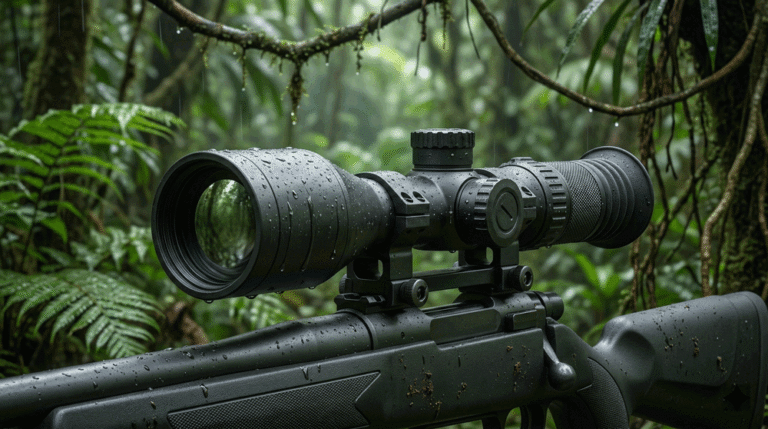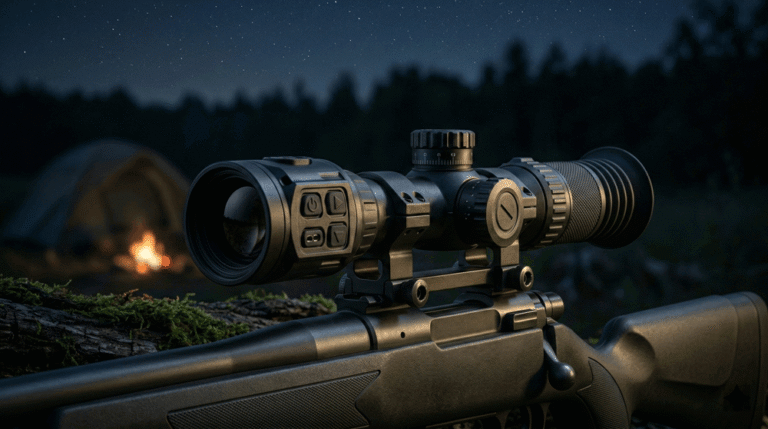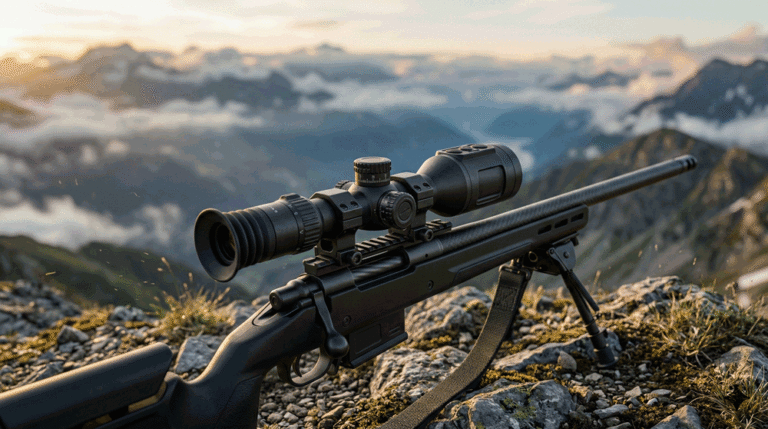
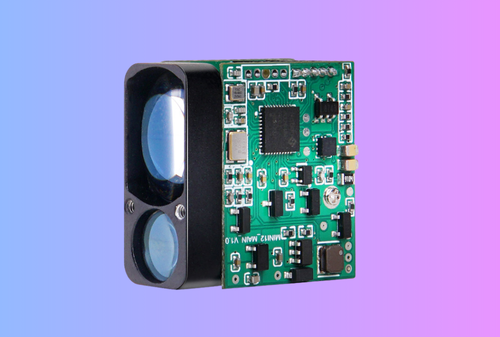
A laser distance measurement sensor earns trust only when wavelength, optics, timing, and UI are matched to real scenes and business constraints. This guide compares 905 nm and 1535 nm for handheld and compact platforms, explains eye-safety headroom, detector choices, battery life, size/weight, and cost, and shows how to publish range confidence curves buyers can verify. If you are short-listing engines, start from the proven integration path on Laser Rangefinder Module and scale into system lines under Modules and Products.
Table of Contents
ToggleExecutive Summary
905 nm wins on detector cost, supply chain, and small form factors with silicon APDs; 1535 nm wins on Class-1 eye-safe launch energy and lower solar background, often yielding higher range confidence in bright sun or long-range use. Both bands work—confidence depends on SNR, target coverage (divergence × boresight × wobble), and decision discipline. Publish Pd vs distance on 10–20% panels and natural targets; avoid billboard “max range.”
Choose 905 nm for golf and cost-sensitive handhelds; choose 1535 nm for premium hunting/utility units, or where long-range performance in sun justifies InGaAs cost. Keep IEC 60825-1 Class 1 intact under worst-case pulse width (τ), repetition rate (f), burst length (N), and divergence—UI changes must not alter emission timing. If you plan sensor fusion, coordinate timing with day/night overlays under Thermal + LRF Fusion & Ballistics.
Use Cases & Buyer Scenarios
Scenario 1 — Golf/Consumer (50–400 m, noon sun)
Price and battery life dominate. A 905-nm chain with Si-APD, 1.0–1.2 mrad divergence, micro-burst N=9–11, and first-target bias gives the best ROI. HUD must resist glare and show a small confidence bar so users stop chasing digits. This SKU should drop in cleanly to a daylight lineup—see how we reuse fonts/UX from observation pages such as Thermal Binoculars.
Scenario 2 — Hunting/Outdoors (100–800 m, brush + dawn/dusk)
Foreground clutter punishes receivers; low light reduces contrast. 1535 nm allows higher Class-1 energy and rejects solar background, lifting SNR for last-target with verify bursts. Add a narrowband filter if glare is the limiter. If you overlay ranges into scopes, keep HUD language consistent with Thermal Rifle Scopes to shorten learning time.
Scenario 3 — Tripod/Vehicle/Mapping (800–2,000 m, mixed weather)
With rigid mounts and larger apertures, the limit shifts to eye-safe headroom and analog noise. 1535 nm usually simplifies timing tables and raises long-range confidence, provided the InGaAs front-end is quiet. Sync timestamps for fusion pipelines and export the range stream toward solutions under Solutions and Module Integration for OEMs.
Spec & Selection Guide
What really changes with wavelength
| Factor | 905 nm | 1535 nm (≈1550) | Field impact |
|---|---|---|---|
| Detector | Si APD (low noise, low cost) | InGaAs APD (higher noise, higher cost) | 905 wins on BOM/size; 1535 needs careful analog design |
| Class-1 headroom | Modest AEL | High AEL (retina less sensitive) | 1535 supports more launch energy within Class 1 |
| Solar background | Higher | Lower | 1535 more tolerant to noon glare |
| Optics & windows | Plastics or standard AR glass | IR glass + hard AR preferred | 905 cheaper; 1535 more robust to sparkle |
| Battery life | Lower TX energy per lock | Often higher energy per lock | 1535 needs disciplined burst/τ to meet runtime |
| Size/weight | Smaller RX aperture feasible | More glass/thermal design | 905 packages easier for pocket SKUs |
| BOM & ASP | Entry-to-mid price tiers | Mid-to-premium tiers | Use confidence curves to justify premium |
Mini matrix — pick by market and constraint
-
- If the KPI is retail price and runtime, then start at 905 nm and spend effort on HUD readability and decision discipline; align with Rangefinder Module Integration.
-
- If long-range confidence in bright sun is the KPI, then spec 1535 nm with InGaAs and a low-noise analog chain.
-
- If you plan fused day/night SKUs, then start 1535 nm on the premium chassis and cross-sell with Thermal Monoculars or Accessories.
Integration & Engineering Notes
Electrical & Interfaces
Make wavelength invisible to the host: SET_MODE(FIRST|LAST|SCAN), SET_BURST(N), SET_TAU(ns), SET_GATE(params). GET_RANGE() returns {range, confidence, n_valid, sigma, mode}; GET_STATS() exposes latency (mean/95th) and mWh/100 ranges. Isolate TX rails from HUD/MCU; capture τ and f in signed timing tables so UI updates cannot alter emissions.
Optics & Mechanics (aperture, divergence, windows)
Handheld divergence 0.9–1.2 mrad balances coverage and wobble; tripod units can go ≤0.8 mrad. For 1535 nm, prefer IR-grade glass with hard AR (R ≲ 0.5%/surface) and blackened baffles to suppress sparkle; for 905 nm, standard AR works but still measure window-induced drift after stress. Keep TX/RX boresight within ≤0.2 mrad and verify “eye box” on a 10 m grid by shifting eye relief ±10 mm. Fogproof sealing lifts confidence more than any elegant DSP—reuse sealing from rugged optics under Manufacturing & Quality.
Firmware/ISP/Tuning (matched filtering, clustering, cadence)
Matched filtering around a shipped τ (10–20 ns) boosts weak returns. Build a histogram per burst, cluster candidates by proximity, compute amplitude and cluster width (σ), and apply first/last bias after clustering; when σ is wide, fire a short verify burst. Debounce the HUD to a human-friendly 5–8 Hz and render a 0–100 confidence score defined in the manual at Support.
Testing & Validation (bench → field)
Panels: 10/20/80% at 50/100/200/400/800 m. Natural targets: bark poles, brown fabric (fur proxy), brush wall with/without backstop. Sun: ≥100 klx, handheld sweep 5–10°/s. Weather: drizzle/spray; fog box; −10 → +40 °C cycles. Acceptance: Golf—Pd ≥90% on poles @150 m (first-target); Field—Pd ≥80% on bark behind grass @300 m (last-target + verify). Publish energy per 100 ranges and latency 95th ≤180 ms.
Compliance, Export & Certifications
IEC 60825-1 Class 1. 1535 nm enjoys higher AEL; 905 nm needs tighter controls—either way you must re-compute single/multi-pulse rules whenever τ, f, or N changes. FDA Laser Notice No. 56. Align U.S. filings to your IEC report; keep labels near the aperture and include label photos in the Technical File. Maintain EMC (FCC/CISPR), IP sealing (IEC 60529), RoHS, and reliability reports; host PDFs under Certificates and typical coverage terms under Warranty. Sales teams can link spec sheets from Downloads.
Business Model, MOQ & Lead Time (OEM/ODM)
MOQs. 905 nm: 200–300 pcs baseline; 1535 nm: 500–1,000 pcs when custom windows/filters or InGaAs chains are involved. Lead time. EVT with catalog glass 4–6 weeks; add 6–10 weeks for 1535-nm optics and analog tuning. Ship SDK, timing CSV, divergence certificate, and a one-page acceptance sheet with Pd curves—templates live under Module Integration for OEMs.
| Assumption | 905-nm Golf SKU | 1535-nm Field SKU |
|---|---|---|
| Ex-works | $99 | $159 |
| Landed (duty + freight) | $9 | $10 |
| Distributor sell | $159 | $229 |
| Gross per unit | $51 | $60 |
| Monthly run | 900 | 600 |
| Monthly gross | $45,900 | $36,000 |
Pitfalls, Benchmarks & QA
-
- Assuming 1535 nm always outranges 905. Not if InGaAs noise or window losses eat the headroom—measure Pd curves, not “max.”
-
- Chasing narrow divergence on handhelds. <0.8 mrad reduces practical hits; spec 1.0–1.2 mrad and lock the eye-box.
-
- Letting HUD changes alter emission timing. Signed timing tables; Class-1 envelopes must not move with UX modes.
-
- No bright-sun tests. Validate digits at ≥100 klx and apply anti-bloom; otherwise users chase washed digits.
-
- Skipping fogproofing. Fog kills range faster than algorithms—qualify windows and seals to IP67 and temperature cycles.
FAQs
Q: Which wavelength saves more battery?
Per range, 905 nm typically draws less TX energy; 1535 nm can match runtime by using shorter τ and smarter micro-bursts. Always publish mWh/100 ranges.
Q: Will 1535 nm be safer for eyes?
It offers more Class-1 headroom, but you must still prove AEL across τ, f, N, and divergence, then label correctly. Safety is a system, not a wavelength property.
Q: Can one chassis serve both?
Yes—design the window/AR stack and field stop to suit both bands, leave PCB space for the InGaAs chain, and keep common SDK calls. Paperwork must be refreshed.
Q: What about fusion with thermal optics?
Coordinate timestamps and UI. See example overlays and cadence choices on Thermal Optics pages and the fusion guide.
Q: How do I present confidence to end users?
Show a 0–100 bar; when <60 prompt “Steady and rescan.” The definition belongs in your manual and on FAQs.
Decision Flow — wavelength choice you can defend
Start
  ├─ Primary market? (golf / hunting / mapping)
  │     ├─ golf  → 905 nm; Si APD; 1.0–1.2 mrad; first-target; glare-proof HUD
  │     ├─ hunt  → 1535 nm; InGaAs; last-target + verify; narrowband filter if glare
  │     └─ map   → tripod; either band; pick by sun & long-range Pd curves
  ├─ KPI? (price & battery / long-range confidence)
  │     ├─ price → 905 nm with strict UI & timing discipline
  │     └─ range → 1535 nm with analog noise control
  ├─ Chassis limits? (aperture, window, power)
  ├─ Publish acceptance: Pd vs distance, latency 95th ≤ 180 ms, mWh/100 ranges
  └─ Freeze optics + timing + compliance file → Pilot → MP → List on Products
Call-to-Action (CTA)
Need a wavelength decision backed by eye-safety math and field curves, not hype? We’ll prototype both bands, tune τ and burst strategy, and publish Pd/energy/latency charts buyers trust—then package the SDK and compliance file for fast retail onboarding. Start a spec review via Contact or explore roadmap bundles on Solutions and Module Integration for OEMs. For company context and QA discipline, see Why Choose Us and Company.
Sources
-
- IEC 60825-1 — Safety of Laser Products (Ed. 3). Classification, AEL, limiting apertures, multi-pulse rules. (IEC Webstore)
-
- FDA — Laser Notice No. 56. U.S. recognition of IEC 60825-1; product report guidance. (U.S. FDA Guidance)
-
- RP Photonics — Eye Safety, Beam Divergence. Definitions and practical implications. (RP Photonics Encyclopedia)
-
- Thorlabs — APD Tutorials (Si vs InGaAs). Detector QE, noise, and bandwidth trade-offs. (Thorlabs)
-
- Edmund Optics — Atmospheric Transmission & NIR Materials. Window/filter material guidance for 905/1550 nm. (Edmund Optics)