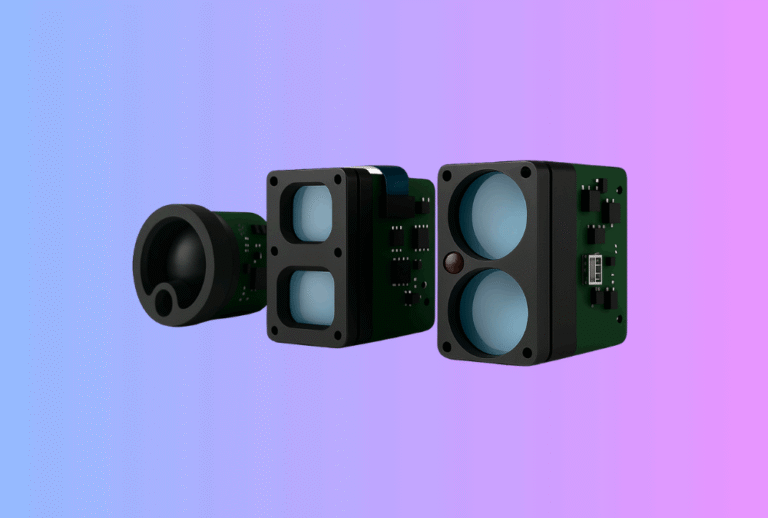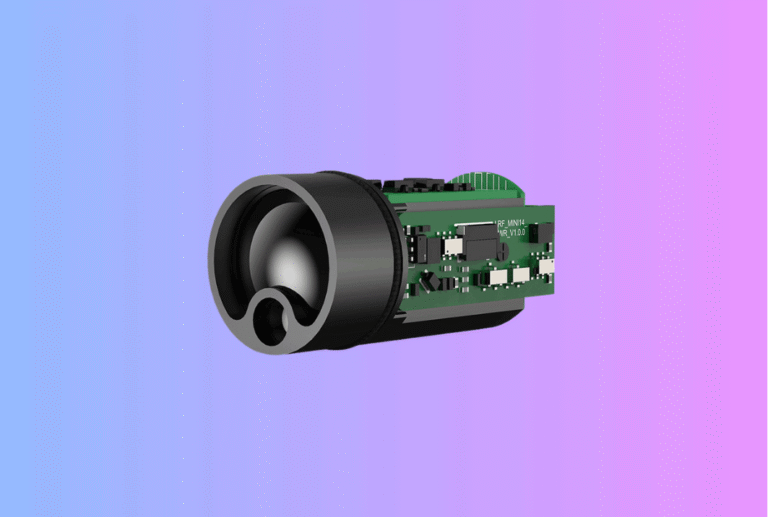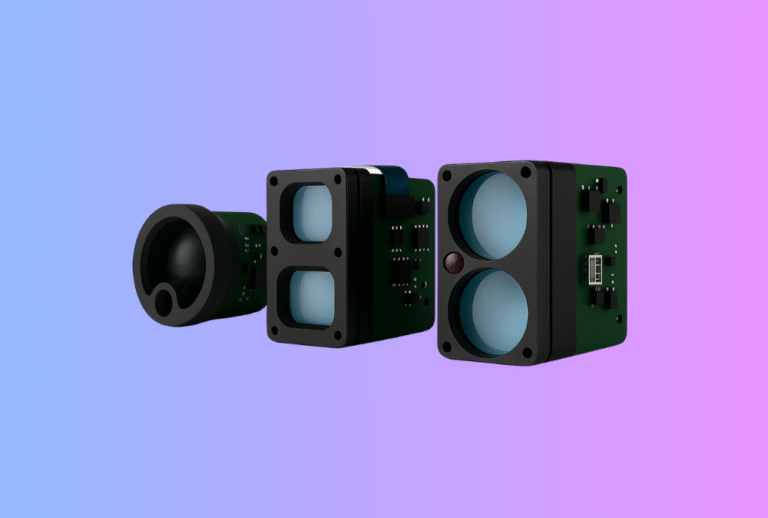
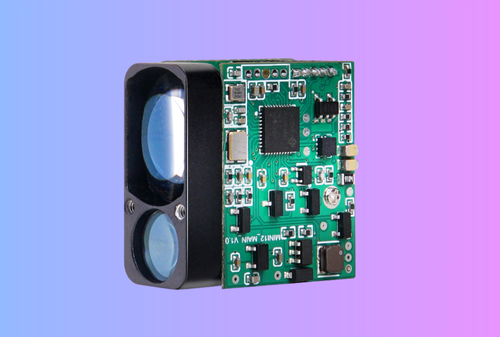
A laser rangefinder module can meet its electrical specification, communicate correctly with the host, and still fail to deliver a reliable user experience once it enters the final product. In many OEM programs, the missing piece is not firmware, not optics selection, and not core ranging performance. It is mechanical integration.
Table of Contents
ToggleThis is where many projects lose time. The module may range correctly on the bench, then drift after enclosure assembly, lose consistency across temperature change, behave differently from unit to unit, or become hard to calibrate in production. The reason is usually simple: the host product treats the laser rangefinder module as a component to be installed, while the real engineering task is to create a stable mechanical and optical system around it.
For OEM engineers, that means laser rangefinder module mechanical integration is not just about “finding space” inside the housing. It is about datum strategy, boresight stability, optical path protection, sealing, window behavior, vibration survival, assembly control, and long-term repeatability. If those topics are not designed as one package, the module may work at prototype stage but turn into a source of field complaints later.
This guide is written from that engineering perspective. It assumes your team is already past generic product awareness and is now dealing with the real questions that appear when a module has to live inside a commercial device: how should it mount, what should reference what, how do you align it, how do you keep that alignment, and how do you make production repeat the result.
Why mechanical integration is a project-level risk
Many product teams assume that if the rangefinder module vendor has already calibrated the module, the hard part is done. That assumption is attractive, but incomplete. A calibrated module still depends on the host mechanical system. Once the module is mounted behind a product-specific window, attached to a bracket, compressed by gaskets, surrounded by other optics, and exposed to shock, vibration, or thermal cycling, the original calibration is only one part of the final outcome.
This is especially true in products that combine thermal imaging, visible optics, ballistic features, UAV payloads, handheld meters, or rugged industrial housings. In those products, the user does not care whether the module was accurate before assembly. The user cares whether the finished product points, ranges, and repeats correctly in actual use.
That is why mechanical integration should be reviewed as early as interface and power planning. Your existing Rangefinder Module Integration page already frames optics, boresight, beam path, mounting, and sealing as part of the integration stack, not as afterthoughts. This article takes that same logic and expands it into a dedicated mechanical guide for engineering teams.
Start with system geometry, not with available space
A common integration mistake is to begin with packaging constraints only. The team looks at the enclosure, identifies the free volume, and asks how the rangefinder module can fit. That method seems practical, but it often leads to compromised geometry.
The better starting point is system geometry. Before the module is mounted, the team should define what the module must align to. Is the laser expected to follow a thermal optical axis, a visible channel, an aiming reticle, a digital overlay reference, or an external pointing structure? Is there intended parallax compensation in software, or must the mechanical design keep the axes close enough that the residual error remains acceptable across the target distance range? These questions determine where the module should sit, how it should tilt, what the window should do, and which surfaces must become true datums.
If geometry is not defined at this stage, the project may still produce a working mechanical package, but it will not produce a stable alignment package. In practice, that means late jig changes, awkward shimming, reticle mismatch, user trust issues, and much harder factory setup.
Treat boresight as a controlled engineering outcome
Boresight is often discussed loosely, but in OEM rangefinder integration it should be treated as a controlled engineering outcome. The team should define exactly which axes matter, which alignment relationship is critical to user value, and how that relationship will be established and verified.
In some products, the rangefinder module only needs stable self-consistency, because the output is used numerically by software. In others, especially thermal or sighting products, the laser path must maintain a defined relationship to the host optical channel. In those cases, alignment is not merely a calibration issue. It is a mechanical architecture issue.
Your site already reflects this logic in several places. The LRF integration page explicitly lists Optics & Boresight Plan, Beam & Optical Path, and Mounting & Sealing as separate integration topics. Other Gemin pages also reference co-boresight, alignment, recoil, sealing, and thermal-drift compensation as part of real OEM programs rather than marketing extras.
A strong boresight plan should answer five questions. What is the reference axis? Which components are fixed by design and which are adjustable? At what stage is alignment performed? How is alignment verified? And how is alignment protected from drift after the unit leaves the fixture? If those answers are vague, the product is not mechanically ready.
Datum strategy decides whether production will be easy or painful
One of the most important but least glamorous parts of laser rangefinder module mechanical integration is datum strategy. Teams often spend more time discussing sensors and interfaces than the surfaces that actually define position. But in production, datums decide whether alignment is repeatable or chaotic.
A good datum strategy ensures that the module sits in a known position relative to the host optical path, enclosure, and fixture. A weak datum strategy forces the factory to compensate manually for ambiguity. That is where time, yield, and consistency are lost.
On your site, this issue already appears in related LRF content. The DFM article recommends orthogonal V-groove or dowel-pin datums so the same boresight jig can be reused across EVT, DVT, PVT, and after-sales work. The troubleshooting and compliance-oriented content also points back to datum strategy as a core way to keep boresight repeatable after transport, recoil, and environmental stress.
For OEM engineers, the lesson is straightforward: define primary, secondary, and tertiary constraints deliberately. Avoid relying on cosmetic housing walls, adhesive squeeze, or flexible covers as reference geometry. The module should sit against controlled mechanical references that are meaningful both in engineering builds and in production builds. If the design depends on “operator feel,” the design is not finished.
Mounting is not just retention
Engineers sometimes talk about mounting as though the only question is how to keep the module in place. In practice, mounting does much more than retention. It defines stress flow, alignment repeatability, serviceability, and how the module responds to vibration and temperature.
The first question is whether the module should be hard-mounted, semi-isolated, or mounted through an intermediate bracket. A fully rigid mount may preserve geometry well but transfer more stress under impact or thermal expansion. A more compliant mount may protect against shock but introduce drift or long-term creep if not designed carefully. The right answer depends on the application, but the tradeoff should be explicit.
The second question is torque behavior. Fastener choice, tightening order, seating surfaces, and thread-lock strategy can all change how the module settles in the host product. A design that aligns correctly in the lab but shifts during final torque is not really aligned. The fastening process must be part of the integration design.
The third question is service behavior. Can the module be removed and reinstalled without losing its reference? If a window or bracket must be replaced in service, what ensures that the alignment relationship remains controlled? These are not after-sales details. They affect whether the product can remain stable over its lifecycle.
Tolerance stack should be mapped before prototype freeze
Tolerance stack problems often hide until the project reaches a point where changes are expensive. The prototype may appear successful because the first few builds are carefully handled by engineers, often using selective fit or quiet manual compensation. Once the design moves toward volume, the real effect of accumulated tolerances becomes visible.
For a laser rangefinder module, the relevant stack is usually larger than teams first expect. It may include the module housing, mounting bracket, fixture references, enclosure wall, optical window position, gasket compression, screw seating, and the relationship to a thermal or visible optical axis. If any of those are weakly controlled, the final boresight can vary even when each individual part is technically in tolerance.
This is why mechanical integration reviews should include a real stack-up discussion, not just nominal CAD checks. Engineers need to understand which dimensions are most sensitive to ranging accuracy, pointing relationship, and window clearance. Once those are known, tolerances can be tightened selectively where they matter most instead of everywhere.
The window is part of the optical-mechanical system
Many OEM teams still underestimate the window. They know the laser rangefinder module needs a clear aperture, but they treat the window mainly as a protective cover. In reality, the window is part of the optical-mechanical system and can affect both performance and reliability.
The window influences transmission loss, stray reflections, contamination behavior, fogging risk, beam clipping, and alignment robustness. Its position and angle matter. Its coating matters. The way it is compressed into the enclosure matters. Even the gasket scheme around it matters, because uneven compression can tilt or stress the assembly.
Your site already alludes to this repeatedly. The rangefinder integration page tells OEM teams to set beam divergence, window material, and optical routing early. The DFM article refers to the window & gasket stack and recommends consistent pre-compression control. The eye-safety compliance guide adds that window reflections and sealing details can affect both optical behavior and safe beam management.
The practical takeaway is simple: do not finalize the window late. It should be reviewed together with divergence, aperture clearance, sealing, anti-fog strategy, and mechanical alignment. A bad window decision can make a good module look inconsistent in the field.
Sealing can destroy alignment if designed carelessly
Sealing is necessary, especially in rugged handheld, outdoor, vehicle, and industrial products. But sealing can also be one of the quietest causes of alignment drift.
The problem is not the presence of a gasket or adhesive. The problem is when sealing forces are introduced without understanding how they load the optical and mechanical references. A gasket that compresses unevenly, an adhesive that cures with shrinkage, or a housing that distorts under sealing torque can all shift the module or window enough to create measurable alignment change.
This is why mounting and sealing should not be designed by separate logic. The team must ask where compression goes, how the force closes through the product, and whether the sealing method can alter the module’s final position. In well-controlled designs, sealing and alignment coexist because the load paths are understood. In weaker designs, sealing becomes a hidden recalibration event.
That risk is already visible in multiple Gemin pages where mounting, alignment, recoil, sealing, and window discipline are grouped together rather than treated as unrelated topics.
Recoil, shock, and vibration must be treated differently
Many teams collapse all environmental mechanical loads into one generic durability question. In reality, recoil, shock, and vibration affect alignment in different ways and should be reviewed separately.
Shock is about short, high-energy events such as drop or transport impact. Vibration is about repeated lower-energy loading over time. Recoil is a special case that combines repeat loading, directional impulse, and the possibility of gradual drift. A mount that survives drop may still walk under recoil. A design that handles recoil may still show fastener loosening under long vibration exposure.
Your site already reflects that hunting-grade and rugged OEM use cases need dedicated attention here. The recoil/waterproof qualification article focuses on recoil profiles, sealing, and freeze-thaw durability. Other pages connect mounting, alignment, and recoil control to field credibility rather than just pass/fail testing.
For development teams, this means the fixture and validation plan should mirror the dominant stress type. Do not assume that one generic “mechanical test” proves alignment stability. The mode of load matters.
Thermal expansion can become a mechanical alignment problem
Mechanical integration is not only about static geometry. It is also about what happens when that geometry moves with temperature. Different materials in the host assembly expand at different rates. Brackets, housings, windows, adhesives, screws, and optical holders all respond differently to heat and cold.
Even when the laser rangefinder module itself remains functional, the relationship between the module and the host optical reference can shift. This is especially important in products where the user expects the rangefinder to align with a thermal image channel, visible aim reference, or calibrated ballistic display.
That is why thermal drift should not be treated only as an electronics topic. Mechanical engineers should ask whether the chosen materials and constraint scheme create a bias movement as temperature changes. If so, the team should decide whether to redesign the stack, accept the movement within budget, or compensate at system level.
Your existing thermal-plus-LRF and thermal-scope integration content already acknowledges that physical alignment, recoil behavior, and temperature drift are linked in real product programs.
Decide early whether alignment is design-fixed or process-adjusted
A major strategic choice in OEM laser rangefinder module integration is whether alignment is mostly fixed by design or achieved through an adjustment process. Each route has advantages and costs.
A design-fixed approach tries to create a geometry so repeatable that alignment falls within budget without much operator intervention. This can improve scale and reduce factory time, but it requires stronger datum control and tighter part discipline. A process-adjusted approach allows shimming, screw-set alignment, fixture-based correction, or calibrated compensation during assembly. This can help at early stages or for highly sensitive products, but it adds time, fixture dependency, and sometimes after-sales complexity.
Your DFM article already hints at this by recommending that teams decide whether the emitter, receiver, or both are adjustable, and ideally keep one fixed by design while the other is corrected in a controlled final step.
For most OEM programs, the best answer is often hybrid. Use mechanical design to remove as much ambiguity as possible, then reserve a limited, controlled alignment step where the sensitivity truly demands it. That approach usually scales better than relying on either pure theory or pure operator skill.
Fixtures are part of the productization strategy
Teams sometimes treat assembly fixtures as temporary manufacturing tools, but in alignment-heavy products they are part of the productization strategy. A good fixture does more than hold parts in place. It creates a repeatable geometry for alignment, verification, and sometimes service recovery.
A fixture strategy should answer several questions. What reference does the fixture use? Does it reference the module, the host housing, or the external optical axis? Can the same fixture logic be used across EVT, DVT, pilot run, and after-sales? Can the fixture expose whether the problem is part variation or assembly variation?
The reason this matters is simple: if the only way to align the product is through a fragile engineering setup, production will struggle. Your site’s existing DFM, troubleshooting, and NPI-oriented LRF content already points toward reusable bench fixtures and repeatable boresight tooling as ways to reduce angular drift and support later phases.
In other words, fixture planning should begin before production, not after alignment issues appear.
Parallax and user perception belong in the mechanical review
Mechanical integration is often discussed in purely engineering language, but the final judge is the user. A product can be mechanically “acceptable” and still feel untrustworthy if the user sees a mismatch between where the device seems to point and where the ranging result makes sense.
This is where parallax and perceived alignment become important. In thermal scopes and similar devices, your site already notes that poor alignment or uncorrected parallax can produce deceptive readings, which are worse than no reading at all. That is an excellent engineering principle because it ties mechanical precision directly to user confidence.
So the mechanical review should include not just geometric truth in CAD, but user-facing truth in the operating scenario. At what distance is the visual relationship most sensitive? What kind of target background makes misalignment obvious? When does the user stop trusting the reading? Those answers help define whether the acceptable alignment budget is generous or tight.
Mechanical integration has to survive production variation
A prototype assembled by senior engineers can hide a weak design. The real test of mechanical integration is whether ordinary production flow can reproduce the result without heroics.
That means the engineering team should ask difficult questions before release. Does the assembly depend on selective screw torque tuning? Does gasket compression vary with operator sequence? Does the optical window seat differently after rework? Does module position drift if the bracket supplier changes slightly? Do alignment results remain stable across multiple lots?
This is where mechanical integration and production engineering meet. Your Gemin quality page emphasizes process control, traceability, and consistent final inspections across modules and terminal optics, which is exactly the environment a good mechanical-alignment design should be built for.
The best OEM design is not the one that can be aligned once. It is the one that can be aligned repeatedly, inspected quickly, and maintained without guessing.
Build the validation plan around failure modes, not convenience
A weak validation plan often checks only whether the module still functions after assembly. A stronger plan checks the failure modes most likely to affect alignment.
That may include boresight shift after fastening, after sealing, after drop, after vibration, after temperature cycling, after window replacement, after reassembly, or after storage. It may also include lot-to-lot comparison if bracket or housing variation is a real risk. The right plan depends on the product, but the core idea is the same: validation should target the mechanisms that actually move geometry.
This philosophy is already visible across your site’s LRF content. The broader integration pages discuss optics, boresight, window routing, mounting, and sealing as intentional workstreams. The reliability, troubleshooting, and hunting-focused pages all connect real field survival to the ability to preserve alignment under load and environment.
A validation plan built around convenience tells you whether the product can be assembled. A validation plan built around failure modes tells you whether the product can be trusted.
A good mechanical design simplifies calibration, not just assembly
Calibration is often treated as a downstream operation, but the mechanical design determines how painful or efficient calibration will be. A design with clear references, stable torque behavior, controlled windows, and repeatable datums will make calibration faster and more stable. A weak design forces calibration to absorb the uncertainty of the mechanics.
That is why one of the best questions an OEM engineer can ask is this: are we calibrating the module, or are we compensating for unstable mechanics? If the answer leans too far toward the second, the design likely needs attention before scale-up.
A good mechanical architecture gives calibration a clean, narrow job. It does not ask calibration to rescue an ambiguous assembly.
Conclusion
Laser rangefinder module mechanical integration is not a secondary detail in OEM development. It is one of the main reasons a product becomes either stable and credible or fragile and inconsistent. When teams treat alignment, mounting, windows, sealing, vibration, and datum control as one system, integration becomes faster, calibration becomes easier, and production becomes more predictable.
When those topics are handled separately, the project usually pays later. The module may still range, but the finished device drifts, confuses users, consumes factory time, or becomes difficult to support after launch.
For OEM engineers, the right goal is not simply to “install the module.” The goal is to create a mechanical and optical package that preserves geometry from prototype to pilot run to field use. That is what turns a laser rangefinder module into a reliable commercial subsystem instead of just a promising lab component.
FAQ
Why is mechanical integration so important for a laser rangefinder module?
Because the final ranging behavior depends on more than the module itself. Mounting, boresight, windows, sealing, and vibration control all influence whether the finished product stays aligned and repeatable.
What is the most common mechanical mistake in LRF integration?
One of the most common mistakes is weak datum strategy. If the module does not reference stable, controlled surfaces, the factory ends up compensating for ambiguity instead of repeating a solid design.
Should alignment be fixed by design or adjusted in production?
That depends on the product. Many OEM projects use a hybrid approach: reduce ambiguity through design, then allow a limited, controlled alignment step where sensitivity requires it.
Does the protective window really matter that much?
Yes. Window position, angle, coating, compression, and contamination behavior can affect transmission, reflections, beam clipping, fogging, and long-term consistency.
How should vibration and recoil be validated?
They should be validated according to the real application. Drop, vibration, and recoil are not the same load case, and each can affect alignment differently.
CTA
If your team is planning a new OEM product or redesigning an existing rangefinding device, it is worth reviewing the mechanical package before alignment problems become production problems. Start with our Rangefinder Module Integration overview, explore configurable Laser Rangefinder Module options, or contact our engineering team to discuss datum strategy, boresight targets, window stack, sealing method, and validation flow for your product. These topics already sit at the center of Gemin’s published LRF integration framework and related OEM content.
Related Articles
- Rangefinder Module Integration
- Laser Rangefinder Module
- Laser Rangefinder Module Power Supply and EMI Design Guide
- DFM for Laser Rangefinder Modules
- Laser Rangefinder Module Troubleshooting: 20 Issues & Fixes
- LRF + Ballistics in Thermal Scopes: OEM Integration Guide