OEM Laser Rangefinder Module: A Buyer's Guide
Choosing the right Laser Rangefinder Module is a critical decision that impacts your product’s performance, cost, and time-to-market. This guide provides OEM/ODM product managers, engineers, and system integrators with a clear framework for selecting, integrating, and deploying LRF technology successfully. We’ll cover everything from core specifications to business and compliance considerations.
Table of Contents
ToggleExecutive Summary
For B2B buyers and integrators, a successful LRF module partnership hinges on more than just specs. Here are the key takeaways for your next project:
-
Wavelength Defines Application: The choice between 905nm and 1550nm modules is a primary decision. 905nm offers a cost-effective solution for most commercial applications, while 1550nm provides superior performance in adverse weather and is inherently eye-safe at higher power levels, making it ideal for long-range and defense systems.
-
Integration is More Than Hardware: A module’s value is tied to its ecosystem. Prioritize modules with flexible communication interfaces (e.g., UART with TTL/RS-232 levels), robust SDKs, and accessible engineering support to accelerate your development cycle.
-
Performance Metrics Must Match Reality: Don’t rely solely on maximum range specs. Beam divergence, repetition rate, and target logic (first/last target) are crucial for real-world accuracy, especially in cluttered environments or for small target detection.
-
Plan for Compliance Early: Laser safety (IEC 60825-1) and export controls are non-negotiable. Verifying a supplier’s certifications and understanding potential dual-use restrictions from the start prevents costly delays and legal issues.
Use Cases & Buyer Scenarios
A Laser Rangefinder Module is not a one-size-fits-all component. The optimal choice is dictated entirely by the end application.
UAVs, Drones & Robotics
For unmanned aerial vehicles, LRF modules are essential for flight control and payload functionality. Product managers in this space require modules that are compact, lightweight, and low-power. Key applications include terrain-following, autonomous landing, obstacle avoidance, and target geo-location for mapping or surveillance payloads. Long-range capabilities (1,000m+) and high measurement frequency (>10Hz) are often critical.
Handheld Optoelectronics
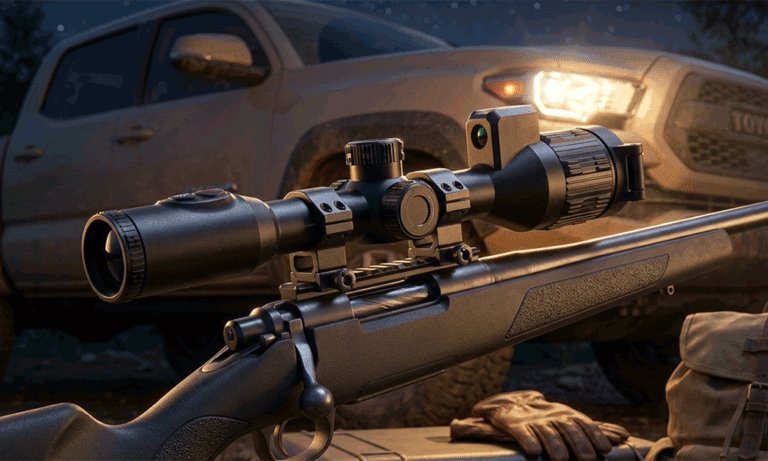
Brands developing handheld devices like Thermal Binoculars or hunting scopes need to integrate LRF modules to provide users with precise distance-to-target data. The primary concerns here are seamless integration with the existing optical path, recoil and shock resistance for firearm-mounted devices, and intuitive data fusion with the primary sensor (e.g., a thermal camera module). The module must be robust enough to handle the harsh environmental conditions typical of outdoor and tactical use.
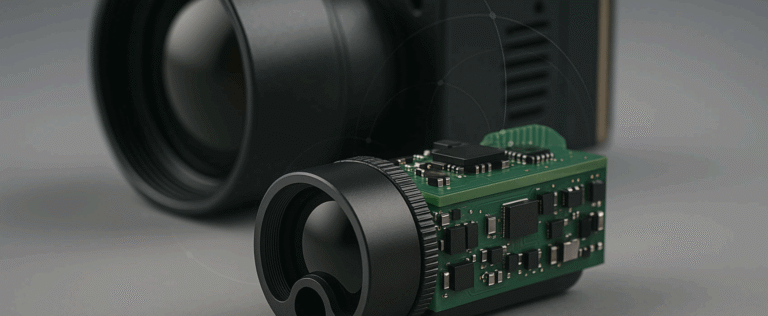
Figure 1: Conceptual integration of an LRF module within a handheld thermal imaging device.
Industrial Automation & Security
In industrial settings, LRF modules drive efficiency and safety. They are used for crane height and position monitoring, inventory management in silos (level sensing), and vehicle positioning in automated ports. For security systems, they provide accurate distance data for PTZ camera tracking and perimeter intrusion detection. Buyers in this segment prioritize reliability, stable performance across temperature ranges, and industrial communication protocols like CAN bus or RS-485.
Spec & Selection Guide
Navigating datasheets requires understanding the trade-offs between key parameters. Here’s what matters most for an OEM/ODM buyer.
Key Performance Parameters:
-
Wavelength (nm): The laser’s operating wavelength.
-
905nm: The industry standard. Cost-effective, widely available, and performs well in clear conditions. However, it can be detected by near-infrared (NIR) sensors and has limitations in fog or dust.
-
1550nm: Offers superior penetration through atmospheric obscurants (haze, smoke) and is considered “eye-safe” at much higher power levels, enabling longer-range measurement. It’s often the choice for military and high-performance aerospace applications but comes at a higher cost.
-
-
Range (m): The maximum distance the module can reliably measure, typically specified for a standard-sized target with high reflectivity. Always scrutinize the test conditions for this spec.
-
Accuracy (m): The +/- error of a given measurement. An accuracy of ±1m is standard for most applications.
-
Beam Divergence (mrad): The angle at which the laser beam spreads over distance. A smaller divergence (e.g., 0.5 mrad) keeps the laser spot size small at long distances, making it easier to range small or specific targets without hitting surrounding objects.
-
Repetition Rate (Hz): How many measurements the module can make per second. Low rates (1Hz) are fine for static targets, while high rates (20-100Hz) are necessary for tracking fast-moving objects.
-
Interfaces: The communication method between the module and your host system. UART is the most common, but options can include USB, CAN, or SPI. A well-documented protocol and sample code are crucial.
Comparison of LRF Module Classes
| Specification | Short-Range / Compact | General Purpose / UAV | Long-Range / Mil-Spec |
| Typical Wavelength | 905nm | 905nm | 905nm or 1550nm |
| Max Range (NATO Target) | 200 – 800m | 800 – 2,500m | 2,500 – 10,000m+ |
| Beam Divergence | 1 – 3 mrad | 0.5 – 1.5 mrad | < 0.5 mrad |
| Power Consumption | Very Low (<0.5W) | Low (<1.5W) | Moderate (2-5W) |
| Primary Interface | UART (TTL) | UART, CAN | UART (RS-232/422), Ethernet |
| Key Feature | Size & Cost | Balanced Performance |
Eye-Safety & Range |
Decision Flow for Module Selection
Use this simple logic to narrow your search:
-
Is the primary end-user a military or defense client?
-
Yes: Prioritize 1550nm modules for eye-safety and performance in obscurants. Investigate export control requirements immediately.
-
No: Proceed.
-
-
Will the module be used to track targets moving faster than 50 km/h?
-
Yes: You need a high repetition rate (>10Hz).
-
No: A standard repetition rate (1-5Hz) is sufficient.
-
-
Is the target typically small and/or surrounded by clutter (e.g., power lines, tree branches)?
-
Yes: A low beam divergence (<1 mrad) is critical.
-
No: A standard divergence is acceptable.
-
-
Is your device battery-powered and size-constrained (e.g., handheld)?
-
Yes: Power consumption and physical dimensions are your top priorities after core range performance.
-
Integration & Engineering Notes
Selecting a module is only the first step. Successful integration requires attention to electrical, mechanical, and software details.
Electrical & Interfaces
Most LRF modules communicate over a serial (UART) port. Ensure the logic levels (e.g., 3.3V TTL vs. 5V) are compatible with your host microcontroller. For robust industrial applications, look for modules offering RS-232, RS-422, or CAN bus interfaces. A quality supplier will provide a comprehensive Software Development Kit (SDK) or at least a detailed communication protocol manual with command examples for triggering measurements and parsing data.
Optics & Mechanics
Proper mounting is non-negotiable for accuracy. The module must be secured on a stable mechanical base, and its optical axis must be precisely aligned (boresighted) with the primary sighting system (e.g., the optics of Thermal Rifle Scopes). For applications involving high shock or vibration, potting the electronics and using ruggedized connectors is essential. Furthermore, ensure your product’s housing provides an adequate IP (Ingress Protection) rating to seal the module from dust and moisture.
Firmware & Signal Processing
The module’s firmware dictates its real-world usability. Key features to look for include:
-
Ranging Algorithm: The ability to select first target logic (for avoiding interference from background objects) or last target logic (for ranging through partial obscurants like foliage) is critical.
-
Sensor Fusion: In advanced systems, the LRF data is fused with other sensors. For example, in a thermal sight, the range data can be used to automatically adjust the reticle for bullet drop compensation, creating a seamless user experience.
-
Tunability: Access to parameters like detection thresholds can help optimize performance for specific target types or environmental conditions.
Testing & Validation
A multi-stage validation process ensures reliability:
-
Bench Testing: Verify communication and basic ranging functionality against a fixed, known-distance target in a controlled environment.
-
Field Testing: Test the integrated product outdoors under various lighting, weather, and temperature conditions. Use targets of varying sizes and reflectivities.
-
Acceptance Criteria: Define clear pass/fail criteria. For example: “The system must achieve ±1m accuracy on a 2m x 2m target at 1500m in clear daylight conditions, 95% of the time.”
Compliance, Export & Certifications
Compliance is a gate to market access. Neglecting it can lead to seized shipments and legal penalties.
-
Laser Safety (IEC 60825-1): This is the most important standard. It classifies lasers based on their potential hazard. Class 1 lasers are considered safe under all conditions of normal use. Many commercial 905nm modules fall into this class, simplifying compliance. Higher-power modules may be Class 3R or 3B, requiring specific labeling and safety interlocks in the final product.
-
EMC/EMI: FCC (for the US) and CE (for the EU) certifications are required to ensure the module does not interfere with other electronics and is not susceptible to external interference.
-
RoHS: This EU directive restricts the use of specific hazardous materials in electronic products.
-
Export Controls: LRF modules with long ranges (>5km) and those designed for military use, especially 1550nm models, are often classified as “dual-use” goods. They are subject to export regulations like the US EAR (Export Administration Regulations). Clarify the Export Control Classification Number (ECCN) with your supplier.
Business Model, MOQ & Lead Time (OEM/ODM)
Partnering with a module supplier is a long-term relationship. Understand the business terms upfront.
-
Minimum Order Quantity (MOQ): For initial evaluation, you can typically purchase single units or small dev kits. For production, MOQs often range from 100 to 500 units per order, depending on the module’s complexity.
-
Lead Times: Expect 2-4 weeks for sample delivery. Mass production lead times typically range from 8-16 weeks, so factor this into your project timeline.
-
Customization (ODM): Many suppliers offer customization services, including private labeling (your logo on the module), custom firmware (e.g., a specific data output format), or modified hardware interfaces.
Simple ROI Model for a Distributor
Here’s a simplified model for a company integrating an LRF module into a new product line, such as advanced Thermal Monoculars.
| Item | Assumption (per unit) | Value |
| LRF Module Cost | Bulk pricing for 500 units | $150 |
| Integration & BOM Cost | Housing, MCU, power, labor | $75 |
| Total Cost of Goods Sold (COGS) | $225 | |
| Wholesale Price to Retailers | $600 | |
| Gross Profit per Unit | $375 | |
| Breakeven Volume | Assuming $50k R&D upfront | 134 units |
This model shows that with a solid product and channel, the initial R&D investment can be recouped quickly, making the addition of LRF technology a highly profitable feature.
Pitfalls, Benchmarks & QA
Avoid common mistakes to ensure a smooth development process.
Common Pitfalls & How to Avoid Them:
-
Ignoring Beam Divergence: A wide beam at 1km can illuminate an entire building, not the window you’re targeting. Solution: Match divergence to your required precision at max range.
-
Underestimating Power Needs: Peak current draw during laser firing can cause voltage drops in your system. Solution: Use dedicated power regulation and sufficient capacitance near the module.
-
Inadequate Optical Alignment: A 1 mrad misalignment can result in a 1m miss at 1km. Solution: Design a rigid mounting system with fine-tuning adjustment screws.
-
Parsing Data Incorrectly: Misinterpreting a single byte in the data stream can lead to false readings. Solution: Thoroughly test your data parsing code against all possible module outputs.
-
Neglecting Environmental Factors: Performance degrades in rain, fog, and extreme temperatures. Solution: Test under adverse conditions and set realistic performance expectations with your customers.
Figure 2: An illustration of Detection, Recognition, and Identification (DRI) criteria for a standard NATO target.
Field Benchmarks (DRI): While DRI is typically used for imaging systems, a similar concept applies to ranging.
-
Detection: The ability to get any range return from an object.
-
Recognition: The ability to consistently range a specific object (e.g., a vehicle) instead of its surroundings.
-
Identification: The ability to consistently range a specific part of an object (e.g., the turret of a tank).
The ability to move from detection to identification depends heavily on low beam divergence and sophisticated target logic. The global laser rangefinder market is projected to grow significantly, reaching USD 4.7 billion by 2030, driven by these increasing demands for precision (Verified Market Research, 2023).
FAQs
1. What is the real-world difference between 905nm and 1550nm? For most commercial applications under 2km in clear weather, 905nm provides excellent performance at a lower cost. 1550nm becomes advantageous for long-range systems (>3km) or in applications where operation in hazy or foggy conditions is frequent. Its primary benefit is eye-safety at high power levels.
2. How does target size and reflectivity affect max range? Datasheet range is typically specified for a large, highly reflective target (like a building). A small, dark, low-reflectivity target (like an animal or a tactical drone) may reduce the effective range by 30-50% or more. Always test against targets representative of your actual use case.
3. What level of integration support can we expect? As your OEM partner, we provide comprehensive support including detailed documentation, reference code for the communication protocol, and direct access to our application engineers to help you troubleshoot mechanical, electrical, and software challenges during your design phase.
4. Can the firmware’s ranging algorithm be customized? Yes. For qualified OEM projects, we can customize firmware to prioritize specific targets, adjust detection thresholds, or create custom output formats to better integrate with your host system’s software, such as ballistic calculators in our Thermal Clip-On Sight products.
5. What is the typical warranty and failure rate for your modules? Our modules come with a standard 2-year warranty and are manufactured under strict quality controls. We maintain a Mean Time Between Failures (MTBF) that meets or exceeds industry standards for industrial and defense-grade components.
Let’s Build Your Next Product
Integrating a laser rangefinder module is a strategic move to enhance your product’s capabilities and competitive edge. The key is to partner with a supplier who provides not just a component, but a complete engineering solution.
Ready to discuss your project? Contact our engineering team to get specifications, request a quote, or order a development kit for evaluation.