If you are looking for the best thermal monocular in 2025, the real question is not “what’s the fanciest optic?” but “what is the best thermal for the money for the way I hunt or scout?”
Table of Contents
ToggleThermal technology has dropped in price and jumped in performance. Today you can get everything from a compact handheld thermal scanner for short-range woods hunting to a long range thermal monocular with 640×512 sensor and built-in laser rangefinder. The challenge is deciding where your money is best spent.
This guide walks through seven proven devices that offer excellent value at different budgets and use-cases, plus a simple buying framework so you can choose the right tool instead of just the most expensive one. Along the way we’ll naturally touch on all the common searches buyers make—like best thermal monocular under $1000, best thermal monocular under $500, thermal monocular for hunting, and more.
How to choose the best thermal monocular for the money
Before we look at specific models, it helps to understand what makes one unit “worth it” and another a waste of cash.
1. Decide what you really do with it
Most buyers fall into one or more of these categories:
- Predator & hog hunters – You use a thermal monocular for hunting to scan fields, confirm targets, and walk to and from stands. Here, a good thermal scanner for hunting is almost more important than your rifle scope.
- Deer, elk and general big-game hunters – You mainly glass at medium ranges, often from static positions. You still want a hand held thermal imager for hunting, but long-range ID is less critical than wide field of view and battery life.
- Landowners, outfitters and pest control – You need to locate animals quickly around buildings, feeders or fields. Fast start-up, intuitive controls and ruggedness matter.
- Search & rescue / security – You’re less price-sensitive and more focused on range, reliability and recording.
Be honest about how often you will actually use the optic. A true workhorse that fits your pattern is almost always the best thermal monocular for hunting for you, even if it isn’t the fanciest spec sheet.
2. Understand the core specs
You’ll see a lot of jargon around every thermal imaging monocular. The key parameters are:
- Resolution – Common cores are 256×192, 384×288 and 640×512. Higher resolution means more recognition detail at distance, especially for monocular thermal vision on small game. If you primarily stalk to under 150 yards, a good 256 core can be enough and makes a very affordable thermal monocular.
- Lens size & base magnification – A 19–25 mm lens is compact with wide field of view; 35–50 mm pushes you toward a true long range thermal monocular. Don’t chase high digital zoom; it always trades detail for magnification.
- NETD / sensitivity – Numbers like <25 mK or <20 mK indicate how well the sensor sees subtle temperature differences. Lower is better, especially in rain, fog and warm, humid conditions.
- Refresh rate – 50 Hz is now common and ideal for panning and tracking running game. Slow refresh (≤25 Hz) feels “smeary” when you swing quickly.
- Battery system – Internal batteries are fine for a budget thermal monocular; serious night hunters often prefer removable packs so the handheld thermal never has to be plugged into a power bank mid-hunt.
3. Handheld thermal vs handheld thermal scope
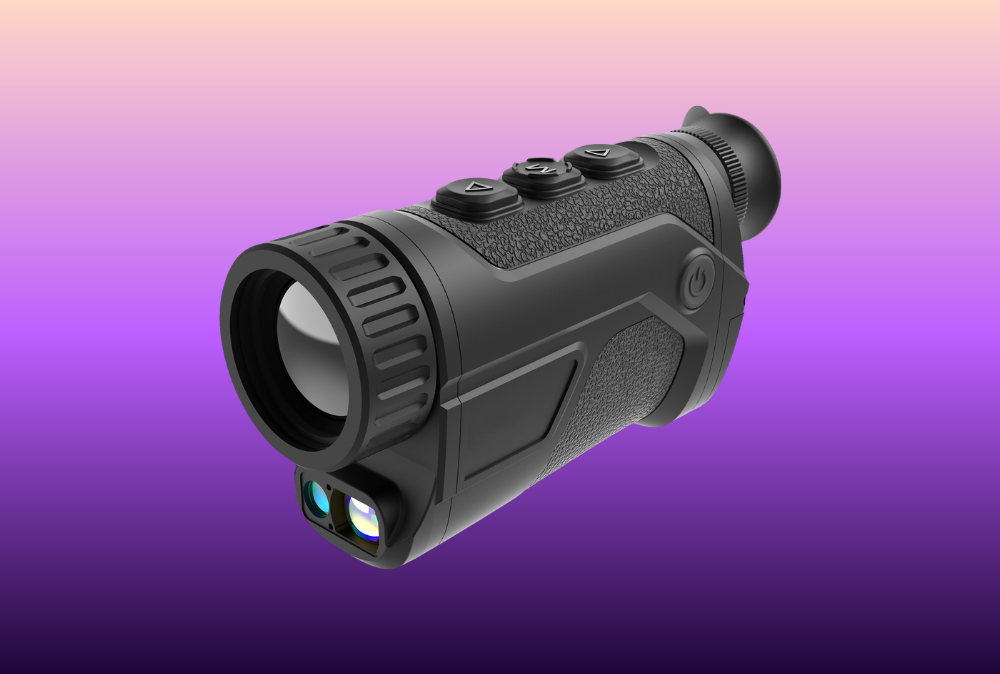
You’ll see terms like handheld thermal scope, “thermal monocular,” and “thermal scanners for hunting.” In this article we focus on monoculars that are not weapon-mounted: scanners used in the hand, hung from a lanyard or carried in a pocket.
A true scanner:
- Is optimized for one-hand scanning and quick focus.
- Often has wider field of view than the corresponding rifle scope.
- May include a laser rangefinder to support your rifle optic.
If you need one device that can act as both scanner and scope, look instead at multi-role optics; that’s outside the scope of this guide.
4. Pick your budget band
For most shooters in 2025, the decision looks like this:
- Under $500 – Entry-level units for short-range scanning. Ideal if you want the best thermal monocular under $500 and are willing to accept lower resolution and detection range.
- $600–$1,000 – Mid-range 256×192 units; this is where the best budget thermal monocular options sit. You get useful range and features without jumping into “serious investment” territory.
- $1,500–$2,500 – Sweet spot for many dedicated hunters. 384×288 or 640×512 sensors, better lenses, and often integrated rangefinders. Many of the best thermal monoculars overall are here.
- $3,000+ – Premium gear for heavy users, outfitters and professionals. Here you find devices that are arguably the best handheld thermal monocular options on the market, but not everyone needs to spend this much.
Quick overview – 7 best thermal monoculars for the money in 2025
Below is a high-level snapshot before we dive into details:
- Pulsar Axion 2 XG35 – Best overall best thermal imaging monocular for most hunters.
- Pulsar Telos LRF XP50 – Best premium long range thermal monocular and thermal monocular with rangefinder.
- InfiRay Finder FH35R V2 – Best value 640×512 monocular with integrated rangefinder.
- Burris Thermal Handheld – Best thermal monocular for hunting focused purely on field use.
- AGM Taipan TM15-256 – Best thermal monocular under $1000 and all-round budget thermal monocular.
- AGM Taipan TM10-256 (or similar 256 core) – Top pick if you need the best thermal monocular under $500.
- ATN BlazeTrek 325 – Compact thermal scanner for hunting and travel with strong performance per dollar.
Now let’s look at why each of these earns a spot as one of the best thermal monoculars in 2025.
1. Pulsar Axion 2 XG35 – best all-round handheld thermal monocular
If you want one optic that can do almost everything well, the Pulsar Axion 2 XG35 is a strong candidate for “best thermal monocular for the money” despite sitting well above budget pricing. Field & Stream rated the Axion 2 XG35 as their best overall pick in 2025.
It uses a 384×288 sensor, 50 Hz refresh rate and offers up to 20× digital magnification, with effective detection past 1,400 yards in ideal conditions. For most real-world situations, that means you can detect animals as soon as they step out of cover and then confirm whether you’re seeing hogs, coyotes or livestock long before your rifle scope would.
Pulsar’s ergonomics make this an excellent pulsar handheld thermal:
- Lightweight magnesium housing with IPX7 waterproof rating.
- Intuitive top buttons you can run by feel.
- Long-lasting APS5 battery (around 11 hours in ideal conditions).
The built-in photo/video recorder, Wi-Fi streaming and multiple color palettes are bonuses for those who like to document hunts.
Best for: serious hunters, outfitters and SAR users who want a compact but truly capable handheld thermal that can be your primary thermal scanner for hunting for many seasons.
2. Pulsar Telos LRF XP50 – premium long-range thermal with laser rangefinder
If you’re ready to invest in a high-end optic, the Pulsar Telos LRF XP50 is one of the most advanced handheld thermal scopes / scanners available. It’s not cheap, but the package is impressive: 1024×768 resolution sensor, long detection range around 1,800 m and a built-in laser rangefinder.
The picture quality is outstanding even at higher magnification, which matters when you use a long range thermal monocular for distant spotting on open fields or western terrain. Hunters testing it in Texas heat reported that the image remained crisp even in tough conditions, and the IPX7 rating plus robust housing make it comfortable for hard use.
Because of its price, this isn’t the obvious pick if you just want a cheap thermal monocular. But if you split the cost over many seasons, and you need reliable ranges for shots at varied distance, it is arguably one of the best handheld thermal units you can buy.
Best for: shooters who demand top-tier monocular thermal vision with precise range data, such as serious coyote hunters, guides or security professionals.
3. InfiRay Finder FH35R V2 – best value 640×512 thermal with LRF
The InfiRay Outdoor Finder FH35R V2 is a newer model that has earned attention because it combines a 640×512 <20 mK sensor, a 35 mm f/0.9 lens and an integrated 800-yard laser rangefinder at a mid-tier price (around $2,499 in the US market).
Key points from field reviews:
- Excellent image quality for identifying coyotes and hogs out to ~400 yards.
- Detection range of about 1,800 m for human-sized targets.
- 2–8× magnification with 50 Hz refresh rate, good for scanning and moderate zoom.
- Two removable batteries providing roughly 6–7 hours combined runtime in typical conditions.
Controls are optimized for scanner use: the record and ranging buttons sit right under your fingers, so it behaves like a true best thermal scanner rather than a repurposed rifle scope.
With all that, the FH35R V2 is a very strong thermal monocular with rangefinder option for buyers who want 640 resolution but cannot justify the flagship prices of some competitors.
Best for: hunters and security teams wanting a high-end imaging core and integrated LRF while still chasing “best thermal for the money” value.
4. Burris Thermal Handheld – hunting-focused thermal scanner
For many users, the sweet spot is a tool built specifically as a thermal monocular for hunting. The Burris Thermal Handheld fills that role: it offers 2–8× magnification, detection range around 700 yards and a simple interface.
The resolution is 206×156, which is lower than premium models, but still adequate for typical predator-hunting distances. Reviews highlight:
- Comfortable, ergonomic housing that’s easy to carry all night.
- Solid detection range for scanning fields and tree lines.
- Built-in photo/video recording for documenting hunts.
If you primarily use your scanner for “thermal monocular hunting” – walking in, scanning fields, verifying eyes at 200–300 yards – you may not need more. This is a very functional hand held thermal imager for hunting that won’t overload you with menus.
Best for: hog and coyote hunters who want a straightforward thermal scanner for hunting with respectable performance but don’t want to pay for 640-core imaging.
5. AGM Taipan TM15-256 – best thermal monocular under $1000
When shooters talk about a truly budget thermal monocular that still works for real hunting, the AGM Taipan TM15-256 frequently comes up. The Taipan line has built a reputation for reliability and simplicity.
Specs that matter for value:
- 256×192 12 μm sensor with 1.5–12× digital zoom.
- 720×540 LCOS display for a clear view at modest ranges.
- Up to about 8 hours battery life on the internal rechargeable pack with Wi-Fi off.
- IP67 protection and drop resistance to about 1.5 m.
Street prices around $600–$800 in 2025 put it squarely in the “best thermal monocular under $1000” conversation.
You also get Wi-Fi streaming, onboard recording and several color palettes. For short-to-medium range woods hunting or farm security, this is an affordable thermal monocular that ticks most boxes for the best budget thermal monocular.
It is not a long-range ID machine, and you should expect pixelation when you push digital zoom. But if you want a solid entry into thermal and don’t plan to shoot far, this is one of the strongest values.
Best for: newcomers wanting the best budget thermal experience, or experienced hunters who want a backup / loaner handheld thermal that “just works.”
6. AGM Taipan TM10-256 (and similar) – best thermal monocular under $500
If your budget is strict and you truly need a cheap thermal monocular, the smaller Taipan models (such as the TM10-256) or similar 256×192 units from major brands often fall near or just below the $500 mark on sale. Retail listings show entry-level Taipan V2 models and some competitors in this band.
These devices generally share characteristics:
- 256×192 sensor with short focal-length lens.
- Wide field of view, ideal for close-in scanning in woods and around buildings.
- Simple menu, basic recording and Wi-Fi features.
They will not win any range contests, and you should not expect them to be your primary long-range thermal monocular hunting tool. But they do let you:
- Detect animals around feeders or barns.
- Walk in and out safely at night.
- Check for bedded game in thick cover.
If you are determined to own the best thermal monocular under $500 rather than save up for a mid-range unit, these entry devices are the way to do it without buying questionable no-name brands.
Best for: budget-constrained hunters and landowners who still want true thermal capability for basic scanning jobs.
7. ATN BlazeTrek 325 – compact thermal scanner for travel and stand hunting
For hunters who prioritize size and portability, the ATN BlazeTrek 325 is an appealing compact option. Field testing reports describe it as a small but capable thermal scanner for hunting, with:
- 800×600 display resolution.
- Detection range up to about 1,000 m.
- 2–16× magnification range.
- Approximate 8-hour battery life.
Because of its size, it slips easily into a jacket pocket or bino harness, making it a great choice as a backup or travel monocular. This versatility earns it a place among the best thermal monoculars for hunters who split their time between dense woods and more open fields.
Think of it as a “do-most-things-well” option for users who care more about practicality than lab specs.
Best for: anyone needing a lightweight best handheld thermal scanner that doesn’t add much bulk but still beats cheaper entry devices in image quality.
Matching devices to common search intents
Because thermal buyers often search in very specific ways, here’s how the picks above line up with typical phrases you may have typed into Google. Each phrase is used here in a natural context so you can see where it really applies.
- Best thermal monocular for hunting / best handheld thermal monocular – Pulsar Axion 2 XG35 or Burris Thermal Handheld, depending on your budget and appetite for features.
- Best thermal imaging monocular – Pulsar Telos LRF XP50 and InfiRay Finder FH35R V2 are top contenders if you want cutting-edge imagery rather than the lowest price.
- Best budget thermal monocular / budget thermal monocular – AGM Taipan TM15-256 offers the most capability at a price most regular hunters can still justify.
- Best thermal monocular under $1000 – again, TM15-256 is the standout, although occasional sales on other units can sneak under that line.
- Best thermal monocular under $500 / cheap thermal monocular – entry-level 256×192 devices like AGM’s TM10-256 class provide usable performance without blowing up your budget.
- Thermal monocular with rangefinder – Pulsar Telos LRF XP50 and InfiRay Finder FH35R V2 are clear answers here, giving you reliable ranging plus excellent imaging.
- Long range thermal monocular – high-end units like the Telos LRF XP50 or Axion 2 XG35, and InfiRay Finder FH35R V2 if you want 640 resolution with strong detection range.
- Thermal scanners for hunting / best thermal scanner – all seven picks can serve as thermal scanners for hunting, but Burris Thermal Handheld and ATN BlazeTrek 325 are especially scanner-centric designs.
By mapping these common keyword-style questions to real devices, you can avoid treating SEO phrases as marketing hype and instead use them as practical decision points.
FAQ – quick answers about budget and value
Is a cheap thermal monocular worth buying?
Yes, as long as you buy from a reputable brand. A cheap thermal monocular with a 256×192 sensor won’t match premium units for range, but it can still transform close-range hunting and farm work. Avoid ultra-low-priced, unknown brands with no warranty or reviews.
What’s the realistic detection range I should expect?
For entry-level units, think 300–400 yards of detection and 100–200 yards of comfortable identification, depending on conditions. Mid-range devices with better lenses and cores push that to 600–800 yards of detection. High-end 640-core scanners like the InfiRay Finder FH35R V2 or Pulsar Telos LRF XP50 can detect man-sized targets well past 1,000 yards and ID common game at several hundred yards.
Do I really need a thermal monocular with rangefinder?
If your hunting involves frequent shots at varied distances in open terrain, a thermal monocular with rangefinder is a big advantage. It lets you range from your scanning position before you shoulder the rifle. If you mostly shoot inside 150 yards, a regular scanner is usually enough.
Are thermal monoculars only for hunting?
No. Many owners use them for checking livestock, tracking lost pets, monitoring property boundaries, or supporting search-and-rescue work. In those roles, a compact handheld thermal or handheld thermal scope can be worth every dollar even if you never fire a shot.
Should I prioritize resolution or lens size?
For tight budgets, prioritize a decent lens and sensitivity first; a well-designed 256×192 sensor with good optics can outperform a poorly implemented 384 core. As you move up the price ladder, higher resolution becomes more important, especially for thermal monocular hunting in wide-open country where you need to identify animals at longer ranges.
Final thoughts – choosing the best thermal monocular for the money
There is no single “perfect” optic that fits every hunter, but by now you should have a clear sense of which of these seven devices matches your needs and budget.
- If you want a do-everything scanner and have the budget, a Pulsar Axion 2 XG35 or Telos LRF XP50 is hard to beat.
- If you are trying to balance performance and price, the InfiRay Finder FH35R V2 and AGM Taipan TM15-256 sit in the sweet spot of “best thermal for the money.”
- If your wallet is tight but you still want real-world capability, the smaller Taipan or similar entry-level models remain the most realistic route into the world of thermal.
By focusing on how you actually hunt, the ranges you truly shoot, and how often you’ll use the optic, you can pick the best thermal monocular for your money in 2025—and avoid paying extra for features that look great on a spec sheet but never matter in the field.