Lead
This is a practical, B2B selection guide for brands and OEM/ODM teams building golf laser rangefinders, specifically the Golf laser rangefinder module. We’ll translate golfer-facing features (pin-lock, slope, scan) into engineering requirements: beam divergence, PRF, algorithms, optics, power, interfaces, and Class 1 eye safety. You’ll leave with a copy-ready RFQ checklist, decision rules, and a commercialization plan.
Table of Contents
ToggleExecutive Summary
When developing golf products, consider incorporating the Golf laser rangefinder module for enhanced performance.
- Design for golf first, not generic ranging. Golf needs fast first-target priority, narrow divergence (to isolate the flag from trees), steady HUD, and compliant slope on/off behavior for tournaments.
- Choose 905 nm + Class 1 as the default. Most consumer golf units use 905 nm Class 1 lasers for compact optics, cost, and battery life—while remaining eye-safe and tournament-friendly.
- Engineer beam geometry and PRF around “pin-seek.” Divergence defines spot size; PRF and detection mode (first-target vs distant-target) determine lock reliability and speed.
- Make compliance and docs part of the product. Build your pack with IEC 60825-1 classification and (US) FDA Laser Notice No. 56 alignment; document slope disable for tournament legality.
- Model ROI beyond BOM. Price tiering, MOQ, rechargeable vs CR2 battery strategy, and acceptance artifacts (short clip + CSV) reduce RMAs and accelerate listings.
See our Laser Rangefinder Module options. For future night-golf or clubhouse perimeter demos, you can also explore our Thermal camera module—but this article focuses on golf LRFs.
Use Cases & Buyer Scenarios
Handheld golf rangefinders (core SKU)
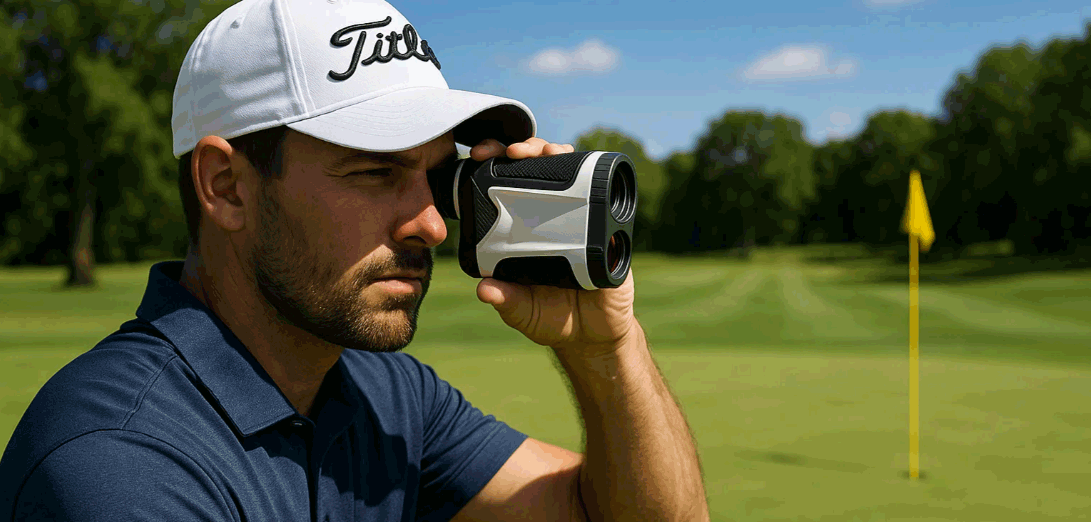
Pin lock with haptic feedback and visual confirmation (reticle change or OLED cue). Accurate to ±1 yd out to ~300–600 yd on flagsticks, angle-compensated “slope” mode for practice rounds, and a user-switchable tournament-legal mode (slope off).
GPS-hybrid and app-connected units
Some market-leading SKUs overlay GPS yardages and course data; your module should expose clean APIs for scan mode, first-target priority, and continuous ranging so the app stack can combine signals.
Brand/ODM private label lines
Shared core with cosmetic variants, magnet mounts, OLED/LCD choices, and battery strategy (USB-C rechargeables vs CR2 cells) segmented by retail price tiers.
Spec & Selection Guide (the heart)
Below are the parameters that actually move the needle on-course and at retail.
Key parameters and why they matter
- Wavelength & Eye Safety
905 nm, Class 1 is the consumer standard for golf: compact emitters, proven receivers, and eye-safe output when designed correctly. State Class 1 in the spec and include label artwork and classification docs. - Beam Divergence (mrad)
Divergence defines spot growth with distance (mrad). Narrower beams reduce “background lock” on trees behind the pin; too tight can slow acquisition on shaky hands. Typical effective divergence for golf modules is in the 0.5–2 mrad range, matched to optics. - Detection Modes & PRF
First-target priority (aka “target mode” in some literature) is critical for pin-seek; scan mode requires adequate PRF for a smooth, fast HUD. Angle-compensation (slope) is a processing feature—ensure your SDK delivers raw distance + angle or a compensated readout in HCD style. - Range, Accuracy & Test Conditions
State yardage with reflectivity/size assumptions: flagstick + reflective prism vs flag cloth in bright sun/wind; publish accuracy (±1 yd typical) and repeatability across the 100–300 yd “golf band.” - Optics & Display
6× magnification is common; OLED excels under shade, LCD helps battery life in bright sun. Offer both if you plan multiple SKUs at different MSRPs (see retail benchmarks). - Battery Strategy
Decide early: CR2 disposable (ubiquitous, compact) vs USB-C rechargeable (modern, eco-friendly). Publish run-time in number of rounds at 20 °C and cold-weather derate. - Interfaces & SDK
For app-connected models: BLE/UART hooks; exposedistance_raw,distance_comp,angle_deg,mode(first-target/scan/slope), andconfidence. - Compliance & Tournament Use
Ship IEC 60825-1 documents, and for the U.S. align labeling via Laser Notice 56; document how slope is disabled for tournament play (USGA allows distance-only devices; slope features must be off if Local Rule applies).
Golf LRF module—comparison table (copy-ready)
| Parameter | “Pin-Seek” archetype | “All-rounder” archetype | Why it matters |
|---|---|---|---|
| Wavelength & safety | 905 nm, Class 1 | 905 nm, Class 1 | Consumer-safe, compact, cost-effective. |
| Beam divergence | 0.8–1.2 mrad | 1.5–2.0 mrad | Narrow beams isolate flags; wider beams easier to acquire on shaky hands. |
| PRF & modes | High PRF scan + first-target priority | Moderate PRF scan + distant-target assist | Smooth HUD & reliable pin-lock. |
| Accuracy (100–300 yd) | ±1 yd typical | ±1 yd typical | Meet golfer expectations in the scoring band. |
| Optics & display | 6× OLED viewfinder | 6× LCD or OLED | Readability vs battery life; price tiering. |
| Power | CR2 cell | USB-C rechargeable | Retail positioning; run-time per round. |
Decision rules and quick flow
If your hero feature is “instant pin lock” → choose 0.8–1.2 mrad divergence + first-target priority + high-PRF scan
If retail wants sub-$200 MSRP → prefer LCD, CR2 power, and simplified modes
If app or GPS overlay is planned → require SDK with distance_raw, distance_comp (slope), angle_deg, mode, confidence
If tournament legality is a must → ship slope mode with a hardware or menu toggle that disables compensation; distance-only complies under USGA Local Rule
Always include Class 1 labeling and IEC 60825-1 documents in the technical file
Integration & Engineering Notes
Electrical & Interfaces
-
Low-noise rail. Keep the emitter/receiver power clean to avoid false returns; budget for inrush and specify a min-to-max supply window.
-
BLE/UART hooks. Expose readouts and modes for app connectivity (scan, first-target, slope on/off).
-
Haptics & UX. Provide a trigger-to-lock time target (e.g., 0.2–0.4 s). Some market SKUs advertise very fast locks; set a realistic SLA your firmware can meet.
Optics & Mechanics
-
Eye box & stability. 6× magnification is common; design eyecups and diopter to reduce hand-shake.
-
Aperture & alignment. Maintain coaxial alignment of emit/receive paths; validate at 100, 200, 300 yd on flagsticks (with/without reflectors).
-
Sealing & durability. IP-rated seals for rain; magnet mounts must survive cart vibration.
Firmware & Algorithms
-
First-target priority. Prefer bias toward nearest reflective return in a small ROI; fall back to confidence models when the scene is cluttered (trees behind greens).
-
Slope compensation. Implement angle-compensated distance (HCD-style) for practice; clearly indicate slope disabled in tournament mode (icon or color change).
-
Scan mode. Stream distances at stable cadence (e.g., 10–20 Hz) for a smooth HUD.
Testing & Validation (bench → course)
-
Bench: verify divergence (knife-edge or far-field target), PRF, and receiver sensitivity.
-
Range lane: measure on flagsticks with prisms and cloth flags at 100/150/200/250/300 yd, bright sun vs overcast; record mean/σ and “lock time.”
-
On-course SAT: 9-hole route with shaded pins and background trees; evaluate first-target reliability and haptic consistency.
-
Artifacts: 10–20 s clip + CSV per pilot batch with timestamp,
distance_raw/comp,angle_deg,mode,confidence.
Compliance, Export & Certifications
-
Laser safety. Classify and label to IEC 60825-1; in the U.S., FDA Laser Notice 56 recognizes IEC conformance for labeling and submissions. Include the classification worksheet, final labels, and user warnings in your technical file.
-
Tournament legality. Under USGA/R&A policy, distance-only devices are permissible; devices with slope are generally permitted only when the feature is disabled by Local Rule (many competitions adopt this). Document your disable behavior.
-
Regional marks. CE/FCC/RoHS per normal consumer electronics; keep radio/BLE filings if you ship connected models.
Our Laser Rangefinder Module family includes Class 1 documentation templates and label artwork to speed approvals.
Business Model, MOQ & Lead Time (OEM/ODM)
-
Sampling. 2–4 weeks with standard optics; 4–6 weeks for custom divergence or unique housings.
-
MOQ. 100–300 pcs per SKU is typical (driven by optics/coating lots and calibration throughput).
-
Lead time to MP. 8–10 weeks after materials lock; add buffer for seasonal demand spikes (golf launches, holidays).
-
Battery strategy & accessories. CR2 SKUs hit lower MSRPs and simplify retail logistics; USB-C SKUs support “eco/modern” messaging and app pairing.
-
Channel pack. Spec sheet, lifestyle images, Class 1 laser docs, “slope off” quick-guide, and 10–20 s acceptance clips—helps reviewers and retailers list faster. Recent retail guides emphasize accuracy, usability, slope options, and display readability as buying criteria.
Mini ROI model for a golf brand
| Driver | Baseline | After module-driven design | Units/yr | Impact |
|---|---|---|---|---|
| Time-to-listing | 8–10 weeks | 3–5 weeks | 10 SKUs | Faster shelf entry |
| NFF returns | 1.5% | 0.7% | 20k units | −160 RMAs |
| Margin mix | 100% single SKU | 60/40 CR2 vs USB-C | — | Higher ASP blend |
| Review velocity | slow | faster (docs + clips) | — | More organic reach |
Pitfalls, Benchmarks & QA
Seven mistakes to avoid
-
Quoting “max range” only. Publish accuracy and lock time in the 100–300 yd golf band on real flags.
-
Over-tight divergence without stabilization—hard to lock for shaky users.
-
No first-target mode. You’ll lock trees behind the green; must bias to the nearest return in the ROI.
-
Slope without clear disable. Tournament reviewers will reject it; document the off-state.
-
HUD jitter. Under-sampling in scan mode produces “steppy” distances; increase PRF and smooth lightly.
-
Battery mis-positioning. CR2 vs USB-C choice changes ASP and review tone; be deliberate.
-
Thin compliance pack. Missing IEC 60825-1 worksheets and labels delays retailer onboarding.
Benchmark plan (copy-ready)
-
Course: 9-hole loop with mixed backgrounds
-
Metrics: lock time (median), lock success %, mean/σ error at 150/200/250 yd, scan cadence stability, slope on/off behavior
-
Artifacts: per-SKU acceptance clip + CSV (timestamp,
distance_raw/comp, angle, mode, confidence)
FAQs
1) Why not 1550 nm for golf?
1550 nm can allow higher eye-safe power in some contexts, but 905 nm Class 1 dominates consumer golf for cost, size, battery life, and sufficient performance in clear conditions.
2) What divergence should I ask for?
Start with ~1 mrad for pin-seek SKUs; move toward 1.5–2 mrad if your users struggle with hand steadiness. Validate on flags at 150–250 yd.
3) How should slope be implemented for tournaments?
Offer a hardware switch or clear menu toggle that disables compensation, with an unmistakable UI indicator; USGA permits distance-only under Local Rule.
4) CR2 or USB-C?
CR2: compact, familiar, strong cold-weather performance; USB-C: modern, rechargeable, pairs well with app-connected SKUs. Publish run-time by “rounds.”
5) Do we need an app?
Not required. But BLE integration enables GPS overlays and shot-tracking features many 2025 buyers expect in premium models.
Call-to-Action (CTA)
Send us your target MSRP, battery preference, and priority features (pin-lock, slope, scan, app). We’ll return a golf-specific RFQ pack—optics and divergence options, PRF/mode recommendations, Class 1 file set, slope disable UX, and a price/lead-time plan—based on our Laser Rangefinder Module line.
Sources
-
FDA — Laser Products: Conformance with IEC 60825-1 (Laser Notice No. 56), 2023. U.S. Food and Drug Administration
-
Intertek — Understanding FDA Laser Notice No. 56 Requirements, 2025. Intertek
-
USGA/R&A — Joint Statement on Electronic Devices (distance-only; slope features must be disabled for competition under Local Rule). USGA
-
Vortex Optics — How Laser Rangefinder Modes Work (HCD angle compensation; scan/target modes), 2023.
-
Optics-Trade — Target vs First-Priority Mode in LRFs, 2018/2023 update.
-
RP-Photonics — Beam Divergence—angle (definition and implications), 2025.
-
Gentec-EO — Quick guide on laser beam divergence measurement, 2023. Gentec-EO
-
Golf Monthly — Best Golf Rangefinders 2025 (review criteria and feature trends), 2025. Golf Monthly
-
RPNB — Product spec example stating 905 nm Class 1, 2025. RPNB
-
Gogogo Sport — What Batteries Do Golf Rangefinders Use? (rechargeable vs CR2 overview), 2025. GOGOGO SPORT
-
Crate Club — Battery types and CR2 prevalence in golf rangefinders, 2024. Crate Club, LLC
-
Zion Market Research — Golf Rangefinders Market Size 2024 → 2034 (7.01% CAGR), 2025. Zion Market Research