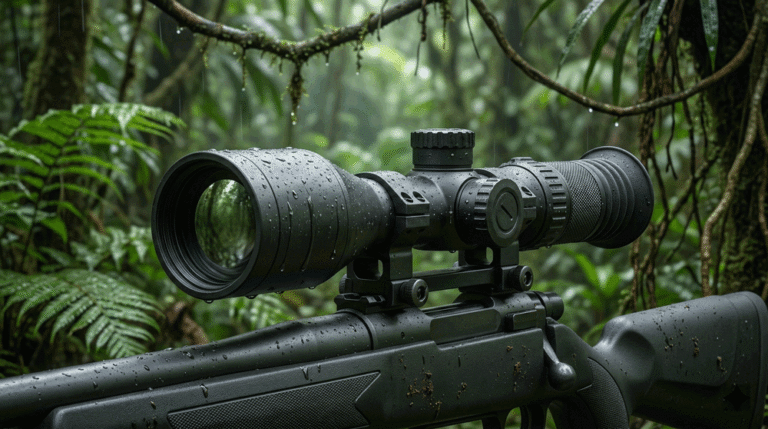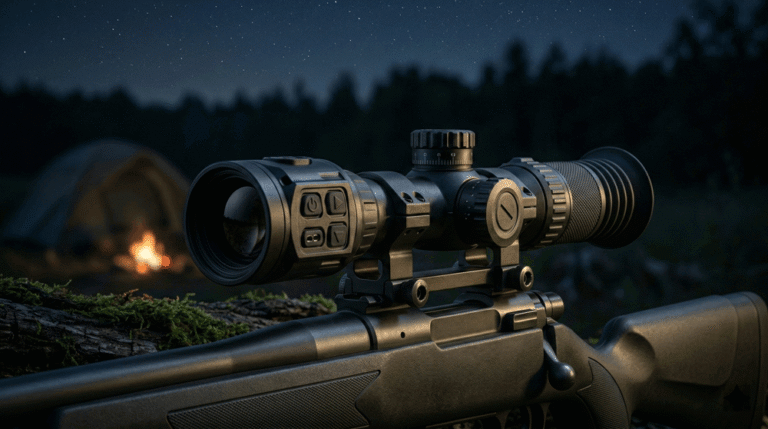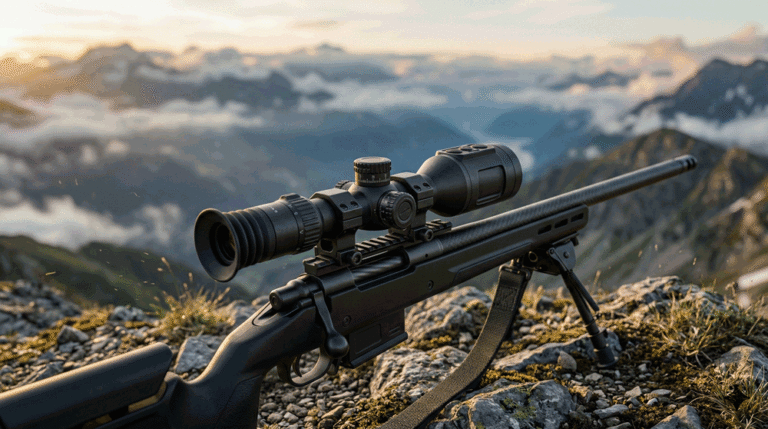
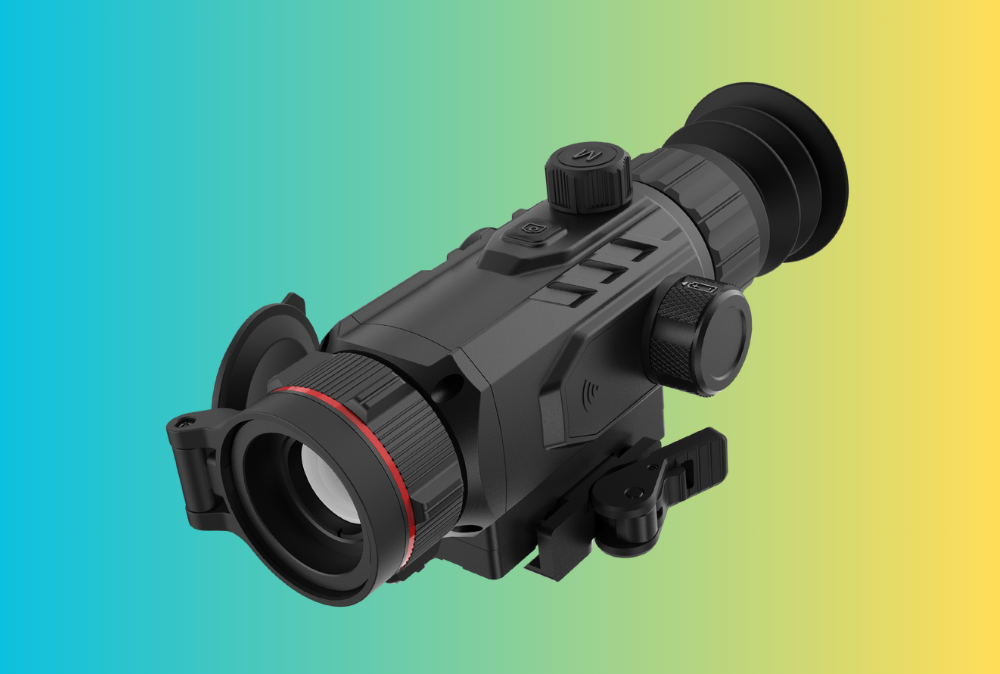
A Thermal Hunting Scope is one of the few optics that can stay on your rifle 24/7. It works in total darkness, in fog or light brush, and it still produces an image in broad daylight. That raises a practical question many hunters ask: should I use my thermal both day and night, and what changes between the two?
Table of Contents
ToggleThis guide walks through how thermal works in different lighting conditions, what you can expect at the range and in the field, and how to choose between dedicated thermal hunting scopes, a clip on thermal scope, and other options such as a thermal scope with rangefinder.
Along the way, we will touch on the most common decision points that everyday hunters face when evaluating the best thermal scopes, from budget-friendly models to premium long-range optics.
1. How a Thermal Hunting Scope Sees the World
A thermal optic does not care whether it is noon or midnight. Instead of using reflected visible light, it reads the long-wave infrared radiation that every object emits according to its temperature.
Inside the housing is a microbolometer array and lens—the same basic technology used in professional thermal rifle scopes and industrial imagers. Warm objects (hogs, coyotes, people, engine blocks) emit more infrared energy and show up as brighter or darker shapes depending on your palette.
The scope’s processor:
- measures how much radiation each pixel receives
- corrects for sensor non-uniformity and noise
- adjusts contrast automatically
- overlays a digital reticle and data on the image
Because that process depends on heat, not sunlight, your Thermal Hunting Scope works essentially the same in daytime and at night. What changes is the scene—background temperatures, clutter and how your own eyes perceive the display.
2. Night Use: Where Thermal Hunting Scopes Truly Shine
Night is where thermal shows its full advantage over visible-light optics and even many traditional night-vision systems.
2.1 Detection without external light
At night, ambient temperatures often drop, and animals stand out strongly against cooler fields, ditches and tree lines. A good best budget thermal scope can spot a hog or coyote hundreds of yards away when your naked eyes see nothing at all.
Unlike image-intensifier night-vision, thermal does not require moonlight or an IR illuminator. That means:
- no back-scatter from fog or dust when you shine an illuminator
- no risk of spooking game that see or hear active light sources
- no visible glow to other people using NV gear
This is why many hunters who regularly run night stands consider a thermal scope—not just any infrared scope for rifle, but specifically a thermal—mandatory kit.
2.2 Identification and shot placement
At realistic ranges, a mid- to high-resolution scope lets you distinguish species and even read body language. With a steady rest and correct zero, you can place shots accurately on hogs, foxes and coyotes in conditions where you’d never even attempt a shot with glass.
Here, premium models marketed as the best thermal rifle scope or best thermal scope for coyote hunting have an edge: higher resolution and better NETD preserve detail at range, which reduces the risk of mis-ID and poor shot placement.
3. Day Use: Strengths and Limitations
Daytime use of a Thermal Hunting Scope is less discussed but increasingly common. Ranchers, guides and pest-control crews often leave thermal mounted around the clock.
3.1 When thermal is useful in daylight
Thermal can be surprisingly powerful during the day when:
- animals bed in tall grass, crops or brush that hide them from glass
- mirage and glare make visible scopes hard to use
- you’re dealing with wounded or hidden animals that are still warm
A herd of hogs that has melted into cane or a coyote lying in yellow grass can still pop out clearly as a heat signature, even though the sun is high.
3.2 What changes in hot weather
In summer and early afternoons, ground, rocks and trees can heat close to the same temperature as animals. That reduces contrast. You will still see targets, but they may not stand out as dramatically as in cool night air.
To compensate, many scopes offer:
- user-selectable gain or contrast modes
- different palettes tuned for high-background scenes
- adjustable focus and sharpness controls
During hot daylight, spending a little time dialing in these settings can make your thermal hunting scopes far more readable.
3.3 Eye fatigue and situational awareness
Looking at an electronic display in bright sun is more tiring than using classic glass. You also sacrifice some natural depth cues and colour information. For that reason, some hunters prefer to keep daytime glass on their primary rifle and use a clip on thermal scope or handheld scanner only as needed in daylight, saving the dedicated thermal for night work.
4. Dedicated Scope vs Clip-On vs Handheld: Day–Night Trade-Offs
How you plan to use thermal over a 24-hour cycle will strongly influence whether you buy a dedicated scope, a clip-on or a scanner.
4.1 Dedicated thermal hunting scope
A dedicated Thermal Hunting Scope is bolted to the rifle and zeroed like any other optic.
Pros
- Best ergonomics for frequent night use
- Simple, repeatable zero with fewer moving parts
- Often the best value in true “best budget thermal scope” discussions
Cons
- You lose the ability to use a traditional day scope on that rifle without swapping optics
- Midday eye fatigue can be higher when using the display for long glassing sessions
If your rifle is a purpose-built night gun, this is usually the most straightforward solution.
4.2 Clip on thermal scope
A clip on thermal scope attaches in front of an existing day optic on the rail or bell. The day scope provides magnification and reticle; the thermal front-end provides the image.
Pros
- You keep your preferred daytime zero and reticle
- One device can serve multiple rifles
- Quick swap between day and night roles
Cons
- More sensitive to mounting accuracy and repeatability
- Typically more expensive for equal imaging performance
- Slightly more complex to set up and keep aligned
For shooters with several high-quality day scopes, investing in the best thermal clip on they can afford is a compelling way to gain both day and night capability without buying multiple dedicated thermal rigs.
4.3 Handheld scanners
A compact scanner or monocular is not an aiming device but pairs perfectly with either type of scope. You scan with the handheld to locate game; the rifle optic stays on a narrower FOV optimized for taking the shot.
From a budget standpoint, many teams pair a mid-range rifle scope with a simpler handheld instead of buying two top-tier optics.
5. Platform Choices: Thermal Hunting Scope on AR-15 vs Bolt Guns
Day–night versatility is strongly affected by the rifle platform.
5.1 Thermal scope for AR15
An AR-15 makes an ideal host for thermal. Lightweight semi-auto rifles with adjustable stocks are easy to carry and balance well even with heavier optics. When evaluating a thermal scope for ar15 builds, consider:
- mount height that matches your preferred cheek weld
- control placement that works from standard AR shooting positions
- total system weight once you add suppressors, lights and bipods
For day–night flexibility, some hunters run a low-power variable optic (LPVO) during the day and switch to a rail-mounted clip-on or dedicated thermal at night, keeping the same rifle and ballistic setup.
5.2 Bolt-action and large-calibre rifles
Heavier calibres align well with longer-range thermal shots but demand optics that handle recoil and rough handling. When hunting at night with powerful rifles, paying for a robust scope—one that deserves to be called among the best thermal scopes rather than just “cheapest available”—is an investment in both safety and consistency.
6. Is a Thermal Scope with Rangefinder Worth It?
Day or night, knowing distance is critical, especially when game hangs up at the edge of fields or clearings. That’s where a thermal scope with rangefinder enters the conversation.
6.1 Advantages in real hunts
An integrated LRF lets you:
- range from the shooting position without juggling separate devices
- use ballistic profiles directly inside the scope
- avoid shining a separate visible or IR laser across the field
For long-range coyotes or open-country hogs where shots past 250–300 yards are common, this can be a game-changer and may justify the extra cost, especially if the optic will live on a single “serious work” rifle.
6.2 When a separate rangefinder is enough
If most of your shots stay within 150–200 yards, or you already own a small handheld rangefinder, a simpler scope without integrated LRF may represent a better best budget thermal hunting scope trade-off. You preserve budget for sensor resolution and lens quality, which influence every shot, day and night.
7. Budget vs Premium: Making Smart Day–Night Choices
Marketing language can make it sound like only the top-shelf flagship models are worth buying. The reality is more nuanced.
- A carefully chosen mid-range optic can be the best budget thermal scope for a hunter who mainly shoots inside 200 yards.
- Premium 640-class units shine when you must identify animals at longer distances in complex backgrounds—classic best thermal scope for coyote hunting scenarios.
- Clip-ons offer huge flexibility but cost more for the same image quality, which matters if you only run one rifle.
Think about how many nights per year you hunt, how far you actually shoot, and whether you expect to use thermal for daytime spotting as well as night engagements. That will help you decide whether to buy one top-tier scope, a solid mid-range scope plus scanner, or a high-quality clip-on that works with existing glass.
8. Practical Tips for Safe Day and Night Thermal Use
- Zero carefully in daytime – Thermal allows zeroing on special paper or steel targets; always confirm at the ranges you expect to shoot.
- Don’t over-zoom – Digital zoom quickly eats resolution. Stay near base magnification and use picture-in-picture.
- Use palettes wisely – White-hot or black-hot are usually best for identification; high-contrast colour modes can help on hot days.
- Manage eye fatigue – Take breaks, especially when using thermal in bright daylight. Your eyes and brain need rest.
- Mind safety and ethics – Seeing more does not remove the need for positive ID. Even the best thermal rifle scope cannot tell you whether a glowing shape is legal quarry or a neighbour’s dog without your judgment.
9. Bringing It All Together
A modern Thermal Hunting Scope is one of the few optics that genuinely bridges day and night. At night it exposes animals you would never see otherwise; in tricky daytime conditions it pierces grass, brush and glare in ways traditional optics cannot.
Whether you lean toward a dedicated rifle-mounted scope, a flexible clip on thermal scope, or a system built around a thermal scope with rangefinder, the key is matching the optic to your rifle, terrain, typical ranges and budget. For some hunters that will mean a rugged mid-range scope that truly earns the title of best budget thermal scope for their needs; for others, it will mean investing in a high-end long-range coyote rig that represents the very top tier of thermal hunting scopes.
Whichever route you choose, understanding how thermal behaves in both daylight and darkness—and how different designs trade range, ergonomics and cost—will help you get the most from every trigger pull, every stand and every season.