Application Scenarios
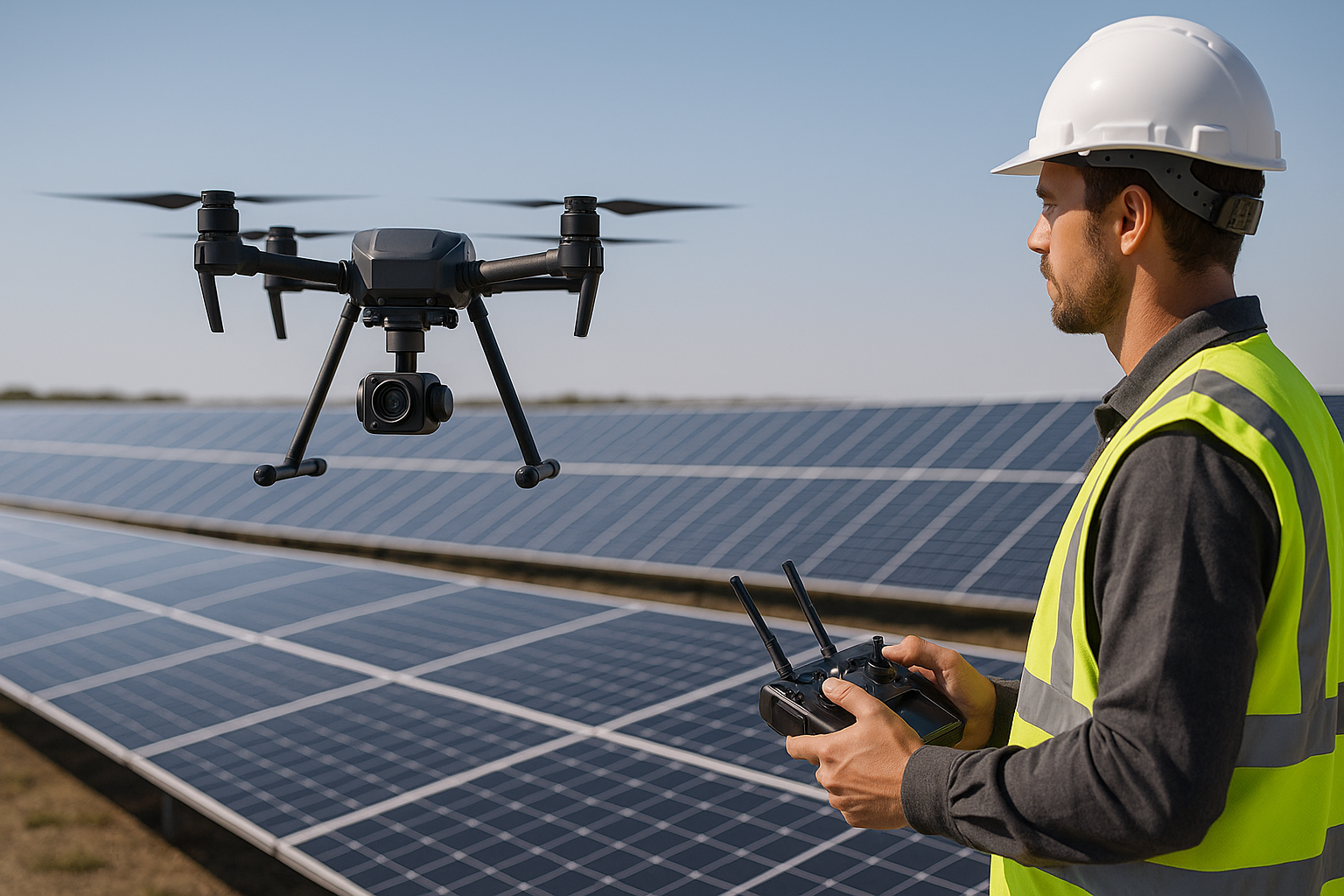
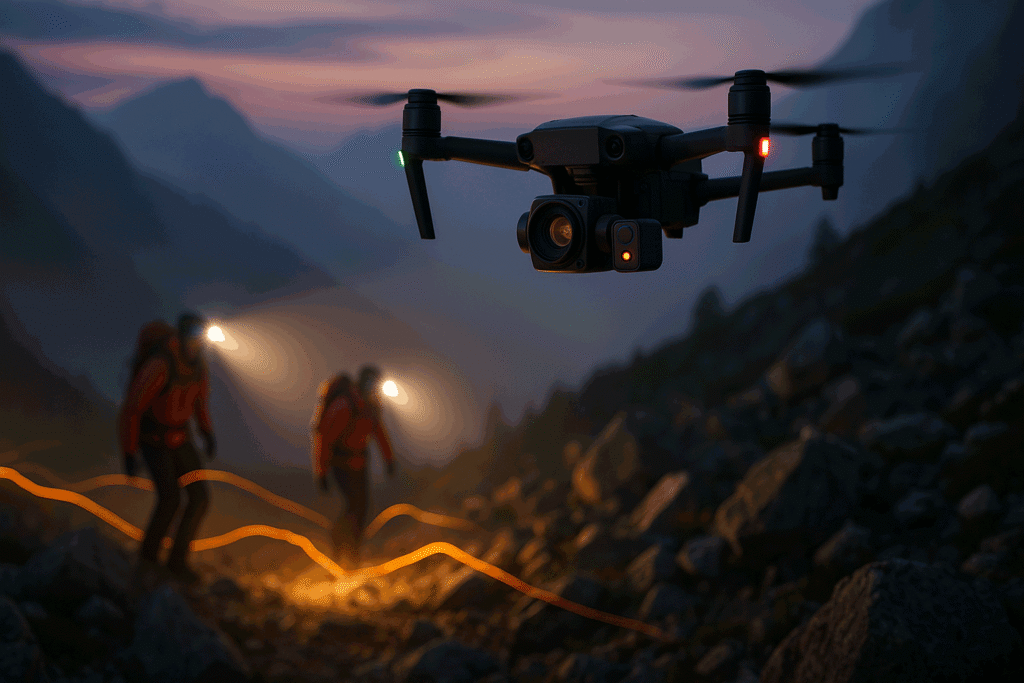
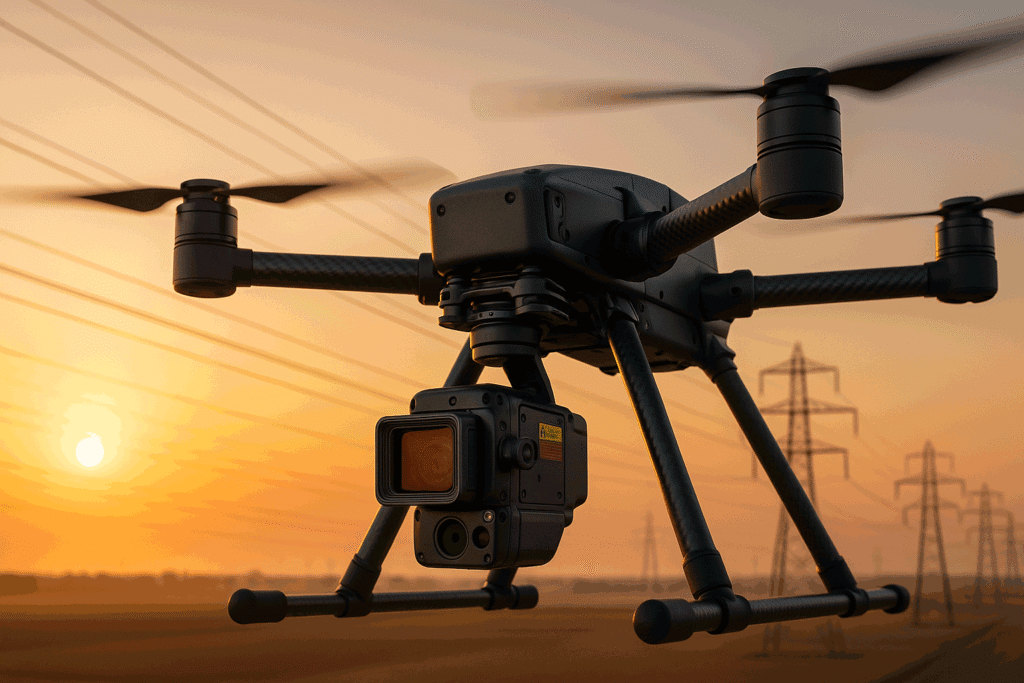
A drone with a laser rangefinder module can do many things. Here are some examples:
| Application Scenario | Description |
|---|---|
| Aerial Photography and Mapping | The drone gets exact ground distance data. This helps it fly smoothly and stay up longer. |
| Navigation and Positioning | The drone gets good 3D terrain data when you use the module with other sensors. |
| Obstacle Avoidance | The module checks how far away things are. This helps the drone not crash and stay on track. |
You can see how the laser rangefinder module helps with each job. It lets the drone measure, find its way, and stay safe in many places.
Selection Criteria
Range and Accuracy
First, you should look at range and accuracy. These two things show how well your drone can measure distance. Some modules, like the Jenoptik DLEM, can measure up to 20 kilometers. They are accurate to one meter or less. Other modules, like the SR2000 and LRF0815C, also work very well. You can see how they compare in the table below:
| Measurement Range | Measurement Accuracy |
|---|---|
| 8 kilometers | ≤ 1 meter |
| 5 kilometers | ≤ 0.5 meter |
| 14 kilometers | ≤ 1 meter |
| 20 kilometers | ≤ 1 meter |
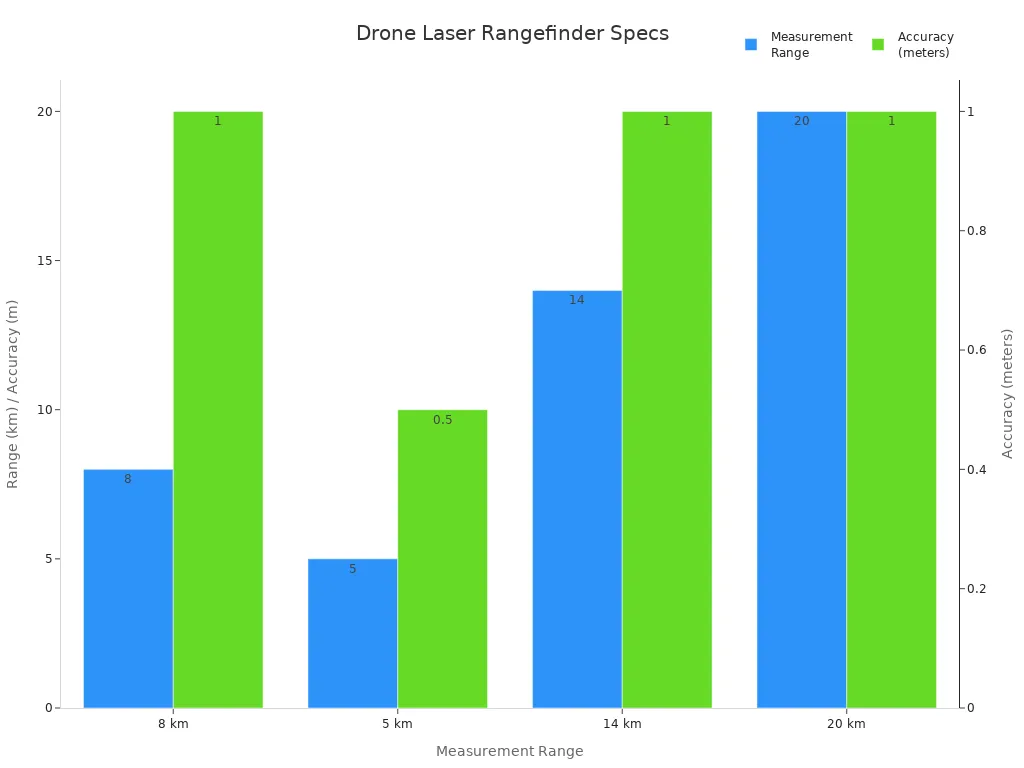
Most modules work best between 1,500 and 4,000 meters. They keep their accuracy under one meter. This helps with mapping, checking things, or counter-UAV jobs. If you need to fly far or measure distant things, pick a module with a long range. For close-up work, better accuracy is more important.
Note: The Jenoptik DLEM laser rangefinder module can reach 20 kilometers. It is a good choice for long-range flights.
Size and Weight
The size and weight of the module change how long your drone can fly. They also change how much it can carry. Lighter modules help your drone stay in the air longer. Many top modules weigh less than 85 grams. They are small and easy to fit on tiny drones.
| Feature | Description |
|---|---|
| Weight | Less than 85g |
| Design | Compact design |
| Performance | Extraordinary in laser ranging |
If you use a heavy module, your drone may not fly as long. For mapping or surveying, a light and small module lets you cover more area.
Power and Interface
You need to check power needs and interface choices. Most modules use little power, so your drone saves battery. Some work with 3.3V, 5V, or special power setups. For connections, you can pick TTL, RS232, or Bluetooth.
| Specification | Details |
|---|---|
| Interface Options | TTL, RS232, Bluetooth optional |
| Power Consumption | Low-power design for embedded use |
| Flexible Power Options | Supports 3.3V, 5V, or custom configurations |
Pick the right interface so your drone can talk to the module. Low power use means your drone can fly longer. This is important for mapping or long flights.
Durability
You want your module to last in tough outdoor places. Many modules have at least IP54 for dust and water safety. Some also meet military rules like MIL-STD-810G for shock and shaking.
| Specification | Rating/Standard |
|---|---|
| Minimum IP Rating | IP54 |
| Military Shock/Vibration Standard | MIL-STD-810G |
Weather can change how well your module works. Rain, snow, fog, and dust can make the laser beam weaker. Always check the weather and temperature before flying. If you use the module outside its temperature range, it may not work as well until it gets back to normal.
Tip: Pick a module with a high IP rating and military-grade strength if you fly in rough places.
Cost Factors
Cost depends on how many modules you buy and what features you want. If you buy a lot, each module costs less. If you buy only a few, you pay more for each one. Special features can also make the price go up.
- Buying many modules gives you a lower price.
- Buying a few modules costs more per module.
- Custom features make the price higher.
You should match your budget to your needs. For big mapping groups, standard modules save money. For special drones, you may need to pay more for custom features.
Laser Rangefinder Module Types
Time-of-Flight
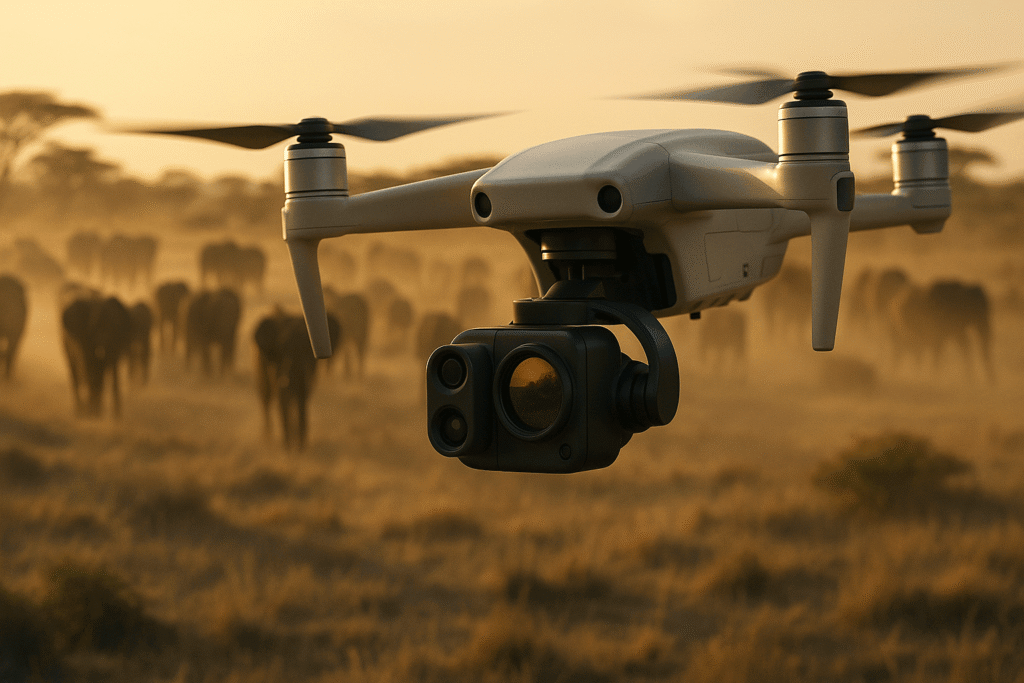
Time-of-flight modules are good for measuring long distances. They send out a laser pulse and wait for it to come back. This helps the drone know how far things are. These modules can measure up to 3,000 meters away. They work well for drone mapping and flying. ToF modules give fast results and make good point clouds. You often find them in drones and self-driving cars that need to see far or avoid things.
| Aspect | Time-of-Flight (TOF) | Phase-Shift (PS) |
|---|---|---|
| Measurement Range | Up to 3,000 meters | Up to 200 meters |
| Measurement Accuracy | 0.5 to 1 meter | 1-3 millimeters |
| Working Principle | Based on time-of-flight calculations | Based on phase shift calculations |
| Best-Suited Applications | Long-range measurements | Short-range, high-precision measurements |
Tip: Pick ToF modules if you need to see far. They are great for mapping big areas or stopping other drones.
Phase-Shift
Phase-shift modules help you measure things very closely. They check the phase difference in the laser light that comes back. These modules are best for jobs that need very exact numbers. You can use them for checking small things or careful mapping. Phase-shift modules can measure up to 200 meters. They are very accurate, down to 1-3 millimeters. They also give quick results, which is good for small spaces.
| Aspect | Phase Laser Distance Sensors | Pulse Laser Rangefinder Sensors |
|---|---|---|
| Measurement Range | 0.03-200 meters | 0-3,000 meters |
| Measurement Accuracy | 1-3 millimeters | 0.5-1 meter |
| Working Principle | Based on phase shift calculations | Based on laser time-of-flight (ToF) |
| Best-Suited Applications | Short-range, high-precision measurements | Long-range measurements |
- Use phase-shift modules for checking things up close or landing exactly.
- ToF modules are better for flying far and mapping big places.
Eye Safety
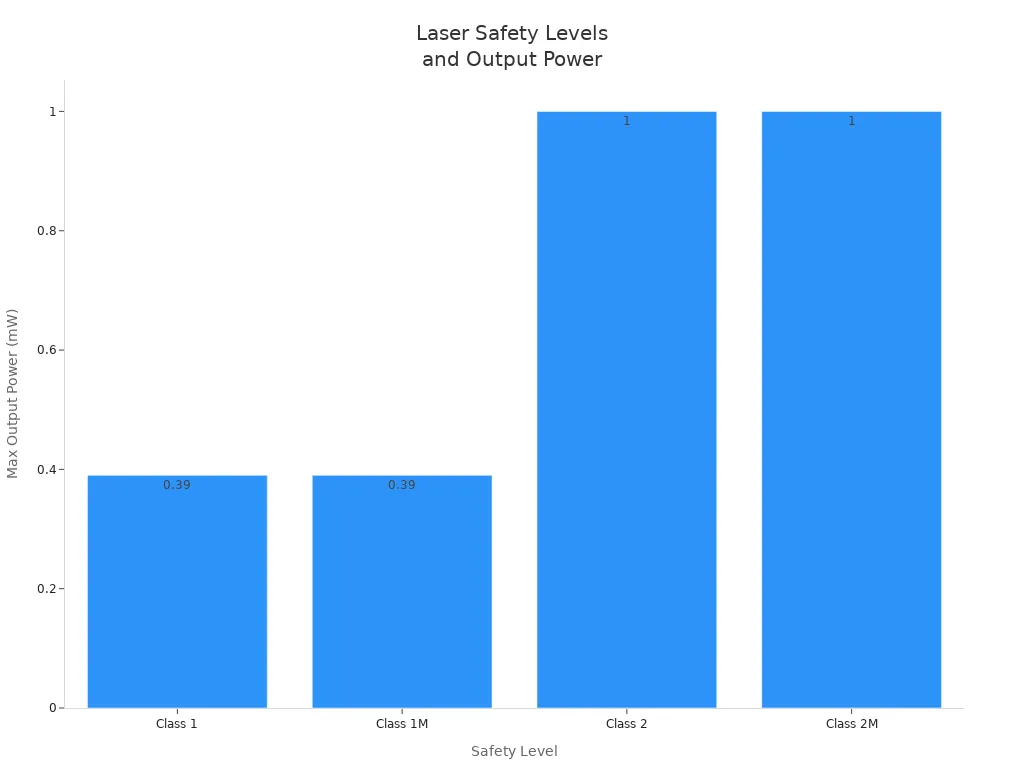
You need to think about eye safety when picking a laser rangefinder module. Lasers have safety classes to show how safe they are. Most drone modules use Class 1 or Class 2 lasers. These are safe for people during normal use. Class 1 lasers have very low power and are not risky. Class 2 lasers are also safe if you do not look at them for long.
| Safety Level | Maximum Output Power | Risk Description | Typical Application Scenarios |
|---|---|---|---|
| Class 1 | <0.39mW (visible) | No risk | Consumer electronics, medical devices |
| Class 2 | <1mW (visible) | Brief exposure safe | Handheld rangefinders, security monitoring |
| Class 2M | <1mW (visible) | Avoid direct viewing | Outdoor surveying, drone obstacle avoidance |
- Pick modules that follow IEC 60825 and FDA 21 CFR 1040.10 rules.
- These rules help keep everyone safe when using drones with lasers.
Selection Guide
Define Needs
Before you pick a laser rangefinder module, know your drone’s job. Think about what you want your drone to do. Will it map big areas, check buildings, or land very exactly? Each job needs different things.
You should focus on three main points: range, accuracy, and hardware quality. The table below shows what to look for:
| Consideration | Description |
|---|---|
| Range Capability | Pick modules for the distance you need; semiconductor for short, erbium glass for long. |
| Accuracy | Better accuracy is needed for exact measurements. |
| Hardware Quality | Check optical parts, energy use, how it fits, and how it connects. |
If your drone must measure far, choose a module with high range. For close jobs, pick one with better accuracy. Always look at hardware quality. Good parts help your drone work well and last longer.
Tip: Write down what you need before you shop. This step saves time and helps you pick the best module.
Checklist
Use a checklist so you do not forget anything important. Here is a simple list to help you:
- What is the farthest distance your drone must measure?
- How exact do your measurements need to be?
- What size and weight can your drone hold?
- What power does your drone use?
- Which interface does your drone support (TTL, RS232, Bluetooth)?
- Does your drone need to work in rain, dust, or hot and cold?
- What is your budget for each module?
- Do you need special things, like eye safety or military strength?
Check each item when you look at different modules. This helps you compare choices and avoid mistakes.
Evaluation Steps
Follow these steps to pick the best module:
- List your technical and job needs.
- Get information from different sellers.
- Use your checklist to compare modules.
- Ask for datasheets and guides.
- Make sure the module fits your drone’s size, weight, and power.
- Look at the support and warranty from each seller.
- Choose the modules that match your needs.
Note: Always talk to sellers if you have questions. Good help makes it easier to use the module.
Testing
Testing is important before you buy many modules. Ask for a sample or demo unit. Try the module on your drone in real life. See if it meets your range and accuracy needs. Test it in different weather and light. Make sure it works with your drone’s system.
If you can, run a test project. Use the module for a full mission. Watch for problems with power, data, or strength. Share your feedback with the seller. They may help you fix problems or give custom solutions.
Tip: Pilot testing helps you avoid big mistakes. It also helps you trust your seller.
Integration Tips
Supplier Collaboration
It is important to work with your supplier. Good suppliers help you more than just selling products. They share their knowledge and help you solve problems. Look at the table below for key features:
| Feature | Description |
|---|---|
| Extended Distance Range | Measures from a few centimeters up to 4500 meters. |
| High Accuracy | Delivers measurements within a few centimeters. |
| Time-of-Flight Technology | Uses pulsed infrared lasers for distance calculation. |
| Robust Design | Works well outdoors, even in tough conditions. |
| Compact and Lightweight | Fits easily into drones without adding much weight. |
| Fast Measurement Rate | Gives quick readings for moving drones. |
| Experience | Over 17 years in laser rangefinder solutions. |
| Production Capacity | Factory can make over 20,000 modules each month. |
You can ask your supplier for help and advice. This helps you avoid mistakes and get good results.
Customization
Sometimes you need special features for your drone. Many suppliers let you change the module to fit your needs.
- You can add the module to UAV gimbal cameras or other systems.
- Some modules find faraway targets like buildings or vehicles with high precision.
- Custom designs help your drone do special jobs better.
- The JRT 1200M module is small, saves energy, and can be changed for different places.
- You can use it for very exact, long-distance measurements.
Talk to your supplier about what you need. Custom modules help your drone work better.
System Integration
You must connect the module to your drone’s system. Many modules, like the ES-LRFM-500, measure up to 4 km and are light and strong. You can use interfaces like UART TTL, I2C, or SPI. These choices make it easier to add the module to your drone.
Tip: Ask your supplier for guides and help. Good instructions help you set up the module fast.
Test the module with your drone before using it for real missions. This helps you find problems early and fix them.
When picking a laser rangefinder module, match its features to your drone’s job. Check if it has the right certifications. Make sure the supplier can make enough modules and keep them good quality. Test how well it measures by using sample units and third-party checks. Use the checklist to compare different modules and try them out in real life. The table below shows what experts think is most important:
| Selection Criteria | Description |
|---|---|
| Technical Certifications | Look for ISO 9001, IEC 60825-1, CE/FCC, and MIL-STD-810G compliance. |
| Production Scalability | Make sure your supplier can meet demand and keep quality high. |
| Measurement Accuracy | Test with third-party calibration and sample units. |
| Environmental Testing | Check waterproof ratings and operational range. |
| Component Traceability | Confirm the quality of lasers and sensors. |
| On-site Audits | Review assembly clean rooms for quality standards. |
| In-house Optical Labs | Prefer suppliers with their own labs. |
| Independent Testing | Verify angular resolution claims. |
Work with your supplier to get better results. Try pilot tests and learn about new technology. Use your checklist to help you pick the best module.
FAQ
What is the main benefit of using a laser rangefinder on a drone?
A laser rangefinder gives you accurate distance measurements. You can avoid obstacles, map land, or land your drone safely. This tool helps your drone work better in many jobs.
How do I know if a module is safe for eyes?
Look for Class 1 or Class 2 laser labels. These classes follow safety rules like IEC 60825. You can use these modules without risk during normal operation.
Can I use a laser rangefinder module in bad weather?
You can use some modules in rain, fog, or dust. Check the IP rating and temperature range. Modules with IP54 or higher work better outdoors.
What interface options do most modules support?
Most modules support TTL, RS232, or Bluetooth. You can connect them to your drone’s flight controller or computer. Always check your drone’s system before you choose.
How do I test if the module works with my drone?
- Ask for a sample unit.
- Install it on your drone.
- Run a test flight.
- Check if you get correct distance readings.
Testing helps you find problems before you buy more modules.