Lead:
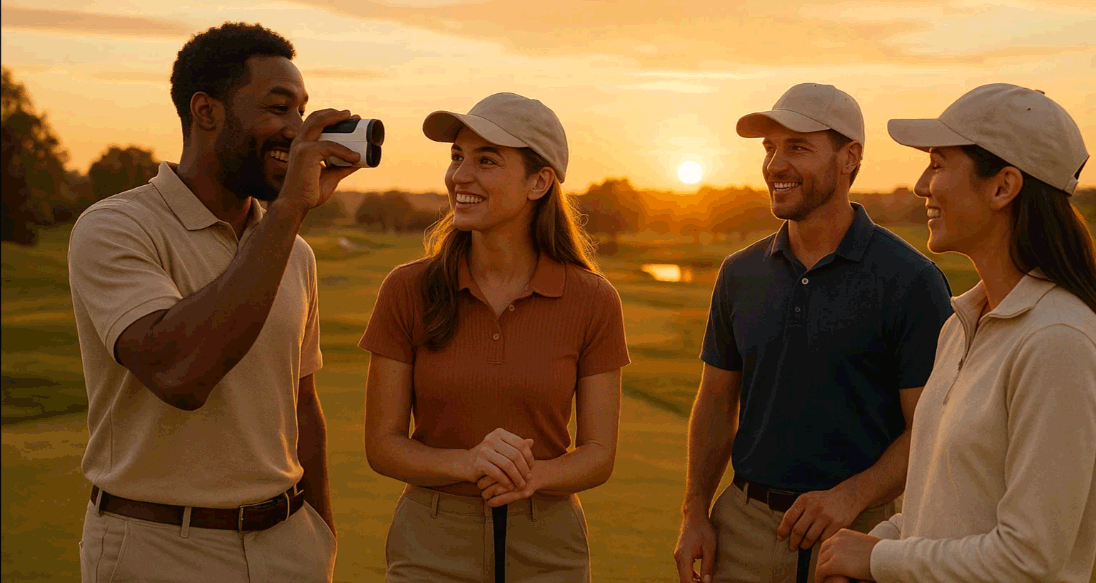
Golfers judge a rangefinder on one moment: the instant it decides “this is the flag.” That decision isn’t magic; it’s a careful blend of optics, flag-lock algorithms, and human-centered UI that earns trust in wind, sun, and brushy backgrounds. This guide shows OEM/ODM teams how to implement a robust laser rangefinder module for golf—and how to package the experience so players feel confident from tee to green.
Table of Contents
ToggleWhy Flag-Lock Is Different from General Ranging
Ranging a bright, flat target in open ground is easy; isolating a thin, moving flagstick with trees, bunkers, or clubhouse windows in the background is not. On most holes, the true target subtends only a few milliradians—narrow compared with a typical consumer laser spot—and it moves with gusts. That means your system must:
- keep the beam footprint small enough not to overpaint backgrounds,
- keep the receiver FOV just wide enough to tolerate hand tremor, and
- use temporal logic (not just “first” or “strongest” echo) to recognize a flag-like signal.
Do those three things well and golfers will say “it just grabs the pin.” Do them poorly and customer support will hear, “it locks the tree behind the green.”
Core hardware & SDK: Laser Rangefinder Module
The Anatomy of a Flag-Lock Decision
Think of flag-lock as a layered filter that narrows uncertainty in time and space until only a flag-like hypothesis remains.
1) Geometry gives you a fighting chance
Start with beam divergence and receiver FOV. For golf, a full-angle beam near ~1.5–1.8 mrad (circular or slightly elliptical) keeps the spot inside the flag/flagstick footprint at typical ranges (80–220 m) while remaining hand-friendly. The receiver FOV should envelope that spot—not dwarf it—at those same ranges. If FOV is much wider, bright trees or the clubhouse behind the green will win the echo contest. If it’s much tighter, players “fall off” the cone as they pan across the green.
A compact optical stack with good baffling and an AR-coated window stabilizes noon-sun behavior; background infrared is high on exposed greens and can otherwise wash out weak returns.
2) Multi-return capture is mandatory
Vegetation and spectator signage create multiple echoes in a single shot. The module should capture at least two returns with amplitude information and precise time tags. The goal is not to pick “first” or “strongest,” but to cluster echoes that are close in range and persist across frames, then apply a bias toward the closest stable cluster—which, on most holes, is the flag/flagstick.
3) Motion helps: micro-parallax and tremor models
When golfers sweep the reticle across the green, hand tremor adds small angular motion. Background structures far behind the flag move more in range space than the flag itself. A light-weight motion model—think a Kalman filter with a tiny process noise—lets you measure this parallax. If the close cluster remains constant while a farther cluster “slides,” promote the close cluster’s score.
4) Wind is not noise—it’s information
Flags flutter; trees sway slowly. You can exploit this: a flag-like signal often shows small, quasi-periodic range/doppler-like variation at sub-hertz rates, while solid backgrounds are steady. Don’t overfit, but allow a micro-oscillation prior to lift the probability that a stable, near cluster with low-amplitude variation is indeed the flag.
5) Confidence, hysteresis, and the final moment
Two UI rules make or break perceived quality:
- N-of-M confirmation: require the closest cluster to persist for N of the last M frames (e.g., 4/6 at 12 Hz) before declaring “flag.”
- Hysteresis: once locked, maintain state unless evidence for a different closer cluster exceeds the current cluster by a margin (amplitude + stability). This prevents “flag → bunker lip → flag” flicker as players breathe.
Return distance + confidence each frame; only fire haptics (or change reticle color) when confidence crosses the flag-lock threshold.
A Flag-Lock Pipeline That Ships
Here’s a practical architecture you can implement with a modern laser rangefinder module and a small MCU:
- Shot scheduling at 8–12 Hz with per-pulse IDs and deterministic time tags.
- Echo capture (top 2–3 returns) with amplitude and time-over-threshold.
- Pre-filter: reject physically impossible echoes (e.g., negative range steps, wildly inconsistent amplitude).
- Clustering: merge returns within a narrow gate (e.g., ±0.8 m at 150 m) to create candidate targets.
- Scoring: for each candidate, combine (a) proximity (closer is better), (b) temporal stability, (c) amplitude consistency, (d) micro-parallax vs background, and (e) wind-friendly micro-oscillation.
- Decision: apply N-of-M confirmation; if the top candidate exceeds threshold, raise flag-lock state.
- UI/UX: haptic pulse, reticle tick mark, or color flash; freeze the number briefly (e.g., 500–800 ms) before gradual confidence decay.
Because golfers often pan through the pin, the decision window should be short (≈250 ms), yet robust enough to ignore single-frame spikes. That balance is what players describe as “grabs the pin and sticks.”
UX That Feels Like a Golf Coach, Not a Gadget
Great algorithms can be undermined by busy UX. Golfers want one-hand, one-thought operation.
Reticle design
Thin lines with a small central aiming dot work better than heavy “brackets,” which obscure a thin flagstick at distance. Avoid reticles that mimic rifle scopes; golfers read numbers, not holds.
Feedback timing
A single haptic tick on lock is better than a buzzsaw. The tick should arrive only when confidence is high—no “pre-buzz.” If you show a dynamic number during scanning, mute the haptic until the score crosses threshold.
Micro-copy that sets expectations
Two lines of on-screen copy do more than a manual:
-
Scanning… keep the dot on the flag.
-
Flag-lock ✓ — number held. Press again to rescan.
Short, polite, and truthful beats long jargon every time.
Slope and tournament compliance
Most pro-shop buyers demand a distance-only mode for play under the USGA/R&A Local Rule. Put “Slope” behind a long-press or a mode switch that remembers its state; save the setting across power cycles so players don’t get caught out on the first tee. Your quick-start card should state: “Distance-only mode complies when the Local Rule is in effect.”
Spec & Selection Guide
You can’t tune algorithms in a vacuum. Start with optics and timing that give the DSP a fair chance. The table below summarizes launch targets we’ve found realistic for golf flag-lock; tune to your optics and sensor.
| Parameter | Target for Golf Flag-Lock | Why it matters |
|---|---|---|
| Beam divergence (full-angle) | ~1.5–1.8 mrad | Small footprint reduces background overlap on greens with trees/clubhouse behind |
| Receiver FOV | Envelope the spot at 100–220 m | Wide enough for hand sweep, narrow enough to reject clutter |
| PRF / UI cadence | 8–12 Hz shots; 8–12 Hz UI | Feels instant yet leaves room for N-of-M confirmation |
| Echo capture | ≥2 returns with amplitude | Brush/stands/clubhouse windows often produce multiple returns |
| Decision window | ~250 ms (e.g., 4/6 frames) | Fast lock without flicker |
| Confidence gating | Haptics & color only above threshold | Teaches golfers the buzz means “flag” |
A few pragmatic rules:
-
If your FOV is much wider than the beam, change optics before changing code.
-
Keep definitions consistent (full-angle 1/e² vs FWHM); otherwise, supplier comparisons lie.
-
A clean Class 1 eye-safety file (IEC 60825-1, recognized via FDA Laser Notice No. 56) prevents late surprises in the golf retail channel.
Engineering jump-off: Laser Rangefinder Module
Designing for Bright Sun, Wind, and Spectators
Bright sun on exposed greens
Ambient near-infrared is high. Use AR coatings, internal baffles, and a modest IR bandpass to reduce washout. Auto-dimming the HUD along a log-like curve avoids blooming while keeping digits legible through sunglasses.
Wind and flutter
A waving flag can momentarily drop amplitude or move the spot onto the pole. Your algorithm should treat these as expected: maintain lock with a small hysteresis and a short hold-time (≈500–800 ms).
Spectators, carts, and TV towers
Background clutter often has higher reflectance than the pin. The closest-cluster bias is your friend, but temper it with stability and parallax so a nearby bunker lip doesn’t win.
A Simple Decision Flow
Scan → Acquire echoes (top 2–3) → Cluster by range gate
↓
Score candidates (close bias + stability + parallax + micro-oscillation)
↓
N-of-M confirmation met?
├─ No → keep scanning; show live distance (muted)
└─ Yes → Flag-Lock state → haptic tick + hold number (0.5–0.8 s)
Pin this diagram in your firmware spec and QA checklist. Small teams ship faster when the decision flow is explicit.
Testing & Validation (course-ready, reproducible)
Bench tests help, but golf is won on grass. Build a repeatable three-course card:
-
Open green (no background): baselines false-lock rate and raw lock time.
-
Tree line behind the green: measures background rejection.
-
Clubhouse behind the green: tests glass and complex backgrounds.
At 80, 120, 180, 220 m, run 10 scans each while sweeping past the pin at a steady rate. Log time-to-lock, lock success %, false-lock %, and confidence distribution. Repeat in windy conditions (flag movement) and late afternoon glare. Publish the results in a one-page PDF for retail buyers; it’s more persuasive than a long brochure.
Acceptance examples:
-
≥95% lock success at 120 m with trees behind; mean lock time ≤ 0.9 s.
-
≤2% false-lock overall across the card.
-
Hysteresis prevents flag↔background ping-pong under steady sweep.
Compliance & Tournament Considerations
A golf-bound rangefinder still needs clean Class 1 eye-safety documentation: AEL worksheet, labels with wavelength and Class statement, and the user-manual safety page that matches the shipped device. The U.S. pathway recognizes IEC 60825-1 via FDA Laser Notice No. 56—cite it in your quality file and keep label art under revision control.
For competitive play, the USGA/R&A framework allows distance-measuring devices under a Local Rule only for distance—no slope, wind, or club recommendation. Make distance-only a persistent, obvious mode; label the quick-start with the exact sentence rules officials expect.
Business Model: Kits for Pro Shops and Golf Brands
A consistent flag-lock story sells through quickly at golf retailers. Package:
-
The rangefinder with distance-only default and a clear slope toggle.
-
A quick-start card (two photos: scan & lock).
-
A soft case, microfiber cloth, and CR2/18650 power option.
-
A compliance insert (Class 1 statement + label locations).
For private-label, reuse the same core across entry, mid, and tour lines: the algorithm and optics stay constant; materials, lenses, and HUD polish scale with price.
Cross-sell pathways are natural: golfers who range confidently during the day often graduate to night wildlife observation or ranch work—introduce them to Thermal Monoculars and Thermal Binoculars without changing the button logic. For brands with hunting lines, shared UX flows cleanly into Thermal Rifle Scopes while keeping the golf product strictly distance-only.
Pitfalls to Avoid
-
Over-wide FOV: trying to “be forgiving” invites background wins; fix optics before firmware.
-
Pre-buzz haptics: a buzz before confidence breaches threshold trains players to double-range.
-
Spec drift: mixing half-angle vs full-angle or switching 1/e² vs FWHM mid-project corrupts comparisons.
-
HUD bloom: bright, fixed luminance numbers wash out or blind night-adapted eyes on dusk rounds; auto-dim on a log-like curve.
-
Slope ambiguity: hiding slope behind a single short-press creates tournament risk; use a long-press or physically separate control and remember state.
FAQs
How fast should flag-lock feel?
Most golfers perceive <1 second to lock as fast, provided the number then holds briefly. That is typically 8–12 Hz ranging with a ~250 ms confirmation window.
Do I need prisms on flagsticks?
Some courses use retroreflective tape or prisms, which help. Your algorithm should not depend on them; treat them as a bonus return.
Why do some units mis-lock on the clubhouse?
Usually FOV ≫ beam or an algorithm that picks “strongest” without a close-cluster bias and temporal confirmation. Fix geometry first, then scoring.
What’s the right beam shape?
Circular is okay; slightly elliptical (horizontal ≈ vertical) is fine as long as the full-angle stays near 1.5–1.8 mrad and FOV matches. State your definition consistently.
How should I present slope?
If you include it, tuck slope behind a long-press and show distance-only distinctly. Persist the state across power cycles and say so in the quick-start.
Call-to-Action
Ready to ship a golf rangefinder that grabs the pin and keeps tournament officials happy? We can help you tune optics, implement the flag-lock pipeline, and assemble a Class 1 compliance pack. Build your line on a proven core and keep the UX calm and trustworthy.
Start here: Laser Rangefinder Module
Expand your outdoor line: Thermal Monoculars · Thermal Binoculars · Thermal Rifle Scopes