Most brands treat leak finding as a side feature of a thermal camera. That overlooks a huge, recurring service workflow in HVAC and plumbing. A purpose-built handheld thermal leak detector—essentially a thermal camera tuned for small temperature deltas, close-range inspection, and fast reporting—can open new channels, new SKUs, and steady consumable-like revenue from service fleets. This article maps where the opportunities sit, how to spec a leak-focused handheld, and how to brief an OEM so your next handheld isn’t “just another thermal camera” but a tool technicians ask for by name.
Table of Contents
ToggleWhere thermal leak detection really earns its keep
In HVAC, the job isn’t “find heat”—it’s prove loss. Technicians chase air leaks around registers, duct runs, and plenums; locate missing or wet insulation; confirm coil and line-set anomalies; and visualize condensation risk before it turns into mold. In plumbing, they trace hot-water slab leaks, map radiant floor loops, find moisture paths behind tile, and pre-locate burst or sweating lines to reduce opening walls.
Thermal doesn’t “see water”; it sees temperature patterns created by leaks. Hot water leaks warm floors and baseboards; cold water leaks cool local surfaces; duct leakage shows as abnormal supply/return temps versus background; wet insulation evens out temperature contrasts. Build your handheld thermal leak detector around those realities and you’ll ship a device that closes tickets faster and avoids unnecessary demolition—exactly what service managers want.
Productization: from generic thermal to a leak detector people understand
A leak detector is a point-solution: the optics, firmware, UI, and reports should align to the service visit.
Optics & detector. Most leak hunts are close range (0.3–3 m) over broad surfaces. Prioritize a wider field of view (e.g., ~35–50° HFOV) and excellent low-delta sensitivity (NETD ≤ 50 mK @ 30 °C). Resolution classes that hit the sweet spot:
- 160×120 (entry fleets, triage)
- 256×192 (mainstream HVAC/plumbing service)
- 384×288 (pro/insurance work where tiny deltas matter)
Focus strategy. Fixed focus optimized for ~0.5–3 m is fine for triage models; manual focus with a short MFD (down to ~0.25–0.3 m) shines for valve boxes, coils, and under-sink runs. Offer a clip-on macro for Best-tier units.
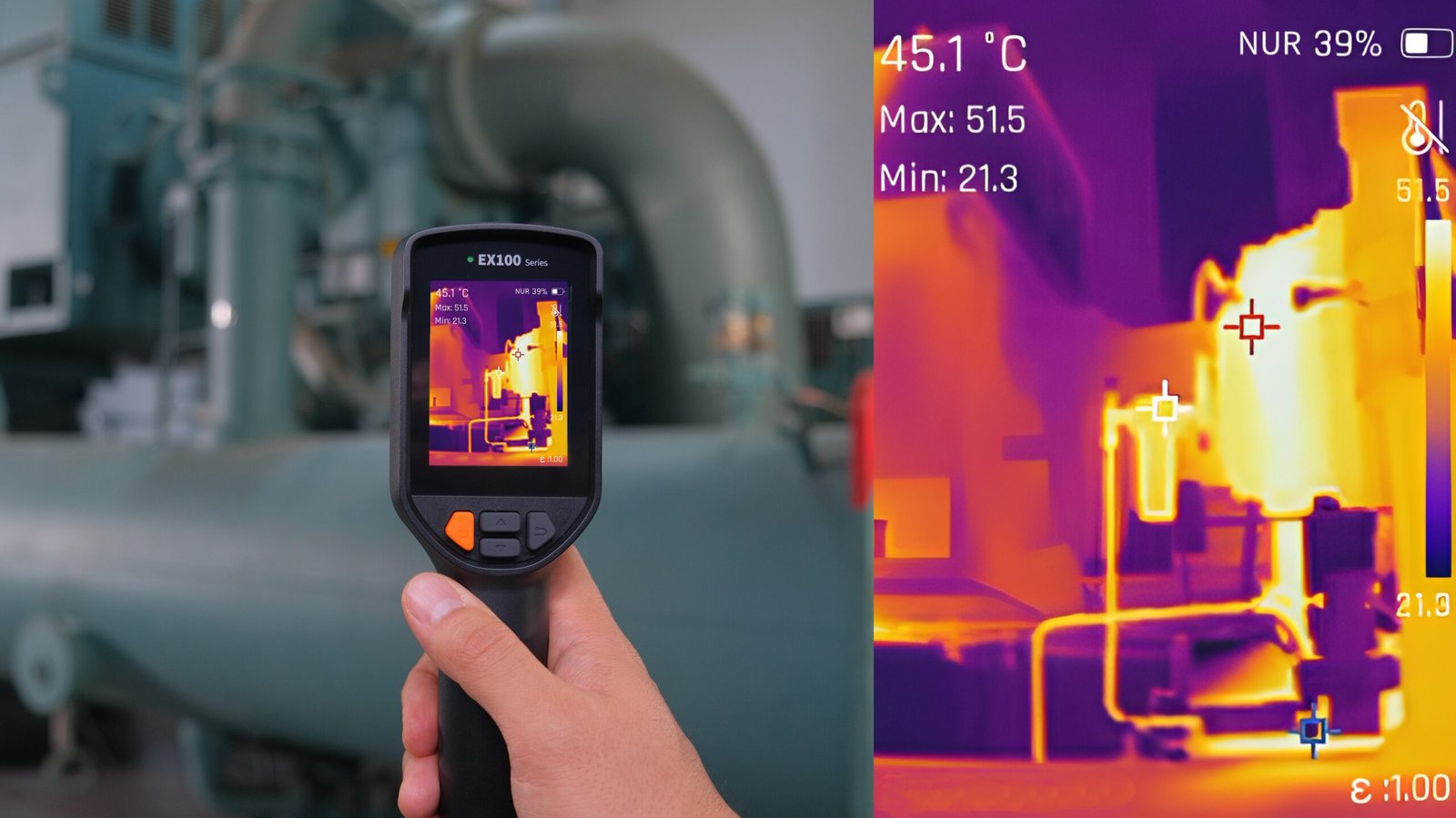
Measurement tools that matter. Technicians don’t need 12 palettes and a game of icon hide-and-seek. They need spot/box with min-max-average, isotherm alarms (e.g., highlight <16 °C or >40 °C), ΔT readout (difference between ROI and reference), and emissivity presets for drywall, tile, copper, PEX, painted metal, and foil duct.
HVAC-specific overlay. Add an ambient + RH sensor and compute dew point. Show a small “dew-point proximity” indicator so techs can explain: “This surface is 1.5 °C above dew point—condensation risk is low,” or “You’re 0.5 °C away—risk is high.” That one overlay turns your handheld thermal leak detector into an upsell engine for insulation and airflow fixes.
Reporting & data. Radiometric images with embedded metadata (date/time, device ID, emissivity, ambient, RH, dew point, ΔT) plus one-click PDF templates (“HVAC Air Leak”, “Slab Leak Pre-Locate”, “Roof Intrusion Screening”). Most pros just want a clean before/after and a note field that syncs to their work order.
Channel strategy: portfolios that fit how HVAC and plumbers buy
Service companies buy in tiers and deploy by role (triage vs. diagnostic vs. proof).
Good (Triage). 160×120, wide FOV, fixed focus, spot + box + simple isotherm, radiometric JPEG, USB-C. Aim this at contractor trucks, rental counters, and maintenance kits.
Better (Diagnostic). 256×192, manual focus (or excellent fixed focus with near MFD), NETD ≤ 50 mK, dew-point overlay, ΔT, Wi-Fi to a light mobile app, report templates. This is the fleet workhorse.
Best (Proof/Insurance). 384×288, macro accessory, tighter accuracy, IP54-IP65 sealing, advanced isotherms and multi-ROI logging, desktop software for batch reporting and CSV export to CMMS.
The same core module can underpin all three. That’s good for BOM, training, and spares.
Spec cheatsheet for an HVAC/plumbing leak detector (OEM brief)
| Area | Recommended direction | Why it helps technicians |
|---|---|---|
| Detector & NETD | 256×192 or 384×288, ≤50 mK | Separates subtle wet/cold spots from background noise |
| FOV & lens | 35–50° HFOV primary; macro clip-on optional | Fits walls, floors, coils; macro for valves/PCB |
| Focus | Fixed (Good) / manual w. short MFD (Better/Best) | Sharp images from 0.3–3 m without dancing back and forth |
| Temperature span | –20…250 °C (extend to 400 °C for coil/compressor work) | Covers HVAC coils to hot water lines without a range change |
| UI | Isotherm alarm, ΔT, quick palette, emissivity presets | Techs act fast; fewer menu dives |
| Sensing | Ambient + RH for dew-point overlay | Explains condensation risk; prevents misdiagnosis |
| Sealing & drops | IP54–IP65, 1.5–2.0 m drop | Survives vans, rooftops, attics |
| Power | 6 h @ 20 °C / 4 h @ –10 °C with gloved hot-swap | Honest runtime builds trust; swaps don’t lose data |
| Data | Radiometric JPEG + PDF templates + job ID tag | Creates proof fast; reduces callbacks |
Workflow value: where the ROI shows up
A leak visit has three phases: find → prove → quote. A general-purpose thermal camera helps with “find”; a true handheld thermal leak detector accelerates all three.
In attics and crawlspaces, isotherm alarm highlights cold air paths through recessed lights or soffits in seconds. At slab level, ΔT between a hotspot and surrounding tile quantifies a hot-water leak without opening floors. For sweating ducts, the dew-point overlay explains why uninsulated runs sweat on humid days, turning an invisible psychrometric chart into a picture the homeowner understands. Each of those moments saves 10–20 minutes per call and closes higher-value work without arguments.
A simple internal model many service managers accept:
- If a leak-focused handheld saves 15 minutes on 3 calls per day, that’s 45 minutes/day or ~16 hours/month per tech. At a blended labor rate of $80/hour, that’s $1,280/month of reclaimed capacity per unit—before counting higher close rates from better visual proof.
Kits and bundles that move volume
Technicians don’t buy features; they buy outcomes in a box. Turn your SKUs into kits:
- HVAC Air-Tightness Kit: Better-tier handheld thermal leak detector, short tripod/handle, magnet mount for air handlers, RH probe, foam-cut case.
- Plumbing Slab-Leak Pre-Locate Kit: Best-tier unit with macro lens, chalk/marker, moisture meter companion, knee pads, slim case.
- Building Envelope Starter: Good-tier handheld, simple blower-door friendly report template, QR links to training videos.
Kits clarify the job, improve ticket size, and make dealers’ lives easy.
OEM/ODM notes for a China manufacturer (so the samples land right)
When you brief your handheld thermal leak detector OEM, write the service scenarios first. Share a one-page “job storyboard” for each: duct leak, slab leak, condensation risk, radiant loop map. Ask for sample firmware with:
- A single “Leak” profile where isotherm and ΔT are pre-configured.
- Dew-point overlay with adjustable safety margin (e.g., warn at ≤1.0 °C above DP).
- A one-tap “Leak Report” that stamps job ID, ambient, RH, emissivity, and ΔT onto the image and exports a PDF.
Hardware-wise, insist on glove-friendly controls, honest runtime at cold temps, and a wide FOV primary lens. Reuse your existing thermal camera module where possible to keep image “feel” consistent across your handheld family, and lean on our thermal camera module integration playbook for fast platform spin-ups.
Positioning & messaging your leak SKUs (so dealers can explain them)
Keep it painfully simple at the counter. “This one helps you find leaks fast (Good). This one helps you prove them and write reports (Better). This one captures tiny deltas and wins insurance disputes (Best).” On the box front, answer three questions in plain English: How close? How clear? How long? Back that with a 60-second video (QR) showing each job storyboard.
Frequently asked questions
Does thermal detect water?
No. It detects temperature differences created by water movement/evaporation or air leakage. Pair it with a moisture meter for confirmation where necessary.
Can I do this with a generic thermal camera?
Yes—but you’ll spend more time fiddling with palettes and measurement tools. A handheld thermal leak detector pre-sets those choices, adds dew-point context, and outputs a report that looks professional without extra software gymnastics.
What about ultrasonic and tracer gas?
Those tools are complementary. Thermal is fast and non-invasive for pre-locate and scope; ultrasonic pinpoints pressurized air leaks in noisy rooms; tracer gas confirms micro-leaks. Most pro fleets carry two of the three.
Internal link ideas (for your site build)
- Leak-focused devices often share cores with our thermal camera modules.
- See integration options on thermal camera module integration.
- If you target industrial checks too, pair with a handheld thermal inspection camera brief.
- For broader retail planning, see our guide to handheld infrared camera portfolios.
CTA — Build a leak-focused handheld your techs will actually use. Reuse our proven thermal camera module and fast-turn integration playbook to spin Good/Better/Best handheld thermal leak detector SKUs with the right optics, ΔT tools, and dew-point overlay. Tell us the jobs—HVAC triage, slab-leak pre-locate, envelope proofs—and we’ll translate them into an OEM spec and samples. Talk to our team to start your project.