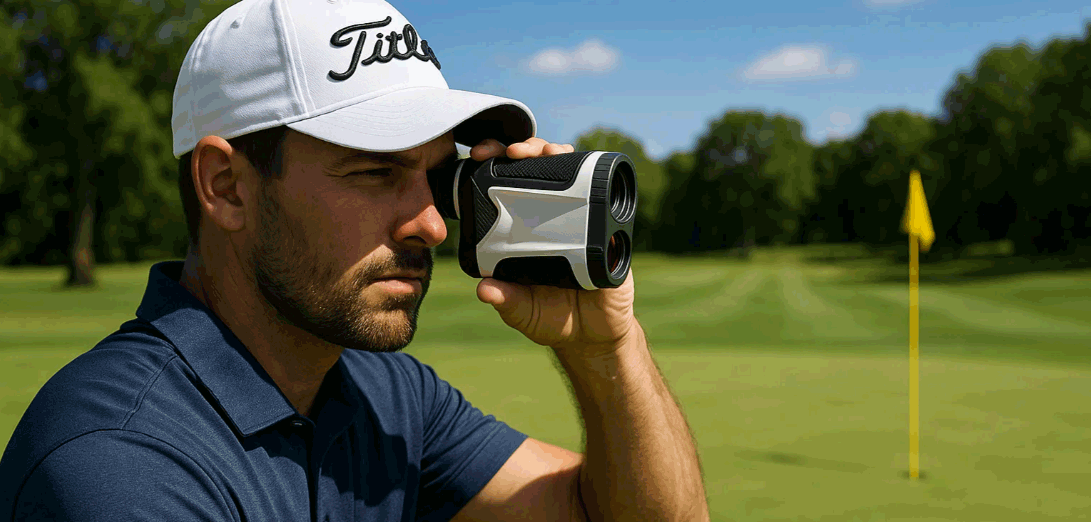
This guide shows OEM/ODM product managers, integrators, and distributors how to implement slope on/off correctly in a golf laser distance module—so your products stay tournament-legal while delivering a better practice experience. We’ll cover firmware and hardware toggles, lockouts, referee-friendly checks, and audit logs that pass retailer and committee scrutiny.
Table of Contents
ToggleExecutive Summary
Slope is a software feature with compliance consequences. Treat it like a safety function:
- Separate distance-only (competition) from slope-enabled (practice) at the architecture level—UI, firmware, and persistence.
- Prove to committees and retailers that distance-only really means distance only at the point of use, with a visible indicator and a one-step field check. Under USGA/R&A policy, devices are permitted in competitions only when limited to distance; slope and other elevation/“plays-like” aids must be disabled.
- Keep laser safety paperwork stable (Class-1, Laser Notice No. 56) while you add modes; the slope toggle must not change the optical emission profile.
- Reduce support cost with a write-once lock, tamper-evident logs, and a referee mode that any marshal can verify in seconds.
- Publish acceptance gates—latency, lock-rate, and “distance-only verification”—instead of adjectives. It de-risks channel launches and reduces returns.
Use Cases & Buyer Scenarios
Scenario 1 — Distance-only for sanctioned tournaments
Your retail partners demand a version that officials can approve on the tee. You ship a firmware profile where slope code exists but is cryptographically locked off, the HUD shows a “Distance-Only” icon, and a long-press combo opens a Referee Check screen that confirms “Slope OFF” with time stamp and firmware hash. This profile survives power cycles and factory reset.
Scenario 2 — Practice mode for teaching and fitters
Coaches want “plays-like” yardage on range hills. You provide a slope-enabled profile with ACD (angle-compensated distance), angle readout, and a small confidence bar. A quick-toggle returns to distance-only; the switch leaves an audit entry so retailers can resolve “slope used in play?” disputes without RMAs.
Scenario 3 — Distributor private-label with dual SKUs
A distributor needs “distance-only” and “slope-ready.” You maintain one hardware BOM and two signed firmware bundles. Carton labels carry a QR code to a serial-linked Compliance Page that shows current mode, last toggles, and referee checks. Future night-hunting bundles reuse the same architecture when pairing with Thermal Monoculars or a Thermal camera module.
Spec & Selection Guide
What “slope” means and why committees care
- Line-of-Sight (LOS) distance comes from your time of flight sensor (ToF).
- Angle-Compensated Distance (ACD) = LOS × cos(θ), where θ is uphill (+) or downhill (−).
- Tournament-legal means distance only when the Local Rule is in effect; elevation, “plays-like,” wind, club suggestions, and similar aids are not allowed. Your product is legal only if those aids are disabled and not used during the round.
Architecture decisions that prevent rework
- Mode separation at boot.
Boot into one of two profiles: Competition (distance-only) or Practice (slope on). Each profile sets UI, APIs, permissions, and persistence. No hidden backdoors. - Immutable defaults.
A write-once fuse (e.g., OTP bit) or signed config prevents field units from changing the default profile without your key. Retailers love this for “Competition Edition” SKUs. - Visible truth.
The HUD shows a persistent “Distance-Only” badge when in competition mode. The icon must be readable at noon sun; pick a high-contrast style you already validated for glare in your Laser Rangefinder Module line. - One-step referee check.
A long-press (e.g., Power + Menu, 3 s) opens a screen that says “Slope OFF,” firmware hash, time stamp, and battery state—nothing else. Marshals don’t dig menus. - Logs you can stand behind.
The device keeps a rolling, signed log:[timestamp, user action, mode change, angle sensor enabled?]. A short QR or USB-CDC dump lets support teams verify “no slope during round.”
Comparison table (implement once, ship many SKUs)
| Item | Competition profile (distance-only) | Practice profile (slope on) | Notes |
|---|---|---|---|
| LOS distance | Enabled | Enabled | Always available |
| Angle sensor | Disabled (driver off) | Enabled | Power gating preferred |
| ACD/plays-like | Hidden | Shown (ACD + θ) | No “suggested club” in either profile |
| HUD icon | “Distance-Only” | “Slope” | High-contrast, sunlight legible |
| API | GET_RANGE only |
GET_RANGE,GET_ANGLE,GET_ACD |
Firmware rejects angle calls in competition mode |
| Logs | Toggle attempts + referee checks | Toggle history + ACD requests | Signed, circular buffer |
| Persistence | Survives reboot/reset | Survives reboot/reset | Write-once default per SKU |
Decision rules (mini matrix)
- If a Committee event is likely, then ship a Competition default with a physical or cryptographic lock; don’t rely on users to switch modes.
- If you sell into mixed play (league + weekend practice), then expose a Referee Check that proves slope was off and unused during rounds.
- If your app mirrors HUD data, then block all ACD/angle API calls when in Competition; distance mirroring only.
- If you update firmware OTA, then require signed payloads and re-state the Competition default after updates.
Integration & Engineering Notes
Electrical & Interfaces
Expose a clear, minimal SDK:
SET_PROFILE(COMPETITION|PRACTICE)→ returns profile + signed receipt (host stores it).GET_PROFILE()→ profile, firmware hash, last switch time.GET_RANGE()→ LOS distance + confidence + valid returns.- Only in PRACTICE:
GET_ANGLE(),GET_ACD(). REFEREE_CHECK()→ immutable screen + one-line USB/QR summary.GET_LOG(n)→ last n signed entries (mode, attempts, checks).
Isolate the angle sensor power rail so Competition literally removes power from the IMU; this prevents side-channel use and saves mWh. Provide µs-resolution timestamps (handy later if the module feeds Thermal Rifle Scopes with ballistic overlays).
Optics & Mechanics (mounting, sealing, readability)
Slope mode changes the math, not optics. Keep the optical path identical in both profiles so your rangefinder module maintains Class-1 emission and calibrated LOS distance regardless of slope state. Make the “Distance-Only” icon readable under 100 klx sun (dark background, bold white glyph). Retain the same sealed window, AR coatings, and O-ring stack you qualify on weatherized products; mode switches must not affect ingress or fogproofing.
Firmware/ISP/Tuning (range algorithm, sensor fusion, UI)
- Angle quality. Filter the IMU with a short horizon (e.g., 100–200 ms) so ACD settles quickly while the user steadies the aim.
- Range fusion. In Practice, compute ACD = LOS × cos(θ) but log both values; never overwrite LOS. In Competition, compute LOS only and ignore θ even if sensor reading is present (ideally it isn’t because power is off).
- UI discipline. No hidden menus that reveal angle in Competition. If a user tries to switch during a round (optional design), confirm with a multi-step consent and log it.
- Battery. Angle sensor duty-cycle when idle; boost sample rate (and display cadence) only during ranging.
Testing & Validation (bench → field, acceptance)
Acceptance gates complement your normal bright-sun and repeatability tests:
- Distance-only verification: In Competition,
GET_ANGLE/GET_ACDmust return “Not Available,” IMU rail reads off, and HUD never shows angle or ACD. - Referee check: From sleep and from on, the long-press brings the check screen in ≤2 s; info is readably large at noon.
- Tamper case: Attempt to change profile with unsigned payload or wrong code; device refuses and logs the attempt.
- Round integrity (optional): In Competition, lock profile for N hours or until round ends (user-ended or battery removed + time-guard).
- Latency & lock-rate: Slope state must not change ranging latency (≤180 ms 95th) or lock-rate (≥90% in 5 s scan at 200 m, 100 klx).
- Persistence: Power-cycle and factory-reset must not change profile without proper authority.
Compliance, Export & Certifications
Rules of golf. Under current USGA/R&A guidance, committees may allow distance-measuring devices but they must measure distance only during play; elevation/slope features must be disabled. Design your system to make “distance-only” obvious and verifiable.
Laser safety. Slope on/off must not alter accessible emission. Keep your IEC 60825-1 Class 1 classification valid for the worst-case pulse settings and repetition rate you ship, and align U.S. paperwork with FDA Laser Notice No. 56 (FDA recognizes conformance with IEC 60825-1 Ed. 3).
CE/FCC/RoHS. Changing UI or angle-sensor duty-cycle doesn’t change EMC/Radio basics; if BLE is present, include radio testing. Keep a Technical File with the slope implementation spec, referee-check UI, and logs format. Label the device and manual with a simple description of Competition vs Practice behavior.
Business Model, MOQ & Lead Time (OEM/ODM)
Slope done right is a pricing lever and a risk reducer:
- MOQs. 200–300 pcs for a catalog rangefinder module; 500–1,000 if you want dedicated “Competition Edition” packaging and QR compliance pages.
- Lead time. If you already ship LOS distance, adding a signed slope profile and logs is a 4–6 week firmware + QA project; add 2–3 weeks for retailer acceptance pilots.
- Private-label. Offer Distance-Only (competition default) and Slope-Ready (practice default) firmware bundles on the same hardware. Retailers can upsell while staying safe.
Tiny distributor ROI (illustrative)
| Assumption | Value |
|---|---|
| Ex-works (distance-only) | $92 |
| Ex-works (slope-ready: angle sensor + logs) | $99 |
| Distributor sell, distance-only | $139 |
| Distributor sell, slope-ready | $159 |
| Gross per unit (slope-ready) | $60 |
| Monthly mix (60% slope-ready of 1,000 units) | 600 |
| Monthly gross | $36,000 |
The $7 BOM uplift (sensor, license, QA time) supports $20 higher ASP and fewer returns from “slope confusion” in events.
Pitfalls, Benchmarks & QA
“Hidden” slope still accessible. If angle APIs respond in Competition, you’re non-compliant even if ACD isn’t displayed. Fix: power-gate IMU; reject API calls; log attempts.
Icons that vanish in sun. If “Distance-Only” washes out at noon, marshals won’t trust it. Fix: reuse your glare-tested UI (dark background, bold glyph, high contrast).
Profile flips mid-round. A user toggles to Practice to get a number, then back to Competition. Fix: optional round lock; always log toggles with timestamps.
OTA updates that change defaults. A firmware push silently re-enables slope. Fix: require signed payloads; enforce Competition default with a separate signed switch.
Ambiguous datasheets. “Tournament-legal*” asterisked footnotes invite returns. Fix: publish a clear statement and link your Sources.
Laser paperwork drift. Changing UI should not touch AEL—but re-check divergence and emission after mechanical revisions. Fix: keep Class-1 files aligned with current firmware/hardware.
Benchmark recipe. Take five “Competition” units and five “Slope-Ready” to a course: run referee checks, attempt illegal switches, log latency and lock-rate at 100 klx, and export logs post-round. Share the one-page chart with channel partners.
FAQs
Is a physical slope switch required?
No. A cryptographically locked profile with a referee check is enough, provided slope is disabled and cannot be used in play. Some brands still add a physical slider for clarity; your logs make either approach verifiable.
Can we keep the IMU powered in Competition but hide ACD?
Not recommended. Power-gate the sensor so angle data cannot be read by the host or mirrored to apps, and so battery life improves.
How fast should the slope toggle work?
Instant for UX, but logged. If you implement a “round lock,” require an explicit user confirmation and show a countdown before enabling Practice.
Does slope affect laser safety classification?
It shouldn’t. Slope is math and sensor fusion; your laser sensor module emissions should remain Class-1 in all profiles. Verify after any optics or firmware timing changes.
What should we publish on the datasheet?
A plain statement: “Competition Mode = distance-only; Slope disabled. Referee Check available.” Add latency, lock-rate, and a link to your Sources.
Call-to-Action (CTA)
Need a slope architecture that marshals trust and retailers approve? We’ll help you implement signed profiles, referee checks, logs, and a glare-proof HUD on your rangefinder module—with paperwork aligned to Class-1 and tournament policies. Ask how the same compliance backbone can support premium bundles with a Thermal camera module or future overlays in Thermal Binoculars.
Sources
- USGA & The R&A — Distance-Measuring Devices. Core principle: devices are allowed when limited to distance only; elevation/slope features must be disabled during play. (USGA — Joint Statement; The R&A — Rule Finder) USGA+1
- USGA — Golf’s New Rules: Use of DMDs (Rule 4.3). Modern rules allow DMDs; Committees may still restrict by Local Rule. (USGA — Major Change explainer) USGA
- FDA — Laser Products: Conformance with IEC 60825-1 (Laser Notice No. 56). FDA recognition of IEC 60825-1 pathways; keep Class-1 files aligned with shipped firmware. (FDA Guidance, PDF) U.S. Food and Drug Administration+1
- IEC — 60825-1: Safety of Laser Products. Equipment classification and AEL framework; emissions unaffected by slope UI if optics/timing unchanged. (IEC Webstore) IEC Webstore