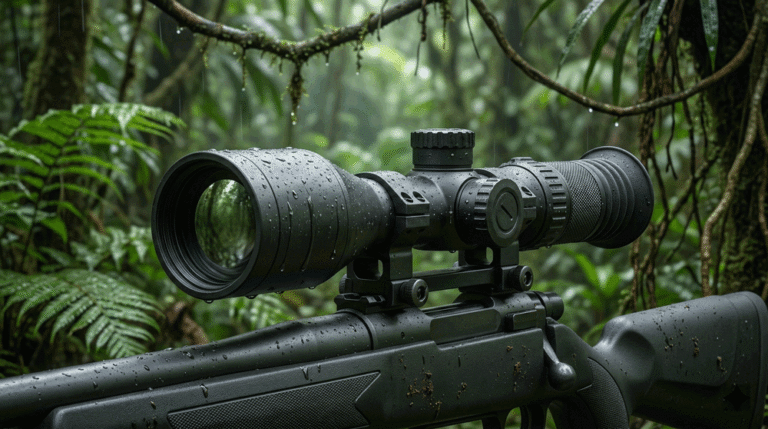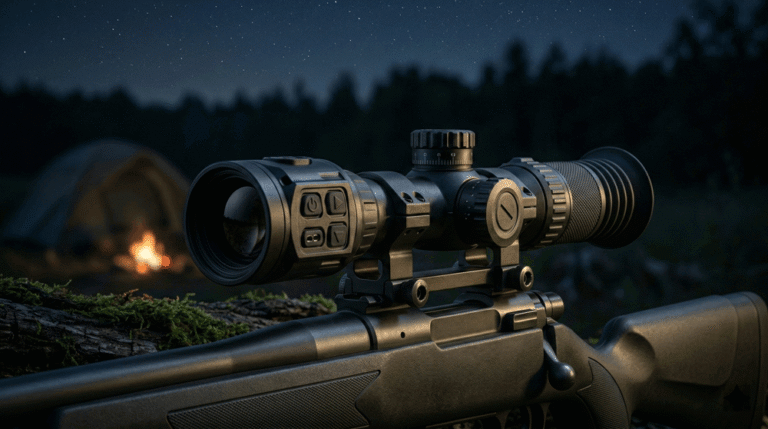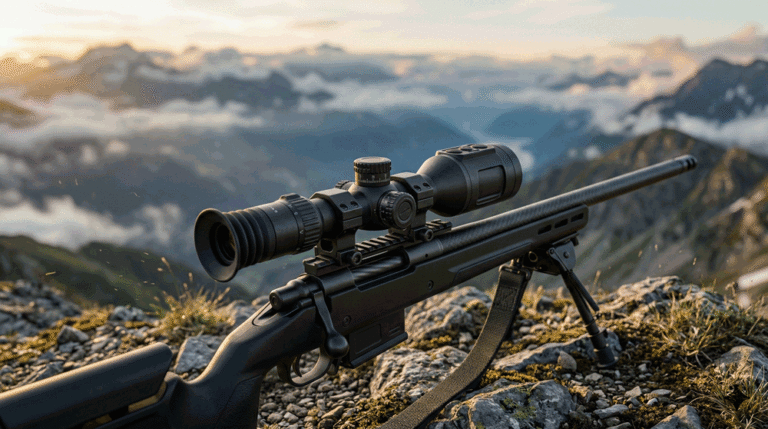
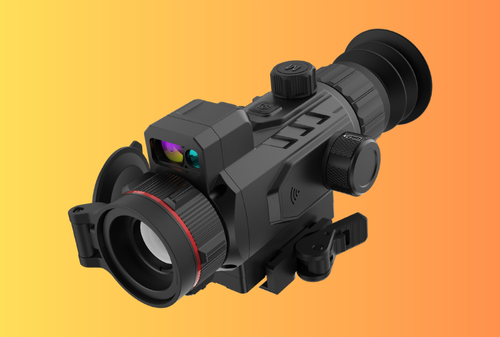
When you launch a thermal scope for AR15, the real test begins long after the first shipment leaves your factory. On paper, many products look similar: same sensor resolution, similar NETD claims, comparable detection ranges. In the field, though, what decides whether a line survives more than one season is something much less glamorous: how many support tickets, RMAs, and dealer complaints the product generates.
Table of Contents
ToggleThis article looks at the AR platform through an engineering and commercial lens. It focuses on how to design a thermal scope for AR15 that simply works on real rifles in real hands, so that your margin isn’t slowly eaten away by “it won’t hold zero” emails and lengthy troubleshooting calls.
Understanding the AR15 Thermal Scope in Context
The AR15 is not just another host rifle. It is a modular system with a flat-top upper receiver, usually carrying a Picatinny-style rail, and a huge variety of handguards, gas systems, and barrel lengths. That modularity is exactly what your customers love: they mount lights, lasers, bipods, suppressors, different uppers and calibers, all on the same lower. For a thermal scope, this means an environment that is mechanically more variable and operationally harsher than a traditional bolt-action hunting rifle.
A thermal scope on an AR15 is expected to do several things at once. It must provide clean thermal imagery and a usable reticle at the distances where ARs are actually used, which often means 100 to 300 meters rather than extreme long range. It has to maintain a repeatable zero despite frequent trips in and out of trucks, being knocked against roll bars or gates, and enduring thousands of rounds over its lifetime. It needs to sit at the right height over bore so that shooters can still achieve a natural cheek weld, and it has to coexist with backup sights, clip-on devices, or day optics in some setups.
Seen from a B2B perspective, the “product” is not only the device itself. The real product is the complete experience that the dealer and end user have from unboxing to first successful night in the field. Every part of that journey that is confusing, fragile, or under-engineered becomes a support ticket. The role of engineering is therefore to reduce ambiguity and failure modes wherever possible.
Why the AR15 Thermal Market Punishes Weak Engineering
Most AR15 thermal scopes end up in a few predictable verticals. Predator and varmint hunters use ARs for coyote control and small game. Hog hunters often run them as truly hard-use tools: rifles ride in UTVs and trucks, get exposed to dust, mud, and rain, and may see entire magazines emptied in a single engagement. Law enforcement and private security adopt AR-platform rifles for patrol and perimeter work, expecting repeatable performance under time pressure. Outfitters and guides use thermals in rental fleets where each scope may see multiple inexperienced users per week.
Each of these verticals has its own expectations, but they share one trait: they do not treat optics gently. Predator hunters swap rifles and loads to adapt to different seasons. Hog-control teams shoot high round counts in a single night. Law-enforcement rifles may sit unused for months and then be demanded to perform perfectly after a single check at the range. Rental fleets see rough mounting, careless handling, and frequent zero changes. Whenever engineering does not anticipate these realities, support is forced to compensate.
The economic consequence is straightforward. A single return can easily cost a three-figure sum once shipping, inspection, rework, and restocking are accounted for. Even if the thermal scope for AR15 sells at a comfortable gross margin, every percentage point of additional RMA rate chips away at profit. In saturated markets, dealers quietly drop lines that generate more hassle than revenue. The brands that survive are those whose scopes go onto rifles, get zeroed, and then disappear from the support queue.
Engineering Priorities for a Thermal Scope for AR15
Designing the Mechanical Interface Around Real AR15 Rails
The first place where engineering decisions show up in support tickets is the mount. On a drawing, a Picatinny rail has well-defined dimensions and tolerances. In the real market, AR15 rails vary considerably by manufacturer and price point. Some uppers are close to military specifications; others are hobby-grade and wander outside ideal dimensions. Handguards may or may not match the upper receiver rail perfectly. A mount that only works flawlessly on perfect rails is a mount that will generate complaints.
For a thermal scope intended specifically for the AR platform, an integrated one-piece mount is usually the safest choice. It eliminates the user’s need to choose separate rings, guess at ring height, or align multiple components. The clamp geometry can be designed so that it references the top surface of the rail and tolerates slightly oversized or undersized cross slots without rocking. The clamping range and screw design should accept both budget and premium ARs, and the torque requirement should be clearly printed on the mount itself so that users are not tempted to overtighten.
There is also the question of height over bore. AR shooters are now accustomed to optic heights in the range of roughly 1.5 to 1.93 inches above the rail. If the mount places the thermal scope too low, shooters crowd the stock and struggle with night-vision or ear protection. If it sits too high, cheek weld becomes inconsistent. Engineering the mount around these common expectations from the outset prevents a wave of “scope feels awkward” comments that are hard to fix after launch.
Zeroing UX: Turning a Pain Point into a Strength
Zeroing is the second major source of friction. Many support emails that mention a thermal scope for ar15 “not holding zero” actually come down to poorly guided zeroing procedures, not true mechanical drift. Traditional zeroing workflows assume a user understands how to adjust turrets or digital reticles and how to interpret the shift of a shot group. In practice, night-vision newcomers often get lost as soon as the image is frozen and the reticle is moved.
A more robust approach is to design the firmware with a dedicated AR-friendly zeroing mode. Instead of exposing every adjustment option immediately, the scope can offer a “guided zero” that walks through choosing a distance, firing a group, freezing the image, moving the reticle to the group’s center, and confirming the change. On-screen text can be minimal but precise, using plain language and clear prompts rather than dense abbreviations. Audio or haptic feedback can reinforce steps when appropriate.
Multiple rifle profiles are an equally important part of zeroing UX. AR owners frequently run several uppers in different calibers, or alternate between bullet weights and load types. Allowing the user to store and label multiple zero configurations makes it realistic to share a single thermal optic between rifles without constant re-zeroing. The storage must be robust, with non-volatile memory and sanity checks so that data is not lost during firmware updates or power interruptions.
Together, these choices make zeroing feel more like a controlled experience than a trial-and-error exercise. That in turn reduces the category of tickets that begin with “I followed the instructions and it still isn’t right,” which are the most time-consuming for support staff to handle.
Managing Recoil, Vibration, and Thermal Stress
Although the recoil energy of a typical 5.56 AR15 is moderate, the way that energy is transmitted is distinct. Gas systems, bolt carriers, and buffers produce a characteristic pulse and vibration profile. Suppressors change timing and back-pressure. Some users will also mount the same thermal scope on larger calibers built on AR-style platforms, such as .300 Blackout or 6.5 Grendel. Limiting validation to a recoil sled or a couple of controlled lab setups is not enough.
A credible validation program mounts production-representative scopes on actual AR rifles with different barrel lengths, gas-system lengths, and configurations. The devices are then subjected to firing schedules that mimic realistic usage: magazines fired in quick succession, rifles allowed to cool, and then fired again. Between firing cycles, scopes are bumped, slung, and transported in ways that approximate a truck gun rather than a benchrest rifle. Only under these conditions does the real interaction between mount, rail, screws, internal assemblies, and firmware behavior reveal itself.
Thermal cycling is just as critical. AR15 rifles may be used after sitting in a cold vehicle, then brought into a warm environment, then back out again. Housing materials, lens barrels, and mounting hardware expand and contract at different rates. Engineering choices about alloys and fasteners directly influence whether zero shifts gradually with temperature or remains stable. Careful pairing of materials and thorough thermal testing can prevent seasonal complaints that are often misattributed to electronics.
Electronics, Power, and Firmware for Real-World AR Use
Once the mechanical fundamentals are sound, electronics and firmware determine whether the thermal scope for ar15 feels reliable day to day. From the user’s perspective, the device should power on quickly, stay on as long as expected, and respond consistently to controls even in cold or wet conditions.
Power architecture is often underestimated. AR users do not want to chase rare or proprietary battery types. Selecting cells that are widely available and specifying realistic runtime at different temperatures removes uncertainty. At the same time, the internal power path needs to tolerate brief disconnects, high recoil, and the voltage sag that occurs when batteries age. Integrating an external power option, such as a sealed battery pack or power bank connector, can support long sessions without compromising the internal design.
Firmware is where many brands either build long-term trust or slowly accumulate user frustration. A conservative philosophy generally serves B2B buyers better than a constant feature race. The software should prioritize stability, predictable behavior, and clear error handling over frequent cosmetic additions. Features like recoil-activated recording, Wi-Fi streaming, or picture-in-picture are attractive, but they must be implemented with strict attention to edge cases: low battery, intermittent recoil patterns, or marginal wireless connections.
Updates should be designed as safe operations right from the start. A dual-bank firmware structure with rollback capability, clear progress indicators, and signed images reduces the odds that a user will “brick” a scope during an update. An internal log of critical events, readable by service personnel, gives your support team tools to diagnose failures remotely rather than requesting immediate returns.
Finally, accessory integration matters more than spec sheets acknowledge. Many AR15 owners already have weapon lights, IR illuminators, and cable management systems on their rifles. A thermal scope that introduces awkward cable paths, obstructs charging handles, or creates interference with existing devices generates annoyance that often turns into “this scope is a hassle” comments. Housing shape, port placement, and connector selection should be evaluated on fully built AR rifles rather than on a bare receiver in isolation. When a scope sits comfortably alongside these accessories, it quietly reduces friction and keeps customers focused on performance rather than ergonomics.
In terms of broader ecosystem, many brands now treat stand-alone scopes as part of a family that includes Thermal Imaging Modules used in security or industrial systems. Aligning interfaces and behavior across these families simplifies integration work for OEM customers and leads to more repeatable deployments.
Configuring a Product Line Around AR15 Dealers’ Price Ladders
The AR15 thermal market is not a single price point. Dealers typically want at least three clear steps: an entry-level model that can be bundled with rifles or sold to budget-conscious buyers, a core model that carries most of the volume, and a premium model that satisfies professionals and enthusiasts. The challenge is to define these steps so that each configuration has a clear role and does not overcomplicate manufacturing or support.
A simple way to conceptualize this structure is to compare three archetypal configurations:
| Configuration | Fleet AR15 Thermal (Entry) | All-Round AR15 Thermal (Core) | Premium AR15 Thermal (Pro) |
|---|---|---|---|
| Sensor resolution | 384 × 288 | 640 × 512 | 640 × 512 (higher-grade) |
| Objective lens | 25 mm | 35 mm | 50 mm |
| Field of view at 100 m | Wide | Medium | Narrow, more magnified |
| Typical human detection distance | Around 1,000 m (spec-level) | Around 1,500 m | Around 2,000 m |
| Power concept | Single internal battery | Internal battery + external pack | High-capacity internal + external |
| Mounting solution | Fixed integrated mount | Integrated mount, semi-QD | Premium QD lever mount |
| Target buyer | Rental fleets, bundles, entry SKUs | Main dealers, serious night users | Professionals, guides, LE units |
The entry configuration is deliberately simple: conservative resolution, modest lens size, straightforward power, and a mount that is not meant to be removed often. Its purpose is to minimize setup errors in scenarios where users may be inexperienced, and where dealers need a product that “just works” with minimal explanation. For this type of scope, firmware complexity should be restrained; fewer menu items and fixed profiles can be an advantage.
The core configuration is the heart of the line. Here the combination of 640-class resolution, intermediate lens, and balanced field of view matches the typical coyote or hog hunter who uses an AR to scan fields and engage targets within a few hundred meters. Features like multiple rifle profiles, picture-in-picture, and moderate streaming options make sense because this user segment is willing to invest a little time learning the interface. Mounting can shift toward a semi-quick-detach design that allows removal for storage or transport while still holding zero within acceptable tolerances.
The premium configuration is where the most demanding customers live. These users often have multiple rifles, extensive accessory setups, and clear expectations formed by high-end glass day scopes. They may want long-range identification ability, high-contrast imaging in difficult atmospheres, and integration with recording or streaming systems for professional use. Here, advanced firmware features are appropriate, but only if they are backed by comprehensive training and documentation. The mechanical design must anticipate heavier calibers, suppressors, and more extreme environmental exposure.
Across all three configurations, alignment with your Thermal Rifle Scopes portfolio helps dealers understand where each model sits relative to existing glass optics. When your day scopes and thermals share similar naming, reticle families, and control layouts, users move between them more easily and support calls decline.
Integration, Compliance, and OEM/ODM Collaboration
Engineering decisions become even more important when the thermal scope for ar15 is sold as part of an OEM or private-label project. In that context, your scope is not merely a stand-alone product; it is one component in a rifle system that carries someone else’s brand.
Mechanical and cosmetic integration are the visible part of this relationship. Housing lines, color finishes, and engraving positions can be aligned with the rifle maker’s design language. Consistent application of logos and model names on both scope and rifle reassure end users that they are buying a coherent system. This attention to appearance does not replace technical validation, but it strongly influences perceived quality.
Internally, firmware and user interface integration play a large role in overall experience. If a rifle maker already has a well-known line of daytime optics, matching core elements — such as button layout philosophy, reticle behavior, and menu structure — reduces the learning curve. A hunter who is familiar with menu navigation on one product will find it easier to adopt another. When video output or network streaming are required, aligning the thermal scope’s interfaces with existing back-end systems or applications keeps integrators from writing custom glue logic every time they deploy a new configuration. These are the areas where you may want to refer customers to your broader Thermal Camera Solutions documentation so that integration work remains consistent across projects.
Compliance adds another dimension. Although an uncooled thermal optic is often regarded primarily as an imaging device, its radio modules, power system, and construction materials are subject to regulatory frameworks such as EMC directives, safety standards, and restrictions on hazardous substances. In some markets, additional attention is required for export controls. A disciplined approach to documentation — including test reports, declarations, and labeling — ensures that private-label partners are not left to resolve these questions alone. When compliance is clearly presented as part of an OEM/ODM Partner Program, it signals that you understand the full lifecycle of bringing a product to market.
Cost, Warranty, and Lifecycle ROI
The business case for a robust thermal scope for ar15 is not only about the procurement price. It is about the total economic impact of the product over several years. A slightly more expensive design that cuts the RMA rate in half can be the better bargain for both you and your customers.
At the capital-expenditure stage, purchasing teams evaluate unit cost, minimum order quantities, and tooling or customization charges. They may be tempted to choose a cheaper design that seems comparable on paper. However, the real leverage lies in the costs incurred after the scopes are in the field. Every malfunction that leads to a return consumes dealer time, disrupts trust with the customer, and requires shipping, inspection, and rework. The fewer unknowns there are in the design, the more predictable these costs become.
Operationally, training and documentation play a substantial role. If a dealer can unbox a thermal scope, follow a concise quick-start guide, and successfully mount and zero it on an AR15 with minimal confusion, the likelihood of subsequent complaints drops. When you provide a short, focused manual for mounting and zeroing, an additional reference guide for advanced features, and a small library of two- or three-minute videos, you enable dealers to solve many questions locally. Good documentation is essentially an investment in support capacity, provided once and used repeatedly.
Warranty design sits at the intersection of engineering confidence and market expectations. Offering a long warranty on an inadequately tested product is a recipe for losses. Offering a short warranty on a well-designed scope may limit adoption. When you have validated your design thoroughly on AR platforms, it becomes realistic to offer a generous warranty and still maintain acceptable costs. That, in turn, reassures dealers and end users that your brand intends to support the product line for the long term.
From a buyer’s standpoint, the key insights can be summarized clearly even without extensive bullet lists. They should look at how well the scope’s mechanical design anticipates real AR rails and recoil profiles; how intuitive and robust the zeroing process feels; how conservative and predictable the power and firmware behavior is; how fully the manufacturer has prepared training and documentation; and how aligned the thermal line is with other optics they already use. When these elements are in place, the incremental cost of a better-engineered scope is usually more than offset by reduced downtime and fewer customer escalations.
Partnering and Next Steps
Developing a thermal scope for AR15 that keeps support tickets low is ultimately a collaborative effort. It requires that manufacturers, OEM partners, and distributors look beyond headline specifications and focus on the everyday interactions between user, rifle, and optic. The most valuable discussions often happen early, at the requirements stage, when there is still room to influence housing design, mount geometry, firmware behavior, and testing plans.
If you are defining a new AR-focused thermal line, it is worth sitting down with engineering, product management, and customer support at the same table. Support can bring real-world examples of recurring problems. Engineering can propose design choices that eliminate those failure modes. Product management can align these improvements with a coherent set of configurations tailored to dealers’ price ladders. When this triad works together, the resulting product not only sells well; it also sustains its reputation year after year.
In your public-facing materials, you can reinforce this by inviting customers to explore how your optics family is structured and how you approach cooperation. References to an OEM/ODM Partner Program that explicitly includes AR-platform testing, documentation co-branding, and shared training resources send a strong signal. When customers are ready to move from concept to implementation, a clear route to Contact Our Engineering Team gives them confidence that their specific use cases will be heard.
In the end, the most successful thermal scope for ar15 is not the one that generates the most excitement on launch day. It is the one that quietly mounts, zeros, and performs night after night, on hundreds of ARs from different makers, with minimal drama. That kind of reliability is not an accident. It is what happens when engineering and business teams consciously design for a future in which the support queue stays short, dealers stay loyal, and users simply trust that their thermal will work whenever they need it.