
Industrial maintenance teams rarely argue about whether to buy an industrial thermal camera any more. The real debate is where the money should go: more handheld industrial thermal cameras for route-based inspections, or online thermal imaging systems that watch a few critical assets 24/7.
Table of Contents
ToggleIf you are a product manager, maintenance leader, or an OEM/ODM buyer working with a China industrial thermal camera manufacturer, this budget split is one of the most strategic decisions you will make. Get it wrong and you either overspend on fixed systems that stare at the wrong spot, or rely on handheld checks where you really need continuous protection.
This article walks through a structured way to think about the trade-off. We will:
- Clarify what we mean by handheld industrial thermal camera and online industrial thermal imaging camera systems
- Explain the physics and reliability benefits that make thermography so powerful in condition-based maintenance
- Show where handheld and online approaches each create the strongest ROI
- Propose a practical, numbers-backed framework for splitting your budget
- Close with OEM/ODM and China-factory considerations, plus FAQs and a clear next step
Throughout, the focus is on depth and practicality—linking thermal imaging back to real risk, thermodynamics, and system behaviour, not just marketing claims.
1. Why industrial thermal camera strategy matters
Infrared thermography is powerful because almost every failure mode in electrical, mechanical, and process equipment shows up as a temperature pattern long before you see smoke, noise, or vibration.
Studies and industry data consistently show that incorporating thermography into predictive maintenance can:
- Cut maintenance costs by roughly 25–30% and reduce unplanned downtime by around 35–45%, with ROI figures near 10× when the program is well run.
- Reduce electrical-related failures and fire risk by catching hot connections and overloaded conductors early.
Those improvements are not magic. They come from basic physics: abnormal resistance, friction, or heat transfer show up as hotter spots in an infrared image.
The question is not whether industrial thermal imaging cameras deliver value; it is where to deploy them so that each degree of temperature you measure gives the maximum risk reduction per dollar spent.
2. What counts as an “industrial thermal camera” today?
When someone says “industrial thermal camera” they might be talking about a rugged handheld imager, a fixed smart sensor inside a kiln hood, or an OEM thermal module integrated into a custom enclosure. For budget decisions, you need a clean definition.
2.1 Handheld industrial thermal camera
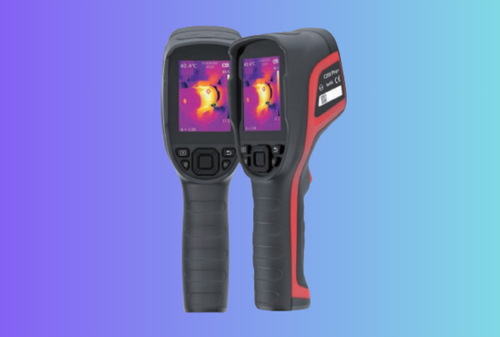
In this article, a handheld industrial thermal camera is:
- A portable, battery-powered device used by technicians on inspection routes
- Built around an uncooled infrared detector (e.g. 160×120 to 640×512)
- Designed to survive plant environments: IP-rated housing, drop resistance, glove-friendly controls
These cameras are used for route-based infrared thermography in:
- Electrical maintenance of panels, MCCs, switchgear, and transformers
- Mechanical checks on motors, pumps, gearboxes, and conveyors
- Energy-loss surveys on insulation, steam, HVAC, and building envelopes
From a product perspective, you can either buy finished instruments (for example, industrial handheld thermal imagers from a China OEM/ODM supplier), or build your own around thermal imaging modules.
2.2 Online thermal imaging system
An online thermal imaging system uses one or more fixed industrial thermal imaging cameras looking at the same asset 24/7. Each camera is:
- Mounted in a permanent location, often in an industrial enclosure
- Connected to software that continuously records temperature fields
- Integrated with PLC/SCADA or IIoT platforms for alarms and control
Vendors and case studies describe fixed thermal imaging systems as non-contact tools for continuous monitoring, trending, and process control in kilns, furnaces, conveyors, and high-voltage switchgear.
Gemin’s own online thermal monitoring systems are examples of this category, built on the same detector physics as handheld cameras but hardened for 24/7 operation and industrial networking.
The key point: handheld and fixed systems share the same thermal “eyes”; they differ in how often they look and how their data is used.
3. How handheld and online thermal imaging behave differently
From the outside, both types of industrial thermal camera produce colourful images. Under the hood, their roles in your reliability strategy are very different.
3.1 Sampling versus continuous observation
A handheld thermography route is a sampling process. A technician visits assets weekly, monthly, or quarterly. Each inspection captures a snapshot of the thermal state at that moment. Reliability literature describes this as route-based condition monitoring: powerful, but still dependent on human schedules.
An online thermal imaging system, by contrast, observes continuously. It captures images or temperature matrices every few seconds and can trigger alarms whenever thresholds or trend criteria are breached. For fast-moving failure modes or fire risk, that difference is critical. Continuous thermal monitoring vendors highlight benefits such as:
- Reduced electrical fire and explosion risk from arc-flash conditions
- Increased uptime through early detection of hot spots
- Less human exposure to live equipment because alarms arrive before manual checks are needed
3.2 Physics of failure: where does time really matter?
Think about the heat equation for a moment. Temperature in equipment rises with:
- Power dissipation (e.g. I²R losses, mechanical friction, exothermic reactions)
- Thermal resistance to the environment, including insulation and airflow
- Thermal capacity of the component and surrounding materials
Failures like loose electrical terminations can escalate from “warm” to “dangerously hot” in hours or days, especially under load swings. Kiln refractory failures or conveyor belt friction can heat up in minutes. For those assets, missing a single rapid excursion has consequences that handheld cameras can’t mitigate.
On the other hand, slow-developing issues—gradual insulation degradation, poor building envelope performance, slowly rising bearing temperatures—change over weeks or months. Here, periodic handheld surveys are fully adequate.
Industrial thermal camera strategy should therefore be driven by the time-constant of failure modes, not by how much you like gadgets.
3.3 Human cognition versus algorithmic vigilance
A handheld inspection leverages human pattern recognition. Skilled thermographers can spot subtle anomalies by comparing assets in context, applying knowledge of load, ambient conditions, and emissivity. This is one reason infrared thermography remains one of the most effective condition-monitoring modalities.
Online systems, in contrast, apply simple but relentless algorithms:
- Threshold alarms on maximum or average temperature in regions of interest
- Rate-of-change triggers that flag rapid heating
- Pattern-based rules for process profiles (e.g. kiln shell temperature bands)
They do not replace human judgment, but they screen for events that deserve human attention. Budget-wise, you pay more up front for fixed systems so that you can free skilled people from constant manual vigilance.
4. Where handheld industrial thermal cameras create the most value
Before you spend on sophisticated automation, you need a solid base of handheld capability.
4.1 Broad asset coverage at low marginal cost
A single handheld industrial thermal camera can cover hundreds or thousands of assets in one plant: electrical cabinets, drives, pumps, valves, steam traps, and structural elements. Thermography guides note that one of its strengths is rapid, non-contact screening of many components in a single route.
That makes handheld devices ideal for:
- Building your first predictive maintenance program
- Establishing a baseline risk map
- Supporting energy audits and ISO 50001 initiatives
In terms of pure physics, many issues you care about—like poor insulation or lightly loaded motors—change slowly enough that periodic snapshots are sufficient.
4.2 Diagnostic depth and root cause analysis
When SCADA alarms, vibration sensors, or operators report strange behaviour, a technician with a handheld industrial thermal imaging camera can quickly narrow down root causes:
- Differentiating between electrical overload and mechanical friction
- Identifying whether a temperature rise comes from a single bearing or a systemic coolant issue
- Checking nearby components that fixed cameras do not see
This diagnostic agility is hard to replicate with fixed systems. Handheld devices let you “walk the physics”: follow heat upstream or downstream until the anomaly pattern makes sense.
4.3 Training and organisational learning
Handheld cameras are also training tools. Maintenance and reliability engineers learn to connect IR images with real failure modes and process behaviour. External training programmes and IR thermography courses emphasise that building internal competence is as important as hardware selection.
Once your team speaks “thermal” fluently, they are much better positioned to specify where online monitoring will pay off.
5. Where online industrial thermal imaging systems justify their cost
Fixed industrial thermal imaging camera systems are more expensive per asset. To make the physics and the finance align, you deploy them where time, safety, and product quality are unforgiving.
5.1 High-voltage switchgear and critical electrical assets
Continuous temperature monitoring of switchgear is increasingly recognised as a best practice. Fibre optic and infrared-based solutions provide real-time hotspot detection at critical contact points, reducing arc-flash risk and improving uptime.
A fixed system can:
- Watch busbars and connectors that cannot easily be accessed by handheld cameras during operation
- Trigger alarms long before insulation damage turns into a fault
- Reduce the need for open-door inspections and associated safety risk
Here, the thermodynamic time constant is short and the consequence of failure is high—ideal territory for online monitoring.
5.2 Kilns, furnaces, and thermal processes
Rotary kilns, reheating furnaces, incinerators, and boilers operate near material limits. Uneven shell temperature, refractory damage, or burner imbalance can rapidly degrade product quality or cause serious damage. Fixed thermal systems are used to monitor such processes, providing real-time radiometric images and alarm logic.
A handheld camera is still valuable for commissioning and local troubleshooting, but it cannot supply continuous shell temperature profiles or feed automatic control loops. Fixed cameras shine here because they close the loop between heat patterns and process control.
5.3 Long conveyors and critical bearings
Conveyor belt fires often start with overheating idlers, misaligned belts, or friction in buried rollers. Thermal imaging can detect these hot spots early, but only if you happen to be looking when they occur.
Fixed industrial thermal imaging cameras mounted along critical conveyors can:
- Scan rollers and belt surfaces continuously
- Raise alarms when any pixel in a zone exceeds safe thresholds
- Provide historical data for understanding load-related heating patterns
The same logic applies to large, critical bearings or couplings in rotary equipment where failure would stop an entire line.
5.4 Remote or unmanned assets
As utilities and process industries digitise, more substations, pumping stations, and renewable assets operate with minimal local staff. Here, an online industrial thermal camera acts as a remote sensor feeding condition-based maintenance platforms. Condition-based maintenance definitions stress the importance of real-time monitoring for assets that are hard to reach and critical to system performance.
If dispatching a technician is expensive or slow, a fixed camera plus connectivity is often cheaper over the life of the asset than purely route-based checks.
6. A physics-informed framework for splitting your budget
Instead of arguing from opinion, you can apply a simple, physics-grounded model to split your industrial thermal camera budget.
6.1 Classify assets by failure energy and time
For each asset, estimate two factors:
- Stored or passing energy – electrical power level, mechanical power, thermal content
- Failure time-scale – how quickly a dangerous or damaging temperature rise can occur
Assets with high energy and short time-scales (HV switchgear, kilns, large conveyors) move to the online monitoring candidate list. Low-energy, slow-changing items (small motors, building envelope) stay in the handheld-only list.
This classification lines up with evidence that thermography and continuous monitoring are most valuable where early identification of weaknesses prevents catastrophic failures and reduces downtime.
6.2 Quantify inspection frequency versus risk
Next, simulate your route coverage:
- If a handheld inspection is monthly, the maximum time-to-detection of a new anomaly is ~30 days.
- If your risk analysis says a dangerous condition could develop in 12 hours, route-based thermography alone is clearly insufficient.
Condition-monitoring providers emphasise that the goal is to detect all faults early enough to avoid failure. Use that principle: if the worst credible fault could reach a critical temperature before the next round, the asset goes into the online monitoring bucket.
6.3 Start with a 70/30 rule-of-thumb
For most plants starting from zero:
- Allocate roughly 70% of your first-year thermography budget to handheld industrial thermal cameras, training, and route development.
- Allocate the remaining 30% to pilot online thermal imaging on the top 5–10% of assets by risk and time-constant.
This reflects the fact that, statistically, broad predictive maintenance programs using route-based thermography already deliver significant cost and downtime reductions.
Over time, as you prove the value of fixed systems on those pilot assets, you can rebalance toward a 50/50 mix for sites where process criticality justifies it.
6.4 Bake in learning and feedback
Every anomaly you catch with a handheld industrial thermal imaging camera should trigger a question:
“If this fault had grown faster, would we have wanted a fixed camera here?”
Conversely, every alarm from a fixed system should prompt a check:
“Could we have seen this in a cheaper way with better routing or sensors?”
This feedback loop keeps your budget aligned with real physics and failure behaviour, not with the shifting marketing of camera vendors.
7. OEM/ODM view: designing an industrial thermal camera portfolio
If you are a brand owner or integrator working with a China industrial thermal camera manufacturer, this framework also tells you how to structure your product line.
7.1 Shared thermal core, multiple form factors
At the heart of both handheld and fixed systems is the same physics: an uncooled infrared detector plus optics. By building on common thermal imaging modules, you can offer:
- Handheld industrial thermal cameras for route-based inspections
- Fixed industrial thermal imaging cameras in enclosures for kilns, conveyors, and switchgear
- Smart-sensor nodes connected to online thermal monitoring systems
Shared cores simplify calibration, firmware maintenance, and spare parts.
7.2 Segmenting by application, not only by resolution
Instead of marketing three resolutions of a generic camera, design bundles that follow the risk-based logic above:
- “Electrical reliability kit”: handheld industrial thermal camera plus optional fixed switchgear sensors
- “Kiln and furnace kit”: high-temperature fixed imagers with handheld units for commissioning and refractory checks
- “Conveyor safety kit”: narrow-FOV fixed cameras plus one handheld imager for diagnosis
This approach naturally leads to offerings that mirror how predictive maintenance programs and continuous thermal monitoring are described in the literature: route-based plus fixed-point modalities working together.
7.3 China industrial thermal imaging camera manufacturer considerations
When selecting a Chinese industrial thermal camera factory for OEM/ODM work, look beyond BOM pricing:
- Expertise with both handheld and fixed systems
- Ability to integrate industrial protocols and cybersecurity best practices
- Willingness to support long-term product lifecycles and customisation
Partners like Gemin Optics, who supply industrial handheld thermal imagers and online thermal monitoring systems built on shared cores, make it easier to execute a coherent strategy instead of a scattered catalogue.
8. FAQs: handheld industrial thermal camera vs online thermal imaging system
Q1. If budget is tight, can we start with handheld cameras only?
Yes. For many plants, a well-planned handheld industrial thermal camera program delivers the fastest initial ROI. Start with the assets where thermography has the clearest track record—electrical panels, motors, steam lines—and build routes, templates, and reporting practices. As your data grows, you will see where continuous monitoring would clearly have added value.
Q2. How do we decide which assets deserve fixed cameras first?
Look for the combination of high energy, short failure time-scale, and high consequence:
- HV and MV switchgear feeding critical loads
- Kilns, furnaces, and dryers operating near material limits
- Long conveyors where a fire would be catastrophic
Continuous thermal monitoring applications and switchgear hot-spot monitoring guidelines consistently highlight these as early adopters.
Q3. How do thermal imaging benefits compare to other condition-monitoring tools?
Thermography is complementary to vibration, ultrasound, and oil analysis. Reviews of condition-monitoring modalities note that infrared thermography is particularly strong for electrical and thermal problems, while vibration excels at mechanical dynamics. A well-designed program combines multiple sensors, using IR as the “heat map” that shows where energy is being wasted or where failure mechanisms are producing excess heat.
Q4. Are there risks of over-relying on continuous monitoring?
Yes. Fixed systems only see what their optics can see. If an unexpected failure occurs outside the field of view, you will still miss it. That’s why route-based inspections with handheld industrial thermal imaging cameras remain essential. Continuous monitoring should reduce blind spots on the most critical and fast-moving risks, not replace human-led surveys everywhere.
Q5. Can we retrofit online cameras to existing assets without major redesign?
In many cases, yes. Fixed industrial thermal imaging cameras and fibre optic temperature sensors are designed for retrofit—installed through windows, on existing structures, or in add-on enclosures. Case studies from electrical and process industries show successful retrofits on switchgear, busways, kilns, and furnaces without major downtime.
9. Work with a China industrial thermal camera manufacturer you can trust
The real message of this article is simple:
- Handheld industrial thermal cameras give you breadth—broad coverage, fast diagnostics, and a way to train your team to see heat as data.
- Online industrial thermal imaging systems give you depth—continuous vigilance on the few assets where physics and risk demand it.
A good budget split respects both the thermodynamics of failure and the economics of your plant.
As a China-based industrial thermal camera manufacturer and OEM/ODM supplier, Gemin Optics is set up to help you execute that strategy, not just sell isolated products. You can:
- Build custom solutions around shared thermal imaging modules
- Private-label industrial handheld thermal imagers for your predictive maintenance and energy-audit offerings
- Integrate online thermal monitoring systems into critical assets where continuous protection is essential
If you are planning your next industrial thermal camera investment or OEM/ODM roadmap:
Contact the Gemin Optics team to discuss your asset mix, risk profile, and budget split.
Share your key applications—electrical, mechanical, or process—and we’ll help you design an industrial thermal imaging strategy that aligns physics, reliability, and finance instead of leaving them to chance.