Industrial maintenance teams are under pressure everywhere: fewer technicians, more assets, tighter shutdown windows, and stricter safety rules. In that environment, the industrial thermal camera and industrial infrared camera are no longer “nice-to-have gadgets” – they are core tools for keeping plants running and routes under control.
Table of Contents
ToggleFor OEM/ODM buyers and brand owners, the naming can be confusing. Some vendors say industrial thermal camera, others say industrial infrared camera or simply industrial IR camera. Meanwhile, you still have to choose a China factory, define specs, and prove that the investment will actually shorten inspection routes and reduce downtime.
This article is written from the perspective of a China-based industrial thermal camera manufacturer and OEM/ODM supplier. It shows how to think about specifications, route design, and supplier selection – and how Gemin Optics can support you with both devices and thermal imaging modules for deeper integration.
1. Why Industrial IR Cameras Are Reshaping Inspection Routes
1.1 The traditional inspection route problem
In many plants, inspection routes still look like this:
- A technician walks a fixed loop with a clipboard or tablet.
- They open panels, aim a spot IR thermometer, write down readings.
- They try to remember last month’s numbers and decide whether to worry.
This approach has several problems:
- Slow coverage – One person might only cover a fraction of switchgear rooms, MCCs, motors, bearings, and process lines in a shift.
- Human variation – Different technicians measure different spots at slightly different distances and angles.
- Safety exposure – Opening energized panels, climbing ladders, or entering hot zones just to “take a look”.
- Low data density – A handful of point temperatures per asset gives a very incomplete picture.
Standards such as ISO 18434 explicitly recommend infrared thermography as a key tool for condition monitoring, because thermal patterns often reveal faults earlier than vibration, noise, or visible inspection.
1.2 What changes when you add an industrial thermal camera
When you deploy a modern industrial IR camera – handheld or fixed – the route changes:
- A handheld industrial thermal camera captures a full temperature map of the asset in one shot, not just a single point.
- A fixed industrial infrared camera watches critical assets continuously and only alerts when a threshold or trend is exceeded.
Typical impact on inspection routes:
- Fewer stops per route – One image covers several connection points, busbars, or bearings at once.
- Less time in hazardous locations – Technicians can scan from a safer distance through IR windows or view live feeds from an online thermal system.
- Route-by-exception – When industrial IR cameras are integrated with software, routes become “visit only the red and amber alarms”, not “walk every asset every month”.
For B2B buyers, the question is not “thermal vs non-thermal”. It is how to specify an industrial thermal camera China manufacturer or Chinese industrial IR camera factory so that your devices really shorten routes – instead of becoming expensive toys.
2. What Is an Industrial Thermal Camera (vs Industrial Infrared Camera)?
2.1 Thermal imaging in plain language
Every object above absolute zero emits infrared radiation. A thermal imaging camera uses a special detector – typically an uncooled microbolometer – to measure that radiation and convert it into a temperature image.
Key points in simple terms:
- The detector sees in the long-wave infrared (LWIR) band, roughly 8–14 µm, where thermal emissions from room-temperature objects are strongest.
- Each pixel represents a tiny patch of the scene; higher resolution means more detail and more precise location of hot spots.
- The camera electronics and firmware convert raw detector data into a false-color thermal image and, in many models, calibrated temperature values.
When you buy an industrial thermal camera OEM/ODM solution, you are essentially buying this combination: detector + optics + electronics + firmware + mechanical housing + connectivity.
2.2 Industrial thermal camera vs industrial infrared camera vs industrial IR camera
In everyday industrial language, these terms are often used interchangeably:
- Industrial thermal camera – usually an LWIR camera optimized for temperature measurement and condition monitoring.
- Industrial infrared camera – sometimes the same as thermal, but may also refer to near-IR or SWIR imaging that sees reflected light, not temperature.
- Industrial IR camera – a shorthand that can mean either of the above.
For B2B buyers, the naming is less important than the spec sheet. The critical questions are:
- What spectral band is the camera sensitive to? (LWIR 8–14 µm for thermography, or a different band for special tasks?)
- Is the camera radiometric – i.e., can it measure temperature accurately, or just display relative contrast?
- Is it designed as a general-purpose industrial thermal imaging camera, or is it essentially a vision camera with near-IR sensitivity?
In most route-based maintenance and online monitoring projects, you want a radiometric LWIR industrial thermal camera.
2.3 Handheld vs fixed industrial IR cameras
From an inspection-route perspective, two main form factors matter:
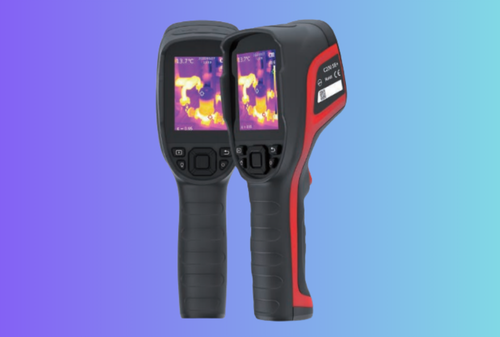
- Handheld industrial thermal camera
- Used by technicians walking inspection routes.
- Best for mixed environments and assets that cannot be monitored continuously (mobile equipment, remote sites, low-risk assets).
- Typical specs: 160×120 to 640×480/512 resolution, temperature range from around –20 °C up to 550 °C or higher, depending on model.
- Fixed / online industrial infrared camera
- Mounted permanently above critical assets (busbars, kilns, conveyors, flare stacks).
- Streams continuous data into SCADA, DCS, or a dedicated monitoring system.
- Used to trigger alarms, trend data, and replace routine “walk-by” inspections with route-by-exception.
A simple way to think about their roles:
| Term | Typical meaning | Typical band | Example use case |
|---|---|---|---|
| Industrial thermal camera | Radiometric LWIR camera for temperature imaging | 8–14 µm (LWIR) | Switchgear, motors, process lines |
| Industrial infrared camera | Thermal camera or other IR camera (NIR/SWIR) depending on vendor | Varies (NIR–LWIR) | Thermal or special imaging (e.g., gas detection) |
| Industrial IR camera | Shorthand for either of the above; check spec sheet | Varies | General marketing term |
| Online industrial IR camera | Fixed / networked camera for continuous industrial monitoring | Usually LWIR | 24/7 monitoring, alarms, route-by-exception |
When you brief a China industrial infrared camera supplier, always clarify your required spectral band and radiometric function, not just the marketing term.
3. Key Specs and Design Choices for Industrial Thermal Cameras
3.1 Detector resolution and pixel pitch
Resolution is one of the first numbers OEM buyers look at. Common resolutions for industrial thermal cameras include:
- 160×120 or 192×144 – entry-level inspection tools.
- 256×192 or 320×240 – mid-range for general maintenance.
- 384×288 or 640×480/512 – higher-end cameras for complex or long-distance tasks.
Higher resolution supports shorter inspection routes because:
- Each frame covers more equipment at a given distance.
- You can scan overhead busbars or transmission components from the ground instead of climbing platforms.
- You can keep a safe distance from hot or live equipment while still resolving small connectors or hotspots.
Pixel pitch (e.g. 12 µm vs 17 µm) also matters. A smaller pixel pitch at the same lens focal length gives tighter angular resolution, which can further reduce the number of vantage points per route.
3.2 NETD and temperature performance
NETD (Noise Equivalent Temperature Difference) describes how small a temperature difference the camera can resolve. High-end industrial thermal imaging cameras often achieve NETD values below 40 mK, and premium modules can reach below 30 mK.
For inspection routes, this matters because:
- Better NETD lets technicians spot subtle temperature rises in early fault stages (slightly overloaded cable, misaligned bearing).
- Early detection means interventions can be bundled and scheduled, reducing emergency call-outs and rush routes.
You also need to match the temperature range to your assets:
- General electrical and mechanical maintenance: –20 °C to 250/350 °C is often enough.
- Furnaces, kilns, and casting: ranges up to 550–1,000+ °C are common.
A good industrial thermal camera OEM supplier in China will offer multiple ranges (or switchable ranges) so you can use the same platform across different industries.
3.3 Optics, FOV, and working distance
Optics are where route length and safety are often won or lost.
Key concepts:
- Field of View (FOV) – Wide FOV (e.g. 45°–60°) covers more area at close range; narrow FOV (e.g. 6°–15°) gives you more detail at long distance.
- Instantaneous FOV (IFOV) – The angular size of a single pixel; determines how small an object you can resolve at a given distance.
How optics choices affect routes:
- For switchgear rooms, a moderate FOV (24°–40°) lets a technician capture entire panels from a comfortable distance, reducing steps and repositioning.
- For overhead busbars or outdoor lines, a narrow FOV telephoto lens allows scanning from safe ground-level positions instead of walking catwalks.
- For online industrial IR cameras, different FOV options allow one camera to monitor several lanes of a conveyor or multiple furnace zones, reducing the number of cameras – and future manual checks.
When you work with a Chinese industrial IR camera factory, ask for lens options tied to your inspection distances and target sizes, not just a generic “wide” or “tele” description.
3.4 Industrial housing, ingress protection, and certifications
Industrial thermal cameras must survive real-world abuse:
- Dust, oil mist, and moisture in process plants.
- Temperature swings near furnaces or outdoor installations.
- Shock and vibration on moving equipment or mobile platforms.
Key requirements OEM buyers should consider:
- Ingress protection – IP54 or higher for handhelds; IP66/67 for many fixed outdoor cameras.
- Mechanical robustness – Drop tests (e.g. 2 m), vibration resistance, and reliable connectors.
- Regulatory compliance – CE, FCC, RoHS, and where applicable ATEX/IECEx for hazardous areas.
These aren’t just paperwork. Clear IP and certification ratings let your end users deploy industrial thermal cameras without constant re-qualification, and they reduce the risk that route redesign projects get blocked by HSE teams.
3.5 Data, connectivity, and software integration
An industrial infrared camera that only stores images on an SD card is no longer enough. To shorten inspection routes, you need data that flows into existing systems.
Useful features include:
- Standard interfaces – Ethernet, Wi-Fi, Modbus/TCP, OPC UA, or industrial protocols to connect with SCADA and DCS systems.
- Tagging and route management – For handheld industrial thermal cameras, the ability to organize images by asset ID, route, or line.
- Trend and threshold analytics – Software that can track temperature over time and flag deviations, in line with condition-monitoring practices such as ISO 18434.
In fixed installations, online industrial IR cameras effectively replace walking routes with dashboards and alarm lists. Technicians are dispatched only when:
- A zone reaches a pre-defined alarm threshold.
- A trend curve shows abnormal heating rate.
- A pattern appears inconsistent with historical thermograms.
3.6 Working from modules: thermal imaging and rangefinding
Many OEMs and system integrators prefer to build their own housings and software while sourcing thermal imaging modules or laser rangefinder modules from a specialist China supplier.
In that case, you might:
- Use thermal imaging modules as the core of your own industrial thermal camera platform, adapting optics and firmware for specific verticals.
- Add laser rangefinder modules when precise distance or height measurement is needed (e.g. flare stacks, tank levels, clearances).
This module-first approach lets you create differentiated industrial IR camera products for your own brand, while still benefiting from a mature China manufacturer’s calibration, compliance, and production system.
4. Industrial IR Camera Use Cases: Where Shorter Routes Really Matter
4.1 Power distribution and switchgear
Electrical distribution has always been one of the strongest use cases for industrial thermography. Guidelines for thermographic inspection of electrical systems highlight how abnormal heat often precedes failure.
Traditional route:
- Open panel doors (if allowed), visually inspect, and measure selected points with a contact thermometer or spot IR gun.
- Repeat annually or quarterly, often during short shutdown windows.
With handheld industrial thermal cameras:
- Scan the panel with the door closed through IR windows.
- Capture a full thermal image of all connections, breakers, and busbars.
- Tag and store thermograms by panel ID and route.
With fixed industrial infrared cameras:
- Install cameras to view critical busbars, joints, or breaker clusters.
- Set thresholds and alarm profiles for normal load variation.
- Let the system flag anomalies; technicians only visit flagged panels.
Result: fewer open-panel operations, fewer ladder climbs, and a shift from calendar-based to condition-based inspection routes.
4.2 Petrochemical plants and refineries
In petrochemical environments, industrial IR cameras help in several areas:
- Monitoring uneven heating in reactors, towers, and heat exchangers.
- Watching hot flanges, valves, and piping for insulation damage.
- Supporting flare-stack observation and – in specialized systems – optical gas imaging.
Here, shortening inspection routes is not only about efficiency but also about exposure time in hazardous zones:
- Fixed industrial thermal cameras installed near process equipment reduce the number of manual rounds inside process units.
- Handheld cameras with telephoto lenses allow technicians to inspect elevated structures from safe platforms.
An industrial thermal camera China manufacturer should be able to offer:
- High-temperature ranges suitable for process equipment.
- Housings that integrate with purged or explosion-proof enclosures where needed.
- Documentation to support plant safety and compliance teams.
4.3 Motors, bearings, and mechanical drives
For rotating equipment, ISO 18434 specifically calls out thermography as a useful condition-monitoring technique
Old approach:
- A technician with a vibration analyzer and a notebook or tablet visits each motor monthly.
- Only obvious hot spots are detected visually.
With industrial thermal cameras:
- A handheld industrial thermal camera quickly scans bearing housings, couplings, and motor bodies.
- Abnormal heating patterns – e.g. one bearing running hotter than its neighbor – stand out immediately.
- Data from online industrial IR cameras on critical machines can be trended to detect slow deterioration.
Route impact:
- Fewer stops on healthy assets; more time allocated to problematic ones.
- Clear “go/no-go” criteria based on temperature patterns, not just technician intuition.
- For plants with many similar machines, copy-paste alarm settings and route templates streamline work.
4.4 Kilns, furnaces, and high-temperature processes
In cement, steel, glass, and ceramics, thermal cameras have long been used to monitor:
- Refractory condition in rotating kilns and furnaces.
- Temperature distribution on shells and casings.
- Burner performance and flame patterns (with specialized IR systems).
With online industrial IR cameras, plants can:
- Map hot zones continuously and adjust burners or feed in real time.
- Detect refractory failure early before a catastrophic breakout.
- Reduce frequent manual checks with handhelds, keeping personnel away from extreme heat.
Instead of walking long furnace lines with handheld tools, technicians may only be dispatched when thermal maps show unusual behavior.
4.5 Buildings, logistics hubs, and data centers
Beyond heavy industry, industrial thermal cameras play a growing role in:
- Detecting building envelope leaks, roof moisture, and insulation defects.
- Finding overloaded connections and hotspots in data center switchgear and busways.
- Inspecting dock doors, cold rooms, and refrigerated logistics for thermal leakage.
For data centers in particular, early detection of hot spots in power distribution is critical. Thermal imaging is widely recommended for such tasks in condition-monitoring references.
Shorter routes come from:
- Scanning entire rows of cabinets quickly with a mid- or high-resolution industrial thermal camera.
- Using fixed cameras to watch the most critical UPS rooms 24/7.
- Generating exception reports that route technicians directly to problematic racks.
5. How to Choose a China Industrial Thermal Camera Factory / OEM Supplier
Choosing a China industrial thermal camera manufacturer or industrial infrared camera OEM supplier is not only about the price list. It is about whether your partner can help you deliver shorter, safer, and more predictable routes for your end users.
5.1 Engineering capability and customization
A serious industrial IR camera OEM/ODM supplier in China should offer:
- In-house thermal imaging module design – so they can adjust NETD, frame rate, interfaces, and optics to your use case.
- Custom optics – different FOVs and focal lengths for power lines, switchgear rooms, or furnace walls.
- Mechanical customization – housings tailored to your brand, with appropriate IP ratings and mounting options.
- Firmware and SDK support – clear APIs, industrial protocols, and sample code to integrate into your own platforms.
Ask for real project examples and reference designs, not just a catalog.
5.2 Quality control, calibration, and testing
Temperature accuracy and repeatability are central to condition-based maintenance. A strong China manufacturer will:
- Calibrate cameras against traceable blackbody sources.
- Provide documented accuracy specs across ambient and target temperature ranges.
- Run thermal cycling, vibration, and aging tests representative of real industrial environments.
Look for alignment with condition-monitoring practices such as ISO 18434 and industry best-practice guidelines for thermographic inspections.
From a practical B2B angle, you want:
- Stable batch-to-batch performance for fleet deployments.
- Clear acceptance-test procedures that your own engineers can repeat.
- Transparent PCN/ECO processes when components change.
5.3 Certifications, documentation, and standards alignment
For global deployment, an industrial infrared camera supplier should be comfortable with:
- Electrical & EMC: CE, FCC, and local variants where needed.
- Environmental & safety: RoHS, REACH, and, for hazardous locations, ATEX or IECEx cooperation via enclosure partners.
- Laser safety (if cameras integrate rangefinders): alignment with IEC 60825-1 for Class 1 / 1M laser products.
Beyond markings on the label, look for:
- Complete declaration of conformity packs.
- Drawings and 3D models for mechanical integration.
- English documentation appropriate for your distributors and integrators.
5.4 Delivery lead time, MOQ, and lifecycle support
Industrial projects run on schedules and long lifecycles. A capable industrial thermal camera China factory will:
- Support realistic sample MOQs – e.g. 5–20 units – so your team can run pilots and demo programs.
- Commit to defined lead times for volume orders, with clear bottlenecks and mitigation plans.
- Offer product lifecycle roadmaps, including last-time buy policies and compatible successors.
For brand owners, this stability is more important than chasing the very lowest FOB price. A predictable lifecycle lets you standardize your route-based services and support packages.
5.5 After-sales support and OEM collaboration
Finally, look at how the supplier works after shipment:
- Do they offer root-cause analysis and failure reporting?
- Can they support your local partners with technical training (online or on-site)?
- Are they willing to co-develop route templates, acceptance-test scripts, or training materials under your brand?
The best industrial IR camera OEM suppliers behave like engineering partners, not only exporters. This is especially important if you also use their industrial handheld thermal imagers in your service offerings.
6. Gemin Optics as Your Industrial Thermal Camera OEM/ODM Partner
6.1 China-based design and manufacturing
Gemin Optics is a China-based designer and manufacturer of thermal imaging modules, laser rangefinder modules, and complete thermal devices, serving OEM/ODM partners worldwide.
From an industrial thermography perspective, this matters because:
- We control the thermal camera module platform – including detector selection, optics, ISP, and SDK – so we can adapt it to industrial inspection and online monitoring.
- We understand how modules flow into handheld industrial thermal cameras, fixed systems, and multi-sensor devices that combine imaging with ranging.
- We build for long-term B2B relationships, with a focus on repeatable quality and predictable lead times.
6.2 From modules to devices: building your industrial IR portfolio
Depending on your role – brand owner, system integrator, or distributor – you can work with Gemin Optics at different levels:
- Use our thermal imaging modules as the building blocks for your own industrial thermal camera lines, choosing resolutions, NETD levels, and interfaces that match your routes and targets.
- Pair them with laser rangefinder modules when you need precise distance data alongside thermal imaging – for example, measuring line sag, target height, or stand-off distance in hazardous areas.
- Deploy our industrial handheld thermal imagers under your own brand, tuned for power, petrochemical, manufacturing, or building inspection routes.
Because the same core platforms support both modules and finished devices, you can standardize:
- Training material for your service teams.
- Route templates and alarm criteria.
- Spare parts and repair procedures across multiple product families.
6.3 Typical OEM/ODM project workflow
A typical industrial thermal camera OEM project with Gemin Optics follows a structured path:
- Application and route analysis
- Define assets, temperature ranges, distances, and safety constraints.
- Decide where handheld vs online industrial IR cameras make the most impact on route length and downtime.
- Spec and platform selection
- Choose detector resolution, NETD, FOV, frame rate, and connectivity.
- Select module-level or device-level platforms depending on your integration needs.
- Prototype and pilot deployment
- Build prototypes for real-world trials on actual routes.
- Collect thermograms, route timing, and user feedback from technicians.
- Optimization and industrialization
- Refine optics, UI, and alarms based on pilot data.
- Finalize calibration procedures and acceptance tests.
- Ramp-up and lifecycle support
- Move to volume production with clear QA checkpoints.
- Maintain ongoing support, firmware updates, and lifecycle guidance.
Throughout this process, you work with a Chinese industrial IR camera manufacturer that understands both the device-level engineering and the realities of inspection routes in power plants, factories, and logistics hubs.
7. Work with a China Industrial Thermal Camera Manufacturer You Can Trust
If you are planning an industrial thermography program – handheld, online, or a mix – the choice of industrial thermal camera platform and industrial infrared camera OEM supplier in China will directly affect your inspection routes, safety records, and maintenance costs.
Gemin Optics combines thermal imaging modules, industrial handheld thermal cameras, and OEM-ready designs into a portfolio optimized for B2B partners. As a China-based manufacturer and supplier, we focus on engineering support, stable quality, and realistic pricing that supports long-term, route-based services rather than one-off gadget sales.
If you:
- Manage global maintenance or inspection services,
- Need private-label industrial IR cameras for your brand, or
- Integrate thermal imaging into your own systems and dashboards,
we’re ready to help.
Contact our team to discuss your industrial thermal camera project. Tell us about your application, temperature ranges, working distances, preferred form factor, and annual quantities, and we’ll propose an OEM/ODM roadmap that shortens inspection routes and de-risks your deployment.
Or, if you already have a draft RFQ for an industrial IR camera OEM program, you can submit your OEM/ODM requirements here so we can review your specs and suggest the most suitable module and device combinations.