Industrial maintenance teams are being asked to do more with less: more critical assets, tighter NFPA 70B obligations, and tougher uptime targets, often with the same headcount and shrinking outage windows. In that reality, an industrial thermal imager is no longer a “nice-to-have gadget”. It is one of the most powerful tools you can put in a maintenance manager’s hands for condition-based maintenance and safety.
Table of Contents
ToggleBut choosing the right device — and the right industrial thermal imager China manufacturer or OEM supplier — is not trivial. Resolution, NETD, FOV, temperature range, IP rating, software, and calibration all affect whether the camera truly supports your preventive maintenance program or ends up locked in a drawer.
This article provides a practical industrial thermal imager buying checklist for maintenance managers, with a strong focus on B2B implementation. We’ll also clarify how the terms industrial thermal imager, industrial thermal camera, and industrial infrared camera are used, and how they map into standards such as ISO 18434 and NFPA 70B.
1. Why a Structured Checklist Matters
1.1 Thermography has moved from “nice to have” to “must have”
Infrared thermography is now widely recognized as a core technique for condition monitoring and diagnostics of machinery, not just an optional add-on. The ISO 18434 series provides specific guidance for using infrared thermography as part of a condition monitoring program for machine systems.
On the electrical side, the 2023 edition of NFPA 70B has turned what used to be “recommended” practice into a consensus standard:
- Electrical equipment must be inspected at intervals not exceeding 12 months, with some risk categories requiring even more frequent thermographic inspections.
For a maintenance manager, that means:
- You will have to perform regular thermographic inspections.
- You need an industrial thermal imager that can stand up to daily use and produce reliable, defensible data.
- Your choice of industrial thermal camera OEM supplier affects safety, uptime, and compliance.
1.2 A camera that fits your plant, not just the brochure
Many maintenance teams buy a camera based on one or two headline specs — usually resolution and price — and then discover:
- The FOV is too narrow for cramped MCC rooms.
- The battery life cannot cover a full inspection route.
- The software does not support ISO-/NFPA-aligned reporting requirements.
A structured buying checklist helps you:
- Match the industrial thermal imager to your actual routes and assets.
- Avoid surprises when you start working under NFPA 70B or ISO 18434 frameworks.
- Build a stronger case for investment with your finance and HSE teams.
The rest of this article is organized as a step-by-step checklist you can adapt into your own RFQs.
2. Industrial Thermal Imager vs Industrial Thermal Camera vs Industrial Infrared Camera
2.1 Basic principles in plain language
Every object above absolute zero emits infrared radiation. Thermal imagers measure this radiation and convert it into a visible image and, in many cases, calibrated temperature values.
Key points, without jargon:
- An industrial thermal imager uses a detector (typically an uncooled microbolometer) sensitive in the long-wave infrared (LWIR) band around 8–14 μm.
- The detector has many tiny pixels; each pixel corresponds to a small area of your target.
- Electronics and firmware convert the raw signal into a false-color thermal image showing hot and cold spots.
Thermal imaging is powerful in maintenance because a small rise in surface temperature often appears long before a component fails. Industrial guides consistently highlight thermal imaging as a proven way to detect early faults by revealing abnormal hot or cold spots in equipment.
2.2 Terminology: imager vs camera vs IR camera
In practice, you will see all three terms in vendor brochures:
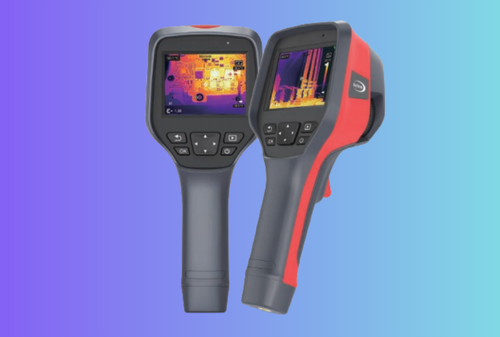
- Industrial thermal imager – Usually emphasizes temperature measurement and inspection work; commonly handheld.
- Industrial thermal camera – Often used for both handheld and fixed systems, especially those integrated with software platforms.
- Industrial infrared camera / industrial IR camera – A more general term; may refer to LWIR thermography devices or to cameras in other IR bands (near-IR, SWIR) used for specialized imaging rather than temperature measurement.
For maintenance managers working under ISO 18434 and NFPA 70B, the critical questions are:
- Does the device operate in the correct spectral band (typically LWIR) for thermography?
- Is it radiometric, i.e., can it measure temperature accurately and consistently?
- Are its accuracy and repeatability adequate for your reporting and decision criteria?
2.3 Handheld imagers vs fixed industrial IR cameras
This checklist focuses mainly on handheld industrial thermal imagers, because they are the tool you give to technicians to execute routes. However, many plants also deploy fixed industrial thermal cameras or online industrial infrared cameras for 24/7 monitoring of critical assets.
A practical strategy is:
- Use handheld imagers for broad route coverage and lower-risk equipment.
- Use fixed industrial IR cameras for high-risk assets, then let those systems generate alarms and shorten your manual routes.
Understanding both options helps you plan a cohesive thermography program instead of piecemeal purchases.
3. Core Imaging Specs: What You Really Need (and What You Don’t)
3.1 Detector resolution
Typical resolutions for industrial thermal imagers include:
- 160 × 120 – Entry level; adequate for close work and small screens.
- 256 × 192 or 320 × 240 – Mid-range; common in newer instruments.
- 384 × 288 or 640 × 480/512 – Higher-end for complex assets and longer distances.
Higher resolution helps maintenance teams:
- See small hot spots on busbars, lugs, and PCB traces.
- Cover larger areas from each vantage point, shortening inspection routes.
- Capture images that remain interpretable after zooming or printing in reports.
However, more pixels also mean more data and potentially higher cost. For many NFPA 70B electrical programs, 320 × 240 is a practical baseline; higher resolutions are valuable when you inspect crowded cabinets, long busways, or small components at a distance.
3.2 NETD and image quality
NETD (Noise Equivalent Temperature Difference) tells you how small a temperature difference the imager can resolve. Lower NETD values (e.g., <40 mK) indicate better sensitivity and cleaner images.
In practice:
- Low NETD reveals subtle thermal anomalies earlier.
- High NETD (noisy images) can obscure minor but important temperature rises.
For route-based maintenance, a target NETD of ≤40 mK at 30 °C is a sensible minimum; more demanding applications (e.g., R&D) may specify ≤30 mK.
3.3 Temperature range and accuracy
Your industrial thermal imager must cover the surface temperatures you actually encounter:
- Electrical switchgear and MCCs – Often from ambient up to 150–200 °C.
- Motors, bearings, pumps – Typically below 120–150 °C under normal operation.
- Furnaces, kilns, process equipment – May exceed 500 °C.
Many industrial imagers offer multiple ranges, for example:
- –20 to 120 °C (low range)
- 0 to 350 °C (general industrial)
- 300 to 650 °C (high-temperature option)
Accuracy is equally important. NFPA 70B emphasizes Delta T (ΔT) — the temperature difference between similar components under similar load and the difference to ambient.
A realistic spec is:
- ±2 °C or ±2% of reading (whichever is greater), under defined conditions.
Do not accept vague claims; insist on documented accuracy and calibration methods.
3.4 Optics and field of view (FOV)
Optics define how the imager “sees” your plant:
- Wide FOV (e.g., 42–60°) – Good for cramped spaces, close-range work, and large surfaces.
- Medium FOV (e.g., 24–32°) – A balanced choice for general maintenance.
- Narrow / telephoto FOV (e.g., 6–15°) – Essential for overhead lines, tall structures, and long distances.
A good industrial thermal camera or industrial infrared camera platform may offer interchangeable lenses so you can tailor FOV to each route. If the camera is fixed-lens, make sure the chosen FOV matches your typical working distances; otherwise, your technicians will spend time repositioning or climbing just to frame images properly.
3.5 Focus system
Focus affects both image quality and route speed:
- Fixed focus – Simple and rugged, but best only for a limited distance range.
- Manual focus – Maximum control; good for experienced thermographers.
- Motorized / autofocus – Speeds up inspections when scanning many targets at varying distances.
Maintenance teams often prefer manual plus one-button autofocus: autofocus for speed, manual tweak for critical measurements.
3.6 Frame rate and image modes
For static inspections, 9 Hz imagers can be sufficient. However, higher frame rates (25–30 Hz) help when:
- Scanning moving equipment (belts, rollers, fast-moving conveyors).
- Inspecting while walking, with less risk of motion blur.
Useful image modes include:
- Full thermal.
- Picture-in-picture or thermal overlay on a visible image.
- Multiple color palettes to highlight specific temperature ranges.
4. Ruggedness, Safety, and Compliance
4.1 Ingress Protection (IP) rating
Maintenance routes often go through dusty, humid, or outdoor environments. The Ingress Protection (IP) code, defined in IEC 60529, classifies protection against solid objects (first digit) and water (second digit).
Examples:
- IP54 – Limited dust protection; protected against splashing water.
- IP65 – Dust-tight; protected against low-pressure water jets.
- IP67 – Dust-tight; protected against temporary immersion.
For general plant use, IP54–IP65 is a practical range for handheld imagers. If your inspection routes include outdoor substations or wash-down areas, consider higher ratings.
4.2 Drop and vibration resistance
An industrial thermal imager should be tested for:
- Drops from typical working heights (e.g., 2 m).
- Vibration tolerance in line with your industry norms.
This isn’t just a durability issue; it is also a budget issue. Cameras that fail after a few accidental drops create unplanned downtime and replacement costs.
4.3 Laser pointer and rangefinder safety
Many imagers include visible laser pointers or even integrated rangefinders. In those cases, verify:
- Compliance with IEC 60825-1, the international standard for laser product safety and classification.
- Clear labeling of laser class (typically Class 1 or 2 for safe use in normal operation).
OSHA and other regulators reference IEC 60825-1 in their guidance for laser hazards, so aligning with this standard simplifies safety documentation.
5. Software, Reporting, and Workflow
5.1 Reporting aligned with NFPA 70B and ISO 18434
The most expensive part of thermography is not the camera; it is the time your people spend collecting, analyzing, and reporting data. NFPA 70B and ISO 18434 both emphasize structured thermographic surveys, recording conditions and interpreting Delta T values.
Your industrial thermal imager and its software should make it easy to:
- Record asset ID, load conditions, and environmental information at the time of inspection.
- Measure and document Delta T between similar components and between components and ambient.
- Generate reports that clearly rank findings by severity and recommended action.
Look for:
- Desktop analysis software with batch processing and customizable templates.
- The ability to export data in open formats (PDF, CSV, images) for CMMS integration.
- Multi-user licensing suitable for a maintenance department, not just one engineer.
5.2 Integration with CMMS and asset management
To avoid isolated “thermography islands”, check whether the imager platform can:
- Export tagged images and results that link to your CMMS assets.
- Integrate via APIs or bulk import/export with systems used in your site (SAP PM, Maximo, Infor, etc.).
Even if this requires some custom work, choosing an industrial thermal camera family with documented, stable data formats will save effort later.
5.3 Training and certification support
Standards and best-practice documents emphasize the need for competent thermographers who understand equipment design and operating conditions, not just camera menus.
Ask whether the manufacturer or supplier can:
- Provide training material aligned with recognized certification schemes.
- Offer application notes for common routes (electrical, mechanical, building).
- Support your internal trainers and procedure authors.
6. Application-Driven Buying Checklist
This section translates the discussion so far into a practical checklist for maintenance managers buying an industrial thermal imager.
6.1 Define your use cases and routes
Start with these questions:
- What assets will we inspect?
- Electrical: switchgear, MCCs, transformers, bus ducts, UPS.
- Mechanical: motors, bearings, pumps, conveyors.
- Process: heaters, furnaces, tanks, kilns.
- Buildings and infrastructure: roofs, walls, loading docks, data centers.
- What standards or internal rules apply?
- NFPA 70B electrical maintenance requirements. TÜV SÜD+1
- ISO 18434-based condition monitoring programs.
- How often will we inspect?
- Annual full-plant survey? Quarterly? Continuous for critical assets?
- Who will use the imager?
- Full-time thermographers, or general technicians?
This defines the baseline for resolution, temperature range, ruggedness, and usability.
6.2 Checklist: core technical specs
For each candidate industrial thermal imager, document:
- Spectral band: LWIR (8–14 μm) for thermography.
- Radiometric: Yes/No.
- Resolution: e.g., 320 × 240, 640 × 480.
- NETD: ≤40 mK preferred for industrial maintenance.
- Temperature ranges: e.g., –20–120 °C, 0–350 °C, 300–650 °C.
- Accuracy: ±2 °C or ±2% (under stated conditions).
- FOV options: standard lens + optional wide/telephoto.
- Focus: fixed, manual, autofocus, or combination.
- Frame rate: 9 Hz vs 25/30 Hz (check local regulations).
If a vendor cannot provide clear, documented specs, treat that as a red flag.
6.3 Checklist: usability and ergonomics
Route efficiency depends heavily on ergonomics:
- Weight and balance – Can a technician carry the imager for a full shift?
- Grip and controls – One-handed operation, large buttons for gloved hands.
- Display – Bright, high-contrast screen; readable outdoors and in dark rooms.
- Battery life – Enough for a full route plus a margin; hot-swappable packs preferred.
- Start-up time – Slow boot times waste minutes on every route.
Ask technicians to participate in trials and provide feedback before you commit to a fleet purchase.
6.4 Checklist: safety and ruggedness
Confirm:
- IP rating suitable for your environment (e.g., IP54 or IP65).
- Drop rating (e.g., 2 m).
- Operating temperature range (e.g., –15 to +50 °C).
- Laser safety compliance with IEC 60825-1 for pointers or rangefinders.
Document these in your risk assessments and standard operating procedures.
6.5 Checklist: software and reporting
Evaluate:
- Supported operating systems (Windows, macOS, web-based).
- Report templates and customization.
- Ability to measure ΔT and apply severity criteria per your interpretation of NFPA 70B and ISO 18434.
- Licensing model (per camera, per seat, or site-wide).
- Data export formats for CMMS and long-term archiving.
6.6 Checklist: lifecycle, calibration, and support
Long-term reliability is critical for maintenance programs:
- Calibration – Interval, method (factory vs field), and cost.
- Warranty – Coverage length and what is excluded.
- Spare parts – Availability of batteries, chargers, cables, and lenses.
- Lifecycle roadmap – Expected years of availability and successor models.
Run a simple total cost of ownership (TCO) estimate over 5–7 years to compare options fairly.
7. Choosing a China Industrial Thermal Imager Manufacturer or OEM/ODM Supplier
When you move from buying a few cameras to building your own product line or private-label offering, the quality of your China industrial thermal imager factory or industrial infrared camera OEM supplier becomes strategic.
7.1 Evaluate engineering depth, not just catalog breadth
A capable partner should offer:
- In-house design of thermal imaging modules and processing electronics.
- Control over key performance parameters (NETD, frame rate, interfaces).
- Experience adapting platforms for different markets: electrical, petrochemical, building, or process monitoring.
This is essential if you plan to develop your own branded industrial thermal camera range or integrate imagers into larger systems.
7.2 Look for standards awareness
Ask potential partners how they support end users working under:
- NFPA 70B electrical maintenance programs.
- ISO 18434-aligned condition monitoring processes.
They should understand concepts like ΔT, severity criteria, and documentation needs, even if they do not provide the standards themselves.
7.3 OEM/ODM flexibility
For private-label industrial thermal imagers, evaluate:
- Custom housing design and branding options.
- Lens and FOV options for your main verticals.
- Firmware branding, menu languages, and feature sets.
- Ability to deliver both handheld imagers and fixed industrial infrared cameras on the same core platform, simplifying training and support.
7.4 Supply chain stability and quality systems
Look beyond unit price:
- Verify quality systems and test processes, especially thermal calibration and environmental testing.
- Request sample reports from their production line (e.g., burn-in tests, calibration curves).
- Discuss component sourcing and how they handle obsolescence.
A stable industrial thermal imager China manufacturer should be transparent about these topics.
8. Gemin Optics as Your Industrial Thermal Imager OEM/ODM Partner
Gemin Optics is a China-based designer and manufacturer focused on thermal imaging and rangefinding technologies. For maintenance managers, system integrators, and brand owners, this means you can source:
- Thermal imaging modules as building blocks for your own industrial thermal camera and industrial infrared camera products.
- Handheld industrial thermal imagers suitable for electrical and mechanical routes, configurable for different resolutions, FOVs, and connectivity.
- Fixed or online thermal imaging platforms for 24/7 monitoring of critical assets, which complement your handheld inspection programs.
Because we work with OEM and ODM partners worldwide, we understand the realities of:
- Meeting NFPA 70B-driven inspection schedules with practical tools.
- Supporting ISO 18434-aligned condition monitoring programs.
- Balancing performance, price, and lifecycle support for long-term industrial deployments.
Whether you need a compact industrial thermal imager OEM platform for service contractors, or a more advanced industrial thermal camera with integrated rangefinding for specialized applications, we can help you define the right specification and roadmap.
9. Talk to a China Industrial Thermal Imager Manufacturer You Can Trust
If you are planning or expanding a thermography program — and you want tools that match your routes, standards, and budget — it is worth investing time upfront in a structured buying checklist.
An industrial thermal imager that is correctly specified can:
- Help you comply with NFPA 70B and ISO 18434 expectations.
- Shorten inspection routes without sacrificing coverage.
- Detect faults earlier, reducing unplanned downtime and safety incidents.
Gemin Optics works as a China industrial thermal imager manufacturer and OEM/ODM supplier, supporting global partners with engineering-driven platforms rather than one-off gadgets. If you’re evaluating options for industrial thermal imagers, industrial thermal cameras, or industrial infrared cameras, we’re ready to support your next step.
You can contact our team to discuss your industrial thermal imager project, share your asset list, inspection routes, and performance requirements, and we’ll help you build an OEM/ODM plan that fits. Or submit your OEM/ODM requirements and RFQ so we can propose suitable module and device combinations tailored to your maintenance strategy.