
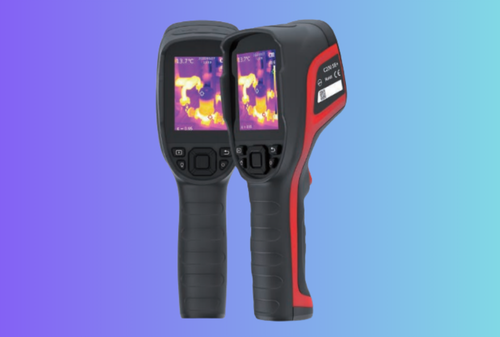
In the high-stakes world of industrial operations, unplanned downtime is the enemy. For decades, maintenance teams relied on simple tools to predict failure: vibration pens, multimeters, and the ubiquitous “spot gun” or infrared thermometer. However, as machinery becomes more complex and uptime targets become more aggressive, the limitations of the basic industrial thermal scanner have become apparent.
Table of Contents
ToggleFor B2B buyers, distributors, and OEM integrators, the market is shifting. The demand is no longer just for a tool that detects heat; the demand is for a comprehensive “predictive maintenance kit” that visualizes, analyzes, and reports data instantly.
This guide explores the evolution from the simple industrial thermal scanner to sophisticated handheld thermal imaging systems. We will analyze the technical specifications that matter, the value of “kits” over standalone units, and how global brands can partner with a China manufacturer like Gemin Optics to source high-performance solutions.
The Evolution: Why the “Scanner” is No Longer Enough
To understand the future of procurement in this sector, we must define the terminology. Historically, an industrial thermal scanner often referred to a single-point infrared pyrometer. These devices tell you the temperature of one specific spot. While useful for quick checks, they lack context. If you are scanning a massive switchgear cabinet, a single-point scanner might miss a loose connection just two inches away from your target point.
The Shift to “Imagers”
Today, the term industrial thermal scanner is evolving to encompass full industrial thermal imagers. Unlike a spot scanner, an imager utilizes a focal plane array (FPA) detector to generate a visual map of heat.
For an OEM buyer or distributor, this distinction is critical. End-users—whether in petrochemical plants or data centers—are moving away from “checking spots” to “imaging assets.” They need to see the thermal gradient across a surface to identify issues like:
- Unbalanced loads in three-phase power systems.
- Blocked pipes in heat exchangers.
- Insulation gaps in refractory linings.
The Economic Driver: Predictive Maintenance (PdM)
The global push for Predictive Maintenance (PdM) 4.0 is driving the sales of these devices. PdM relies on data. A simple industrial thermal scanner provides a number; a thermal imaging kit provides a dataset (image + temperature matrix + metadata). This data is essential for trending analysis over time, allowing teams to fix assets before they fail.
Defining the “Full Handheld Thermal Imaging Kit”
When we speak of a “kit” rather than a “unit,” we are addressing a holistic solution for the industrial user. For a China manufacturer or supplier, selling a kit increases the value proposition and offers higher margins.
A true industrial thermal scanner kit for predictive maintenance typically includes:
1. The Core Thermal Handheld Device
This is the heart of the system. It must feature a high-sensitivity detector (NETD <40mK or <35mK) to detect subtle temperature differences.
- Pro Tip for OEMs: The performance of the handheld unit relies entirely on the quality of the embedded module. At Gemin Optics, our [thermal camera modules] are designed to be the engine behind these industrial handhelds, offering resolutions from 256×192 up to 640×512.
2. Interchangeable Optics
One lens does not fit all scenarios.
- Standard Lens: For general inspections (motors, pumps).
- Telephoto Lens: For inspecting high-voltage transmission lines from a safe distance.
- Wide-Angle Lens: For scanning large building envelopes or tight server rooms. Successful OEM products often feature modular designs where lenses can be swapped.
3. Power Management Systems
Industrial shifts are long. A “kit” must include hot-swappable batteries and an external charging bay. Reliance on a single internal battery is a deal-breaker for heavy industrial users.
4. Connectivity and Software
The modern industrial thermal camera is an IoT device. It needs to connect via Wi-Fi to tablets for field reporting, or via USB-C for deep analysis on PC software.
Key Technical Specifications for B2B Buyers
If you are a product manager sourcing an industrial thermal imager from a China factory, or an integrator looking to build a custom solution, you must look beyond the marketing fluff. Here are the specs that determine field performance.
Detector Resolution (The Eyes of the System)
The resolution determines how many pixels are measuring temperature.
- 160 × 120 (Entry Level): Suitable for close-range electrical cabinets.
- 384 × 288 (Industry Standard): The “sweet spot” for mechanical and facility maintenance.
- 640 × 512 (High End): Required for distant utility inspections and R&D. High-resolution sensors allow the user to stand further away from hazardous equipment, improving safety.
Thermal Sensitivity (NETD)
NETD (Noise Equivalent Temperature Difference) measures the camera’s ability to distinguish between very small temperature differences.
- A high NETD (e.g., 100mK) yields a “noisy” or grainy image.
- A low NETD (e.g., <35mK) produces a crisp image. For our OEM partners, Gemin Optics emphasizes low-NETD integration in our [thermal camera module integration] services, ensuring the final product delivers crystal-clear imaging even in low-contrast environments.
Frame Rate
For a static industrial thermal scanner, 9Hz might be acceptable. However, for scanning moving conveyor belts or rotating machinery, 30Hz or 50Hz is mandatory to avoid motion blur.
Use Cases: Where the “Kit” Proves Its Worth
To market these products effectively, or to understand where your OEM product will be used, you must understand the application landscape.
High-Voltage Electrical Inspection
Problem: High resistance in connections generates heat. Solution: A handheld industrial thermal camera allows an inspector to scan hundreds of connections safely. Why a Kit? The user needs a telephoto lens to scan substations from outside the fence line, and a wide lens for indoor cabinet work.
Mechanical Systems & Tribology
Problem: Misaligned shafts and worn bearings generate friction (heat) before they vibrate significantly. Solution: Thermal imaging detects this friction early. Why a Kit? Software integration is key here. The ability to overlay thermal images with visual images (fusion) helps mechanics locate the exact component needing repair.
Process Control and Manufacturing
Problem: Ideally, products (like glass, plastic, or food) must be maintained at specific temperatures during production. Solution: Continuous thermal monitoring. Why a Kit? In some cases, handhelds are used for spot checks, but often these facilities require automated solutions. This is where [thermal camera module integration] becomes vital for building fixed-mount monitoring systems.
Sourcing Strategies: Finding a Reliable China Manufacturer
For global brands, the strategy of “Designed in [Country], Assembled in China” is evolving into “Co-developed in China.” The capabilities of Chinese thermal imaging manufacturers have skyrocketed.
However, finding the right OEM/ODM supplier for an industrial thermal scanner project requires due diligence.
1. Assessing Core Competency
Does the supplier make their own cores? Many “manufacturers” simply assemble bought components. A supplier like Gemin Optics, which specializes in the underlying [thermal camera module], offers deeper customization options because we control the technology stack from the sensor up.
2. Integration Capabilities
Industrial tools must be rugged. They need to survive drops (shock resistance) and water (IP67). You need a partner who understands [manufacturing & quality]. Ask your potential supplier about their testing protocols:
- Do they perform burn-in testing?
- Do they have climate chambers to test operation at -20°C and +50°C?
- Can they assist with housing design for heat dissipation?
3. Supply Chain Stability
The industrial thermal imager market is sensitive to component shortages. Working with a vertically integrated China manufacturer helps mitigate supply chain risks.
Gemin Optics: Your Partner for Industrial Thermal Solutions
At Gemin Optics, we understand that an industrial thermal scanner is more than just a sensor in a plastic box. It is a precision instrument that thousands of technicians rely on for safety and efficiency.
We are a premier China-based manufacturer and OEM/ODM supplier dedicated to optical and thermal excellence. While our website showcases our expertise in [thermal monoculars]and [thermal rifle scopes], the core technology driving these rugged outdoor devices is identical to what is required for high-end industrial maintenance tools.
From Module to Masterpiece
We offer flexible engagement models for B2B buyers:
- Core Modules for Integrators: If you are building your own industrial thermal camera housing or a drone payload, you can source high-performance [thermal camera modules] directly from us. We offer various resolutions and lens interfaces to fit your PCB design.
- Custom Integration Services: Do you have a concept for a specialized industrial thermal scanner? Our engineering team supports [thermal camera module integration], helping you optimize power consumption, image processing algorithms, and mechanical fit.
- Private Label Solutions: For brands looking to expand their catalog quickly, we offer ODM services. We can adapt our rugged handheld platforms—such as our [thermal monoculars]—into industrial inspection tools by adjusting the firmware for radiometric (temperature measuring) capabilities rather than hunting scenarios.
Quality You Can Trust
We don’t just ship products; we verify them. Our commitment to [manufacturing & quality] ensures that every module and device leaving our facility meets strict performance standards. We welcome factory audits and are transparent about our production processes.
The Future of the Industrial Thermal Scanner
The market is not standing still. As we look forward, the industrial thermal imager is becoming smarter.
- AI Integration: Future kits will include on-device AI that automatically recognizes asset types (e.g., “Motor,” “Fuse Box”) and suggests potential faults based on thermal patterns.
- Cloud Connectivity: The “scanner” will become a live node in the factory network, streaming data directly to the cloud for real-time analysis.
- Fusion Tech: Combining thermal data with [laser rangefinder modules] allows the camera to calculate the exact distance to the target, automatically compensating for atmospheric transmission loss—a critical factor for accurate temperature measurement over long distances.
Conclusion
The era of the basic industrial thermal scanner is fading. In its place rises the comprehensive thermal imaging kit—a connected, rugged, and high-resolution solution that powers the predictive maintenance strategies of the future.
For B2B buyers and distributors, the opportunity lies in upgrading your product lines to meet this new standard. By partnering with a capable China OEM/ODM manufacturer, you can deliver top-tier technology to your customers without the exorbitant R&D costs of starting from scratch.
Gemin Optics is ready to be that partner. Whether you need raw thermal modules to integrate into your own systems or a fully customized handheld solution, we have the expertise and the supply chain to make it happen.
Start Your OEM/ODM Project with Gemin Optics
Don’t let your product line fall behind. Upgrade your offerings from simple scanners to advanced imaging solutions today.
Why Choose Gemin Optics?
-
Direct Manufacturer: No middlemen, competitive pricing.
-
R&D Expertise: Deep knowledge in thermal cores and optical integration.
-
Flexible Partnership: From modules to full white-label devices.
Take the next step.
Looking for Core Technology? Explore our Thermal Camera Modules.
Need Custom Engineering? Learn about our Module Integration Services.
Ready to Talk Business? Contact our engineering team to discuss your industrial thermal scanner project requirements.