Lead. If you build consumer laser rangefinders (LRFs), the optics stack determines more than image clarity—it sets your lock rate, daylight readability, and battery life. This guide walks OEM/ODM teams through AR coatings, aperture and exit-pupil math, and display choices (OLED vs. LCoS), then ties these to compliance and cost so you can spec once and scale.
Table of Contents
ToggleExecutive Summary
-
- AR coatings are free range: every percent of transmission you win at each surface raises effective SNR and reduces the laser pulse energy you need for the same range, improving battery life and easing Class 1 margins.
-
- Aperture isn’t just “bigger is brighter.” Match objective diameter to exit pupil and human pupil under bright sun (≈2–3 mm) to avoid wasted glass, then allocate saved area to coatings and sealing.
-
- Microdisplay choice drives the power budget. Emissive OLED/micro-OLED generally offers higher contrast and lower system power in compact HUDs than LCoS (illumination + LCoS losses), improving daylight legibility per watt.
-
- Compliance is designable. With thoughtful optics, it’s easier to meet IEC 60825-1 Class 1 and align to FDA Laser Notice No. 56 (conformance pathway), while keeping marketing-grade brightness on the HUD.
-
- Engineer acceptance upfront. Define lock-rate, ranging latency, HUD luminance, and mWh/100 ranges as acceptance metrics; validate from bench to bright-sun field.
Use Cases & Buyer Scenarios
Scenario 1 — Golf LRFs under harsh sun
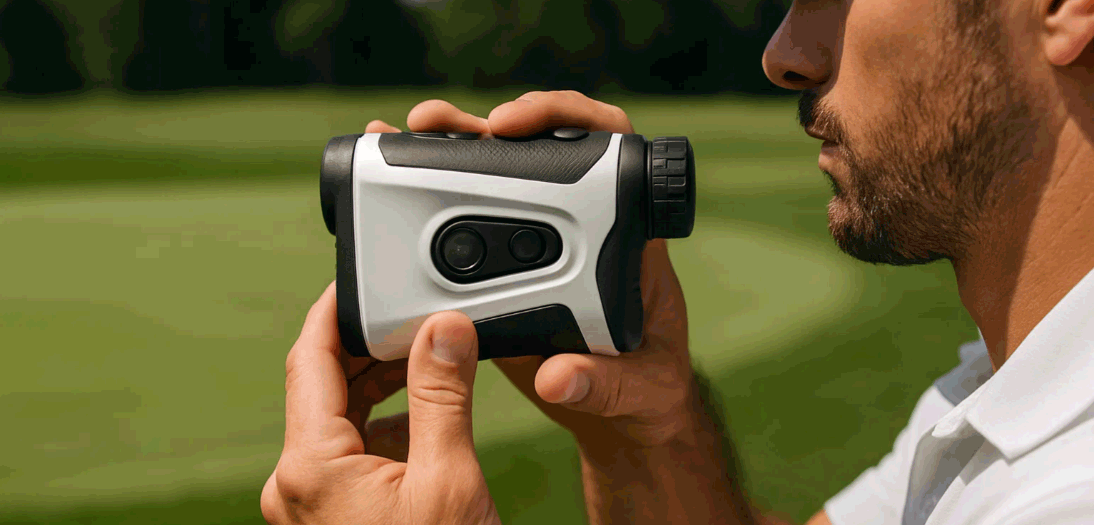
You sell distance-only models that must be readable at noon and pass tournament checks. You choose dual-band AR on the objective and eyepiece, a 22–24 mm entrance pupil, and micro-OLED HUD targeted to 2,000–3,000 cd/m² peak with adaptive dimming. You maintain Class 1 by combining low-divergence TX optics with tight AEL budgeting and robust internal baffling.
Scenario 2 — Outdoor/hunting compact LRFs in brush
Your buyers prioritize confidence in clutter (branches, fog, dusk). You bias toward slightly larger divergence and multi-return logic to stabilize range confidence, then recover brightness via broadband AR and a modest 23–25 mm objective to keep mass down. Cross-sell a Laser Rangefinder Module as a drop-in for binoculars.
Scenario 3 — Multi-sport consumer LRF with long standby
You need week-long casual use from AAA/CR2 or 18650. You pick micro-OLED for HUD efficiency, aggressive sleep/instant-on, and low-energy ranging modes (short bursts, accumulated returns). Your coatings and aperture keep the HUD backlight (if LCoS) or OLED drive minimal at a given luminance.
Spec & Selection Guide
Consumer LRFs have three tightly coupled optical sub-systems:
-
- Transmit/receive optics (objective, field stop, filters)
-
- HUD optics (microdisplay + eyepiece)
-
- Baffles & coatings (AR/HR/OLPF as needed)
Below we define key parameters and why they matter.
Core definitions and trade-offs
-
- Anti-reflection (AR) coating efficiency: Uncoated glass reflects ≈4% per surface; modern multi-layer AR can push reflection to <0.5% across your band. On a four-surface path, moving from ~84% to >97% total transmission can be the difference between a solid lock and hunting.
-
- Beam divergence (full-angle, 1/e²): Smaller divergence concentrates energy (longer theoretical range) but raises sensitivity to hand-shake and mis-aim; slightly larger divergence increases hit probability in brush at the cost of far-range SNR.
-
- Aperture (objective diameter): Enlarging the entrance pupil raises collected signal and viewfinder brightness, but weight and cost scale ~D². If your HUD or eye pupil clips the beam, excess diameter yields diminishing returns.
-
- Exit pupil: Exit pupil ≈ (objective focal length / eyepiece focal length). For bright sun, human pupil is ≈2–3 mm; designing 4–5 mm exit pupil improves eye relief and ease-of-use but past ~5 mm you waste light most of the day.
-
- HUD microdisplay: OLED/micro-OLED is emissive (no illumination train), typically higher contrast and lower optical losses than LCoS (reflective panel + illumination + PBS). System power and daylight readability depend on the whole optical path, not panel spec alone.
-
- Accessible Emission Limit (AEL) & Class 1: Safe-by-design constraint under IEC 60825-1; optical throughput and divergence choices directly affect how much TX power budget you can allocate while remaining Class 1. FDA Laser Notice No. 56 recognizes IEC pathways for U.S. marketing.
Comparison table (illustrative)
| Parameter | Option A (OLED HUD, broadband AR) | Option B (LCoS HUD, single-band AR) | Why it matters |
|---|---|---|---|
| HUD optical path | Emissive micro-OLED + 2-element eyepiece | LED illum. + LCoS + PBS + eyepiece | Fewer elements → lower loss, often lower power for given nits. |
| Objective diameter | 24 mm | 28 mm | Bigger is not always brighter if HUD/eye clips; weight vs. field utility. |
| Exit pupil | 3.8–4.2 mm | 4.5–5.0 mm | Ease of eye placement vs. wasted light in sun; pick to user context. |
| AR coating | Multi-layer 450–950 nm + near-IR notch | V-coat at 905 nm only | Broadband raises both viewing and receive SNR across ambient spectra. |
| Laser divergence | 1.2 mrad | 0.8 mrad | Wider improves lock in brush; narrower extends max range in open. |
| Typical system power (ranging+HUD) | Lower at equal perceived luminance | Higher due to illumination + LCoS losses | Extends mWh/100 ranges; affects thermal design. |
Simple decision rules
-
- If your value prop is mid-range stability in clutter (200–600 m), then select 1.0–1.5 mrad divergence, broadband AR, 22–25 mm objective, and OLED HUD.
-
- If you sell open-range max distance claims, then target 0.7–0.9 mrad divergence, invest in precision alignment and HR mirrors, and accept tighter hand-shake demands.
-
- If retail price pressure is high, then keep diameter modest (24–25 mm), optimize coatings, and save cost with smarter firmware (multi-pulse accumulation) rather than glass area.
Integration & Engineering Notes
Electrical & Interfaces
-
Low-latency serial: Provide UART at 115.2–921.6 kbps for range, confidence, and multi-return data. USB-CDC is helpful for factory tools; CAN for ruggedized platforms.
-
Time base: Implement a 1 PPS or sync input if you fuse with GNSS/IMU; expose timestamped returns with µs resolution.
-
SDK: Offer C/C++ and Python bindings for range calls, burst size, AGC parameters, and HUD brightness.
-
Power domains: Separate laser TX, receiver/ADC, and HUD rails. Budget peak current for TX caps so HUD doesn’t brown-out during pulses.
If you later add thermal aiming aids, align your protocol with the semantics already used across Thermal Rifle Scopes and Thermal Monoculars to simplify channel support.
Optics & Mechanics
-
Barrel alignment: Co-boresight TX and RX with <0.2 mrad wedge. Use shims or adjustable barrels; lock with UV-curing adhesive after thermal cycling.
-
Stray-light control: Blackened baffles, knife-edge stops, and AR-coated windows reduce ghosting; keep the window slightly wedged to avoid back reflections into the detector.
-
Sealing: O-rings at objective and eyepiece; hydrophobic top-coat protects AR from fingerprints; specify IP-ratings in line with your distribution promises.
-
Thermal drift: Use low-CTE mounts or compensate in firmware; hold optical center through –20 °C to +60 °C.
-
Recoil/vibration (if mounting on rails): Qualify to 1,000 rounds of 5.56 NATO equivalent; record post-test boresight drift ≤0.3 mrad. For true clip-on products, reference mechanical and optical expectations adopted in Thermal Clip-On Sight lines.
Firmware/ISP/Tuning
-
Adaptive gain control on the photodiode receiver reduces false locks from bright grass or wet flags.
-
Multi-pulse accumulation with outlier rejection raises effective SNR without bumping TX power—nice for Class 1 headroom.
-
HUD pipeline: Daylight mode (γ≈1.8–2.0, higher UI contrast), dusk mode (γ≈1.6, larger fonts). On OLED, per-pixel drive saves power compared to full-field illumination losses in LCoS.
-
User prompts: If the system sees unstable returns, guide the user to “steady, scan, and release.”
If you plan binocular integrations later, reuse tone mapping and overlay styles from Thermal Binoculars for brand consistency.
Testing & Validation (bench → field)
-
Bench: Measure optical transmission per surface; verify AR spec (R<0.5% at 905 nm ±20 nm). Use an integrating sphere for HUD luminance vs. current.
-
Range tunnel: Calibrate ranging bias across 10–800 m, log latency (ms) and confidence.
-
Field: Bright-sun readability at ≥100 k lx; dusk readability at ≤5 lx; lock-rate in brush at 200–400 m over 100 scans; mWh/100 ranges at 20 °C.
Compliance, Export & Certifications
-
IEC 60825-1 Class 1: Classify and test in line with IEC 60825-1:2014 (Ed. 3). Design-time levers include TX energy per pulse, rep rate, divergence, and optical housings that prevent access above AEL. In the EU, EN 60825-1:2014+A11:2021 is the harmonized text; EN 50689 adds consumer-product specifics.
-
FDA Laser Notice No. 56: For the U.S., FDA recognizes conformance to IEC 60825-1 Ed. 3 for performance standards; follow reporting/labeling obligations and retain test records.
-
CE/FCC/RoHS: CE is a manufacturer self-declaration that the device meets applicable directives (LVD/EMC/RoHS). FCC covers RF emissions (even if you only have BLE). Keep a Technical File and Declaration of Conformity.
-
Labels & records: Mark Class 1 near the aperture; include aperture warning graphics as applicable; maintain test data for market surveillance.
-
Export: Consumer LRFs at 905 nm generally ship under EAR99/low-risk codes, but verify if you add advanced ballistic solvers or weapon-specific mounts (check local law). For thermal add-ons, confirm whether your Thermal Pistol Sights or related lines trigger dual-use controls in your region.
Business Model, MOQ & Lead Time (OEM/ODM)
-
MOQs: Typical 500–1,000 pcs for custom cosmetics; 50–200 pcs for pilot runs.
-
Samples: EVT samples in 3–5 weeks if HUD and optics are in catalog; 8–12 weeks for new glass or custom coatings.
-
Mass production: 10–12 weeks after DFM lock; keep camera-ready artwork for pad-print and a CMF sheet for coatings and top-coats.
-
Private label: Offer cosmetic kits, brand-specific HUD themes, and market-specific manuals; consider Thermal Monoculars or Thermal Rifle Scopes cross-bundles for channel lift.
Tiny distributor ROI
| Assumption | Value |
|---|---|
| Ex-works cost (OLED HUD, 24 mm, AR) | $89 |
| Landed cost (duty+freight) | $7 |
| Distributor price | $139 |
| Gross per unit | $43 |
| Monthly run-rate | 1,000 units |
| Monthly gross | $43,000 |
Sensitivity: +10% AR yield (better coatings or vendor) often lets you market higher “lock confidence,” supporting $5–$10 ASP uplift with the same BOM.
Pitfalls, Benchmarks & QA
Common mistakes (and fixes)
-
Oversizing the objective—you carry weight and BOM without real brightness gain because the exit pupil or eye clips it. Fix: Size for 3–4 mm exit pupil in sun; invest in coatings.
-
Chasing max range with ultra-tight divergence—hand jitter kills real-world locks. Fix: pick 0.9–1.2 mrad unless your audience is tripod-steady.
-
Using single-band AR only—great at 905 nm, mediocre in visible; HUD looks dull, RX still loses. Fix: dual- or broadband AR stacks.
-
Bright HUD, dead battery—LCoS illumination losses make you crank LEDs. Fix: model system nits per watt; consider OLED/micro-OLED.
-
Ignoring Class 1 margins until late—then you’re stuck lowering performance. Fix: budget AEL from day one with guard bands under IEC 60825-1 and the FDA pathway.
-
No field metrics—bench looks great, customers complain. Fix: spec acceptance tests below and publish key numbers.
-
Forgetting CE/FCC docs—channel partners demand them. Fix: prepare DoC, test reports, label art early.
Benchmark methodology
-
Detection/lock-rate: % of successful locks over 100 scans on 20×20 cm targets at 200, 300, 400 m in both open and brush.
-
Latency: Time from trigger to display update (ms), mean and 95th percentile.
-
HUD readability: Minimum luminance (cd/m²) for legibility at 100 k lx; font height at 20 mm eye relief.
-
Energy: mWh per 100 successful ranges, at 20 °C, including HUD.
-
Stability: Range repeatability (±m) over 10 locks on fixed target; drift across temperature swing.
FAQs
Q1. Do AR coatings really change battery life?
Yes. Higher transmission raises receive SNR at the same TX energy; you can reduce pulse energy or the number of pulses, lowering mWh per lock. The effect compounds across multiple surfaces.
Q2. OLED vs. LCoS: which lasts longer on a CR2?
In compact HUDs, emissive OLED often wins because there’s no illumination train and fewer optical losses for the same perceived nits; still, measure system nits per watt with your optics.
Q3. What exit pupil should I target?
For bright-sun golf/outdoor, 3–4 mm balances ease of eye placement and avoids wasted light. For low light, consider 4–5 mm but ensure eye relief remains comfortable.
Q4. How hard is Class 1 compliance?
Plan early. With proper divergence, baffling, and AR-aided SNR, you can keep pulse energy low and still lock dependably. Align to IEC 60825-1 and Laser Notice No. 56, keep records, label correctly.
Q5. Can I share optics with binocular integrations?
Yes. If you roadmap binoculars, reuse coatings and HUD stack. Cross-promote with Thermal Binoculars and a Laser Rangefinder Module SKU to de-risk integration.
Q6. Are CE/FCC mandatory for non-connected LRFs?
CE (LVD/EMC/RoHS) applies for EU sale; FCC Part 15 applies if you add radios or digital emissions. Document and declare accordingly.
Q7. What about microLED microdisplays?
They’re promising, but at very small pixels the efficiency and calibration needs can raise power vs. OLED at equal brightness; watch this space for maturity.
Call-to-Action
Planning your next consumer LRF or a binocular integration? Our team can help you choose the right coatings stack, aperture, and HUD for your market—then validate it with field-driven metrics. Explore our Laser Rangefinder Module options or talk to us about adding ranging to Thermal Rifle Scopes, Thermal Monoculars, or Thermal Clip-On Sight programs. Distributors: ask about private-label kits and channel-ready documentation.
Sources
-
IEC 60825-1:2014 — Safety of laser products (Ed. 3), IEC Webstore (accessed 2025). IEC Webstore
-
FDA — Laser Products: Conformance with IEC 60825-1 Ed. 3 (Laser Notice No. 56), Guidance (2023). U.S. Food and Drug Administration
-
UL — Understand the new laser product safety standards in Europe (EN 60825-1:2014/A11:2021; EN 50689), 2021/2023 updates. UL Solutions
-
Edmund Optics — An Introduction to Optical Coatings (reflection/transmission basics), 2024. Edmund Optics
-
Micro-display notes — OLED vs. LCoS power/contrast comparisons, vendor and industry summaries (2019–2023). Micro OLED Display+1
-
EU Commission — CE marking: internal market guidance (Blue Guide references), 2022–2024.