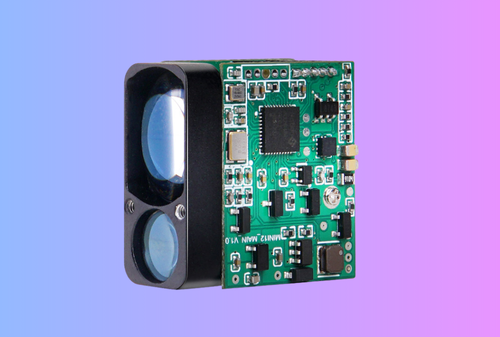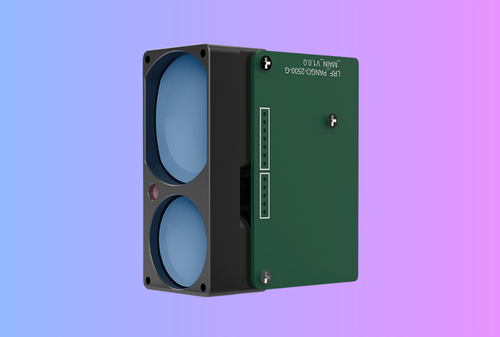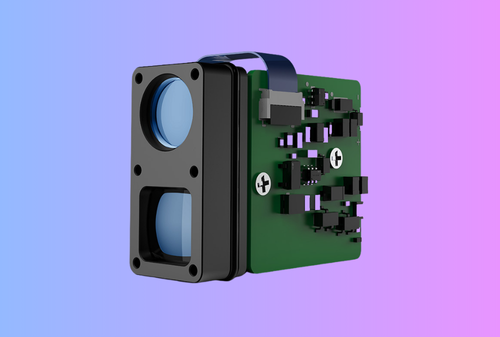
A laser rangefinder module may perform well during early bench testing and still become unstable later in product integration. This is one of the most common traps in OEM development. On the bench, the setup is usually simple. The power rail is short and clean. The cable is short. The host board is not yet crowded. Wireless subsystems, displays, high-speed processors, storage, motors, and switching converters may still be absent or inactive. The module appears to range correctly, the communication link looks normal, and the engineering team gains confidence.
Table of Contents
ToggleThen the project moves into real product integration.
The host board becomes denser. The cable gets longer. The enclosure changes the grounding path. A DC-DC converter starts switching close to the module. A display backlight, radio, or processor shares the same rail. The user presses multiple functions at once. Suddenly the ranging result becomes intermittent, the communication interface shows unstable behavior, startup gets inconsistent, or field performance feels less repeatable than the lab prototype suggested.
This is why laser rangefinder module power supply and EMI design deserves its own engineering guide. It is not enough to confirm that the module powers on and returns distance data in a controlled setup. For OEM engineers, the real goal is to make the module electrically stable inside the actual host architecture, under the actual noise conditions, with the actual cable routing, grounding strategy, and user workflow that the final product will see.
If your team is still building the overall architecture, this article should sit alongside your broader Rangefinder Module Integration planning. If you are already selecting hardware, it should also be read with your Laser Rangefinder Module product page in mind, especially where interface choices and SDK support affect electrical integration. Your site also now has a recent thermal-module article on EMI and power noise design, which makes this LRF article a natural companion for the module category.
Why power and EMI problems appear late
A laser rangefinder module is often evaluated too early in too-clean an environment. That is not because the engineering team is careless. It happens because early samples are meant to prove functional viability, not full-system robustness. The bench environment is doing more work than it seems.
A lab supply usually has generous current headroom. The return path is obvious. The cable length is short. The host software is minimal. The enclosure is not yet complete. There may be no nearby switching noise source, no long harness, no battery droop, no burst load from another subsystem, and no real-world user behavior driving concurrent events.
Once the module enters the true host product, the assumptions change. The electrical environment becomes dynamic rather than static. Ground is no longer an ideal reference. A rail that looked clean in isolation now carries multiple loads. A communication line that was stable over 10 centimeters now runs beside switching edges or display signals over a much longer path. That is when the engineering team starts seeing symptoms that are easy to misclassify as firmware issues, optical issues, or random product instability.
In reality, many of those symptoms are signs of incomplete power integrity and EMI planning.
What “good” electrical integration really means
For an OEM laser rangefinder module project, good electrical integration is not simply the absence of obvious failure. A product is not electrically mature just because it ranges successfully most of the time. Good electrical integration means that power delivery, grounding, noise control, interface behavior, and validation methods are defined well enough that performance remains repeatable across prototypes, environmental conditions, production builds, and real user handling.
That means the engineering team should be able to answer a set of practical questions with confidence.
What is the actual supply range at the module pins, not just at the battery or board entry? What happens on the rail during startup, measurement bursts, or concurrent subsystem activity? How is current returned? What noise source is nearest to the module and how is it isolated? Which cable paths can radiate or receive noise? What happens when the product is cold, hot, low on battery, or connected to accessories? What is the acceptance threshold for “stable enough,” and how is it verified during EVT, DVT, and PVT?
If these questions do not yet have documented answers, the module is not fully integrated, even if it appears functional.
Start with the power architecture, not with symptoms
When an LRF module behaves inconsistently, many teams begin by chasing symptoms. They log communication packets, tweak host firmware timing, adjust polling strategy, or add retries. That work can be useful, but it should not be the first step. The first step is to review the power architecture.
A laser rangefinder module should be treated as a sensitive opto-electronic subsystem, not as a generic peripheral. The rail feeding it must be evaluated in the context of source impedance, current headroom, transient response, startup sequencing, and shared-load behavior. Engineers should define whether the module receives its own regulated rail, a filtered branch from a shared rail, or a directly battery-derived input with local conditioning. The right choice depends on the system, but the decision must be deliberate.
A design that looks acceptable in the schematic can still fail in the physical product if the rail is too far away, the return path is poorly controlled, or switching noise couples into the local supply at the wrong moment. This is why power architecture belongs near the beginning of the design review, not at the end.
Rail stability matters more than nominal voltage
One of the easiest engineering mistakes is to focus on nominal voltage while ignoring dynamic behavior. A rail may be “within spec” in a static measurement and still be unacceptable during real use. The module does not consume power in an abstract, averaged way. It experiences real startup events, active ranging cycles, communication events, and interaction with other host loads.
Engineers should evaluate how the supply behaves when the module starts, when the host processor wakes, when the display turns on, when wireless transmission occurs, and when the battery is at its lower operating range. It is not enough to say the rail is 5 V or 3.3 V. The useful question is how stable that voltage remains at the module input during the events that matter.
This is especially important in handheld and battery-powered designs. A board-level rail may look strong at the regulator output but sag or ring at the module connector because of harness impedance, poor return path geometry, or simultaneous current demand elsewhere in the system. If your team only measures the source point, you may miss the real problem.
Separate “shared rail” convenience from “system-safe” design
In early development, it is tempting to place the module on a rail that already exists in the host system. This reduces complexity and speeds up prototypes. In some products it remains acceptable. In others it becomes the root cause of later instability.
A shared rail is not automatically bad, but it must be justified. If a laser rangefinder module shares power with a processor, radio, display backlight, storage device, or actuator, the design review should explicitly ask whether those loads can inject noise, startup dips, or burst disturbances into the module supply path. It should also ask whether the LRF module itself can disturb nearby sensitive circuits.
The right answer is not always “add another regulator.” Sometimes the better solution is local filtering, better layout, cleaner return control, staged startup, or cable redesign. But what should be avoided is accidental sharing without electrical review. Convenience at prototype stage often becomes risk at field stage.
Grounding is a design system, not a layout afterthought
Grounding problems are often misunderstood because they do not always look like obvious ground failures. A module may still power up, communicate, and measure distance, but with intermittent behavior that seems random. In many cases the underlying issue is that return current is taking a path the team did not intend.
A good grounding strategy defines where current should return, how the module references the host, how shield connections are treated, and how noisy subsystems are kept from polluting sensitive measurement paths. This becomes especially important when the module is connected through a cable, mounted in a separate compartment, or installed in a metal enclosure that can unintentionally create alternate return paths.
The engineering team should decide whether the enclosure participates in shielding only, in return current control, or in both. Cable shield termination must also be intentional. A shield tied incorrectly can become an antenna rather than a protection measure. Likewise, a floating metal structure near the signal path can create behavior that is difficult to interpret during debug.
Good grounding is not glamorous, but it often separates a clean production design from a project that keeps accumulating unexplained “noise issues.”
DC-DC converters are often the nearest aggressor
In compact OEM products, the nearest strong noise source is frequently a switching power converter. The problem is not that switching converters are inappropriate. Most modern products need them. The problem is when the converter sits too close to the module, shares an uncontrolled return path, or radiates into the cable and interface structure.
LRF module electrical design reviews should always map the physical position of nearby converters, not just their existence in the schematic. A converter with fast edges, poor loop control, or poorly managed routing can inject both conducted and radiated noise into the module environment. If the host platform includes multiple converters, engineers should identify which one switches nearest to the module, which one shares the strongest return interaction, and which one changes mode under varying load.
This point matters even more in products that combine ranging, thermal imaging, display drive, storage, and wireless communications in a tight enclosure. Your broader rangefinder integration workflow already emphasizes de-risking the full electrical and firmware package before production; this article simply drills one layer deeper into that requirement.
Cable length changes everything
A cable that seems harmless in bench testing can become a major EMI pathway in the final product. Once the module is connected across a longer cable, several things change at once. Supply impedance rises. Return behavior becomes less ideal. Signal lines become more exposed to coupling. Common-mode noise becomes easier to excite. The cable can both receive and radiate interference.
This is why cable and connector design should be considered part of laser rangefinder module EMI design, not a purchasing decision made later. Engineers should define cable length targets, routing corridors, shielding needs, connector locking behavior, strain relief, and proximity to known noise sources. If the module sits near optics or moving mechanical parts, the cable should also be reviewed for vibration-driven wear and intermittent contact.
The best cable is not simply the shortest one. It is the one whose routing, return path, shield strategy, and connector behavior are all compatible with the product’s electrical and mechanical architecture.
Interface lines are signal paths, not just “communications”
When engineers say the module “talks over UART” or “uses CAN,” they sometimes understate the electrical significance of the interface. These lines are not abstract logical channels. They are physical conductors in a real noise environment, and their stability depends on voltage margin, edge quality, cable geometry, reference integrity, and host timing assumptions.
A robust communication link starts with correct electrical context. How long is the line? What is adjacent to it? Is the host reference stable? Does the product use level shifting? Are idle states and boot states well defined? What happens if the host and module start in different sequences? What happens when the battery is low and line thresholds become marginal?
This is one reason your LRF product page’s emphasis on multiple interface options such as UART, RS232, RS485, USB, and CAN is strategically useful for OEM buyers. Different system architectures need different electrical tradeoffs, and the interface choice is part of the integration design, not just a catalog checkbox.
Decoupling should be placed for the module, not for visual neatness
Decoupling is one of the most discussed and most frequently mishandled parts of module integration. The issue is rarely that engineers forget it exists. The issue is that decoupling gets treated as a generic PCB habit instead of a module-specific electrical requirement.
The purpose of decoupling is to support local transient current demand and reduce the rail’s susceptibility to incoming noise. That only works if placement, loop area, return path, and capacitor mix actually support the module’s behavior. A capacitor that is technically present but electrically distant may help much less than expected. A capacitor network chosen only from habit may miss the frequency content that matters in the real system.
In OEM practice, it is better to review decoupling as part of the module’s local electrical zone. What noise spectrum are you trying to reduce? What transient event are you trying to support? What path does the current take from source to module and back? Once those questions are answered, capacitor placement becomes an engineering decision rather than a visual one.
Startup sequencing needs to be defined early
Many integration teams focus on steady-state operation and forget that startup is often where instability first appears. A module may require a certain rail readiness, host readiness, or timing relationship to behave consistently. If the product includes several subsystems waking together, a race condition can look like a random field failure when it is actually a repeatable sequencing flaw.
The startup review should define when the LRF module receives stable power, when the host begins communication, what reset behavior is expected, and how error handling works if the module is not ready in time. It should also define how the system behaves after brownout, battery swap, accessory hot-plug, or watchdog reset.
A disciplined startup plan does not just improve reliability. It also makes debugging much faster, because the engineering team has a known expected sequence rather than trying to infer one from inconsistent logs.
Brownout and low-battery behavior should be part of validation
Battery-powered OEM products often behave well when fully charged and become unreliable near the lower operating boundary. This is a classic late-stage surprise. The rail technically remains above the minimum threshold most of the time, but transient dips, cable losses, and concurrent subsystem activity push the module into marginal operation during real use.
That is why brownout behavior should be treated as a first-class validation topic. Engineers should define what happens when the battery is near depletion, when the user activates multiple functions, and when the converter changes operating mode under reduced input headroom. Does the module continue ranging correctly? Does communication remain valid? Does the host detect and handle degraded conditions gracefully?
A project that never validates low-battery electrical behavior is often validating only its best-case condition.
EMI control starts with physical partitioning
A strong EMI design does not begin with ferrites and last-minute patches. It begins with physical partitioning. Where are the noisy subsystems? Where is the laser rangefinder module? Which cables cross those domains? Which ground regions must remain quiet? Which signals are most vulnerable to coupling?
When teams skip this partitioning view, they often end up adding mitigation after symptoms appear. That is slower and more expensive than designing separation into the product from the beginning. Even small changes in physical location, cable routing, or regulator placement can dramatically reduce the coupling opportunities that later become debug headaches.
In practice, this means your mechanical, electrical, and firmware teams should review the module zone together. EMI is never purely an electrical topic. It is a system-layout topic.
Shielding is useful only when the return path is understood
Shielding is sometimes treated as a universal cure for EMI. In reality, shielding helps only when engineers understand what kind of coupling they are addressing and how the shield is terminated. A cable shield with the wrong grounding strategy can shift noise rather than suppress it. A local can or enclosure shield can improve behavior in one frequency range and create new issues elsewhere if the return reference is poorly defined.
For laser rangefinder module integration, shielding decisions should be based on actual noise mechanisms. Are you controlling radiated coupling into the interface lines? Conducted noise along the harness? Emissions from a switching node? Sensitivity of the module’s local analog or mixed-signal region? Each of those may call for a different mitigation strategy.
The important point is that shielding should be part of a reviewed architecture, not an emergency add-on after the product starts failing compliance or field tests.
ESD and connector strategy belong in the same discussion
Whenever a module is connected through an external or semi-external cable path, ESD protection should be reviewed as part of the same electrical integration package as EMI. These topics are related because connector location, cable handling, grounding, shielding, and interface protection all interact.
An otherwise clean signal path can become fragile if it receives repeated ESD exposure through a user-accessible connector, service point, or cable assembly. Likewise, protection parts added without path analysis can degrade signal integrity or create unintended capacitance where the interface margin is already narrow.
This is why connector choice should not be separated from electrical review. Locking style, pin order, shield continuity, ground-first behavior, service access, and protection placement all matter to long-term field stability.
Measure at the module, not only at the source
One of the best ways to improve debug discipline is to adopt a simple rule: measure where the module sees the problem, not only where the board designer expects the system to be healthy. If you only probe the regulator output or the main power entry, you may miss the voltage drop, ringing, or noise that actually reaches the module pins.
For OEM laser rangefinder module troubleshooting, useful measurement points typically include the module input pins, local ground reference, interface lines at the module connector, and the rail behavior during event transitions. Engineers should compare idle behavior with active ranging, startup, low battery, and concurrent subsystem activity. The goal is to observe the real electrical environment at the module boundary.
This mindset saves time because it forces the debug effort toward first principles instead of assumptions.
Make EVT, DVT, and PVT electrical goals explicit
A good development program does not treat electrical robustness as a vague aspiration. It defines electrical goals at each phase.
During EVT, the goal is usually architectural confidence. Can the selected rail concept support the module? Are the interface assumptions valid? Does the module coexist with the host in basic operation? During DVT, the focus should shift to enclosure-driven grounding changes, cable routing, startup behavior, low-battery stability, and EMI sensitivity in near-final packaging. During PVT, the focus becomes repeatability, production test coverage, incoming inspection criteria, and whether unit-to-unit electrical variation can push marginal builds into failure.
This staged thinking fits well with your existing rangefinder module integration framework, which already presents development as a de-risked path from evaluation to mass production rather than a one-step sample decision.
Incoming and production tests should include electrical stress cases
Electrical maturity is not proven only by lab debug. It should also appear in the test strategy. Incoming inspection and production test should include the conditions most likely to expose power and EMI weakness, especially if the module will be used in a dense embedded system.
This does not mean every factory test must be elaborate. It means the engineering team should define which simplified electrical checks correlate with real system stability. That may include startup consistency, communication integrity under normal load, basic behavior near low input threshold, and repeatability when the product runs multiple functions together.
If the test strategy ignores the real electrical stress points, production may pass units that were never screened for the conditions most likely to trigger field complaints.
A stable product is an electrical package, not just a good module
OEM engineers often focus heavily on the module vendor during selection, which is reasonable. But once the module is chosen, the electrical package around it becomes just as important as the module itself. A high-quality laser rangefinder module can still appear weak inside a poor host electrical design. Conversely, a disciplined power and EMI architecture can make integration faster, validation cleaner, and production much more predictable.
That is the mindset this article is meant to reinforce. Laser rangefinder module power supply and EMI design should not be treated as a late-stage debug topic. It belongs at the front of system design, right next to optical alignment, interface definition, and validation planning.
When teams do that well, they reduce more than technical failures. They reduce schedule slip, unexplained field behavior, service burden, and engineering fatigue. That is the real value of getting the electrical foundation right.
FAQ
Why does a laser rangefinder module work on the bench but become unstable in the final product?
Because the bench setup is usually much cleaner than the final system. In the product, the module may see longer cables, noisier rails, switching converters, shared loads, enclosure grounding effects, and simultaneous subsystem activity.
Is a shared rail always a bad idea for an LRF module?
No. A shared rail can work, but it needs deliberate review. The key issue is whether other loads inject noise, startup disturbance, or transient dips into the module’s local supply path.
What is the most common hidden electrical problem in OEM integration?
Poor control of the real return path is one of the most common hidden issues. Engineers often validate voltage presence but do not fully validate how current returns through the product.
Does interface choice affect EMI behavior?
Yes. Interface choice affects cable behavior, signal margin, threshold robustness, noise immunity, protection strategy, and long-run stability. It is an electrical architecture decision, not just a software one.
When should electrical stress testing begin?
As early as possible. Low-battery behavior, startup sequencing, cable sensitivity, and shared-load interactions should be explored during development rather than saved for final compliance or field feedback.
CTA
If your team is designing a new OEM product around an LRF platform, the fastest way to reduce downstream debug is to review power architecture, grounding, cable routing, interface choice, and electrical validation before the system gets crowded. You can start with our Rangefinder Module Integration page, review configurable Laser Rangefinder Module options and interface paths, or contact our engineering team to discuss your host architecture, cable plan, startup behavior, and EMI risk points. The current Gemin Optics site structure already supports this path with dedicated integration and module pages for OEM projects.
Related Articles
- Rangefinder Module Integration
- Laser Rangefinder Module
- Thermal Camera Module EMI and Power Noise Design Rules
- LRF + Ballistics in Thermal Scopes: OEM Integration Guide
- Long-Term Reliability of Laser Rangefinder Module