Laser Rangefinder Module Price Guide 2025: What Really Drives Cost
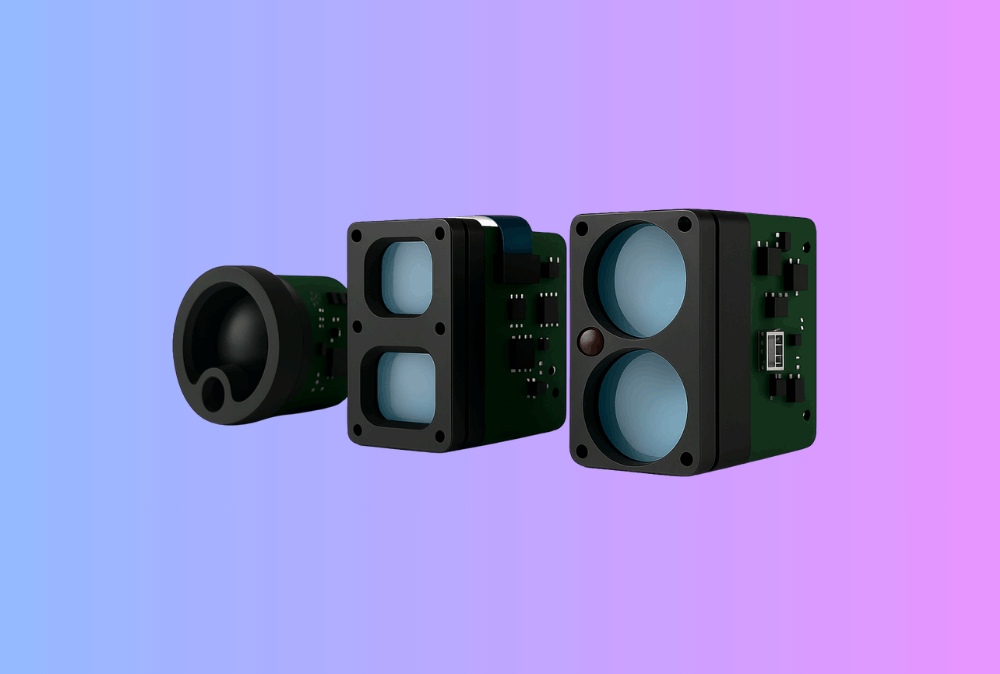
Lead: Looking for a realistic Laser Rangefinder Module price before you RFQ? This cost-first guide breaks down the BOM, process, and risk factors that push the price up or down—so OEM/ODM buyers, integrators, and distributors can negotiate smart, plan margin, and scale with fewer surprises.
Table of Contents
ToggleExecutive Summary
- Price is a system outcome—not a part price. Wavelength (905 vs 1550 nm), detector type (Si-APD vs InGaAs), optics/diffuser tolerances, and test/calibration depth together set cost brackets and yield.
- Volume & variant control matter more than you think. A single configurable SKU with stable optics often beats three micro-variants that fragment demand and destroy economies of scale.
- Compliance, not just performance, affects unit cost. IEC 60825-1 Class 1/1M eye-safety, CE/FCC/UKCA, and traceable calibration add non-negotiable costs but protect channel onboarding and liability.
- Market tailwinds justify investment. Independent analysts size the laser-rangefinder market in the low-billions with mid-single to low-teens CAGR through 2030+, supporting ROI for robust, compliant modules.
See our Laser Rangefinder Module lineup for sample plans and integration kits. Pair with a Thermal camera module when you need fused detection + absolute range.
Use Cases & Buyer Scenarios
UAV & robotics teams budgeting for fleet deployments
You need predictable pricing from EVT→PVT→MP. Choose a wavelength/detector path and lock optical divergence early to protect Class 1 margins and unit economics.
Outdoor optics brands planning seasonal launches
Combining ranging with Thermal Rifle Scopes, Thermal Monoculars or Thermal Binoculars? Expect extra cost for recoil/vibe validation, boresight stability, and compact power management.
Industrial/security integrators
For towers, gates, and patrol kits (e.g., Thermal Clip-On Sight or Thermal Pistol Sights stacks), budget for IP-rated enclosures, anti-fog windows, and field-recal kits. These raise COGS but slash RMAs.
Spec & Selection Guide (the heart)
Below are the cost drivers that most impact a Laser Rangefinder Module price. Use them to frame RFQs and avoid apples-to-oranges quotes.
1) Wavelength & detector path
-
905 nm + Si-APD: mature, lower BOM; tighter Class 1 power budget; typically competitive ≤1.5 km.
-
1535/1550 nm + InGaAs APD: higher eye-safe energy → better long-range SNR; detector cost historically higher but improving with new APD designs and sensitivity gains.
Impact: Detector + optics dominate the delta. Expect step-ups for InGaAs sensors, narrowband filters, and beam-shaping tuned for Class 1.
2) Optics & beam shaping
-
Collimators, diffusers, and AR/AF coatings define divergence, hot-spot control, and Class 1 margin. Tight Cp/Cpk on divergence means better yield but higher part/test cost.
-
Windows (AR + anti-fog) add $ and assembly time; poor windows increase scrap.
3) Emission & receiver electronics
-
Driver peak current and thermal design influence emitter lifetime and spec margins.
-
APD bias control (temperature-compensated) reduces unit-to-unit variation and rework—a hidden cost often bigger than a slightly pricier APD.
4) Calibration & test depth
-
Factory calibration (offset/scale/jitter/divergence/power) with ISO/IEC 17025 traceability adds bench time but yields fewer RMAs and faster acceptance.
5) Compliance & documentation
-
Designing to IEC 60825-1 Class 1/1M and updating to EN 60825-1:2014/A11:2021 in the EU is a cost line—instrumentation, labels, reports—but shortens channel onboarding and protects liability.
6) Enclosure, sealing & ruggedization
-
IP66/67 sealing, recoil/vibe mounts, and corrosion-resistant fasteners add BOM/assembly minutes; critical for outdoor optics and industrial sites.
7) Firmware & SDK maturity
-
A robust SDK with hardware timestamps, confidence/SNR, and self-test reduces customer NRE. It’s OPEX saved—buyers often accept a higher module price if integration is faster.
A quick comparison of cost-relevant specs
| Spec / Choice | Lower Cost Bias | Higher Cost Bias | Why it matters |
|---|---|---|---|
| Wavelength & detector | 905 nm + Si-APD | 1550 nm + InGaAs APD | Eye-safety headroom vs detector price/availability. |
| Divergence | 1.5–3 mrad | 0.5–1 mrad | Tighter beams require tighter optics & metrology. |
| Window | None/basic AR | AR+AF (anti-fog), scratch-resist | Harsh environments & warranty expectations. |
| Calibration | Pass/fail only | Multi-point, 17025 artifacts | Up-front bench time vs fewer RMAs. |
| EMC/EMI | Basic | CE/FCC pre-scan + fixes | Avoid re-spins and launch delays. |
| Enclosure | Indoor IP-lite | IP66/67 + recoil | Assembly minutes, gaskets, torque process. |
Decision rules
If target range ≤1.5 km AND strict COGS → 905 nm + Si-APD, moderate divergence (≈1.5–2.5 mrad).
If range >2 km OR crowd-facing demos → 1550 nm + InGaAs; budget for higher BOM but easier Class 1 margins.
If product is outdoor/recoil/IP67 → add window/coatings and vibe testing; accept +cost to prevent RMAs.
If channel requires fast acceptance → fund IEC 60825-1 + CE/FCC + 17025-traceable calibration; recover via faster sell-in & lower returns.
Integration & Engineering Notes (to protect price after PO)
Electrical & Interfaces
-
Provide deterministic UART/USB/CAN or MAVLink plus hardware timestamps. Integration time drops, and your module competes on total cost, not sticker price.
Optics & Mechanics
-
Design datums (V-groove/dowel pins); pre-plan boresight strategy so assembly minutes are predictable and fixtures can be shared across CMs.
Firmware/ISP/Tuning
-
Include safe-state (“fail-dark”) and self-cal; expose SNR/return count so customers can debug without your FAE on site.
Testing & Validation
-
Calibrate power/divergence in the same loop you use for eye-safety (Class 1/1M) to prevent last-minute re-work that burns margin.
Compliance, Export & Certifications (cost you should plan for)
-
Laser safety: IEC 60825-1 classification; for EU, the A11:2021 amendment is now harmonized—update your file set.
-
EMC/EMI: CE/UKCA & FCC Part 15; pre-scan reduces expensive lab repeats.
-
Materials: RoHS/REACH statements packaged with your CoC.
-
Calibration credibility: Reference or outsource to labs aligned with ISO/IEC 17025.
Business Model, MOQ & Lead Time (OEM/ODM)
Typical commercial patterns
-
Samples: 2–4 weeks for standard optics; 4–6 weeks for custom divergence/windows.
-
MOQ: 50–200 pcs (standard); 300+ for custom housings/optics.
-
Lead time MP: 6–10 weeks ARO after design freeze; add time for labels and traceability packs.
Price ladder (illustrative—not a quote)
| Volume tier | 905 nm Si-APD baseline | 1550 nm InGaAs baseline | Notes |
|---|---|---|---|
| 50 pcs | Higher | Highest | NRE and calibration amortized across few units. |
| 200 pcs | ↓ 10–20% | ↓ 10–15% | Start seeing optics & assembly economies. |
| 1,000 pcs | ↓ 20–35% | ↓ 15–25% | Optics binning + automated fixtures pay off. |
| 5,000+ pcs | ↓ 35–45% | ↓ 25–35% | Supplier commitments unlock detector pricing. |
Your actual pricing depends on optics, calibration depth, and compliance scope.
RFQ field checklist (copy/paste into your spec)
-
Wavelength & target range; detector preference (Si-APD/InGaAs)
-
Beam divergence target & tolerance; window/coatings; IP rating
-
Interfaces (UART/USB/CAN/MAVLink), timestamps, SDK deliverables
-
Calibration depth (offset/scale/jitter/divergence/power), artifacts
-
Compliance scope: IEC 60825-1 class, CE/FCC/UKCA, RoHS/REACH
-
NPI/MP timelines, MOQ, private-label & documentation packs
-
Warranty/RMA targets and required field-check tools
Pitfalls, Benchmarks & QA
Seven price-killers to avoid
-
Mixing variants too early. Split volumes destroy price curves; lock one optical stack where possible.
-
Ignoring eye-safety till the end. Missed Class 1 margins → optics rework → schedule slip and scrap.
-
Under-scoped calibration. Saving minutes at FT often costs weeks in RMAs. Plan a minimal but traceable loop.
-
Detector availability not secured. InGaAs supply shifts lead times and price; negotiate options up front.
-
No EMC pre-scan. Chamber re-runs erase negotiated discounts.
-
DIY SDK debt. If the vendor SDK is weak, your NRE explodes and deployment slips.
-
Over-promising range. Quote reflectivity and weather assumptions; misalignment here causes costly returns.
Benchmark honestly (and cheaply)
-
Test Lambertian vs retroreflector at fixed ranges (e.g., 50/100/250/500/1000 m).
-
Publish FAR (false-alarm rate) thresholds alongside detection rates.
-
Log weather, sun angle, and window condition; they’re free but essential.
FAQs
1) Why can 1550 nm modules cost more yet claim better long-range value?
The wavelength sits outside the most sensitive retinal band, allowing higher eye-safe energy; with modern InGaAs APDs, SNR at range improves—so fewer shots and faster locks. Detector/optics costs are higher but trending down.
2) Where does calibration show up in price?
As bench minutes, artifacts, and firmware coefficients—but it repays through faster acceptance and lower RMA.
3) How do compliance costs pay back?
IEC 60825-1/CE/FCC readiness shortens distributor onboarding and prevents blocked shipments or field retrofits.
4) Do SDK and docs really matter to price?
Yes—buyers pay for time. A strong SDK reduces integration weeks; total landed cost of ownership (engineering + schedule) beats a cheaper but opaque module.
5) Can we start with 905 nm and upgrade later?
Often yes, but re-validating optics, power budgets, and certifications adds time and cost. Plan for a clear migration path.
6) What drives price swings between suppliers?
Detector sourcing, optical yield, calibration depth, and warranty reserves. Ask vendors to disclose these levers in RFQs.
7) Is the market growing enough to support private label?
Multiple sources project growth into the 2030s (mid-single to low-teens CAGR), which supports distributor and brand investments.
Send us your target range, optical stack, interface needs, volumes, and compliance scope. We’ll return a pricing model with options (905 vs 1550, calibration depth, IP rating) plus a sample and onboarding plan for your channels—starting from our Laser Rangefinder Module family.