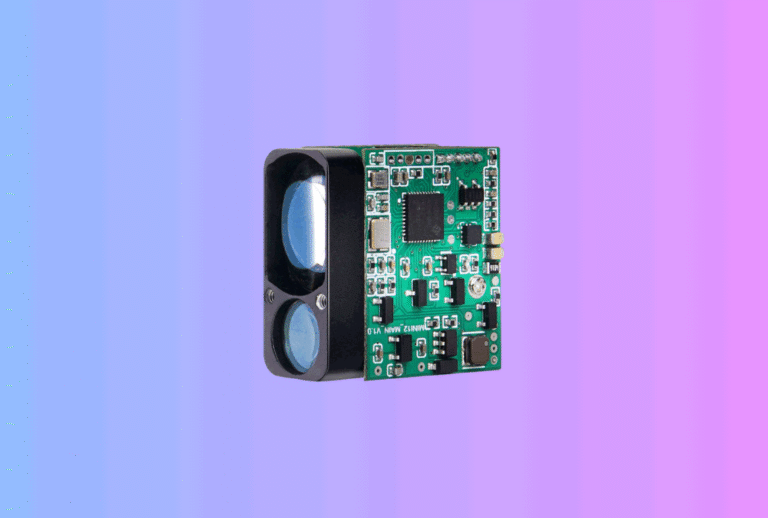
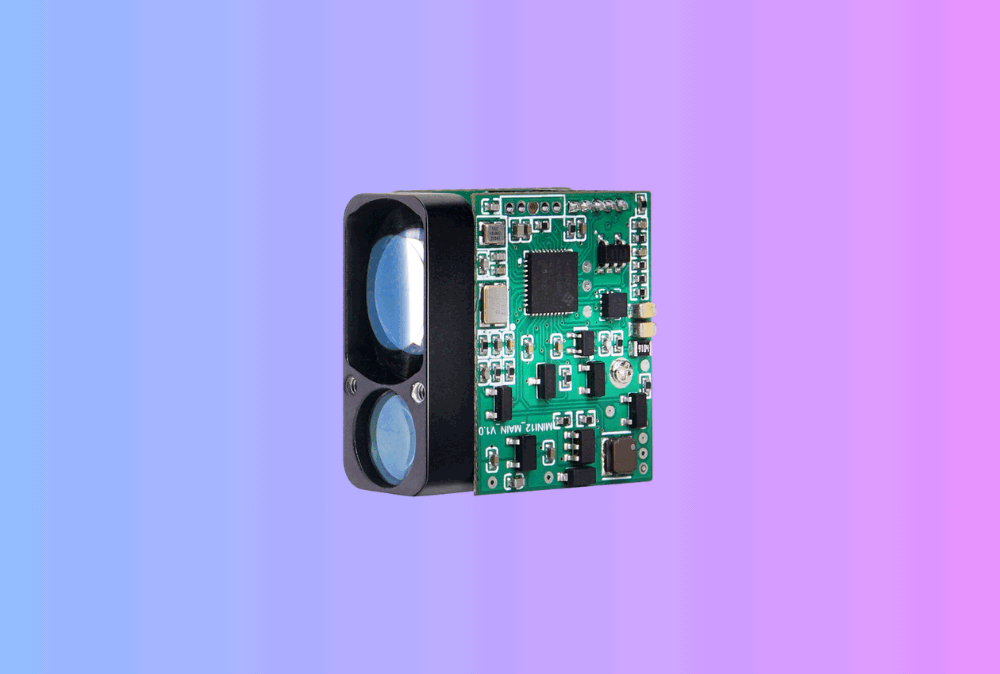
A laser rangefinder module is one of the simplest ways to give robots and AGVs precise distance awareness for docking, obstacle detection and edge protection. But if you only “bolt on a sensor,” you quickly run into real-world problems: blind spots, nuisance stops, unstable readings in dust, or EMC issues that appear during CE/FCC testing.
Table of Contents
ToggleThis guide walks through how robotics and warehouse integrators can design around a module, not just drop one in. It is written from the perspective of a China-based OEM/ODM manufacturer that supplies configurable laser rangefinder modules and supports long-term industrial programmes.
1. Why rangefinder modules are attractive for AGVs and mobile robots
In warehouses and factories, mobile platforms need reliable distance information in front of, beside and sometimes behind the vehicle. A laser rangefinder module offers compact, absolute distance data along its beam, with repeatability that is hard to match using only vision or bumper switches.
For AGV and AMR designers, a module-based approach brings three big advantages.
First, it decouples the “ranging engine” from the rest of the robot. You can standardise on one or two module platforms and reuse them across different chassis and software stacks. That simplifies spare parts, testing and documentation.
Second, an industrial-grade module is already calibrated, temperature-compensated and verified. Instead of building your own ranging electronics from scratch, you integrate a tested building block and focus on coverage logic, safety zones and fleet behaviour.
Third, modules are easier to plan for over 5–7 years than custom one-off electronics. When you use a configurable platform and the supplier has a clear roadmap—like the OEM approach described in Gemin’s rangefinder module integration service—you can align product lifecycles with your robot platform.
2. How a laser rangefinder module fits into your system
At its core, the module performs a time-of-flight measurement: it emits a laser pulse, measures the return time from a target, and converts that into distance using precise timing electronics and signal processing.
In a robot or AGV, the module becomes one element in a broader perception stack:
- The module provides precise forward distance, often in a narrow beam.
- Safety LiDAR or scanners provide wide-area protective fields.
- Bumpers, ultrasonics or cameras provide redundancy and cross-checks.
The module communicates with your main controller—usually via UART, RS232/RS485 or CAN—sending distance, signal quality and status flags. How you interpret that data (stop, slow, warn, log only) is what turns a generic measurement into a safe, predictable behaviour.
3. Coverage, FOV and mounting: designing around geometry
Most integration problems are geometric, not electronic. Before comparing modules, define how you actually want your AGV to “see” the world.
Start by mapping zones on a top view of the vehicle: a hard-stop zone immediately in front, a warning zone beyond it, and perhaps slower “caution” distances at higher speeds. Consider corner swing, overhanging loads and the path of forks or arms.
Once you have those shapes, you can work backwards to range and FOV. A single forward-facing module may cover straight-ahead hazards and dock faces. If your vehicle has long forks or significant overhang, you may need angled modules near the corners to see pallet edges and racking columns.
Mounting height and tilt angle are equally important. If the module is too low, it lives in spray and debris; too high, and it may miss low obstacles or pallets on the floor. Many designers position modules so that the beam crosses typical leg and pallet heights, then tilt slightly downward so it “cuts” the floor near the vehicle and can detect dock edges or pits. Small angle changes can move the blind zone by half a metre or more, so modelling and real-site testing are essential.
4. Performance requirements: not just “0.2–30 m”
Datasheets often headline maximum range, but AGVs care more about usable performance on real targets. Dark pallets, rubber bumpers, dull painted steel and high-angle surfaces are much harder than white calibration boards.
In practice, you will specify your laser rangefinder module performance in terms of:
- minimum and maximum useful range in the actual warehouse environment
- accuracy and, more importantly, repeatability across that range
- behaviour on low-reflectivity and angled targets
- how the module reports low signal, saturation or invalid readings
The goal is to engineer a system that fails predictably. The robot should know when it has good, marginal or bad distance data, and react accordingly. That requires a protocol that exposes not just “distance” but also signal quality and error codes—a point where a mature OEM-grade module, like those described in Gemin’s OEM laser rangefinder module guide, makes integration easier.
5. Matching interface and controller: UART, RS485 or CAN?
For robotics, the physical interface is not an afterthought. It determines wiring, noise immunity and software effort. The table below summarises common choices.
| Interface | Typical Use in AGVs | Strengths | Points to Check |
|---|---|---|---|
| UART / RS232 | Simple, short runs to a local MCU | Easy to implement; good for evaluation and low-noise environments | Cable length limits; need for proper shielding in noisy bays |
| RS485 | Longer runs on the chassis | Differential signalling, robust in industrial EMI | Termination, grounding, multi-drop addressing if sharing a bus |
| CAN | Integration into vehicle network | Native to many ECUs; good for diagnostics and status | Message mapping, CAN IDs, bandwidth with other traffic |
When choosing a module, look for clear protocol documentation and examples. In many AGVs, designers start with UART during evaluation, then migrate to RS485 or CAN in the final design for noise immunity and easier system-level diagnostics.
Whatever bus you choose, reserve bandwidth for status and health reporting, not just distance values. That’s what allows you to build fleet-level monitoring and predictive maintenance later.
6. Safety concepts and eye safety
A lot of warehouse robots still depend on certified safety scanners and bumpers for their primary protection. A laser rangefinder module usually acts as an assistance sensor: good for early detection, docking and control logic, but not a complete safety system by itself.
When you integrate a module, you should still map its role into your overall safety concept. It might feed a safety PLC as a non-safety-rated input that requests deceleration, while certified scanners enforce the final stop zone.
Eye safety is another axis. Most modules for mobile equipment target IEC 60825-1 Class 1 operation, often at 905 nm or 1550 nm. Your mechanical design must keep that classification valid: avoid housings or windows that concentrate the beam and be careful with any modifications to optical paths. Insist on up-to-date eye-safety documentation from the module supplier so your labels and manuals are accurate across markets.
7. Mechanical, environmental and EMC design
Once you are comfortable with coverage and electrical integration, mechanical and environmental engineering decide whether the system survives the real factory.
AGVs live in vibration, shock and occasional impacts. Brackets must be rigid enough to prevent slow creep in alignment yet decouple the module from harsh shocks when possible. A small angular shift at the mount can move the beam by tens of centimetres at 10–20 m, so structural stiffness and fasteners matter.
Dust, fibres and moisture are constant companions in warehouses. For the rangefinder, a clean, well-sealed window in front of the optics often matters more than the naked module’s IP rating. Choose window materials and coatings that transmit well at the module’s wavelength and are easy to clean without scratching. Routing of cables should anticipate drip paths, wash-downs and operator access.
Electromagnetic compatibility is the last layer. Motor drives, inverters and chargers create noise. Good practice includes shielded cables, careful grounding and keeping the rangefinder harness away from high-current paths. A supplier experienced with industrial markets—and referenced across multiple laser rangefinder module case studies—can often share layout tips that save you one or two painful CE/FCC test cycles.
8. Testing and validation: from bench to warehouse
Validation should move in stages rather than jumping straight to live traffic. Bench tests come first: measure distance on calibration boards and real materials at various angles, log readings at different distances, and check update rate and latency under your chosen interface and baud rate.
Next, simulate worst-case obstacles: wrapped pallets, shiny steel, black rubber, mesh cages. Compare module outputs to ground-truth distances and assess how often readings are invalid or unstable. The goal is not to eliminate every odd sample but to understand patterns and design filtering logic that respects your braking distances and safety margins.
Only then is it time to move to on-site trials. Run the AGV in real aisles with live traffic, first with low speeds and controlled scenarios, then with more realistic operating patterns. Pay special attention to dock edges, ramps, intersections and areas with strong reflections. Use these trials to refine tilt angles, module positions and decision thresholds.
Throughout this process, logging helps. A module that reports both distance and signal quality, combined with a robot controller that can store traces, will give your engineers enough data to improve algorithms and convince safety stakeholders.
9. Lifetime, derating and supply stability
Even in clean facilities, AGVs are expected to run continuously for years. That makes derating and platform choice part of the design.
From a module perspective, derating means avoiding “always at maximum stress” operation: don’t run at full pulse repetition frequency if your control loop does not need it, and ensure the thermal environment around the module keeps internal temperatures comfortably within spec. A supplier who designs for 5–7 year lifetimes will often share guidance on practical limits for duty cycle and ambient conditions.
Supply stability is the other half. Choosing a platform module documented for long-term production is safer than a one-off custom board. Because Gemin Optics uses its rangefinder cores not just in AGV modules but also in other outdoor and industrial products, the underlying components benefit from aggregated demand. That helps keep sensor and optics supply predictable and reduces your risk of sudden redesigns.
For brands planning to combine ranging with thermal imaging or other sensors later, co-planning with a partner that also builds thermal modules and thermal rifle scopes can simplify future multi-sensor projects and avoid diverging hardware stacks.
10. Working with Gemin Optics on AGV and robotics LRF projects
As a China-based laser rangefinder module manufacturer and OEM/ODM supplier, Gemin Optics focuses on modules that are ready for integration rather than lab experiments. For robotics and AGV customers, that typically includes:
- configurable modules with ranges suitable for indoor AGVs and outdoor UGVs
- industrial interfaces (UART, RS232/RS485, CAN) backed by clear protocols and SDKs
- factory calibration, temperature compensation and 100% functional testing
Beyond hardware, we help OEMs map their requirements into robust designs: geometry reviews, interface selection, EMC and environmental guidance, and ramp-up planning. Our integration services sit alongside our thermal and optics solutions, giving system integrators one ecosystem for ranging, imaging and future sensor fusion.
CTA – Design Your Next AGV Around a Stable Laser Rangefinder Module Platform
A laser rangefinder module is not just another sensor on the BOM; it is a core building block for safe, predictable navigation in warehouses and factories. When you treat coverage geometry, performance, interfaces, mechanics and lifecycle as a single design problem—and work with an OEM partner who understands all of them—you reduce integration risk and build fleets that behave consistently year after year.
If you are planning a new AGV or mobile robot platform, or upgrading an existing design, you can explore Gemin Optics’ configurable laser rangefinder modules and the dedicated rangefinder module integration service. Share your zone diagrams, speed profiles and environmental constraints with our engineering team, and we can help you choose and integrate a module platform that matches your safety concept, supply needs and long-term roadmap.