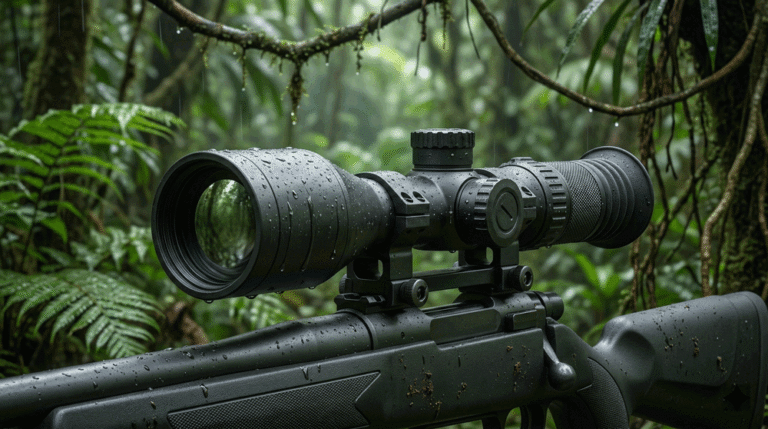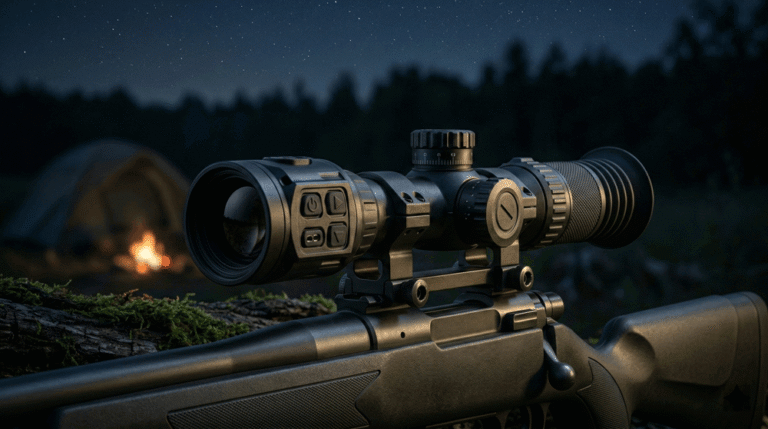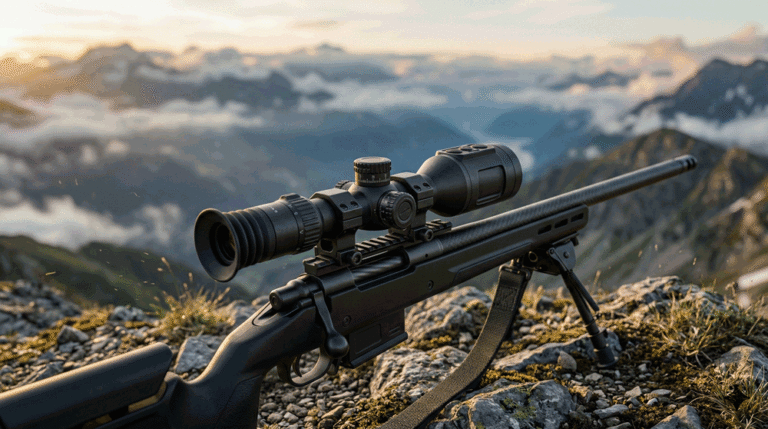
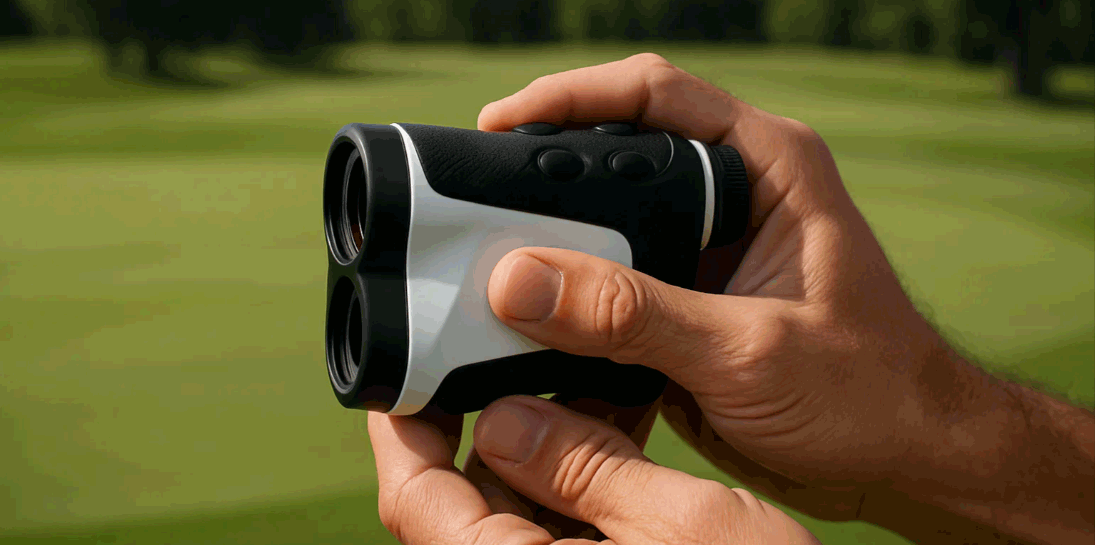
Lead. Hunting devices fail in the places spec sheets don’t reach—at the bench under magnum recoil, in freezing sleet, and inside a hot truck cab. This article shows OEM/ODM product managers, integrators, and distributors how to qualify a laser rangefinder OEM module for real hunts: rifle-grade recoil profiles, IP sealing that survives process drift, and freeze–thaw/temperature cycling backed by MIL/IEC references. You’ll leave with concrete selection rules, test gates you can publish, and a verification plan buyers trust.
Table of Contents
ToggleExecutive Summary
A hunting LRF is a system: optics, mechanics, electronics, and firmware take the same shock and weather. Qualify it as a system.
- Recoil comes first. Map your customer’s rifles to a repeatable g-profile and prove boresight stability and ranging continuity between shots, not in a separate lab day.
- Waterproof means process, not a sticker. O-rings are geometry + squeeze + grease + torque + cleanliness; document all five and re-test after thermal and drop stress.
- Thermal is where fog is born. Control internal dew point (dry purge, clean build), then run IEC 60068-2-14 change-of-temperature cycles for “no internal condensation” and stable HUD contrast.
- Paperwork still matters. Classify to IEC 60825-1 Class 1 and use the FDA Laser Notice No. 56 pathway for U.S. shipments; re-confirm after stress.
- Publish acceptance, not adjectives. Lock-rate, latency, boresight drift, and mWh/100 ranges sell better than “rugged.”
Use Cases & Buyer Scenarios
Scenario 1 — Magnum rifle integration
A channel partner wants rail-mounted ranging. You instrument a rifle to obtain a gunfire shock time history, then replicate it on a shaker using Method 519.8 guidance and a fixture matched to your mount stiffness. Your acceptance gates are plain: ranging continuity ≤300 ms after each shot; boresight drift ≤0.3 mrad after 100 rounds; no cracked windows, no reticle skew. Because the same customer buys night optics, align reticle prompts with your Thermal Rifle Scopes UI so training carries over.
Scenario 2 — All-weather handheld with long standby
Autumn RMAs read “foggy window” and “died after cold night.” You change the program to IP67 immersion plus temperature cycling, add nitrogen purge to a measured dew point, and switch the battery-door seal to a double-lip radial design. You publish energy per 100 ranges at −10 °C and +40 °C, and lock-rate in drizzle. The same module later feeds a binocular line, so you keep HUD layout consistent with Thermal Binoculars.
Scenario 3 — Private-label upgrade path
A distributor wants one SKU now, a “pro” SKU next quarter. You first qualify a compact Laser Rangefinder Module handheld to IP67 + rough-handling + 1.0 m transit drop. The pro SKU adds a documented 519.8-style gunfire profile and ISO 20653 spray/jetting so it survives pressure-wash. Marketing gets a one-page verification summary and a simple ROI table showing how a modest BOM uplift reduces returns and justifies a higher ASP.
Spec & Selection Guide
Your goal is predictable function after the stresses hunters actually apply. These parameters decide outcomes and how to pick them.
Definitions you’ll use throughout
- Recoil g-profile: a time-domain acceleration curve (g vs ms) measured at the mount. Peak g alone is misleading; dwell and rebound drive failures like barrel creep, reticle drift, and solder cracks. Method 519.8 explains how to derive deterministic histories from SRS data.
- Boresight stability: angular shift between TX/RX optical axis and the sighting axis, in mrad, before/after stress. If boresight moves, a perfect range still misses.
- Ingress codes: IP67 (IEC 60529) = dust-tight + 1 m/30 min immersion. ISO 20653 adapts the IP logic to road-vehicle conditions with spray/jet pressure (e.g., IPX6K/IPX9K-style).
- Change of temperature: IEC 60068-2-14 cycling (e.g., −20 ↔ +55 °C with dwell) that exposes seal breathing, trapped moisture, and HUD contrast drift.
- AEL / Class 1: Accessible Emission Limit for IEC 60825-1 Class 1 at your wavelength and repetition rate. It must hold for worst-case burst settings and after stress; Laser Notice No. 56 describes FDA’s conformance approach.
Choosing a qualification baseline (handheld vs rail-mount “pro”)
Ingress & sealing. Declare IP67 for rain and dunking. If end-users pressure-wash or mount on vehicles/ATVs, add ISO 20653 spray/jet validation and publish nozzle, pressure, temperature, distance, and duration.
Drop & handling. Use MIL-STD-810H Method 516.8 (Transit Drop) with the unit powered and ranging between drops. A practical level for compacts is 1.0–1.2 m onto steel with a 3 mm vinyl interposer, six faces + four edges + four corners.
Thermal & fogproofing. Build a sealing stack: dry purge to internal dew point ≤−40 °C, O-ring squeeze 15–25% with correct groove fill, compatible grease, torque windows, and clean assembly. Prove “no internal condensation” after IEC 60068-2-14 cycles and a −30 °C storage cold-soak.
Recoil. For rail-mount SKUs, derive a g-time history from an instrumented rifle and replicate using Method 519.8. Acceptance is boresight drift ≤0.3 mrad and ranging continuity ≤300 ms after each shot over a 100-round equivalent schedule.
Compact comparison (illustrative)
| Attribute | Handheld all-weather | Rail-mount “pro” |
|---|---|---|
| Recoil | None / light (tripod only) | 519.8-style rifle time history, 100 rounds |
| Ingress | IP67 immersion | IP67 + ISO 20653 spray/jet (publish parameters) |
| Drop | 516.8 transit drop 1.0–1.2 m | Same + clamp integrity audit |
| Thermal | −20 ↔ +55 °C cycles; −30 °C storage | Same + hot-soak; check self-heating |
| Acceptance | Lock-rate ≥80% @200 m in rain; no fog; drift ≤0.3 mrad | Same + post-shot ranging continuity ≤300 ms |
If/then decision rules
- If marketing says “pressure-wash ready,” then qualify to ISO 20653 jetting and publish nozzle/pressure/temperature/distance/time.
- If you claim “rifle-mount capable,” then test to a 519.8 gunfire shock profile and publish boresight drift ≤0.3 mrad after 100 rounds.
- If your top RMA is “fog,” then set an internal dew-point spec, purge with dry nitrogen, and make no condensation after 60068-2-14 an acceptance gate.
- If you change pulse width/burst settings for robustness, then recalc Class 1 AEL and reconfirm the Laser Notice 56 pathway.
Integration & Engineering Notes
Electrical & Interfaces
Keep power domains honest. A laser capacitor bank can sag rails; isolate TX from MCU/HUD and budget peak current at cold. Provide UART (115.2–921.6 kbps) for range, confidence, and mode; expose USB-CDC for factory tools and firmware. If partners will fuse ranges into ballistics or video overlays—common in Thermal Rifle Scopes—add a 1 PPS or sync input and timestamp each measurement at microsecond resolution. Your SDK should set first/last/scan modes, burst length, and AGC options; always return confidence and valid-return count with the distance.
Optics & Mechanics (mounting, alignment, sealing, recoil/vibration)
Treat alignment like a spec. Keep TX/RX barrels within 0.2 mrad wedge; design mounts so recoil loads bypass glass. For sealing, follow the O-Ring Handbook: 15–25% squeeze, 85–95% groove fill, rounded land edges, lubricant compatible with elastomer and optics, and torque windows for bezels/doors. Use AR-coated windows, blackened baffles, and a small wedge on the window to avoid back-reflections into the receiver after drops. If a SKU will live on rails, reinforce bosses with metal inserts and use threadlocker that matches the housing resin.
Firmware/ISP/Tuning (AGC, fusion, filtering, ranging algorithm)
Cold and recoil change noise and aim. Set cold-start AGC to expected noise floors so the first ranging after a −10 °C night doesn’t false-lock. Matched filtering makes slightly longer pulses (often required to keep Class 1 while raising pulse energy) look clean to the detector. On the HUD, keep prompts actionable: if confidence dips after a recoil burst, show “Rescan (low confidence),” not a silent number. Keep tone and overlay style consistent with your Thermal Monoculars line for brand muscle memory.
Testing & Validation (bench → field, acceptance criteria and metrics)
Bench tests reduce surprises; field tests decide the truth.
- Recoil lab + range day. Measure the rifle’s g-profile with a tri-axial accelerometer at the rail. Replicate on a shaker per 519.8. Validate at a live range with the same mount. Pass: boresight drift ≤0.3 mrad; ranging continuity ≤300 ms after each shot; no cracked optics.
- Ingress. IP67 immersion (1 m/30 min). If you claim spray/jet, add ISO 20653 with published nozzle, pressure, medium temperature, standoff, and duration. Pass: no ingress; full function; no bubbles under vacuum check.
- Thermal. IEC 60068-2-14 cycles (e.g., −20 ↔ +55 °C, dwell to stabilization), then −30 °C storage. Pass: no internal condensation; HUD contrast within ±3%; energy per 100 ranges within ±5% of baseline.
- Drop & handling. MIL-STD-810H 516.8 transit drop (1.0–1.2 m, powered, six faces/edges/corners) and IEC 60068-2-31 rough-handling for latches/doors. Pass: no cracks; boresight drift ≤0.3 mrad; repeatability ±0.5 m at 200 m (10 locks).
- Datasheet metrics that matter. Publish lock-rate (e.g., ≥80% at 200 m in rain), latency (mean/95th), drift, and energy per 100 ranges. Buyers can verify these quickly in pilots.
Compliance, Export & Certifications
A rugged product still needs clean paperwork.
- Laser safety. Classify to IEC 60825-1 Class 1 for your wavelength and worst-case repetition rate, pulse width, and burst counts. For U.S. marketing, follow FDA Laser Notice No. 56 (conformance to IEC). After recoil and thermal stress, re-measure divergence and confirm AEL hasn’t crept.
- CE/FCC/RoHS. In the EU, prepare a Technical File and Declaration of Conformity (LVD/EMC/RoHS). If the device includes BLE/Wi-Fi, add radio testing. In the U.S., assess unintentional emissions (Part 15) for your digital device and document results.
- Marking & records. Place Class 1 and IP claims near the aperture/battery door with a lot code. Keep lot-linked records: recoil logs, ingress photos, torque audits, purge dew points.
Export note: 905 nm consumer LRFs are usually low-risk, but rifle-specific mounts and advanced ballistic integrations can change the picture. If you bundle with Thermal Pistol Sights or a Thermal Clip-On Sight, check regional rules early.
Business Model, MOQ & Lead Time (OEM/ODM)
Planning and proof make channels faster.
- MOQs & samples. 200–300 pcs for catalog optics and seals; 500–1,000 pcs for custom divergence optics, reinforced mounts, or ISO 20653 fixtures. EVT samples in 4–6 weeks with catalog glass; add 6–10 weeks for new windows or barrels.
- Private label tiers. Offer “All-Weather” (IP67 + fogproof) and “Pro-Recoil” (rail profile + ISO 20653 spray). Ship a one-page verification summary with each lot.
- Deliverables. Include SDK docs, a mounting guide, a torque chart, and acceptance test templates. These shorten integration cycles and reduce support tickets.
Tiny distributor ROI (illustrative)
| Assumption | Value |
|---|---|
| Ex-works (Pro-Recoil, IP67, purge) | $109 |
| Landed (duty + freight) | $9 |
| Distributor sell | $169 |
| Gross per unit | $51 |
| Monthly volume | 800 |
| Monthly gross | $40,800 |
The extra BOM for seals, purge, and mounts is modest; the ability to publish real acceptance data supports a $10–$20 ASP uplift and lowers returns.
Pitfalls, Benchmarks & QA
Most rugged claims fail for avoidable reasons. These are the common ones—and the fixes.
Peak-g obsession. Peak g without dwell makes you feel safe until the first cracked adhesive joint. Capture the full recoil time history and replicate it with fixture compliance; audit strain at glue lines.
“IP68 covers everything.” IP68 is depth/time immersion, not high-pressure spray. If users pressure-wash, validate to ISO 20653 and publish your jet parameters.
Fog solved by desiccant alone. Desiccants saturate; moisture returns after cycles. Dry purge to a measured dew point and verify with IEC 60068-2-14.
Testing unpowered. Ingress that looks fine unpowered fails when the HUD warms. Run powered IP and thermal tests with live ranging.
No post-stress Class 1 check. A drop can tighten divergence and push AEL. Re-measure divergence and reconfirm AEL after stress; update the file.
Ambiguous acceptance. “Looks good” is not a pass. Write crisp gates: drift ≤0.3 mrad; lock-rate ≥80% in rain at 200 m; latency ≤180 ms; energy change ≤5%.
Field benchmark that fits on one slide
Take five units to a live range with 100/200/400 m plates and bark targets. Fire 20 controlled shots with the heaviest customer rifle while ranging between strings. Log: boresight drift, lock-rate, latency (mean/95th), and energy per 100 successful ranges at ~100 klx sun and in light rain. The chart you produce from this day is your best sales asset—and your best engineering dashboard.
FAQs
Do we need recoil testing if we only claim “handheld use”?
If there’s any chance customers will mount it, the market treats it as rail-ready. Either state “not for rifle mounting” or qualify to a modest 519.8-style profile and publish limits.
Is IP67 enough for hunters?
For rain and a quick dunk, yes. If users pressure-wash, ride ATVs, or hunt coastal spray, add ISO 20653 jetting and publish nozzle/pressure/temperature/distance/time.
How do we prevent internal fog?
Dry purge (nitrogen or argon) to ≤−40 °C internal dew point, low-permeation seals (correct squeeze and groove fill), and clean assembly. Verify “no internal condensation” after IEC 60068-2-14 cycles.
Will longer pulses break Class 1?
Not if you redesign the AEL budget. Slightly lengthen pulse width while holding peak power, then classify worst-case repetition and burst settings; reconfirm after stress per Laser Notice 56 documentation.
What should we put on the datasheet besides “max range”?
Publish lock-rate in rain at 200 m, latency bars (mean/95th), boresight drift after recoil and drop, and energy per 100 ranges at −10 °C and +40 °C. Buyers can verify these quickly.
How do we sync ranges with ballistics?
Expose a hardware sync (1 PPS or similar) and timestamp at microsecond resolution so downstream fusion in Thermal camera module software or app overlays is trivial.
Call-to-Action (CTA)
If your promise includes “rail-mount capable” and “all-weather,” we’ll help you make it true—and provable. Our team can deliver recoil profiles, sealing stacks, and thermal/ingress plans with clear acceptance gates, then validate them at the range. Explore our Laser Rangefinder Module platform, or discuss fused day/night roadmaps that pair your LRF with Thermal Monoculars, Thermal Rifle Scopes, and a Thermal Clip-On Sight line.
Sources
- FDA — Laser Products: Conformance with IEC 60825-1 (Laser Notice No. 56), guidance for U.S. compliance (2019 PDF). fda.gov
- MIL-STD-810H Method 519.8 — Gunfire Shock, derivation and replication of rifle-grade shock time histories (DoD/industry copy). CVG Strategy
- MIL-STD-810H Method 516.8 — Shock (Transit Drop), purpose and drop-table approach (overview/PDF). CVG Strategy
- IEC 60068-2-14 — Change of Temperature (Test N), temperature-cycling intent and outcomes (Intertek summary). Intertek
- ISO 20653 — Road-Vehicles IP Code (IPX6K/IPX9K spray/jet), automotive-style ingress conditions (Keystone overview). Applus+ Keystone
- Parker — O-Ring Handbook, squeeze/groove-fill fundamentals for robust sealing (2024/2025 edition). Parker Hannifin Corporation