Table of Contents
ToggleWhat NETD Really Tells You — Thermal Imaging Module Guide
A thermal imaging module NETD number sounds like the final word on sensitivity, but it’s only the beginning of real-world performance: detection and recognition at range depend just as much on optics MTF, IFOV, MRTD, calibration behavior, displays/codecs, and even the atmosphere your pixels must cross. In this B2B guide, we unpack what NETD actually measures, what it doesn’t, and how to buy, integrate, and acceptance-test a thermal imaging module so the number on a datasheet turns into mission outcomes.
Understanding NETD
NETD—noise-equivalent temperature (difference)—is a detector/system sensitivity metric: the temperature difference that yields SNR = 1 at the output under defined conditions. Lower NETD means finer temperature contrast can emerge from noise. In the literature, NET (NETD) is framed as a temperature that equals the detector’s internal noise, often reported per √bandwidth; in shot/Johnson-noise-limited cases, more integration time can reduce NET, while flicker-noise-limited cases won’t benefit. Typical uncooled bolometers sit in the ~30–200 mK ballpark, while cooled photon IR detectors can go much lower.
That’s what NETD is. What it isn’t is a guarantee of detection/recognition at distance. Those tasks are controlled by how well contrast at specific spatial frequencies makes it through the entire chain—lens MTF, sampling (IFOV), display and encoder, and the atmosphere between you and the target. MRTD (Minimum Resolvable Temperature Difference) explicitly captures this idea by plotting the minimum ΔT required to resolve a bar pattern vs. spatial frequency—a system curve, not a scalar.
Quick definitions you’ll actually use
-
- MTF/OTF: how the lens & system transfer contrast vs. spatial frequency; the practical measure of image sharpness.
-
- IFOV: the angular “size” of a pixel—the smaller it is (for a given target), the more samples across the target you get.
-
- MRTD: the ΔT you need to resolve a standard target at each spatial frequency; a curve that couples optics, sampling, noise, and display.
What NETD measures vs. what operators see
On the bench, NETD is usually measured under controlled optics (f/#), frame rate, bandwidth, and temperature. In the field, the atmosphere sits between the target and your lens, attenuating and emitting radiation. The infrared atmospheric window around 8–14 µm is “open,” but humidity and clouds can narrow it; absorption/emission along the path follow Beer–Lambert-style attenuation. Thus the same module with the same NETD performs differently in humid air vs. cold, dry nights.
Then there’s the display/encoder. NIST’s firefighter studies linked display image quality (contrast, brightness, resolution, nonuniformity) to task success—practical proof that an excellent sensor can still lose if tone-mapping and compression wash out mid-tones.
Bottom line: NETD is a necessary condition for sensitivity, not a sufficient condition for mission performance.
NETD vs. MRTD vs. DRI: how they relate
To move from a NETD scalar to a field prediction, teams often lean on MRTD curves and Johnson-style D/R/I (Detection/Recognition/Identification) thresholds. MRTD embeds optics MTF and sampling; Johnson’s criteria give pixels-on-target requirements for D/R/I probabilities (classic planning numbers). Use NETD to check that small ΔT features survive noise, use MRTD to check that small details survive blur/sampling, then use DRI to ensure enough pixels across the target.
| Concept | What it is | What it misses |
|---|---|---|
| NETD | Scalar sensitivity at SNR = 1 | Spatial frequency, optics, display/codec, atmosphere |
| MRTD | ΔT vs. spatial frequency system curve | Still needs realistic display/codec settings |
| DRI | Pixel-count thresholds for tasks | Ignores ΔT/SNR and display choices |
Why two modules with the same NETD look different
-
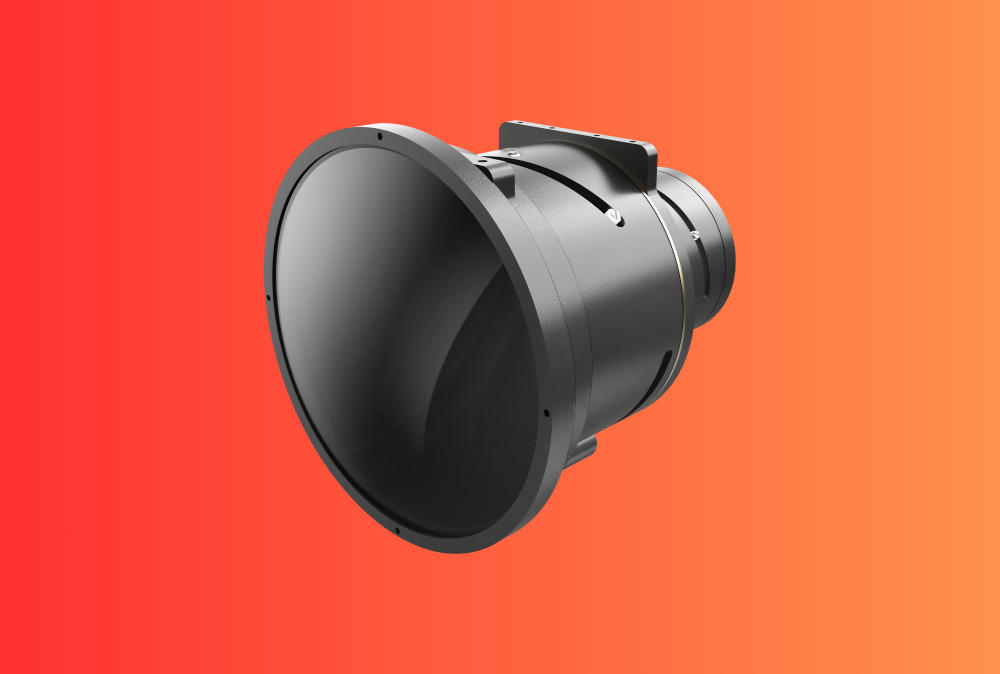
- Lens MTF & f/# – Higher-quality, well-focused optics preserve mid-frequency contrast your operators actually use; diffraction/aberrations and window contamination flatten MTF and waste your NETD advantage.
-
- IFOV & FOV choice – A module with tighter IFOV (via pixel pitch and focal length) puts more pixels on target at the same range; poor IFOV makes even “sensitive” cameras show mushy details.
-
- Atmospheric path – Humid air and long slant paths reduce contrast within the 8–14 µm window; performance swings seasonally.
-
- Display/codec – Bitrate floors and sensible tone curves preserve low-contrast cues; aggressive compression erases them. NIST linked display IQ to task performance.
Field geometry: the part NETD can’t fix
Even an outstanding NETD cannot compensate for undersampling. If a human torso spans only a few pixels, you might detect a blob but not recognize posture or identify gear. Johnson’s classic planning model sets pixel-count thresholds for those tasks; many modern planners still begin there, then derate for weather, motion blur, and display choices.
Rule of thumb: lock IFOV (pixel pitch ÷ focal length) and FOV to your target size and distance first; then ask whether your NETD is low enough to keep that detail above noise under your worst atmosphere.
How vendors report NETD
-
- Conditions matter: frame rate, bandwidth, f/#, and focal plane temperature influence results. Wikipedia’s NET discussion notes the per-√bandwidth reporting and integration-time dependence for certain noise regimes. If your use case differs (higher fps, different f/#), expect a shift.
-
- System vs. detector: some numbers are detector-only; others are camera-level (including optics and electronics).
-
- NUC state: Flat-field/NUC improves apparent uniformity and effective sensitivity; understand the calibration cadence behind the number.
Ask for: test setup (f/#, fps, integration time, temperature, bandwidth), system-level NETD, and sample images/videos at your likely bitrate and tone mapping.
A practical planning flow that starts with NETD but doesn’t end there
-
- Define targets & ranges (e.g., 0.5 m torso at 250/400/600 m).
-
- Select FOV/IFOV to achieve enough pixels across the target for the Johnson task (detection/recognition/ID).
-
- Check optical MTF at the spatial frequencies that matter (focus discipline, window cleanliness).
-
- Choose NETD low enough to keep those details visible in your worst atmosphere within the 8–14 µm window.
-
- Validate display/encoder: set bitrate floors and tone-curves that preserve mid-tones; NIST shows this affects task performance.
-
- Write acceptance tests (below) so fielded units match lab expectations.
Mini case study — perimeter corridor vs. coastal overwatch
-
- Perimeter corridor (dry inland nights): A 384-class system with a clean 35 mm lens produces sufficient pixels across a human at 350 m. A low NETD helps in cool dawns but the key swing factor is MTF & focus; a slightly soft lens erases gains a better NETD would promise.
-
- Coastal overwatch (humid, uniform horizons): Same module and NETD underperform on muggy nights; atmospheric absorption narrows the effective window and reduces contrast, so operators rely on careful tone curves and bitrate; occasional calibration ensures uniformity.
Integration & OEM/ODM: turning NETD into outcomes
-
- NUC policy: decide shuttered vs. shutterless vs. hybrid; keep telemetry (FPA temp, NUC events). Flat-field correction fundamentals are well documented and directly control residual fixed-pattern noise (DSNU/PRNU).
-
- Optomechanics: build a stiff focus with repeatable back-focus. MTF losses here waste sensitivity.
-
- Display/codec presets: ship a Search profile (higher bitrate, gentle tone-curve) and Overwatch profile (preserve mid-tones). NIST ties display IQ to user performance—treat it as a spec, not a preference.
-
- Documentation: record test conditions for the thermal imaging module NETD you publish; align customer acceptance to those conditions.
Acceptance tests you can put in a PRD
-
- System NETD @ fps/f/#: verify the marketed figure under the customer’s fps/f/# and temperature. Use a calibrated source.
-
- MRTD curve: measure at representative spatial frequencies to confirm contrast transfer; capture with final display/codec path if possible.
-
- IFOV/FOV confirmation: compute and validate pixel counts across a bar target at range.
-
- Display/codec IQ: require a minimum bitrate and tone-curve and run a perceptual task (NIST-style) to ensure mid-tones survive.
-
- Atmosphere drill: test on a humid night and a dry night; document contrast loss in the 8–14 µm window to build seasonal expectations.
Cost and lifecycle view
-
- Optics first: improving MTF with tighter tolerances and focus feedback can deliver bigger field gains than shaving 10–20 mK off NETD—especially beyond a few hundred meters.
-
- Bandwidth & storage: preserving low-contrast features takes bitrate; budget OPEX for links and archives so your thermal imaging module doesn’t have its best details discarded by compression. NIST’s work motivates treating display/codec as part of the performance spec.
-
- Weather risk: projects near coasts or in monsoon climates should plan derates due to atmospheric attenuation—even the best NETD cannot defeat humidity indefinitely.
Frequently Asked Questions (FAQs)
Q1: Is a lower NETD always visible to operators?
Not always. If optics are slightly defocused (MTF loss) or the display/codec compresses mid-tones, the field result may look the same. NETD is necessary sensitivity; transferring that sensitivity to the screen requires MTF, IFOV, and display/codec discipline.
Q2: How does NETD relate to resolution?
They are orthogonal: resolution sets sampling (pixels across a target), NETD sets contrast visibility. You need both: enough pixels and enough SNR to see the detail. MRTD links them via spatial frequency.
Q3: Can I forecast range from NETD alone?
No. Use NETD to ensure small ΔT survives noise; then use IFOV/FOV and Johnson’s criteria for pixels-on-target, and derate for atmosphere and display.
Q4: Why do humid nights hurt performance if my NETD is low?
Water vapor narrows the IR window and adds path emission/absorption (Beer–Lambert-type attenuation), reducing scene contrast at range.
Internal Links
-
- Review modules: Thermal camera module
-
- Engineering notes: Thermal camera module integration
-
- Work with us: OEM/ODM Partner Program
-
- Mixed sensing builds: Laser Rangefinder Modules
Call to Action
If you’re sizing a thermal imaging module for real detection/recognition—across seasons, codecs, and optics—we’ll turn your target sizes and ranges into IFOV/DRI math, define system NETD at your fps/f/#, and write acceptance tests (MRTD + display IQ) your ops team and CFO can agree on. Start with our Thermal camera module, see Thermal camera module integration, align via OEM/ODM Partner Program, then contact us to schedule a 30-minute spec workshop.