Lead:
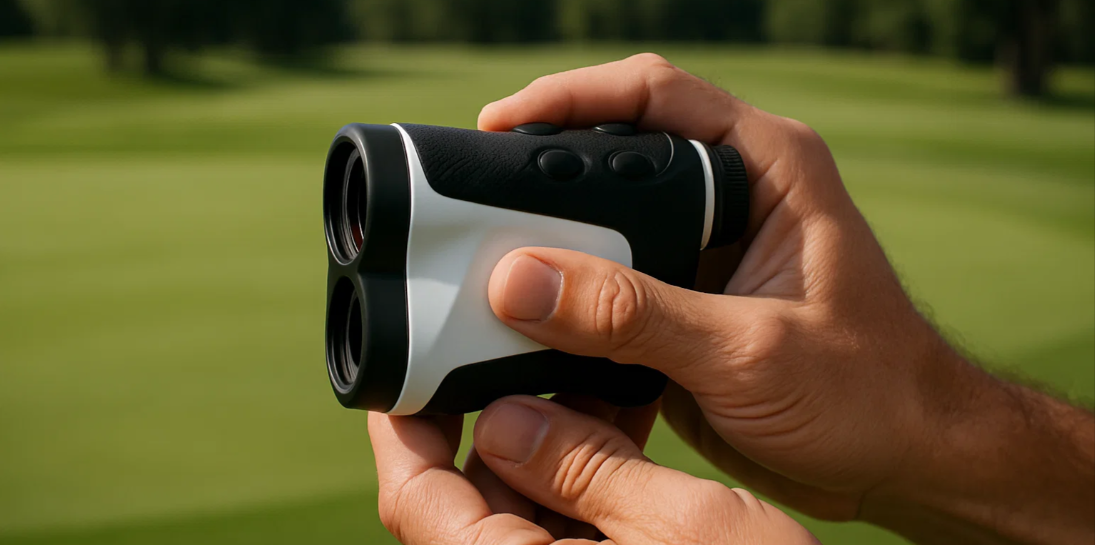
Launching a handheld golf rangefinder that truly “sticks” to the flag starts long before industrial design. It starts with the Laser Rangefinder Module you choose, and with the way you balance beam divergence, receiver FOV, and Class 1 eye safety. This playbook walks brand teams through a realistic module-first approach—from specing and tuning to compliance, packaging, and ROI.
Table of Contents
ToggleExecutive Summary
Golf rangefinders succeed when engineering decisions show up as user confidence on the course. A good Laser Rangefinder Module exposes clean serial control, reliable multi-return data, and consistent confidence scoring. Beam divergence, expressed in mrad across H×V, governs how much of the flag you “paint” versus the trees behind it; the receiver FOV should be sized to the beam rather than to a marketing wish. Compliance is not an afterthought: IEC 60825-1 Class 1 under FDA Laser Notice 56 must be planned alongside optics and firmware so labels, AEL calculations, and manuals are ready the day you cut tools. Finally, a channel-friendly BOM and schedule—samples within weeks, SOP inside a quarter—lets distributors order with conviction.
Use Cases & Buyer Scenarios
Tournament-legal consumer handhelds
Most brands lead with a distance-only unit that can disable slope for events adopting the Local Rule. These products live or die by how quickly they lock the pin between 200 and 300 yds, in bright sun, with average hand shake. The module should aim for moderate divergence and a receiver FOV that just envelopes the spot at those ranges; firmware favors closer-target bias and decisive haptics. If you need an integration starting point, see our Laser Rangefinder Module page for command sets and reference behaviors.
Coaching bundles and pro-shop kits
Some retailers package a rangefinder with a low-light viewer for dawn or dusk. The electrical and UX discipline you apply to a laser—latency budgets, clean HUDs, battery-aware thresholds—carries over to imaging products. For the observation companion in these kits, review Thermal Monoculars and how their ergonomics work around gloves, carts, and rain covers.
Course operations and maintenance
Facilities teams use rangefinders for staking, drainage checks, and sight-line planning. They value noon-sun readability, drop resistance, and documented safety. If your brand covers larger properties or marshaling at dusk, Thermal Binoculars round out the portfolio without complicating tournament legality for players.
Spec & Selection Guide
The specification phase is where teams either pay down risk or accumulate it. Treat beam divergence as the first-order control on pin-seeking behavior. A tighter beam concentrates energy on the flag, while a wider beam forgives aim error but paints more of the background. Most mainstream golf builds land between roughly 2.0–3.0 mrad horizontally and 1.0–1.8 mrad vertically (full-angle). Whatever you choose, document the definition you apply—1/e² or FWHM—and keep it consistent across vendors.
The receiver FOV should not be guessed. If it is much wider than the beam, you collect clutter and invite tree locks; if it is too tight, novice users struggle to keep the flag inside the “sensing cone” during scan. Optically, simple baffles and an NIR band-pass filter do more for bright-sun stability than most algorithmic tweaks attempted later.
On the electronics side, a clean APD/TIA chain with stable gain makes your confidence score predictable across temperature and battery. The scan loop matters as much as raw pulse energy: closer-target bias, multi-return clustering, and an N-of-M confirmation policy reduce jittery false locks while still feeling responsive.
Below is a compact comparison to anchor discussions between product, optics, and firmware:
| Parameter | Entry Handheld | Mid-Tier Flag-Lock | Premium Stabilized |
|---|---|---|---|
| Emitter / Class | 905 nm / Class 1 | 905 nm / Class 1 | 905 or 1550 nm / Class 1 |
| Beam Divergence (full-angle) | ~3.0 × 1.8 mrad | ~2.2 × 1.2 mrad | ~1.5 × 1.0 mrad |
| Receiver FOV | ≤4–5 mrad | ≤3 mrad | ≤2 mrad |
| Scan Behavior | ~8 Hz | 10–12 Hz + closer-target bias | 10–12 Hz + stabilization |
| Typical Flag Lock | 180–250 yd | 220–320 yd | 250–400 yd (with prisms) |
Reading this table as a story helps. The entry device is forgiving and budget-friendly, the mid-tier is the crowd-pleaser for weekend golfers, and the premium unit leans on stabilization and alignment discipline to justify price. All three can be Class 1 with careful AEL budgeting and coatings that lift on-target irradiance without crossing limits.
Integration & Engineering Notes
Electrical & interfaces
Your module should speak UART for mode control and result streaming, with USB reserved for firmware updates and log pulls after field trials. Exposing a compact SDK that returns raw and filtered ranges plus a confidence value shortens tuning cycles. If your roadmap includes mapping or coaching overlays, a light CAN/MAVLink-style telemetry stream keeps the HUD snappy without bloating firmware.
Optics & mechanics
A simple alignment jig saves weeks. Collimate the emitter to the sight axis, capture the spot at two distances, and record the H×V shape you actually ship. Mechanical decisions—lens recessing, gasketed windows, and smart polymer selection—go straight to durability and noon-sun readability. If you plan a magnetic “cart mount,” design the magnetic path so repeated attachment can’t creep the optical stack. For ruggedization habits borrowed from recoil-rated products, see our Thermal Clip-On Sight notes.
Firmware & tuning
Think of the ranging loop as a conversation between motion and evidence. When multiple returns appear, prefer the nearest stable cluster but demand brief consistency before buzzing the haptic motor. Let the low-battery state tighten thresholds rather than surprise users with erratic locks. If stabilization is present, align dwell timing so the indicator fires at the crest of real confidence, not during micro-corrections. For image-pipeline discipline that transfers neatly to HUDs and logs, our Thermal camera module documentation is a good reference.
Testing & validation
Bench tests make numbers comparable; field tests make products lovable. On the bench, two-distance NIR imaging (for example 25 m and 75 m with ND filters) produces defensible divergence data—just state your definition and keep rigs repeatable. In the field, run ten scans per distance at 150/200/250/300 yd on three courses: open, tree-lined, and one with prismed flagsticks. Record lock rate, mean lock time, false-lock percentage, and readability at noon. Finish with a thermal cycle and drop test, then re-verify alignment and AEL margin.
Compliance, Export & Certifications
Treat Class 1 as a product requirement, not a paperwork exercise. Building to IEC 60825-1 (Ed. 3) under FDA Laser Notice 56 lets you harmonize U.S. and international practice: you’ll prepare the AEL rationale, label artwork, and a user-manual safety chapter that match the device you actually ship. In parallel, plan for CE/FCC on the digital hardware and RoHS on the BOM. Tournament legality is a UX issue as much as a legal one—distance-only must be obvious at a glance, survive power cycles, and be explained in a one-page insert with screenshots. For documentation cadence similar to our imaging lines, review Thermal Rifle Scopes and how we version labels, warnings, and quick-starts.
Business Model, MOQ & Lead Time
Most private-label programs work comfortably with 500–1,000 pcs minimums and 2–4 weeks for pilot kits. First PO to SOP inside 10–12 weeks is realistic if artwork and test jigs are decided early; replenishment usually sits at 4–6 weeks depending on optics. Accessory choices—cart magnet, carry case, microfiber cloth, and either rechargeable packs or CR2/18650—change perceived value more than they change COGS. What helps distributors most is a clear single-page ROI built on conservative sell-through and modest promos:
| Assumption | Value |
|---|---|
| Ex-works unit cost | US$95 |
| MSRP / Street | US$199 / US$179 |
| Gross per unit (distributor) | ~US$84 |
| Sell-through | 40 units / store / season |
| Store count & season | 25 stores, 28 weeks |
| Gross margin / season | US$84,000 |
Align these numbers with your market size take and make the seasonality explicit in line reviews.
Pitfalls, Benchmarks & QA
The most expensive mistakes are quiet. Mixing half-angle and full-angle divergence inside one company corrupts every downstream comparison; pick one (full-angle) and state it everywhere. Over-tight beams without stabilization read well on a spec sheet but drive up returns when average golfers can’t hold the pin; nudge the vertical divergence and lengthen scan dwell instead. A receiver FOV that is “generous” in the lab turns vindictive near tree lines. Labels written to older notices invite audit comments, so update phrasing and symbols with the same rigor you apply to optics. And never skip noon-sun tests: users forgive a half-second of extra lock time; they don’t forgive a washed-out HUD.
FAQs
What divergence should I target without stabilization?
Most brands find the sweet spot near 2.0–3.0 mrad × 1.0–1.8 mrad (full-angle). Measure at two distances, record your definition, and size the receiver FOV to the spot—not to a round number.
Does Class 1 limit range?
No. Class 1 caps accessible emission for eye safety; real-world range reflects optics efficiency, divergence choice, receiver SNR, and how your scan loop decides.
How do I explain tournament legality to retailers?
Include a card that defines the Local Rule, shows the slope-off icon, and explains how the state persists after power cycles. Retailers will repeat those sentences to consumers verbatim.
Can thermal know-how help in a golf program?
Yes. Sealing, display readability, latency budgets, and robust quick-starts are shared muscles. Our imaging lines are a repository of those habits.
Call-to-Action
If you want a module-first golf rangefinder that locks fast and ships clean, we can help you choose divergence and FOV, tune the scan logic, and assemble a Class 1 file that matches the device you’ll sell. Start here: Laser Rangefinder Module.