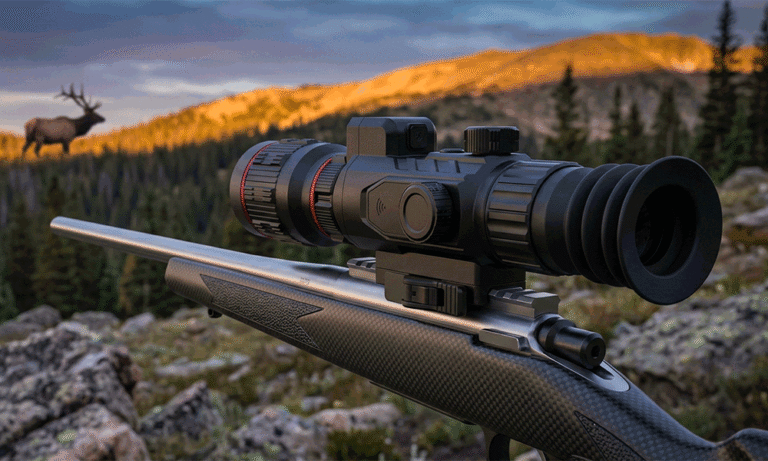
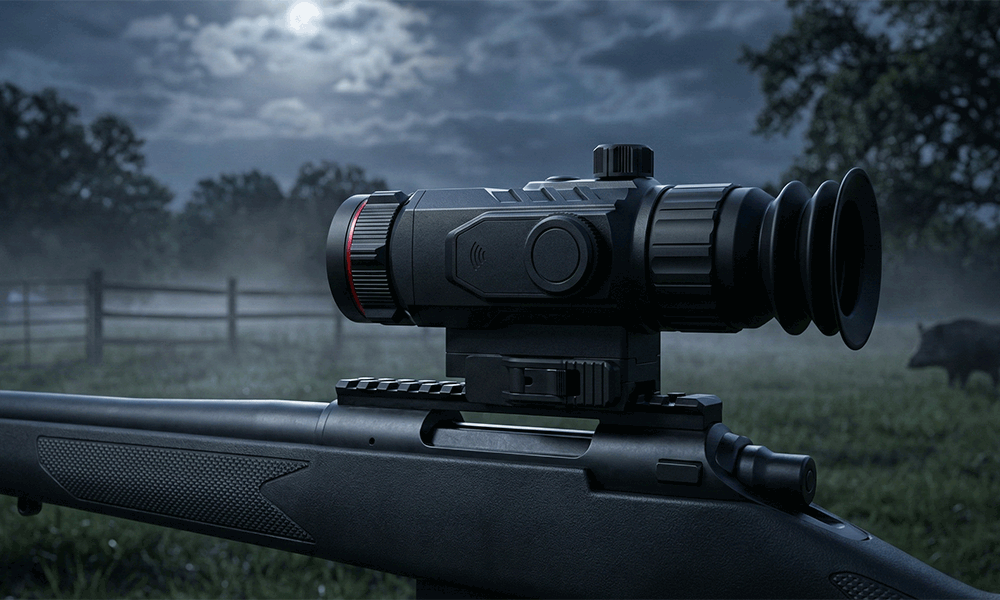
Building a professional thermal optics product line is not about chasing a single “hero spec.” In the outdoor and tactical market, buyers (brands, hunting distributors, and serious end users) pay for one thing above all: confidence in the field. That confidence comes from a complete system working together, shipped consistently, supported properly, and differentiated in ways that matter during real hunts.
Table of Contents
ToggleThis pillar guide is written for OEM/ODM buyers who want to launch or upgrade a thermal product line across thermal scopes, handheld monoculars, and clip-ons. These categories share a large overlap in core components and engineering decisions, which is why a unified OEM strategy often reduces cost, shortens development time, and improves brand coherence.
You’ll learn:
- Where the global market demand is moving (and what “premium” really means now)
- How core hardware choices (12 μm sensors, OLED, germanium optics) shape product grade
- What “deep customization” actually includes (ID, electronics, firmware/UI)
- How integrated LRF and ballistic workflows create pricing power and brand stickiness
- How to structure compliance and export readiness in a practical, brand-safe way
- A tier framework, a realistic development timeline, and an OEM decision checklist you can use immediately
1) Market Insight: Why Professional Thermal Optics Demand Is Shifting Upmarket
Across hunting and outdoor observation markets, the demand curve is shifting in two parallel directions: higher performance and higher integration.
Performance upgrades are driven by the need for reliable identification in hard environments: humidity, cluttered vegetation, dawn/dusk crossover, and long observation sessions. Buyers are less impressed by “detection range” marketing and more sensitive to micro-contrast, image stability, and comfort during scanning. This is why premium tiers increasingly emphasize lower noise, better optics, and stable image processing rather than just “more pixels.”
Integration upgrades are driven by user workflow. Modern hunting and tactical users want fewer separate devices and faster decisions. That’s why features like built-in video recording, app connectivity, LRF, and ballistic assistance have moved from “nice-to-have” into the premium mainstream. Dealers also prefer integrated products because the selling story is clearer and the price tier is easier to defend.
For brands and distributors, this trend creates an OEM opportunity: if you can deliver a platform that feels stable, professional, and customizable, you can support multiple SKUs (scope + monocular + clip-on) without reinventing the engineering stack each time.
2) A Product Grade Framework: Entry Premium, Premium-Value, and Flagship
Before choosing components, define your product grade. Most thermal programs fail because brands mix premium marketing with mid-tier system design, creating expectation gaps and return risk.
A practical OEM approach is to define three tiers and map hardware, features, and support requirements to each.
| Tier | Buyer Expectation | Typical Hardware Direction | Typical Feature Direction | What Makes It “Sellable” |
|---|---|---|---|---|
| Entry Premium | “Reliable first thermal” | 384-class or efficient 12 μm platform, solid optics | 25/50Hz (market-dependent), basic recording | Consistency, easy UI, honest positioning |
| Premium-Value | “Best balance for dealers” | Strong sensitivity class, upgraded optics, OLED | 50Hz, recording, optional app | Stable image, low fatigue, strong warranty flow |
| Flagship High-End | “Buy once, trust always” | Top sensitivity tier + premium optics | LRF, ballistic workflow, premium UI, streaming options | Field confidence, service speed, differentiation |
This framework keeps your line coherent. It also gives your OEM partner clear targets for system design, QC level, and upgrade path.
3) Core Hardware Selection: Why 12 μm Sensors, OLED, and High-Transmission Optics Define Product Grade
Professional thermal optics performance is shaped by three system anchors: sensor platform, display, and optics throughput. If any anchor is weak, the final image will feel weak, regardless of marketing.
3.1 Why 12 μm Sensors Matter (Beyond “Smaller Is Better”)
A 12 μm pixel pitch platform is widely used in modern outdoor thermal optics because it supports compact system design without sacrificing field-of-view flexibility. For many OEM programs, 12 μm enables:
- smaller lens packages for similar FOV targets
- lighter products (important for handhelds and clip-ons)
- better form factor options for multi-SKU platform strategies
However, pixel pitch is not the whole story. What matters commercially is how the platform performs as a system: uniformity, stability, processing maturity, and the ability to ship consistent batches.
A professional OEM strategy treats sensor selection as a platform decision: the sensor should support your intended lineup, not just a single SKU.
3.2 OLED Displays: Why “Premium Feel” Is Often a Display Story
For scopes and monoculars, the user’s perceived sharpness and comfort is heavily influenced by the display. OLED is widely used in premium tiers because it typically delivers:
- strong contrast and deep blacks (important for thermal imagery)
- fast response and smooth motion presentation
- comfortable viewing in low-light conditions
A premium sensor can still feel “average” if the display experience is washed out, slow, or visually fatiguing. This is especially noticeable during long scanning sessions, where comfort becomes a performance feature.
3.3 High-Transmission Optics: Why Lenses Decide Micro-Contrast
Thermal optics is a signal collection problem. The lens determines how much usable infrared energy reaches the detector. For professional hunting optics, high-transmission optics (often germanium-based with robust coatings) can materially improve:
- contrast in humidity and haze
- separation in cluttered vegetation
- identification confidence at distance
- perceived “cleanliness” without heavy noise smoothing
A brand can’t “firmware” its way out of poor optical throughput. If your positioning is premium, optics must be premium in both performance and consistency.
4) Customization Depth: What “Real OEM” Means in Thermal Optics
Many buyers say “OEM” but mean very different things. In professional thermal optics, customization typically falls into four layers: industrial design, electronics, firmware/UI, and system-level feature integration.
4.1 ID and Mechanical Customization
Industrial design is not just aesthetics. In thermal optics it also affects:
- ergonomics (button placement for gloves and night use)
- weight distribution (especially for handhelds and clip-ons)
- thermal management paths (housing as a heat sink)
- waterproofing strategy and serviceability
- recoil survivability (for scopes)
A professional OEM partner should be able to support ID changes without destabilizing reliability.
4.2 Electronics Customization
Electronics work includes power architecture, RF layout (if Wi-Fi/BT), memory/storage for recording, and robust connector design. The commercial value is consistency and serviceability, not “custom PCB for the sake of it.”
Deep OEM programs often include:
- power optimization for runtime stability
- improved EMI control (for stable wireless and clean imaging)
- better connector retention and shock robustness
4.3 Firmware/UI Customization (Where Brands Actually Differentiate)
Most thermal products share similar hardware. In the field, the brand experience often comes down to firmware and UI:
- menu logic and shortcut design
- multi-language implementation and typography
- reticle/zeroing workflow (for scopes)
- NUC behavior and user interruptions
- recording workflow and file management
- app pairing and OTA update strategy
This is where professional hunting brands build loyalty: a UI that works in the field feels premium even before a customer reads the specs.
4.4 System-Level Customization (The “High-End” Path)
System-level customization includes features like:
- LRF integration and calibration workflow
- ballistic calculation and profile management
- fusion overlays (thermal + optical/low-light)
- advanced detection cues (if used responsibly)
These features create real pricing power when they are reliable, calibrated, and usable under stress.
5) Brand Premium: How LRF + Ballistics Create Competitive Moats
Integrated LRF and ballistic calculation are not “feature checklist” items. They change how a user hunts.
With an integrated rangefinder, a hunter can confirm distance instantly without switching devices. With ballistic assistance, that distance becomes actionable. In premium markets, this delivers three brand benefits:
- Higher perceived professionalism (especially for long-range and open terrain)
- Stronger dealer story (clear reason for premium pricing)
- Higher switching cost (users stay with what they trust)
From an OEM perspective, the hard part is not adding an LRF module. The hard part is making it reliable through:
- physical alignment between rangefinding path and aiming/thermal axis
- calibration consistency across batches
- temperature and shock drift control
- UI presentation that is fast and unconfusing in the field
Brands that get this right can defend premium pricing even in competitive markets.
6) Scopes vs. Monoculars vs. Clip-ons: How to Build a Platform Strategy
A strong OEM program creates shared architecture while respecting each category’s unique constraints.
Thermal scopes require recoil survivability, stable zero retention, and a field-ready reticle/zeroing workflow. They are the highest risk category in warranty terms because failure is highly visible and highly consequential.
Handheld monoculars are the volume gateway product. They must be ergonomic, lightweight, stable during scanning, and comfortable for long sessions. They are often the first product a user buys, making them important for brand entry.
Clip-ons demand optical alignment stability and repeatability with day optics. They also demand strict attention to mounting consistency and potential POI shift behavior. Clip-ons can be powerful in regulated markets or for users who want modular flexibility.
A practical platform strategy shares sensor families, processing pipelines, UI logic, and accessory ecosystems (battery, app, cases) while optimizing the mechanical design for each form factor.
7) Development Timeline and Milestones: A Realistic OEM/ODM Roadmap
Professional thermal programs succeed when the development process is predictable. Below is a realistic milestone roadmap for OEM projects. Actual timelines vary with customization depth and certification scope, but the structure stays consistent.
| Phase | Typical Duration | What Happens | What You Should Approve |
|---|---|---|---|
| Requirements lock | 1–2 weeks | Tier definition, core specs, feature scope | Product grade matrix + target BOM logic |
| Platform selection | 1–3 weeks | sensor/lens/display platform decisions | Performance samples + platform feasibility |
| EVT (engineering validation) | 3–6 weeks | early prototypes, mechanical + firmware baseline | field usability, stability under load |
| DVT (design validation) | 4–8 weeks | refined design, reliability tests, UI polish | recoil/thermal tests, UX acceptance |
| PVT (production validation) | 3–6 weeks | pilot run, QC process stabilization | unit-to-unit consistency + yield |
| Mass production | ongoing | scalable production and support | warranty/RMA workflow + spares plan |
This roadmap is also a risk-control tool. The purpose is to ensure that your “premium promise” survives contact with real production.
8) Compliance and Export Readiness: Practical Guidance Without the Hand-Waving
Thermal optics programs cross borders. That means compliance isn’t a checkbox at the end. It needs to be designed into packaging, labeling, documentation, RF design (if applicable), and battery logistics.
This section is intentionally practical. It is not legal advice. It is a structure you can use with your compliance partner and OEM.
8.1 Compliance Deliverables Checklist (Brand-Friendly Version)
| Area | What You Typically Need | Why It Matters |
|---|---|---|
| Product labeling | model, power, manufacturer/importer info (market-dependent) | avoids customs and retail issues |
| User manual | safety notes, operating instructions, warnings | reduces liability and support burden |
| RF compliance (if Wi-Fi/BT) | relevant test reports/declarations (market-dependent) | required for legal sale in many regions |
| Laser safety (if LRF) | correct labeling and safety documentation | required to avoid regulatory and channel risk |
| Battery transport | packaging and shipping compliance (market-dependent) | avoids shipping delays and rejections |
| Distributor documentation | warranty terms, RMA process, compliance pack | builds dealer trust |
For OEM programs, the key is to assign responsibility clearly: what the OEM provides, what the brand provides, and what the importer/distributor must handle locally.
8.2 Country-by-Country Considerations (High-Level)
Different regions have different constraints on hunting use, device categories, and import requirements. A professional approach is to maintain a market compliance profile per target region and confirm:
- allowed use cases for thermal and clip-on devices in that market
- documentation and labeling requirements
- RF and laser requirements where applicable
- shipping pathways and battery constraints
This prevents the common failure mode where a product is technically good but commercially blocked.
9) Validation and Reliability: What “Professional Grade” Must Survive
Premium outdoor thermal optics are judged in harsh real conditions: recoil, drops, cold/warm cycling, humidity, and long high-load sessions.
A brand-ready OEM program validates:
- recoil resistance and mechanical retention (scopes)
- long-session stability under high refresh + recording + streaming loads
- NUC behavior (frequency and interruption style)
- waterproof sealing reliability
- unit-to-unit consistency across pilot production
- serviceability and spare parts planning
Reliability is not only engineering. It is a commercial promise. The more professional the positioning, the more expensive failures become.
10) OEM Decision Checklist: What Brands Should Ask Before Signing a Program
Use this checklist to protect your project and your reputation. A serious OEM partner should answer clearly and structurally.
| Topic | Question to Ask | What a Strong Answer Looks Like |
|---|---|---|
| Platform consistency | How do you control unit-to-unit image consistency? | QC plan + test items + acceptance thresholds |
| Reliability | What recoil/thermal validation do you run for scopes? | test method, pass criteria, failure-mode controls |
| LRF integration | How is physical alignment and calibration handled? | alignment procedure + drift control + QA checks |
| Firmware ownership | How do UI and feature updates work long-term? | version plan, release notes, OTA strategy (if used) |
| Compliance pack | What documents can you provide for target markets? | structured document list and responsibility split |
| Service model | What is the RMA and spare parts strategy? | turnaround plan, swap options, spare availability |
This is how you filter suppliers who can “ship products” from suppliers who can “build brands.”
Conclusion: Build a Thermal OEM Program That Creates Field Confidence, Not Just Specs
Professional thermal optics OEM is a system game. The winners align market demand, hardware anchors, and customization depth into a coherent product-grade strategy. They validate reliability before scaling, and they treat compliance and service readiness as part of the brand promise.
If you want to build a lineup that dealers trust and users recommend, your OEM program must deliver more than a spec sheet. It must deliver consistent field confidence.
Ready to Build Your Outdoor Thermal Optics Line?
If you’re planning an OEM/ODM program for thermal scopes, monoculars, or clip-ons, we can help you define the right product grade, select the correct hardware stack, and execute customization without sacrificing reliability.
Send the following project details through our website inquiry form (or your preferred contact method):
- Target markets (US / EU / AU / Other)
- Product categories (scope / monocular / clip-on)
- Desired tier (Entry Premium / Premium-Value / Flagship High-End)
- Feature scope (LRF, ballistic workflow, recording, app/streaming)
- Expected order volume and launch timeline
You’ll receive:
- a recommended SKU architecture (1–3 launch models + expansion plan)
- hardware stack guidance (sensor, optics, display, refresh strategy)
- a customization roadmap (ID/electronics/UI) with milestone timing
- reliability and compliance checklist tailored to your target markets
Recommended Reading for OEM Buyers
- Integrating Laser Rangefinders (LRF) and Ballistic Calculators into Modern Thermal Scopes
- Engineering for Recoil: How We Ensure Thermal Scopes Withstand High-Caliber Shock
- Customizing the User Interface (UI) for Hunting Brands: Enhancing Field Usability
- Thermal and Optical Fusion: The Next Frontier in Handheld Monocular Innovation