Lead:
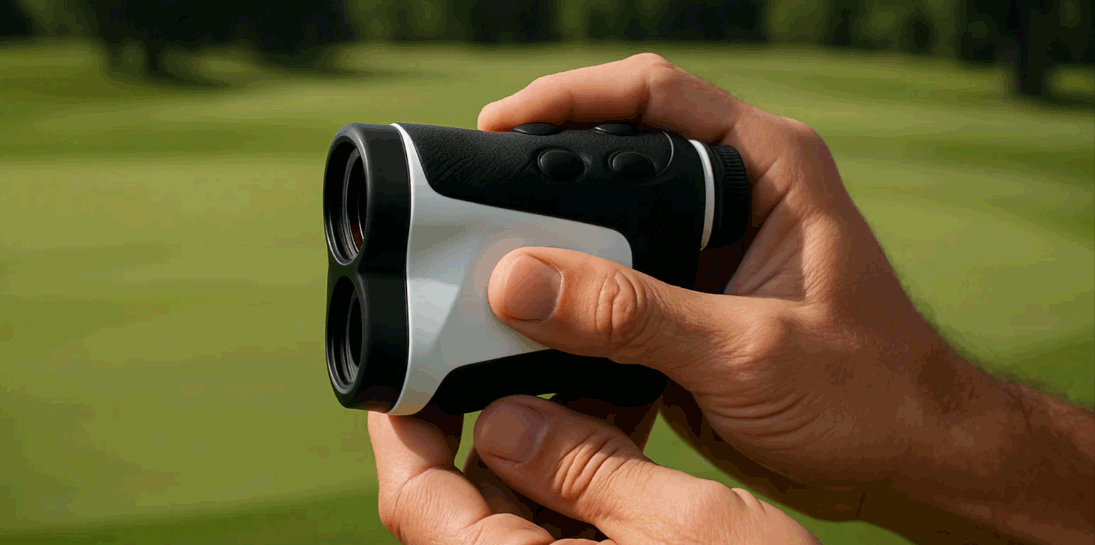
Golf buyers want one device that plays fair on Saturday tournaments and teaches smart yardages on weekday practice rounds. That balance is a firmware and labeling problem: implement slope compensation cleanly, make tournament-legal mode unmistakable, and keep your compliance file bulletproof. This guide shows how to design, ship, and support dual-mode golf rangefinders built on a laser rangefinder module—without UX tricks or legal gray areas.
Table of Contents
ToggleWhy “Slope On/Off” Is a Product Strategy, Not Just a Toggle
In golf retail, slope sells; in competitive rounds under the Local Rule, distance-only is required. Brands that nail the handoff between those two contexts (and make it obvious to marshals and players) win returns and shelf space. The work sits across five layers:
- optics and ranging that never lie;
- slope math that is defensible and predictable;
- dual-mode firmware that cannot be misread on the tee;
- UX that teaches the feature without creating DQ risk;
- a compliance/labeling package that matches what ships in the box.
Everything here assumes you start from a stable core. For command sets, UART control, and confidence-based ranging, begin with Laser Rangefinder Module.
What Slope Compensation Really Does
The device measures line-of-sight distance DDD and inclination angle θ\thetaθ to the pin. Slope compensation outputs an “plays like” distance D’D’D’ that approximates the club you should choose on level ground.
A practical form is D’=D⋅f(θ)D’ = D \cdot f(\theta)D’=D⋅f(θ). The simplest high-confidence model uses cosine for triangulation and a small ballistic fudge derived from test shots (club/ball speed ranges). For consumer devices, resist “secret sauce” that swings numbers wildly; golfers trust devices that change yardage a sensible amount at ±5–15° and saturate beyond that.
Two guardrails:
- Monotonic behavior (if the angle increases, the correction increases).
- No slope ghosting in distance-only mode (the main number must be true LOS, not corrected).
Dual-Mode Firmware: How to Make It Unmistakable
Mode architecture
Use two distinct operating states:
- Tournament-legal (distance-only): shows LOS distance only; hides angle and “plays-like.”
- Practice (slope): shows LOS distance, angle, and plays-like distance, plus any optional “club hint” you support.
Persist the last state across power cycles but boot into whatever the user last chose—not what marketing prefers. Golfers hate surprises on the first tee.
Engagement patterns that avoid confusion
- Long-press (e.g., 2–3 s) on a dedicated SLOPE key to toggle modes. A short press should never change legality.
- Distinct icons: a small “SLOPE” tag or triangle icon only when enabled; no icon when off. Don’t repurpose colors used for flag-lock.
- Hardware tell (optional but powerful): a physical slider with two detents (“SLOPE / LEGAL”) or a colored ring that is only visible in slope mode. Retailers love this; marshals can see it at a glance.
What the screen should show
- Tournament-legal mode: one number (LOS distance). If you must show angle for diagnostics, bury it in a long-press service screen—not in normal play.
- Practice mode: show LOS, angle, and plays-like clearly labeled. Never swap the position of the LOS and plays-like lines between modes; muscle memory matters.
Haptics and audio
A single tick on flag-lock is enough. Do not buzz when toggling slope; golfers change modes on the tee box and don’t want attention.
Slope Math That’s Predictable on the Course
Start with clean ranging (confidence-gated flag-lock). Then compute:
- LOS distance DDD from the laser rangefinder module.
- Inclination θ\thetaθ from a calibrated tilt sensor (2-axis accel or IMU).
- Plays-like D’=D⋅cos(θ)⋅(1+k⋅sin2θ)D’ = D \cdot \cos(\theta) \cdot (1 + k\cdot \sin^2\theta)D’=D⋅cos(θ)⋅(1+k⋅sin2θ)
The cosθ\cos\thetacosθ term corrects pure geometry. The small ksin2θk \sin^2\thetaksin2θ term models “ballistic reality” (trajectory height, air time) and should be a fixed brand constant, not a user profile. Keep kkk gentle (0.0–0.1 range depending on your testing). Publish a table internally so CX, QA, and firmware all tell the same story when a customer asks, “Why did this 145-yard shot play like 151?”
IMU calibration and drift
- Calibrate zero-tilt at the factory with fixtures; store temperature compensation.
- Add a one-tap “level check” in service mode that shows tilt readout so pro-shops can spot a drop-damaged unit.
- If you integrate night/observation devices (shared IMU pipeline), reuse the alignment flow from Thermal Binoculars and Thermal Monoculars.
UX Writing That Prevents Returns
Good micro-copy eliminates arguments:
- Mode labels: “Slope ON (Practice)” vs “Distance-Only (Tournament Legal)”. Avoid “Tournament Mode” alone—some federations vary in wording; “distance-only” is universal.
- Quick-start card: two frames are enough—Press to range; Hold SLOPE 3s to toggle.
- On-device help (1 screen): “Local Rule requires distance-only during competition. Use SLOPE for practice rounds.”
Avoid promise words like “pro-level ballistics.” You’re selling predictable yardage, not a launch monitor.
Compliance & Labeling
Laser safety and records
Design and document to IEC 60825-1 (Ed. 3) Class 1; for the U.S., align labels and records to FDA Laser Notice No. 56. Your tech file should include:
- AEL worksheet with your actual pulse parameters and divergence definition;
- Label artwork (wavelength, Class statement, manufacturer ID) matching product photos;
- Test setup notes and images;
- Change control that re-verifies AEL if emitter, optics, pulse width, or PRF change.
Tournament-legal clarity
Under USGA/R&A frameworks, distance-measuring devices are permitted for distance only when the Committee adopts the Local Rule. Your obligations as a manufacturer:
- Make distance-only unmistakable (UI + optional hardware tell).
- Ship user materials that explain the rule in plain English and never imply “slope is okay in tournament play.”
- Consider a SKU variant with slope physically disabled if you sell into schools or junior circuits.
A footnote in your manual should cite the “distance-only” condition and direct users to check the Local Rule in effect for their event.
Engineering Notes: From Bench to Tee Box
Optics & mechanics
Flag-friendly geometry is still the foundation: a ~1.5–1.8 mrad full-angle beam with receiver FOV sized to just envelope the spot at 100–220 m. Internal baffling and an AR-coated window tame noon glare. Mount the IMU close to the optical axis; store lever arm if needed.
Firmware
- Confidence-based flag-lock with N-of-M confirmation (~250 ms) and hysteresis; publish LOS even during scanning.
- Slope computation runs only in practice mode; do not compute and hide the result in legal mode (avoid debug leakage).
- Persist mode choice; debounce the long-press; never allow a short accidental toggle.
Display & power
Auto-dim on a log-like curve for dawn/dusk rounds; keep digits readable through sunglasses. Budget power so slope math doesn’t cause brownouts on aging batteries.
Validation on Real Courses
Create a reproducible course card that engineering and sales both use:
- Flat fairway (0–2°): LOS and plays-like should match within 1 yd at three distances (100/150/200 yd).
- Uphill approach (6–10°): plays-like increases predictably (publish a small expected-change table).
- Downhill par-3 (6–12°): plays-like decreases; ensure final digits don’t flicker when the golfer breathes.
Collect time-to-lock, success rate, and user comments. Repeat at bright noon and at late afternoon with background trees. If you sell internationally, re-run on links courses (wind, dunes) to verify hysteresis with a flapping flag.
Business & Channel Packaging
For golf retailers and private-label partners, bundle:
- Device preset to distance-only on first boot;
- Quick-start card (2 frames), microfiber cloth, and belt case;
- Compliance insert with Class 1 statement and label locations;
- One-page “slope explainer” that uses the same examples your support team quotes.
If you sell into outdoor distributors who also stock night gear, keep the rangefinder’s UX identical to day products and introduce related observation SKUs later (the user already learned your button logic): Thermal Rifle Scopes and Thermal Clip-On Sight.
FAQs
Is slope legal in tournaments?
Only if the Committee allows it (rare). The common Local Rule permits distance-only. Your product should make legal mode obvious and persistent.
Will slope work without perfect tilt calibration?
It will, but errors grow with angle. Factory calibration plus a service “level check” keeps devices honest after drops.
Should plays-like replace the main number?
No. Keep LOS as the primary number; display plays-like below it in practice mode only.
Can we store user-specific ballistics?
You can, but support cost rises. A gentle global kkk term with good messaging (“plays like on average conditions”) keeps the device predictable.
What about weather (wind, temp)?
Don’t guess. Golfers prefer predictable corrections over noisy “AI.” Teach them to re-range after gusts and use plays-like as a planning aid, not a promise.
Call-to-Action
Ready to ship a golf rangefinder that is clearly legal on Saturday and smart on Sunday? We’ll help you tune optics for flag-lock, implement slope math that behaves, and assemble a Class 1 and tournament-ready documentation pack. Build on a proven core and keep the UX calm, honest, and retail-friendly.
Start here: Laser Rangefinder Module
Sources
- FDA — Laser Products: Conformance with IEC 60825-1 (Laser Notice No. 56) — U.S. recognition of IEC laser safety conformance; labeling/record-keeping guidance. FDA
- IEC — IEC 60825-1 Safety of laser products — Part 1 — standard overview (webstore). IEC Webstore
- USGA / R&A — Distance-Measuring Devices (Local Rule) — distance-only permitted features. USGA