
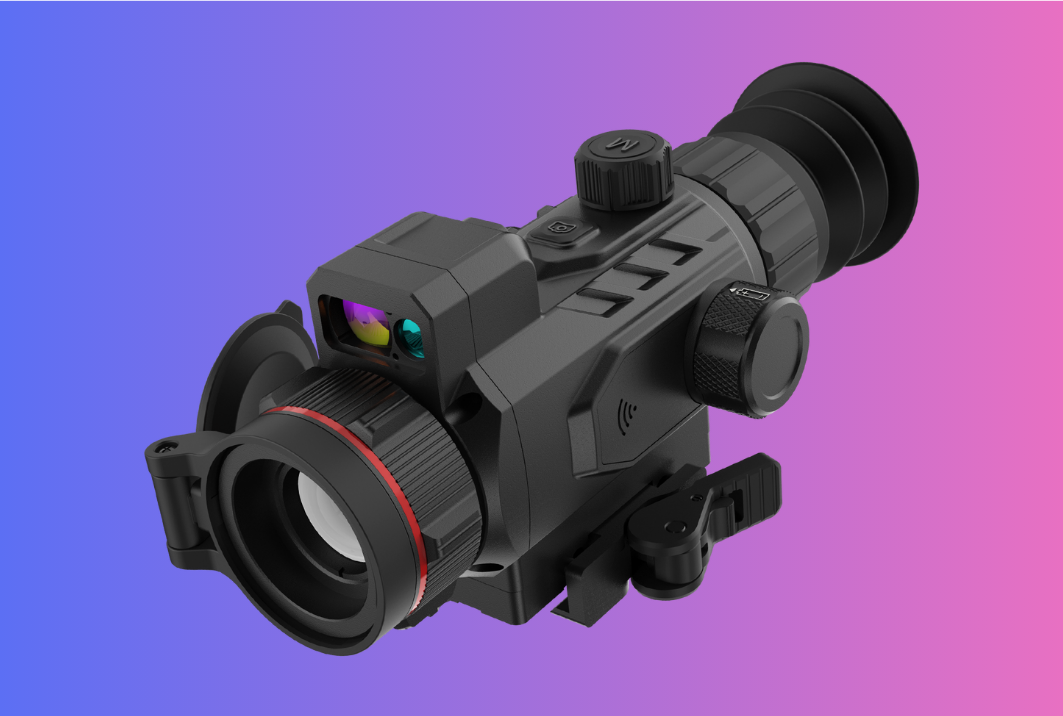
When people discuss Thermal Hunting Optics, the conversation usually starts with sensor resolution, NETD and lens options. But once a scope or monocular reaches the field, one question decides whether hunters keep using it every weekend: “Does the connectivity actually work?” WiFi and Bluetooth features are now standard on specification sheets, yet the real value depends on how they support zeroing, recording, sharing and firmware updates in real hunting conditions, not in the lab.
Table of Contents
ToggleThis article looks at connectivity in Thermal Hunting Optics from the hunter’s point of view, but with an engineering and product-management lens. It focuses on what functions deliver repeatable value, what typically goes wrong, and how OEM/ODM teams can design practical WiFi, Bluetooth and app ecosystems that dealers can confidently recommend.
1. Why connectivity matters in Thermal Hunting Optics
For many years, thermal rifle scopes and handheld monoculars worked as stand-alone devices. Image quality and detection range were enough to differentiate brands. Today, hunters expect their Thermal Hunting Optics to behave more like a connected camera or smartphone accessory.
Several trends drive this expectation:
- Night hunting is often a team activity: one shooter, one spotter, sometimes a guide or landowner following along.
- Short-form video content and hunting vlogs make recording and sharing thermal footage part of the experience.
- Dealers and brands want fewer returns, faster troubleshooting and the ability to push firmware fixes in the field.
Connectivity is no longer a “nice to have” marketing bullet. Done well, it becomes:
- A support tool for dealers, who can help customers update firmware or diagnose issues without shipping scopes back.
- A data pipeline for OEMs, if apps can collect anonymized usage information and feedback with clear user consent.
- A differentiator that keeps hunters locked into one product family instead of mixing brands.
2. Connectivity building blocks inside Thermal Hunting Optics
From an engineering standpoint, modern Thermal Hunting Optics consist of three layers of connectivity.
2.1 On-device hardware
Most connected scopes and monoculars integrate one or more of the following:
- WiFi module (2.4 GHz, sometimes 5 GHz) for high-bandwidth video streaming and file transfer.
- Bluetooth Low Energy (BLE) for low-power remote control, basic status data and wake-up commands.
- USB-C for wired file transfer, charging and occasionally UVC video output.
- Physical IO such as analog video or proprietary accessories ports on some thermal rifle scopes.
Hardware choices define upper limits for throughput, latency and power consumption. However, field experience shows that firmware and app design have a larger impact on perceived quality than the radio chipset alone.
2.2 Firmware and protocols
On the firmware side, product teams must decide:
- Whether to use the scope as a WiFi access point or let it join an existing network.
- How to stream video (RTSP, proprietary protocol, or compressed JPEG frames).
- How to expose device control: REST APIs, custom binary protocol, or SDK.
Well-designed firmware provides a narrow, stable set of functions—start/stop recording, capture snapshot, sync zeroing profiles, read battery and temperature status—rather than offering every internal setting over the air.
2.3 Companion apps and cloud
The third layer is the mobile or desktop app that hunters actually interact with. For most Thermal Hunting Optics, this app should:
- Discover devices quickly, even in areas without internet access.
- Show a reliable live preview for alignment and occasional remote viewing.
- Manage media files, firmware updates and configuration backup.
Cloud integration becomes useful for backup, social sharing and remote diagnostics, but it must not be mandatory for core functions. Many hunting locations have weak or no cellular coverage; designs that require a login just to connect to a scope tend to generate support complaints.
3. What hunters actually use in connected Thermal Hunting Optics
Marketing brochures often highlight a long list of features, but field feedback from guides, predator hunters and dealers is remarkably consistent. The following functions see consistent real-world use; others are mostly “spec-sheet noise.”
3.1 Zeroing and ballistic profile management
For scoped weapons, the most valuable connectivity feature is reliable management of:
- Zero profiles for multiple rifles or ammunition types.
- Point-of-impact adjustments after barrel changes, suppressor swaps or rail modifications.
A good app lets hunters back up these profiles, label them clearly and restore them when moving a connected optic between rifles. Losing zero configurations after a firmware update is one of the fastest ways to damage trust in Thermal Hunting Optics.
3.2 Photo and video capture
The second most-used feature is high-confidence recording. Hunters expect to:
- Start or stop recording via a physical button on the device.
- Review and trim clips on their phone or tablet.
- Export files in standard formats for editing or sharing.
In practice, users rarely require 4K output from Thermal Hunting Optics. They prefer consistent frame rates, file stability and timestamps over headline resolutions. Compressing video to reasonable bitrates also reduces transfer time over WiFi.
3.3 Remote viewing and control
Live streaming to a phone, tablet or external display is used in scenarios such as:
- A guide or landowner monitoring shots from behind the shooter.
- Training sessions, where an instructor uses a tablet to show beginners what the optic “sees”.
- Stationary setups, for example when a handheld unit is mounted as a temporary handheld thermal monitor in a blind.
Here, latency and drop resistance matter much more than raw bit-rate. A 300–500 ms delay is acceptable for observation, but long freezes or repeated reconnects are not.
3.4 Firmware updates
Most hunters only perform firmware updates when dealers or manuals explicitly recommend them to fix bugs or add significant features. Therefore, updates should:
- Be clearly versioned and well documented.
- Include an integrity check to prevent partial installs when the phone battery dies or the WiFi signal drops.
- Be reversible or at least well-tested, to avoid creating new issues in the field.
Quiet, forced updates are risky in hunting applications; transparency and control are preferred.
4. Evaluating WiFi and Bluetooth implementations
From a B2B perspective, buyers evaluating connected Thermal Hunting Optics should look beyond whether “WiFi and Bluetooth” exist on the spec sheet.
4.1 Connection setup workflow
A robust system:
- Connects with three steps or fewer from a standing start.
- Works without requiring account creation or cloud logins.
- Recovers gracefully when the hunter walks out of range and back in.
If field testers report that they need to re-enter passwords, toggle airplane mode or reboot optics regularly, integration is not yet mature.
4.2 Range, bandwidth and coexistence
Specifications often quote ideal line-of-sight ranges. In practice, brands should test:
- Inside vehicles, where metal surfaces attenuate signals.
- Around metal blinds, grain bins or buildings common in hunting environments.
- In the presence of other 2.4 GHz devices such as dog collars or routers.
For many Thermal Hunting Optics, a stable 5–10 m link with low packet loss is sufficient. Over-engineering radio power may increase interference and drain batteries without improving real-world usability.
4.3 Power consumption and thermal management
WiFi streaming can double or triple power draw compared with stand-alone operation. Product teams should:
- Allow users to disable WiFi and Bluetooth entirely when not needed.
- Provide clear battery-life estimates for “viewfinder only” vs “continuous streaming”.
- Monitor internal temperatures; prolonged high-power transmission in warm climates can raise sensor temperatures and affect NETD performance.
5. App design: functions that matter vs “parameter stacking”
Many brands fall into the trap of designing apps as marketing showcases, with crowded menus, extensive social features and animations. In practice, hunters ask for five things in their Thermal Hunting Optics apps:
- Fast, reliable connection every time the scope is switched on.
- Simple media management with clear thumbnails and dates.
- Zeroing and profile management that cannot accidentally corrupt settings.
- Straightforward firmware updates with visible progress and change logs.
- Basic remote control for recording, zoom and color palette.
Features that often look good on paper but see limited use include: complex in-app social networks, advanced video editing and non-hunting-related “utility” widgets. These also increase maintenance overhead when mobile OS versions change.
An effective connected ecosystem focuses on a strong core and leaves advanced workflows—such as professional video editing or custom ballistics calculations—to specialized external applications.
6. Business value of connectivity for brands and dealers
Connectivity in Thermal Hunting Optics is not only a user experience topic; it directly influences inventory performance, RMA rates and long-term customer value.
6.1 Reducing returns through remote diagnostics
Dealers frequently receive units described as “defective” when the real issue is configuration, old firmware or incorrect zeroing. With a well-designed app and logging system, dealers can:
- Request screenshots or exported logs from the field.
- Verify firmware versions and configuration profiles.
- Guide customers through controlled tests before authorizing returns.
This reduces unnecessary RMAs, saves shipping cost and preserves resale value of returned optics.
6.2 Enabling feature-based upsell
With robust connectivity, brands can design product lines where:
- Hardware remains common across several models.
- Premium models unlock additional connectivity features or recording functions through firmware.
This platform approach mirrors strategies already used in some thermal imaging modules, where advanced analytics or extended temperature ranges are firmware-locked. For dealers, it simplifies stock while still allowing good/better/best positioning.
6.3 Using anonymized data to plan next-generation optics
If apps collect opt-in, anonymized statistics—such as average recording duration, most used color palettes or typical magnification ranges—product managers gain evidence for prioritizing the next generation of Thermal Hunting Optics. This must be implemented with transparent privacy controls and legal compliance, but it is far more reliable than anecdotal feedback alone.
7. Connectivity platform choices for OEM/ODM programmes
When OEM buyers work with a China-based manufacturer, they often need to decide how much of the connectivity stack should come from the core supplier and how much they will build themselves.
7.1 Lightweight vs full-featured connectivity
Broadly, there are three common approaches:
- Basic Bluetooth LE remote: the optic exposes a few commands (record, zoom, palette, laser rangefinder triggers). Power draw is low and firmware is relatively simple.
- WiFi video streaming only: the optic runs as a WiFi AP, and the app connects to a single video stream plus a small control channel.
- Full application platform: the optic runs an embedded OS, exposes multiple services, and may support third-party apps or plugins.
For most hunting products, the middle option offers the best balance of capability and complexity. Complex edge platforms are more suitable for industrial OEM/ODM solutions where budgets and integration support are different.
7.2 Interface choices at the module level
If you are integrating an off-the-shelf sensor core, confirm early whether the thermal camera module provides:
- Digital video output (MIPI, LVDS or Ethernet) for direct encoding.
- A control interface (UART, SPI or CAN) that supports remote configuration.
- Synchronization options if the optic also houses laser rangefinder modules.
Good module documentation and evaluation kits reduce the amount of custom firmware glue your team must write, and they make it easier to maintain compatibility across several generations of Thermal Hunting Optics.
8. Common integration pitfalls to avoid
Connected products fail in the field for predictable reasons. The most frequent issues in Thermal Hunting Optics projects include:
- Unstable app maintenance: the optic ships with a strong first-version app, but updates lag behind new Android and iOS releases. Within two years, pairing becomes unreliable and reviews turn negative.
- Inconsistent UX across product families: a brand’s scopes and monoculars use different apps, menu structures and pairing procedures, increasing training and support overhead for dealers.
- Unclear ownership of bugs: when a WiFi streaming issue occurs, each supplier (optic OEM, app developer, platform integrator) blames the others. Clear contracts and test plans are necessary.
- Security oversights: open, password-free WiFi networks, outdated encryption libraries or unsigned firmware updates can create avoidable risk, especially where customers use devices on professional hunting or law-enforcement jobs.
Addressing these points early, in the specification and test-plan stages, saves significant cost compared with fixing them post-launch.
9. How Gemin Optics supports connectivity in Thermal Hunting Optics
As a China-based manufacturer with experience in Thermal Hunting Optics, thermal cores and rangefinder modules, Gemin Optics approaches connectivity as part of the system, not an optional add-on.
Our engineering teams design thermal imaging camera modules and hunting-oriented optics with clear IO maps, documented serial protocols and reference designs for WiFi and Bluetooth integration. For OEM projects, we can provide:
- Evaluation firmware with stable video streams and basic remote control commands.
- Sample mobile applications demonstrating pairing, streaming and file transfer workflows.
- Guidance on power budgeting, antenna placement and enclosure design for different rifle platforms and Thermal Hunting Optics form factors.
For brands that already have their own software teams, Gemin Optics supplies SDKs and protocol documentation so they can build proprietary apps on top of a predictable hardware layer. For customers who prefer a complete package, we can collaborate with application partners to deliver turnkey solutions.
10. Key questions B2B buyers should ask about connectivity
When evaluating connected Thermal Hunting Optics, procurement and product managers can use questions like these:
- Does the app support both iOS and Android with a clear update roadmap?
- How many steps are required to connect a new device for the first time?
- Can zeroing and configuration profiles be backed up and restored across firmware updates?
- Is there a documented API or SDK if we want to integrate the optic into our own app ecosystem?
- What test cases does the factory run for WiFi range, reconnection behavior and firmware update robustness?
The answers to these questions often reveal more about long-term user satisfaction than another increment in sensor resolution or lens size.
11. CTA – Build the next generation of Thermal Hunting Optics with reliable connectivity
Connectivity is no longer an optional feature in Thermal Hunting Optics. Hunters expect clean app workflows, reliable video streaming, and configuration that survives seasons of real-world use. Dealers need tools that reduce returns instead of creating new support problems. OEM brands require stable platforms that can evolve across several product cycles.
Gemin Optics combines thermal cores, thermal hunting scopes and rangefinder technology with practical WiFi and Bluetooth design, aimed at real hunters and the B2B partners who serve them. If you are planning a new generation of connected Thermal Hunting Optics, we can support you from module selection and antenna layout through to evaluation apps and long-term firmware maintenance.
Contact our engineering and business team to discuss your next Thermal Hunting Optics platform, or share your current connectivity challenges so we can explore OEM/ODM solutions together.