For years, thermal optics were mainly associated with bolt-action rifles and heavy carbines. Today, many law-enforcement units, personal-defense users and competition shooters are asking a new question: what would it take to put thermal pistol sights on handguns and pistol-caliber carbines (PCCs) without compromising handling or reliability?
Table of Contents
ToggleFrom an OEM perspective, designing thermal pistol sights and PCC-focused optics is very different from building a full-size thermal rifle scope. Rail length is shorter, recoil impulse is sharper, sight height is constrained by holsters and cheek weld, and the shooter’s operating habits are closer to red-dot use than to traditional magnified scopes.
This article looks at the main design priorities for thermal pistol sights and PCC platforms, from zeroing and recoil management to ergonomics and power strategy. It is written for product managers, engineers and procurement teams who are exploring new product lines based on compact thermal imaging modules and weapon-grade packaging.
1. Why thermal pistol sights and PCCs are a different design problem
Handgun and PCC platforms introduce several constraints that must be considered from the concept phase.
First, the operating distance is usually short. Typical engagement ranges are 10–75 m rather than 200–400 m. That means field of view, reticle design and zeroing logic must be optimised for rapid target acquisition rather than long-range identification.
Second, the mounting surfaces are limited. Most pistols offer only a short section of Picatinny rail or a micro red-dot footprint on the slide. PCC receivers are longer, but still more compact and flexible than a traditional rifle platform.
Third, recoil characteristics differ. A locked-breech pistol or blowback PCC generates rapid, high-frequency shocks with different peak acceleration and direction compared with a gas-operated rifle. Optics must survive this environment without losing zero.
Finally, user expectations are shaped by red-dot sights. Shooters expect simple controls, near-instant start-up, and minimal weight penalty. If the thermal pistol sight makes the pistol feel bulky or slow, it will not be accepted, regardless of image quality.
2. Platform constraints: rails, sight height and shooter ergonomics
2.1 Short rails and mounting footprints
On pistols, the typical options are:
- a short under-barrel Picatinny rail where lights and lasers are normally installed;
- an optic-ready slide with footprints for miniature red-dot sights.
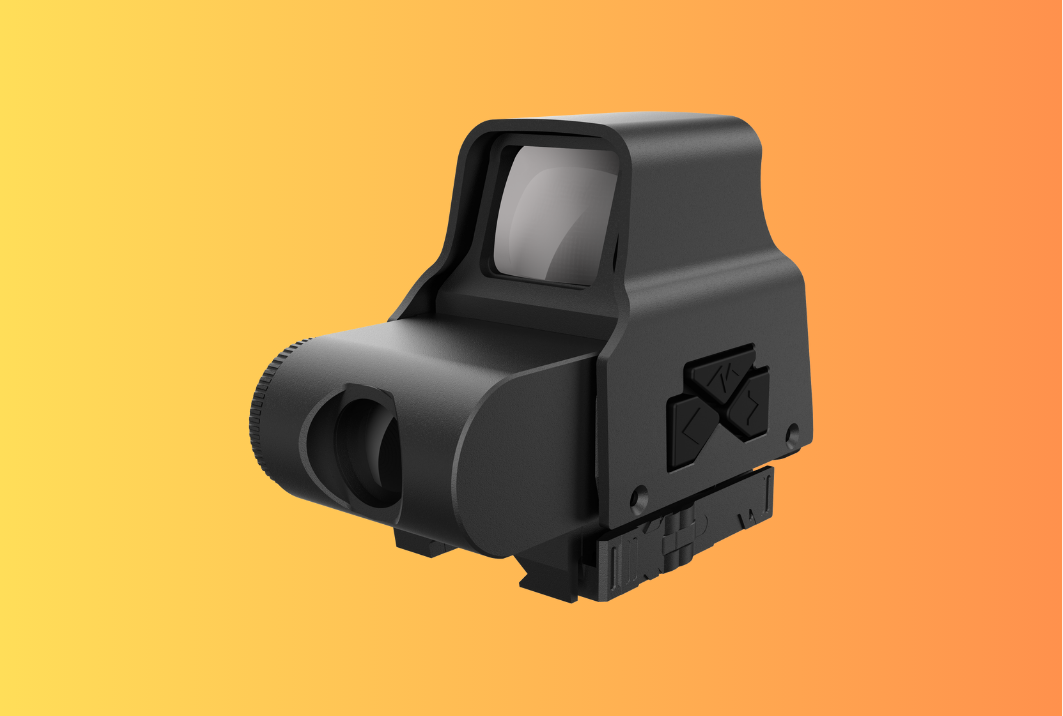
Each option leads to a different thermal pistol sight concept. A frame-mounted sight can be larger and share design DNA with compact thermal rifle scopes, but it must manage parallax and recoil transfer between frame and slide. A slide-mounted optic must be extremely lightweight and shock-resistant to survive reciprocating motion.
PCCs usually offer more rail space, but many users will want a sight that mirrors their pistol setup, especially in law-enforcement or home-defense configurations that share optics between duty weapons. As a result, designers should consider multiple mounting interfaces from the start and treat the mechanical architecture as a modular platform.
2.2 Sight height over bore and co-witness
Pistol and PCC users are highly sensitive to sight height over bore. If the optical axis is too high, the shooter must change grip angle and cheek weld, slowing down target acquisition and making close-range offset difficult to manage.
For slide-mounted thermal pistol sights, the goal is to maintain a height similar to popular duty red-dots. For frame- or rail-mounted solutions, some elevation is inevitable, but careful design of the base and optical path can minimise the penalty.
In many agencies, back-up iron sights (BUIS) will still be required. The thermal sight should either:
- allow mechanical co-witness through part of the window, or
- be quickly removable while maintaining a repeatable return-to-zero.
These requirements directly influence window size, optical path length and the geometry of the housing.
2.3 Handling, holsters and controls
A thermal pistol sight changes how a handgun is carried and manipulated. Designers must consider:
- overall width and length relative to common duty holsters;
- avoidance of sharp edges that can snag during draw;
- control placement that does not interfere with slide or magazine release operations.
Ambidextrous controls are highly desirable, because pistols are often used from unconventional positions in low-light or confined environments.
3. Managing recoil, durability and zero retention
3.1 Pistol and PCC recoil characteristics
Compared with a 5.56 mm rifle, a 9 mm pistol or PCC generates shorter but sharper recoil pulses, and slide motion adds additional impacts. The optic experiences:
- rapid acceleration forward and backward as the slide cycles;
- sudden stops at the end of slide travel;
- occasional drops or knocks during training and duty use.
For a thermal pistol sight to be credible, it must maintain zero and full functionality under this stress.
3.2 Mechanical architecture for ruggedness
A robust design focuses on:
- One-piece main housing machined from aluminium or magnesium to avoid weak joints.
- Isolated optical cell that protects the lens barrel and detector from deformation.
- PCB stack support on shock-absorbing pillars or elastomer pads, with careful attention to solder joint reliability.
- Reinforced mounting interface with steel inserts or cross bolts for repeated rail mounting.
Compliance with elements of MIL-STD-810G/H (shock, vibration, temperature cycling) is increasingly requested in RFQs, especially from institutional buyers. A correct test plan should mimic real pistol and PCC recoil rather than generic drop tests only.
3.3 Zeroing, drift and verification
Zero retention is not only a mechanical question. Digital boresight algorithms and calibration also matter. Good practice includes:
- storing zero profiles separately for different host weapons;
- allowing fine adjustment in both windage and elevation, with clear click values in MOA or mils;
- providing a fast zero-verification mode where the shooter can confirm impact shift after impact or environmental change.
For OEM customers building full weapon systems, Gemin Optics can support factory alignment procedures using our thermal camera modules and associated tools so that end users only need minimal field zeroing.
4. Optics and field of view for close-range thermal use
4.1 Focal length and FOV
Thermal pistol sights and PCC optics are primarily close- to medium-range tools. A typical design goal is to achieve a field of view that allows both quick room-distance engagements and situational awareness on outdoor ranges up to 75–100 m.
A practical way to think about this is to treat the optic as a “thermal red-dot” with a modest optical magnification (often close to 1×). Shorter focal lengths and higher detector resolutions help maintain wide FOV while still resolving small targets.
The table below illustrates typical choices for a 12 μm uncooled detector:
| Use case | Detector resolution | Focal length (approx.) | Horizontal FOV (approx.) | Notes |
|---|---|---|---|---|
| Duty pistol, indoor / urban | 384×288 | 12–15 mm | 24–30° | Fast target acquisition, room clearing. |
| PCC, home defense / patrol | 384×288 or 640×512 | 15–19 mm | 18–24° | Balance of FOV and detail to 100 m. |
| PCC, rural patrol / varmint | 640×512 | 25 mm | 14–18° | More detail on small animals at range. |
These are not strict rules, but they highlight the shift from long-range rifle scopes (narrow FOV, 35–50 mm lenses) to wider-angle, fast-handling optics.
4.2 Detector resolution and image processing
At short ranges, high resolution is still valuable because small targets (hands, weapons, animals) occupy fewer pixels. However, image-processing quality often matters more than raw pixel count.
Key processing features include:
- fast, stable auto-gain control (AGC) for scenes with both hot and cold objects;
- reliable non-uniformity correction (NUC) with minimal interruption;
- edge enhancement and de-noising tuned for close-range recognition rather than long-range detection.
By building on mature thermal imaging camera modules with proven firmware, OEMs can reduce the risk of field complaints about flicker, ghosting or lag.
4.3 Display and eye relief
Many pistol and PCC users prefer a heads-up, both-eyes-open shooting style. Thermal sights should support this by:
- using compact displays with high brightness and contrast;
- designing eye relief and window geometry to allow rapid sight picture acquisition;
- offering adjustable brightness and palette settings optimised for low-light indoor and outdoor conditions.
Reticle options should mirror common red-dot patterns to ease training: simple dots, circles, or minimal crosshairs rather than complex BDC trees.
5. User interface: controls, modes and zeroing workflow
5.1 Control philosophy
On a pistol or PCC, the shooter cannot spare much cognitive load to navigate menus. The control philosophy should therefore be:
- a small number of physical controls (typically two to four buttons or a rocker);
- consistent short-press vs long-press behaviour;
- gesture-like sequences for secondary functions.
Firmware should support commonly requested features such as digital zoom, palette change, NUC trigger and standby / wake-up without forcing the user into deep menu trees.
5.2 Zeroing and multi-platform profiles
Because many buyers will mount the same sight across multiple PCCs or swap between pistol and carbine, internal zero profile management is crucial. Good practice includes:
- storage of multiple named profiles (e.g. “PCC-16in-Subsonic”, “Pistol-Duty-Ammo”);
- clear indication of the active profile on the start-up screen;
- robust data storage that survives battery changes and recoil.
Zeroing workflows should be optimised for common ranges: 10–15 m indoor zero with offset compensation for pistols, and 25–50 m zeros for PCCs. Integrated LRF functionality, based on compact laser rangefinder modules, can further help users verify point-of-impact and distance relationships.
5.3 Recording and connectivity
Some customers will request video or snapshot recording for training or evidence. For pistol-grade optics, internal storage capacity and power budget are limited, so it is important to make trade-offs explicit:
- short clip recording around key events vs continuous streaming;
- wired export (USB) vs wireless modules approaching the behaviour of wireless thermal security cameras.
Clear specifications and simple UX prevent unrealistic expectations and reduce support load post-deployment.
6. Power strategy and thermal management on compact weapons
6.1 Battery formats and runtime
On pistol and PCC platforms, every gram and cubic millimetre counts. Designers must balance runtime, cold-weather performance and user convenience.
Common strategies include:
- Single CR123A or 18350 cells: compact but limited runtime; good for slide-mounted micro optics.
- Dual CR123A or 18650 packs: suitable for rail-mounted or PCC optics where slightly larger housings are acceptable.
- Proprietary rechargeable packs: optimised shape and better low-temperature behaviour, but require dedicated chargers and create long-term supply obligations.
For law-enforcement and defence buyers, the ability to use standard cells from existing logistics chains is often a strong argument. Articles such as a broader thermal optics battery strategy can support procurement decisions across a product family.
6.2 Power modes and cold-start behaviour
Pistol users may carry the weapon daily but only activate the sight for short periods. Therefore, firmware should support:
- ultra-low-power standby with rapid wake-up;
- clear behaviour when batteries are low (early warning, graceful shutdown);
- predictable cold-start performance at low ambient temperatures.
The module’s own thermal design must handle heat from both the detector and processing electronics, especially in sealed, compact housings. Using proven cores from our thermal imaging modules portfolio helps de-risk this aspect because their power profiles and thermal envelopes are well characterised.
7. PCC platforms: bridging pistols and rifles
Pistol-caliber carbines are a unique bridge category. They combine shoulder-fired stability with pistol ammunition and operating systems. From an optic perspective, they allow:
- slightly larger objective lenses and displays;
- longer sight radius and more rail space;
- more stable mounting on non-reciprocating receivers.
However, they are still often used in the same environments as pistols: indoor ranges, vehicles, urban patrols. Design considerations therefore include:
- reticle and zeroing schemes harmonised with duty pistols to minimise training overhead;
- control layouts that match pistol sights so muscle memory transfers across platforms;
- optional magnifier or clip-on compatibility for users who may later add a dedicated thermal rifle scope to their inventory.
By treating pistol and PCC products as a single platform family, OEMs can build a coherent catalogue with shared sensors, firmware and mounting accessories.
8. From thermal core to finished pistol sight: integration roadmap
For OEM brands and system integrators, the practical question is how to move from selecting a thermal core to shipping a weapon-grade optic. A typical roadmap involves:
- Core selection: choose an uncooled VOx detector module with suitable resolution, NETD and interface options, leveraging off-the-shelf thermal camera cores.
- Mechanical platform design: define housing families for slide-mounted micro sights and rail/PCC optics, sharing as many internal components as possible.
- Shock and environmental testing: use fixture guns or recoil simulators to validate zero retention and electronic robustness; perform temperature cycling, ingress protection testing and salt-fog where required.
- User-experience tuning: refine control mappings, boot-time behaviour, NUC scheduling and palettes based on feedback from test shooters.
- Production and QA: implement incoming core testing, assembly jigs and final test procedures according to a documented quality control process.
Working with an experienced China-based manufacturer that already supplies both modules and finished optics can shorten this path and avoid common pitfalls.
9. Working with Gemin Optics on thermal pistol sights and PCC projects
Gemin Optics combines in-house design of thermal camera modules with extensive experience in weapon-mounted products, from thermal rifle scopes and monoculars to compact rangefinding solutions based on our laser rangefinder modules.
For pistol and PCC applications, we support:
- selection and customisation of compact cores optimised for short-range, wide-FOV use;
- mechanical and optical consulting on sight height, mount interfaces and recoil management;
- firmware adaptations for simplified user interfaces and multi-profile zero management;
- OEM and private-label programmes under flexible OEM/ODM solutions frameworks, matched to your channel and branding strategy.
Our goal is not only to deliver hardware, but to act as a technical partner throughout the product lifecycle—from first feasibility discussions to next-generation updates.
10. Start your thermal pistol sight and PCC platform with Gemin Optics
Thermal pistol sights and PCC platforms are a natural next step in the evolution of night-fighting and close-range surveillance tools. To succeed, they must respect the realities of handgun and carbine handling: compact footprints, robust zero under recoil, intuitive controls and reliable power strategy.
By building on proven thermal camera modules, disciplined mechanical design and clear understanding of pistol and PCC use cases, OEMs and distributors can create product lines that expand their market without overwhelming their engineering teams or customers.
If you are exploring new thermal pistol sight or PCC projects and need a partner who understands both zeroing and recoil management as well as sensor technology, you can contact the Gemin Optics engineering team to discuss platform options, development kits and customisation paths tailored to your brand and channels.