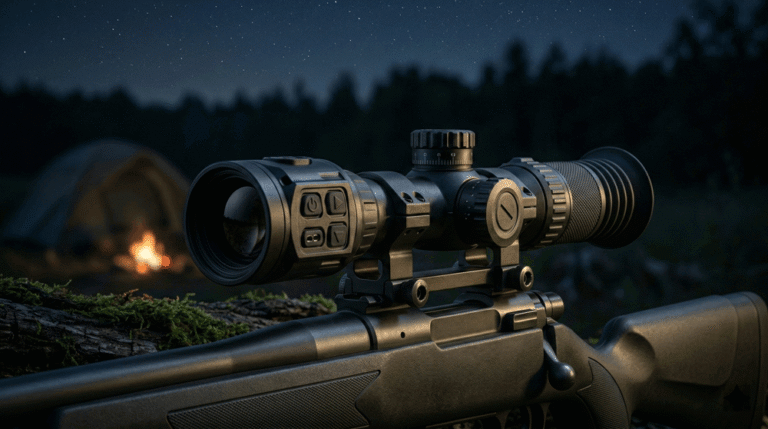
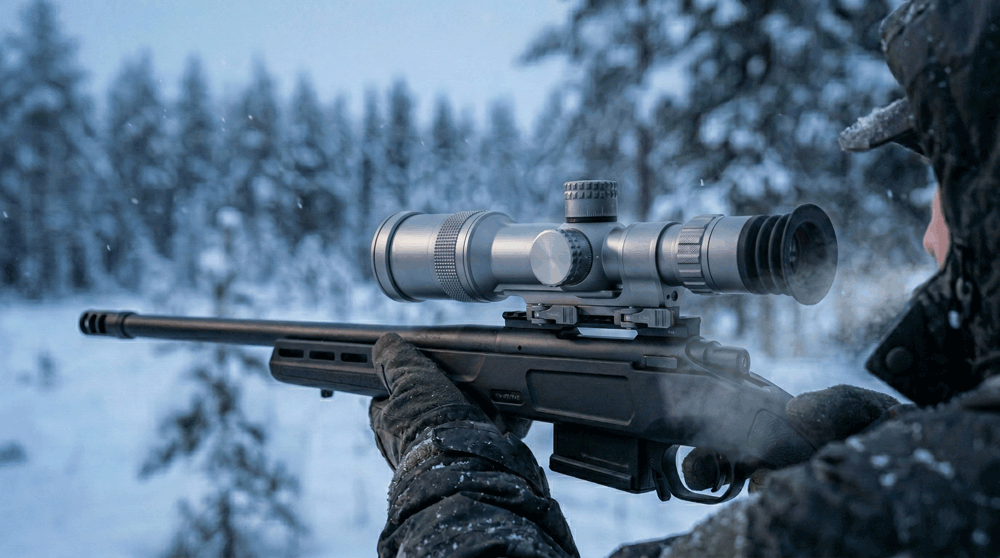
When you source a thermal rifle scope for your B2B brand, the datasheet is not a marketing document. It is a risk document.
Table of Contents
ToggleIt determines whether supplier quotes are comparable, whether your samples will match mass production, whether your channel partners will trust the line enough to stock it, and whether your warranty cost curve stays predictable after launch. In practice, procurement teams do not lose programs because they missed a headline parameter like sensor resolution. They lose programs because the datasheet looks precise but is not verifiable, or because critical assumptions are hidden in “standard configuration,” “optional,” and “customizable.”
This guide is written for procurement, sourcing, and product operations teams evaluating a China thermal rifle scope OEM manufacturer or ODM supplier. It is the first support article for Series 1 and is designed to be used together with the pillar article, Thermal Rifle Scope OEM Specification Guide. Read the pillar to define your specification language and acceptance criteria. Then use this article to score datasheets consistently and request an evidence pack that turns brochure claims into auditable commitments.
If you want to align internally on what a stable OEM partner should provide across documentation, traceability, and quality systems, reference Manufacturing & Quality and Why Choose Us. If your evaluation includes warranty operations and service readiness from day one, keep Warranty open as your baseline workflow reference.
Why thermal rifle scope datasheets mislead procurement teams
A thermal rifle scope is a system product. Field performance is not controlled by a single number. Two scopes can use the same detector and still perform very differently in a hunting context because of lens quality, calibration policy, image processing, UI latency, mechanical alignment, and firmware version discipline. Datasheets frequently under-specify those system behaviors because they are harder to standardize and because they can limit flexibility for the supplier.
That creates a dangerous asymmetry: the buyer assumes the datasheet defines what will be delivered; the supplier assumes the datasheet is a general description of a platform. The program then turns into a series of “we thought you meant…” conversations, usually after the sample stage, when schedule pressure is already high.
Procurement needs a method that forces clarity. Not more numbers. Not more buzzwords. More verifiable statements with defined conditions, tolerances, and change control expectations.
How procurement should read a thermal scope datasheet
Procurement should treat every datasheet line as one of three categories.
First, some lines are truly verifiable: they include conditions, boundary definitions, and a way to test. These are valuable and can enter your comparison model.
Second, some lines are semi-verifiable: they are plausible but missing conditions. These are not useless, but you should not treat them as commitments until the supplier provides test conditions and sample evidence.
Third, some lines are non-verifiable: “crystal clear image,” “advanced algorithm,” “military grade,” “super waterproof,” “ultra low latency.” These lines are not requirements. They are marketing. If you let them influence supplier selection, you are selecting based on copywriting, not capability.
Your goal is simple: turn semi-verifiable lines into verifiable lines by requesting missing conditions, and either rewrite or discard non-verifiable lines.
This is not a paperwork exercise. It is how you prevent hidden scope changes between samples and mass production.
Normalize all supplier datasheets before you compare them
Procurement mistakes are often comparison mistakes. Supplier A lists lens focal length and FOV; supplier B lists only “50 mm lens”; supplier C lists only magnification. Procurement then tries to “mentally translate” and ends up ranking suppliers by aesthetics, not by risk.
Before you compare, normalize each datasheet into the same internal structure. Treat that internal structure as your master comparison sheet, and treat the supplier datasheet as a source input.
At minimum, normalize into these nine blocks: product definition, sensor and imaging, optics, display and UI, mechanical and interfaces, environmental and reliability, power, recording and connectivity, documentation and service. If a supplier cannot provide information in one of those blocks, you do not “assume it is fine.” You mark it as unknown risk and request clarification.
The fastest way to normalize is to use one controlled template and force every supplier to fill it. This also improves quote comparability later.
Here is the one table I recommend procurement teams actually keep and reuse across programs.
| Normalized block | What procurement must lock | What typically goes wrong if you do not lock it |
|---|---|---|
| Product definition | exact model, SKU scope, included accessories, packaging level | hidden exclusions and post-PO disputes |
| Sensor and imaging | detector family, NETD conditions, frame rate definition, processing version | “same sensor” but inconsistent image and noise behavior |
| Optics | focal length, FOV, base magnification, eye relief, focus method | dealer dissatisfaction, slow acquisition, returns |
| Display and UI | display type, resolution, boot to image expectation, key workflows | “feels slow,” confusing zeroing, high support tickets |
| Mechanical | mount type, dimensions, weight, turret or button design intent | fit problems, recoil issues, zero stability disputes |
| Environmental | IP method, temperature behavior, recoil profile definition | unpredictable warranty curve, ingress failures |
| Power | battery type, runtime test mode, external power behavior | channel operation friction, returns from power complaints |
| Recording and connectivity | file formats, storage behavior, app support boundaries | app instability, review damage, support load |
| Docs and service | certificate pack, manuals, release notes, spares, RMA workflow | launch delays, audit failures, high after-sales cost |
If you want procurement and engineering to speak the same language in this step, anchor to the pillar article specification discipline and keep Thermal Rifle Scopes OEM/ODM as your “program view” so the datasheet is evaluated as part of the whole delivery.
Sensor lines procurement should trust less than they think
Procurement often over-weights sensor resolution and under-weights the conditions that make a sensor usable in the field.
Resolution matters, but it is not a commitment to clarity. Pixel pitch matters, but it is not a commitment to a specific optical experience. NETD matters, but only when the measurement condition is defined. Frame rate matters, but only when end-to-end latency and UI behavior are controlled.
A mature OEM or ODM partner should be able to explain sensor-related claims without hiding behind marketing. Procurement should specifically challenge four things.
The first is NETD. If NETD is shown without conditions, treat it as non-committal. Ask: under what conditions was it measured, what is the acceptable range for production units, and how does the supplier manage calibration to keep batches consistent.
The second is frame rate. Many datasheets quote “50 Hz” or “60 Hz” because it looks premium. But the user experience depends on pipeline latency, UI responsiveness, and how recording interacts with the image pipeline. If a supplier cannot define those behaviors, “60 Hz” may not feel like 60 Hz to a hunter.
The third is “algorithm” language. If the datasheet claims advanced image processing, procurement should ask whether image processing parameters are locked by firmware version, whether field updates change the image character, and how changes are communicated. Without version discipline, you risk two batches of “the same model” looking different, which triggers returns and dealer distrust.
The fourth is calibration policy. Datasheets rarely say how calibration is applied, whether NUC behavior is user-controlled, and how the supplier balances image stability with fast response. Procurement does not need to specify algorithmic details, but it should require stable behavior and a versioned definition of core workflows.
If your product roadmap includes LRF and ballistic integration, make sure sensor and optics choices do not block mechanical alignment and future integration constraints. Even if you are not integrating now, you should read LRF Ballistics Thermal Scopes OEM Integration Guide so procurement understands which “small omissions” become expensive later.
Optics is the most under-specified cause of dealer returns
Procurement teams frequently accept optics data that is incomplete because they assume optics is “engineering detail.” In reality, optics decisions drive channel satisfaction.
A datasheet that says “50 mm lens” is not enough. Procurement needs a system definition that includes focal length, Field of View, base magnification, eye relief, and focus method. The reason is commercial: an awkward FOV makes fast acquisition difficult; excessive base magnification amplifies wobble and frustrates new users; insufficient eye relief triggers ergonomic complaints and safety concerns; a weak focus mechanism increases ingress risk.
Procurement should force optics to be specified as a system tied to use cases. If your brand positions a scope as a close-range hog tool, you are selling fast acquisition and confidence at short range. If your brand positions a scope for open-country predator hunting, you are selling identification at distance and stable holds. Those two stories require different optical trade-offs. A supplier can meet a detector requirement and still fail the story.
To keep optics aligned with your SKU ladder, it helps to reuse channel positioning logic that you will later use in sales enablement. Articles like How to Build a Best Thermal Scope Product Line are useful because they force you to define why a given tier exists and what the tier upgrade actually buys. Procurement should evaluate optics against that ladder discipline rather than chasing the “largest lens” narrative.
UI and latency are procurement topics, not engineering topics
In a B2B channel, the first people to judge a scope are often dealers and sales reps. Their judgment is fast and emotional: does it feel premium, does it feel responsive, does it feel intuitive. Many “image complaints” are actually responsiveness complaints.
Procurement should insist that the datasheet or supplemental documentation defines these behaviors in plain language: boot to image expectation under defined conditions, wake behavior if the device supports sleep, how zeroing is done, how profiles are managed, how NUC is triggered, whether menus can be navigated without deep nesting, and whether recording creates lag or instability.
If the supplier cannot describe UI behavior clearly, it is a leading indicator that behavior is not controlled. If behavior is not controlled, it will change across firmware versions, and your support team will end up diagnosing “bugs” that are actually moving targets.
This is where program maturity shows. Mature OEM/ODM suppliers maintain documentation, release notes, and version discipline that B2B partners can rely on. If you want procurement to understand what that discipline looks like, reading FAQs alongside the OEM/ODM program pages can be helpful, because it exposes how the supplier thinks about boundaries, change control, and responsibility.
Mechanical claims must be rewritten into measurable commitments
For rifle scopes, mechanical integrity is brand integrity. “Rugged” is not a requirement. “Holds zero after defined recoil cycles with maximum allowable shift” is a requirement.
Procurement should rewrite mechanical lines into measurable commitments, even if the initial datasheet is vague. The purpose is not to micromanage engineering. The purpose is to remove ambiguity so there is no dispute at acceptance.
A good mechanical rewrite focuses on a few high-impact outcomes: mount interface definition, zero stability acceptance criteria, sealing approach and IP verification, operational temperature behavior, durability of controls, and dimensional constraints. If a supplier cannot commit to outcomes, they are asking you to assume the risk.
If you want a reference for how a B2B-oriented partner frames quality testing as part of the product, study Thermal Hunting Scope Quality Control Testing. Procurement does not need to copy that exact test suite, but it should use the same mindset: clear criteria, repeatable methods, and records that support traceability.
Environmental specs are where warranty costs hide
Datasheets often say “waterproof” and “shockproof.” Procurement should treat those as placeholders and demand definitions.
For waterproofing, require an IP method statement and post-test functional checks. For temperature, require functional behavior across the stated range, not just survival. For recoil, require a profile definition: cycles, axis, and pass criteria. A single number without context is not a test plan.
If your brand is building a dealer network, you should involve service operations early and align environmental requirements with warranty expectations. That is why B2B teams often tie environmental commitments to Warranty during RFQ review rather than after purchase orders, when leverage is weaker.
Power strategy is a channel decision, not a spec-sheet number
A thermal scope can be technically strong and still fail commercially because the power strategy does not match channel reality.
Procurement should evaluate battery choices the way a dealer would: how easy is it to get batteries, how predictable is runtime, how reliable is charging, what happens in cold weather, and how does external power behave. If runtime is quoted without a defined test mode, treat it as a marketing claim. Require runtime tied to explicit conditions such as screen brightness, Wi-Fi state, recording state, and whether the device is in continuous operation or intermittently waking.
Power is also a BOM discipline topic. If accessories like eyecups, mounts, and batteries are “optional,” your real landed cost and customer experience become inconsistent across batches and across distributors. Procurement should force included items to be defined, which directly improves quote comparability.
Documentation and compliance should be requested before samples, not after
B2B launches slip because documentation arrives late.
Procurement should demand a documentation deliverables list and timing. This includes certificates relevant to your target market, user manuals, final datasheets with tolerances, firmware release notes, and a service pack that supports RMA handling.
If your supplier has a structured documentation library, it is a leading indicator that they can support B2B scale. For internal expectation alignment, see Certificates and Downloads so your procurement team knows what “organized deliverables” look like in practice.
Warranty terms must be normalized to compare suppliers fairly
Procurement should never compare warranty by the headline duration alone. “Five years” can be a weak warranty if exclusions are broad or if RMA workflow is slow and unclear.
Normalize warranty across suppliers by requiring the same answer format: coverage scope, exclusions, turnaround time targets, shipping responsibility, spare parts availability, and fault reporting requirements. Warranty must be evaluated as an operational system, not a marketing promise.
Use Warranty as your internal baseline reference for what a structured process looks like, and use Thermal Hunting Scope Service Warranty Training to align dealer enablement expectations. Procurement does not need to own service operations, but it must protect the business by ensuring the supplier can support it.
Request an evidence pack with every datasheet
A datasheet without evidence is a brochure.
Procurement should request an evidence pack that makes key claims verifiable: example image clips under stated conditions, recoil and sealing summaries, burn-in approach, calibration consistency discipline, and firmware version policy. The evidence pack does not need to be perfect. It needs to be structured enough that you can compare suppliers without being seduced by one polished video.
When suppliers resist evidence requests, it is usually a signal that they do not have disciplined testing records or that their platform is not stable across batches.
If you want to align evidence requests with project phases, anchor them to a milestone timeline. Procurement teams often use a milestone framework like OEM Project Timeline to ensure evidence is delivered before each commitment stage, not after.
Enforce quote comparability with a single inclusion checklist
Most quote disputes come from hidden differences in what is included. One supplier includes mount and accessories. Another excludes them. One includes a more comprehensive test plan. Another only does a basic functional check. One includes documentation pack support. Another treats it as extra engineering services.
To prevent this, procurement should enforce a single inclusion checklist and require every supplier to fill it. This is the second and last table I recommend using in this article, because it directly reduces commercial ambiguity.
| Inclusion area | What procurement should require suppliers to specify | What it prevents |
|---|---|---|
| Included items | mount, eyecup, battery, charger, carry case | accessory scope disputes |
| Packaging level | retail box, inserts, labeling, barcodes | listing delays and rework |
| Testing scope | functional checks plus key reliability tests | hidden QC cost later |
| Documentation | final datasheet, manual, certificates, release notes | launch schedule risk |
| Firmware scope | baseline features and version policy | spec drift between batches |
| Warranty operations | RMA steps, SLA, shipping responsibility | after-sales cost surprises |
| Spares and serviceability | spares list, pricing, lead time | uncontrollable repair cost |
Once you have this filled, quote comparison becomes rational. Without it, price comparisons are often misleading.
Red flags procurement should treat as risk signals
Procurement does not need to be paranoid, but it must be skeptical.
If a datasheet has many impressive numbers with no test conditions, treat it as low verifiability. If a supplier refuses to discuss firmware version discipline, assume behavior will change. If there is no traceability language, assume RMA containment will be hard. If warranty is presented only as a duration, assume exclusions will be broad or workflow will be immature. If documentation is not listed explicitly, assume launch delay risk.
These patterns do not guarantee failure, but they should force procurement to ask deeper questions and discount the score until evidence appears.
If you want to evaluate supplier transparency beyond the datasheet, Why Choose Us is a useful reference because a mature partner will openly describe how they reduce risk across quality, documentation, and lifecycle support.
Procurement scoring method for thermal scope datasheets
Procurement needs a repeatable scoring method, otherwise supplier selection turns into a debate dominated by price and a visually appealing PDF.
The scoring method does not need to be perfect. It needs to be consistent. It should reward verifiability and operational maturity, not marketing language.
Here is a practical scoring approach you can implement with your normalized datasheet template.
Start by scoring verifiability. For every key parameter, ask whether the supplier provided test conditions, boundaries, and a method to verify. If not, score it low and request clarification.
Then score program maturity: whether the supplier has documentation discipline, traceability language, warranty workflow clarity, and evidence pack readiness.
Finally score commercial clarity: whether inclusions are explicit and milestone-aligned.
If you use this approach, procurement becomes more predictable, internal alignment improves, and the supplier selection process becomes defensible.
FAQ
What is the most important thing procurement should look for in a thermal rifle scope datasheet?
Verifiability. A number without conditions, boundaries, and a method to test is not a commitment. Procurement should prioritize suppliers who define conditions and support claims with evidence packs.
How should procurement compare NETD across suppliers?
Only compare NETD when measurement conditions are specified consistently. If conditions differ or are missing, treat NETD as non-comparable and request the full test condition statement and acceptable production range.
Why do scopes with the same sensor look different in real use?
Because optics quality, calibration policy, image processing settings, and firmware versions vary. If firmware and calibration discipline are not controlled, image character can change between batches even if the detector is identical.
What are the top datasheet omissions that become warranty problems?
Ambiguous waterproofing claims, undefined recoil profiles, lack of version control, lack of traceability language, and vague battery runtime definitions. These omissions create disputes at acceptance and unpredictability after launch.
Should procurement ask for acceptance tests even if the factory says it has QC?
Yes. Factory QC often means basic functional checks, not performance and consistency checks tied to your brand promises. Acceptance tests protect your batch consistency and reduce dealer return rates.
How early should procurement evaluate warranty and service workflow?
From the first RFQ. Warranty is an operational system and cost model. If you wait until after the PO, you lose leverage and often discover workflow gaps too late. Use Warranty as a baseline reference during sourcing.
What evidence pack should procurement request with a datasheet?
At minimum: sample videos under stated conditions, recoil and sealing test summaries, burn-in approach, calibration consistency statements, firmware version policy, and a documentation deliverables list. Align evidence timing with milestones like OEM Project Timeline.
How can procurement reduce quote disputes after selection?
Force every supplier to fill one inclusion checklist that defines accessories, packaging, testing scope, documentation, firmware scope, warranty workflow, and spares availability. This prevents hidden exclusions and creates apples-to-apples comparisons.
Call to action
If you want, we can convert your current supplier datasheets into a procurement-ready comparison pack that includes a normalized template, a verifiability scorecard, and an evidence request checklist you can send to every OEM/ODM candidate.
Send your target region, price tier ladder, and expected launch timeline via Contact. If your team also needs a full RFQ structure and acceptance test plan, start from the pillar Thermal Rifle Scope OEM Specification Guide and we will align the procurement pack to your spec language.
Related posts (Series 1 only)
- Thermal Rifle Scope OEM Specification Guide
- Thermal Rifle Scope Datasheet Guide for Procurement
- Thermal Scope DRI Range Requirements for OEM Programs
- Thermal Scope FOV and Base Magnification Strategy for OEM Brands
- Thermal Rifle Scope UI Requirements to Reduce Dealer Returns
- Thermal Rifle Scope RFQ Checklist for OEM Sourcing