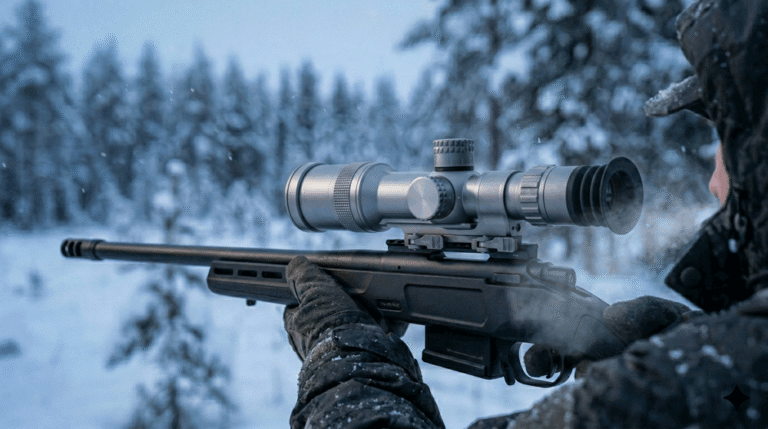

Most thermal rifle scope OEM programs do not fail because the sample looks bad. They fail because the mass production units do not feel like the sample.
Table of Contents
ToggleIn B2B channels, that gap becomes expensive quickly. Dealers will accept a small learning curve, but they do not accept “same model, different behavior.” Distributors can live with a predictable defect rate, but they cannot live with a product that creates inconsistent customer expectations. Your brand can tolerate an occasional hardware failure, but it cannot tolerate recurring complaints that feel subjective: “image is noisier than the demo,” “NUC feels different,” “the menus changed,” “it doesn’t hold zero like the sample,” “recording is buggy,” “battery life seems worse.”
That is why scaling a thermal rifle scope from prototype to mass production is not just engineering. It is process control. It is governance. It is the discipline of defining what must stay the same, what can change, how changes are approved, and how consistency is verified batch after batch.
This article is the pillar for the next series. It gives B2B brands a complete, practical framework to move from prototype to mass production without losing product identity. It is meant to be used after you have already defined your OEM specification language and sourcing discipline. If you have not, start with the previous series pillar, Thermal Rifle Scope OEM Specification Guide, because scale-up only works when the spec is measurable and the acceptance logic is clear.
For program context and delivery expectations, reference Thermal Rifle Scopes OEM/ODM. For how we think about production discipline, traceability, and consistency, keep Manufacturing & Quality in view. If you want your scale-up plan to reduce channel disputes, align warranty assumptions early with Warranty.
Why prototype success does not predict mass production success
A prototype is a moment in time. Mass production is a system.
Prototype units are often built with extra attention. Components are carefully selected. Engineers are present. Tolerances are “managed by experience.” Firmware is tuned for demonstration. Calibration parameters are adjusted by a small group who know the platform deeply. If something feels off, it is corrected quickly and informally.
Mass production is different. Operators build to a work instruction. Purchasing must maintain supply continuity. Incoming materials vary. Yield pressures appear. Production schedules compress. Firmware updates occur to address edge cases. Small substitutions happen because a supplier part is delayed. Calibration station drift becomes real. The test environment changes subtly. The “human layer” of the prototype stage disappears, and process becomes the only thing preventing drift.
For thermal rifle scopes, this difference is amplified because the product is not just electronics. It is optics, mechanics, thermal calibration behavior, and user perception. Many acceptance risks are not binary defects. They are differences in experience that trigger returns.
If you want the mass production product to match the prototype, you need to treat the prototype as a reference standard, then build a controlled system that reproduces it.
Define what must stay invariant across batches
Before you discuss sampling plans, burn-in, or environmental tests, you need one concept: invariants.
An invariant is not “the same sensor resolution.” An invariant is the set of product characteristics that must remain stable for your brand promise to remain true.
For a thermal rifle scope brand, invariants usually fall into four categories.
The first category is field experience invariants. These are the things a dealer notices immediately: boot behavior, UI workflow, core button logic, profile behavior, NUC feel, recording stability, zoom transitions, and whether the image character feels consistent.
The second category is performance invariants. These include the DRI outcomes you promised, the ability to hold zero, recoil survivability, waterproofing behavior, and expected runtime under defined modes.
The third category is mechanical invariants. These include weight range, dimensional envelope, mount interface consistency, turret or button tactile feel, eye relief consistency, and sealing behavior.
The fourth category is governance invariants. These include firmware version discipline, calibration policy discipline, component substitution rules, traceability rules, and change control rules.
Most scale-up failures happen because brands define only performance invariants, then ignore experience and governance invariants. When that happens, the product is “within spec” but feels different, and the channel rejects it.
Golden sample discipline is the center of scale-up
In practice, your scale-up program needs a single “truth.” That truth is the golden sample.
A golden sample is not just a sample you like. It is a locked reference unit (or a small set of reference units) that defines the target experience and performance. It is tied to a specific configuration, a specific firmware build, and a specific calibration baseline. It is stored and protected. It is used to compare future builds and to resolve disputes.
The golden sample discipline also forces clarity: if a supplier proposes a change, the question is not “does it still work.” The question is “does it remain equivalent to the golden sample in the invariants we care about.”
This is how you prevent the worst B2B scenario: the supplier says “same model,” but your dealers say “this feels like a different product.”
Build scale-up around gates, not dates
B2B teams often plan scale-up as a timeline: sample in March, pilot in April, mass production in May. That approach fails under real constraints because dates are easy to promise and hard to control.
A more reliable method is to plan scale-up around gates. A gate is a set of deliverables and acceptance outcomes that must be met before the program moves forward. Gates also provide a structured way to negotiate with suppliers: payments, lead times, and commitments align to gate completion, not optimistic dates.
Below is a gate framework that works for thermal rifle scope OEM programs. It is deliberately simple and focuses on what protects consistency.
| Gate | What must be true to pass | What you should receive as proof | What it protects |
|---|---|---|---|
| Prototype lock | configuration and firmware are defined as baseline | configuration sheet, firmware ID, golden sample definition | stops “moving target” samples |
| EVT stability | core functions and workflows are stable | workflow test results, early failure fixes, version notes | prevents late UX drift |
| DVT validation | reliability and environment behavior are proven | recoil, sealing, temperature results, DRI protocol evidence | prevents warranty spikes |
| PVT readiness | production line can reproduce baseline consistently | pilot yield, calibration station records, traceability proof | prevents batch inconsistency |
| Mass release | governance is in place for drift control | change control rules, release notes format, QC plan | protects long-term channel trust |
If you want your internal stakeholders to align on how these gates map to the supplier’s responsibilities and your brand responsibilities, anchor the overall framework in Thermal Rifle Scopes OEM/ODM and align the factory governance expectations with Manufacturing & Quality.
What “batch consistency” really means for thermal scopes
Batch consistency is not “all units power on.” It is a combination of measurable outcomes and controlled perception.
For thermal rifle scopes, batch consistency often breaks in subtle areas:
Image character changes. The same scene appears noisier or smoother. Edge enhancement differs. Contrast handling changes. The result is not necessarily worse, but it is different. Customers interpret “different” as “lower quality” because their expectation was set by demos and reviews.
NUC behavior changes. Auto-NUC triggers more often, or at different moments. The scope feels more intrusive. Customers interpret it as instability.
Zero feel changes. The scope holds zero technically, but the workflow feels different, the profile logic is confusing, or the reticle movement behavior is not what the demo showed. Customers interpret it as “won’t hold zero.”
Recording stability changes. A firmware update introduces lag or file corruption in some edge cases. Customers interpret it as unreliability, and that unreliability colors their entire impression of the product.
None of these are solved by testing one unit per batch. They are solved by controlling process, controlling configuration, and controlling governance. That is why scale-up must be treated as an operational system.
Control calibration like a production process, not an engineering art
Thermal products depend on calibration and compensation. In prototype phases, calibration is often handled by expert judgment and ad-hoc adjustments. In mass production, calibration must be a repeatable process that produces equivalent outcomes.
To scale reliably, you need to treat calibration as a controlled production asset:
Calibration stations must be standardized. Station drift must be monitored. Calibration parameters must be versioned. Operator steps must be consistent. The factory must be able to demonstrate that the calibration process produces stable outputs across days and across stations.
The key point for B2B brands is that calibration is not just a factory detail. It is a customer experience driver. When calibration consistency is weak, the customer feels it as inconsistent image and inconsistent behavior, which then becomes a channel problem.
This is also where you should connect to governance: calibration parameter changes are changes. They should not happen silently. They should be treated like firmware changes with release notes and approval rules.
Firmware stability must be planned for mass production reality
Most brands want firmware updates. Updates are not the problem. Uncontrolled updates are the problem.
A scale-up plan must define how firmware is managed in production:
Firmware versions must be identifiable. Release notes must exist. Workflow-affecting changes must be documented and approved. Production firmware must be locked for the mass production batch unless a controlled change is released. The factory must not ship “equivalent” firmware because an engineer updated a build between runs.
This discipline matters because dealers train users. Dealers create video guides. Reviewers publish workflows. If firmware drifts without discipline, the content ecosystem around your product becomes incorrect, and support costs rise. Customers then conclude the product is unstable.
If you want to reduce this drift risk structurally, align governance expectations early with your service reality, using Warranty. Warranty disputes often begin with workflow changes that customers interpret as defects.
Supply chain substitutions are not small changes in thermal optics
In thermal rifle scopes, small component substitutions can create large perception differences. Displays can vary in gamma and perceived contrast. Buttons can vary in tactile feel and noise. Lens coatings can vary slightly and change perceived clarity. Even minor mechanical tolerances can affect alignment and long-term zero stability.
Most factories will occasionally face supply constraints. The scale-up question is not whether substitutions occur. It is whether substitutions are governed.
A mature OEM scale-up plan includes substitution rules: what parts are locked, what parts can be substituted, what tests are required when a substitution occurs, and how your brand is notified.
This is not about distrust. It is about protecting product identity and preventing the “same model, different product” complaint.
Pilot runs are about reproducibility, not yield theater
Some suppliers treat pilot runs as a way to show high yield. A B2B brand should treat pilot runs as a way to prove reproducibility.
The pilot should answer one question: can the factory build units that match the golden sample across the invariants you care about, using the same process they will use in mass production.
To do that, the pilot must include multiple units across multiple shifts. It should include calibration station repeatability. It should include workflow stability checks. It should include at least a limited environmental and recoil sampling to ensure the process is not hiding a latent weakness.
The pilot is also where you validate documentation discipline: traceability mapping, test reports, batch records, and a clear release packaging of firmware and configuration.
This is where process becomes visible. It is also where future warranty costs are decided.
Acceptance testing should reflect real channel risks
A common mistake is building an acceptance test plan that focuses on “engineering pride” rather than channel risk. Your acceptance plan should focus on the outcomes that cause the biggest B2B pain when they drift.
That typically means focusing on:
Consistency of core user workflows, because confusion and annoyance cause non-defect returns.
Consistency of image character within defined boundaries, because “feels worse than the demo” causes returns.
Consistency of zero stability and mechanical alignment, because those failures destroy trust and create expensive RMAs.
Consistency of environmental resilience, because water ingress and cold failures are catastrophic for brand reputation.
Consistency of recording stability, because recording failures signal unreliability in the customer’s mind.
You do not need to over-test everything. You need to test what creates business risk.
Design serviceability before mass production, not after
Scale-up is also the time to decide whether your product will be serviceable at reasonable cost.
If spare parts are unclear, if disassembly is difficult, if diagnosis depends on guesswork, your warranty cost will be high. Dealers and distributors will also lose patience because repair turnaround becomes unpredictable.
A scale-up plan should therefore include serviceability decisions: spare parts strategy, diagnostic logic, fault code approach, repair workflow, and expected turnaround. Even if the factory handles repair, you need clarity on how it works and what the cost model looks like.
If you want to align scale-up decisions with service workflow expectations, use Warranty as a baseline and ensure your supplier can support the workflow discipline your channel needs.
A control plan that prevents drift without slowing innovation
The best scale-up programs are not the most rigid. They are the most controlled.
Control means changes can happen, but they happen through a known process. They are documented, tested against invariants, and released intentionally. Innovation remains possible, but drift is prevented.
A practical control plan for a thermal rifle scope OEM program covers eight control zones. This is not a checklist for the blog reader to “tick off.” It is a model for how your brand and your supplier should think.
| Control zone | What must be controlled | What typically drifts if it is not controlled |
|---|---|---|
| Configuration baseline | sensor, lens, display, button mapping, accessories | “equivalent” builds that feel different |
| Calibration discipline | station standardization, parameter versioning | batch-to-batch image character shifts |
| Firmware governance | version lock, release notes, approval rules | workflow drift and dealer confusion |
| Mechanical tolerances | alignment, mount interface, sealing | zero stability and ingress failures |
| Environmental validation | temperature and water behavior definitions | warranty spikes in certain climates |
| Recording stability | file integrity and performance under load | perceived unreliability |
| Traceability | serial-to-batch-to-version mapping | inability to contain RMAs |
| Change control | ECO/PCN behavior and substitution rules | silent drift and channel disputes |
This control plan is easiest to execute when the supplier already operates with structured quality governance. That is why B2B brands often evaluate partners partly through operational transparency and process maturity shown in Manufacturing & Quality.
The outcome you want: stable identity at scale
A successful scale-up produces a simple business outcome: dealers receive a product that behaves like the demo units, reviewers see consistent performance across batches, and your after-sales system is not overwhelmed by subjective complaints.
This outcome does not require perfection. It requires discipline.
When you approach scale-up through invariants, golden sample discipline, gate-based planning, calibration process control, firmware governance, substitution governance, and pilot reproducibility, you reduce the most common B2B failure mode: inconsistency.
That is why the next support articles in this series will go deeper into the most failure-prone parts of scale-up: golden sample and acceptance definition, calibration and NUC consistency, environmental and recoil validation, firmware and configuration management, and serviceability and spares strategy.
FAQ
What is the biggest cause of mismatch between samples and mass production thermal scopes
Uncontrolled drift. Drift is caused by firmware changes without discipline, calibration parameter changes, component substitutions, and weak process control. The product still “works,” but it no longer feels equivalent to the sample.
What is a golden sample and why does it matter in OEM programs
A golden sample is a locked reference unit tied to a specific configuration, firmware version, and calibration baseline. It defines the target identity of the product. It prevents disputes by providing a stable reference for equivalence.
Why do thermal scopes have batch-to-batch image differences
Because image character depends on calibration, processing parameters, optics variation, display characteristics, and test environment. Without calibration station control and version discipline, small variations accumulate into noticeable differences.
How should a B2B brand structure prototype, pilot, and mass production
Use gates rather than dates. Define what must be true to pass each gate, require proof deliverables, and align commercial milestones to gate completion. This produces predictability and reduces late surprises.
Can I allow firmware updates without increasing returns
Yes, if updates are governed. Version identification must be visible, release notes must exist, workflow changes must be approved, and production firmware should be locked unless a controlled release is made.
How does scale-up planning reduce warranty costs
Scale-up planning reduces drift and inconsistency, which are major drivers of subjective complaints and “not as expected” returns. It also builds traceability and serviceability, which reduces RMA costs and improves turnaround.
Call to action
If you share your target SKUs, intended tier ladder, and launch timeline, we can help you turn your prototype-to-mass plan into a supplier-ready scale-up pack: gate definitions, golden sample rules, pilot run structure, calibration governance expectations, and a change control policy that protects batch consistency.
Send your program context through Contact. If your team needs a reference view of how a complete delivery program is structured, start with Thermal Rifle Scopes OEM/ODM and align production governance expectations with Manufacturing & Quality.
Related posts
- Thermal Rifle Scope OEM Prototype to Mass Production
- Golden Sample and Acceptance Criteria for Thermal Rifle Scopes
- Thermal Scope Calibration and NUC Consistency Control
- Thermal Rifle Scope Environmental and Recoil Validation Plan
- Thermal Rifle Scope Firmware Versioning and Configuration Management
- Thermal Rifle Scope Spare Parts Strategy and Serviceability Design