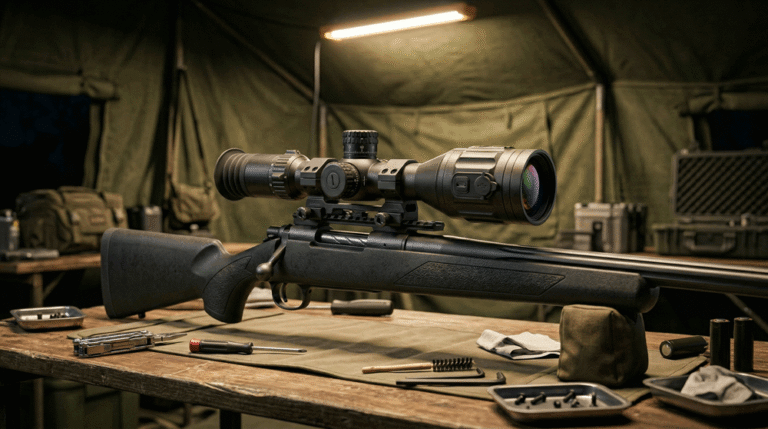
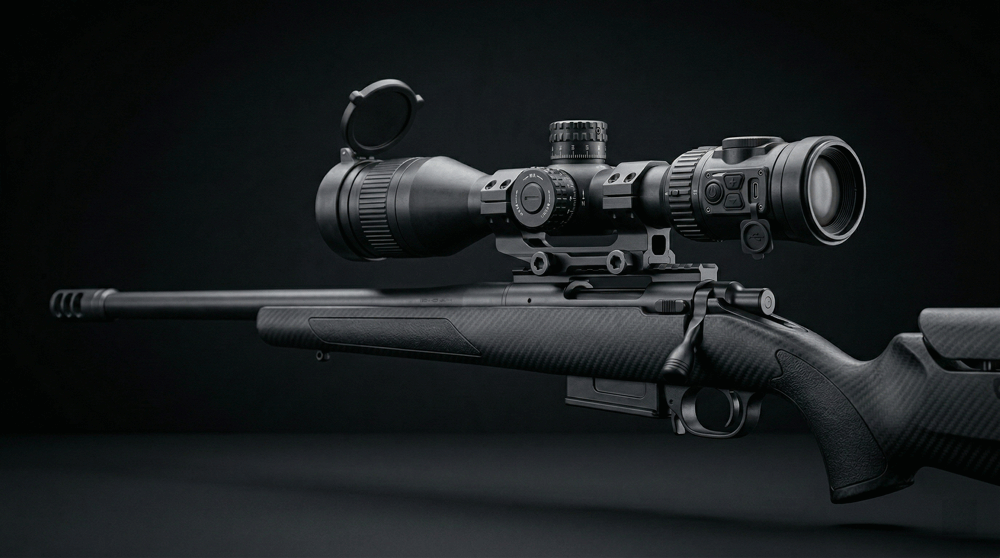
An RMA system is where your thermal rifle scope brand proves whether it is professional.
Table of Contents
ToggleIn B2B channels, warranty policy is only the promise. The RMA workflow is the machine that executes the promise. If that machine is slow, inconsistent, or confusing, dealers will stop trusting your brand regardless of how good the product is. They will stock less, recommend less, and quietly steer customers to a competitor with “easier support.” If that machine is fast, predictable, and fair, dealers will forgive occasional issues because they know problems will be resolved without drama.
Thermal rifle scopes create a special RMA challenge because many returns are not classic hardware failures. They are experience-driven complaints—range disappointment, zeroing confusion, recording instability, NUC behavior surprises, or a mismatch between what a reviewer showed and what a customer received. If your RMA workflow cannot separate “configuration/workflow” from “hardware failure” quickly, you will replace too much, waste margin, and still disappoint customers because resolution takes too long.
This article gives a practical, B2B-first RMA workflow and a failure code approach that reduces cost and increases channel trust. It is designed to work with your series framework article, Thermal Rifle Scope Go-to-Market and After-Sales Framework, and should align with your warranty policy design described in Thermal Rifle Scope Warranty Policy Design. If your brand is working through distributors and dealers, it should also map cleanly to your channel model from Thermal Rifle Scope Channel Strategy. If you want an internal baseline for policy language, keep Warranty as your anchor while you build the operational workflow.
Why thermal rifle scope RMAs feel harder than normal electronics
In most categories, an RMA is a binary decision: does it power on, does it charge, does it work. Thermal rifle scopes are different because the user’s complaint is often about experience.
A customer may say “it’s noisy,” but the unit is within spec. A customer may say “it doesn’t hold zero,” but the real issue is profile confusion. A customer may say “range is weak,” but the optics tier is mismatched to the use case. A customer may say “recording fails,” but the unit is on an older firmware build. These are not imaginary complaints. They are real dissatisfaction. But they require a workflow that is designed to diagnose, educate, and resolve—not simply to replace.
That is why a good RMA system for thermal scopes is a two-engine system. One engine resolves issues without physical return whenever possible. The other engine handles hardware returns fast and consistently when physical return is necessary. You need both.
What an RMA workflow must optimize for in B2B
A strong RMA workflow is designed to achieve four outcomes.
First, speed. Dealers and distributors care about time-to-next-step. Even when a repair takes time, they want confirmation that the claim is moving.
Second, clarity. Every stakeholder should know what information is required, what the next step is, and what the expected timeline is.
Third, consistency. Similar cases should be resolved similarly. If outcomes vary randomly, partners conclude the brand is unreliable.
Fourth, learning. RMA data should become product improvement and training improvement. If you do not code failures and collect structured data, you will repeat the same issues and your costs will rise.
The key point is that RMA is not only an after-sales function. It is a channel growth tool. Dealers stock brands that feel safe. RMA is the safety system.
The RMA workflow: design it as stages with clear ownership
The simplest way to make RMA predictable is to design it as stages with explicit ownership. When ownership is unclear, cases stall and everyone becomes frustrated.
A practical RMA workflow has six stages: intake, qualification, triage, resolution decision, execution, and closure. Your policy should define who owns each stage in each channel model (direct-to-dealer vs distributor-led).
Intake is about receiving the claim and creating a case ID. Qualification is about confirming proof of purchase, warranty status, and whether the claim must go through a dealer/distributor. Triage is about classifying the problem quickly as likely workflow/configuration or likely hardware. Resolution decision is about whether to educate, remote-fix, repair, or replace. Execution is the actual repair/replace/logistics. Closure is returning the unit and recording failure data.
When you write your RMA workflow, you are essentially writing a playbook that dealers can trust. The playbook should be consistent with your warranty policy, which is why this article should be used alongside Thermal Rifle Scope Warranty Policy Design.
Failure codes: why you need them even if you are a small brand
Many brands avoid failure codes because they feel like bureaucracy. In thermal optics, failure codes save money because they stop you from treating every complaint as unique.
Failure codes do not need to be complex. They need to be consistent. The objective is to classify problems into a small set of meaningful buckets that map to resolution paths.
A good failure code system in thermal rifle scopes separates three classes:
First, “no return needed” cases, where the complaint is resolved through training, configuration alignment, or firmware updates.
Second, “return needed but modular fix,” where a known module replacement or repair step resolves it.
Third, “return needed and escalation,” where the issue is unusual, safety-related, or requires deeper factory-level work.
The earlier you implement failure codes, the faster you learn and the more stable your costs become. This is especially important when you scale into multiple regions and multiple partners.
Build your failure code taxonomy around real channel complaints
The best failure codes are not invented in a conference room. They reflect real complaint patterns.
In thermal rifle scopes, the highest-frequency complaint patterns tend to fall into a stable set: power/battery issues, display issues, recording and storage issues, connectivity issues, UI workflow confusion, zeroing/profile issues, mechanical mount issues, sealing issues, and image/NUC behavior issues.
Within these, you want codes that can be applied quickly. The purpose is not to diagnose root cause perfectly at intake. The purpose is to route the case correctly and collect structured data that will later reveal root causes.
A practical taxonomy often has three layers: a top-level category, a subcategory, and a disposition code (no return / return / swap / repair). You do not need to expose all layers to customers. You need them for internal control.
The single RMA matrix that makes the workflow executable
The fastest way to make RMAs predictable is to define, for each failure category, what information you need at intake and what the default resolution path is. This prevents “free-form support” where outcomes depend on who answers the email.
This is the only table in the article. It is written as an RMA matrix you can adapt to your brand.
| Failure category | Intake info you should require | Fast triage question | Default resolution path |
|---|---|---|---|
| Power / battery | battery type, runtime mode, charging behavior | does it reproduce with known-good power | remote troubleshoot → replace battery/module if needed |
| Boot/UI instability | firmware version, steps to reproduce | is it build-related | remote fix/update → return only if reproducible hardware |
| Zeroing / profiles | active profile, zero steps used, mount type | is it user workflow vs drift | dealer training + checklist → return if repeatable with correct process |
| Recording / storage | storage type, file samples, firmware version | does recording crash or corrupt | remote update/settings → return if corruption persists |
| Wi-Fi/app | phone OS version, app version, connection steps | is it compatibility vs hardware | compatibility guidance → firmware/app update → return if module failure |
| Image/NUC behavior | NUC mode, scene description, firmware version | is it policy drift vs defect | policy education + version alignment → return if abnormal artifacts |
| Mechanical / mount | mount model, torque method, recoil platform | does it hold zero after controlled check | controlled check → repair/replace mount interface if needed |
| Sealing / fogging | exposure description, port cover status | is it confirmed ingress | immediate return → repair/replace with root cause capture |
This matrix makes two things happen. It makes intake consistent, so dealers know what to send you. And it creates default resolution paths, so cases don’t stall.
Remote triage: the highest ROI part of thermal scope after-sales
Remote triage is not about denying claims. It is about resolving the right problems in the right way.
If a customer’s unit is on an older firmware build with known recording instability, the best customer outcome may be a controlled update, not a return. If a customer is using profiles incorrectly, the best outcome is a clear, fast tutorial and a checklist that prevents repeat confusion. If a dealer is using incorrect mounting torque, the best outcome is a mounting guidance sheet and a confirmation procedure.
Remote triage reduces cost, but more importantly, it reduces time. Shipping and return logistics are slow. If you can resolve a meaningful portion of cases remotely, your channel feels supported and your service costs remain predictable.
Remote triage also reinforces your pricing framework because it protects the service reserve you planned. If you replace unnecessarily, the reserve is consumed quickly and your channel economics become fragile. This is why RMA design is not “support only.” It is economic stability.
Swap rules: decide them early or your channel will decide them for you
Dealers hate uncertainty. When a customer is unhappy, the dealer wants to know whether they can swap immediately, whether they must ship the unit, or whether they must wait.
If you do not define swap rules, dealers will either refuse to help (hurting your brand) or will swap at their own cost (creating resentment). Either outcome harms you.
Swap rules should be clear and tiered. Many brands allow swap for DOA and early-life failures within a short window, and repair for later issues. Some brands allow dealer-initiated swap if the dealer holds buffer stock and submits the defective unit later. Others require return first. The right choice depends on your channel model and your spares capacity.
But the key is to choose intentionally and write it. Your warranty policy should reflect it, and your pricing reserve should fund it. If you promise swap without funding spares and shipping, the system collapses under volume.
RMA logistics: make packaging and evidence requirements simple
RMA friction often comes from logistics friction. Dealers ship without sufficient evidence, cases bounce back for missing information, and time is lost.
A good RMA system requires a minimal evidence package. For example: serial number, firmware version, failure category code, short video or photo if relevant, proof of purchase, and a short “steps to reproduce.” That is usually enough to avoid endless back-and-forth.
Packaging requirements should also be clear. If a unit arrives damaged due to poor packaging, you create a dispute that helps nobody. Provide simple packaging guidance and standardized labels if possible.
The objective is not to burden dealers. It is to reduce time wasted on preventable issues.
Use RMA data to improve training and reduce returns
The hidden power of failure codes is that they allow learning.
If a high percentage of cases are “zeroing confusion,” your problem is training and workflow. If many cases are “recording corruption” tied to a firmware build, your problem is release governance. If many cases are “fogging” tied to specific exposure patterns, your problem is sealing design or assembly discipline. If many cases are “battery complaint,” your problem is user expectation or power strategy.
A mature brand uses RMA data to reduce future RMAs. That is how service costs decline over time instead of rising. It is also how channel trust improves, because dealers see you improving, not repeating.
This also ties to your upstream product governance. If firmware and configuration are not traceable, RMA learning is weak. If you have traceability and release unit discipline, you can isolate issues to batches and fix them surgically. That is why operational maturity upstream supports channel stability downstream.
FAQ
Why do thermal rifle scope RMAs feel subjective?
Because many complaints are experience-driven rather than binary hardware failures. Image feel, NUC behavior, zeroing workflow, and recording stability can create dissatisfaction even when the unit is functional. A strong triage workflow separates policy/workflow issues from true defects.
Do I really need failure codes as a small brand?
Yes, because failure codes reduce chaos. They create consistent routing, improve resolution speed, and generate data that reduces future returns. Keep the taxonomy small and practical.
What should dealers provide during RMA intake?
At minimum: serial number, firmware version, proof of purchase, failure category, and steps to reproduce. A short video or photo is often helpful for image/NUC and sealing issues.
How do I reduce unnecessary replacements?
Implement remote triage, version identification, and default resolution paths by failure category. Many cases can be resolved through configuration alignment or controlled firmware updates.
Should dealers be allowed to swap units immediately?
Often yes for DOA and early-life failures, but only if swap rules are defined and funded. Unclear swap rules create dealer frustration and inconsistent customer experiences.
How does RMA design connect to pricing?
RMA costs consume service reserves. If RMA is inefficient, your pricing model becomes unstable and discounting increases. Efficient RMA protects margins and partner confidence.
Call to action
If you share your channel model (direct-to-dealer vs distributor-led), target regions, and expected service capacity, we can help you build a practical RMA playbook: intake forms, failure code taxonomy, default resolution paths, swap thresholds, and a dealer-facing quick guide that reduces friction and improves turnaround.
Use Contact to share your service model. If you want the full operating context first, start with Thermal Rifle Scope Go-to-Market and After-Sales Framework and align policy language in Thermal Rifle Scope Warranty Policy Design.
Related posts
- Thermal Rifle Scope Go-to-Market and After-Sales Framework
- Thermal Rifle Scope Pricing Framework
- Thermal Rifle Scope Channel Strategy
- Thermal Rifle Scope Warranty Policy Design
- Thermal Rifle Scope RMA Workflow and Failure Codes
- Thermal Rifle Scope Dealer Enablement and Demo Program