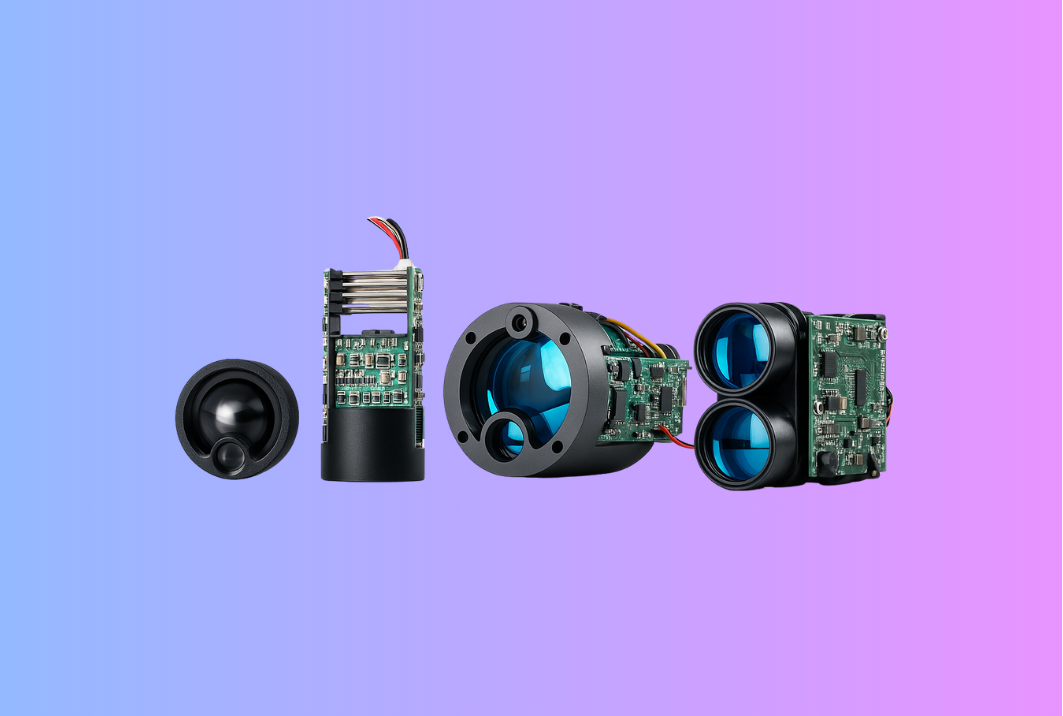
A laser sensor module only succeeds when its host link is predictable in noise and easy to integrate. Whether your handheld is built around a laser rangefinder module or another distance sensor module, the choice between UART and CAN drives latency, cable length, EMC performance, and serviceability. This guide compares the two—mechanically, electrically, and in firmware—with field-proven rules, acceptance tests, and a decision flow you can paste into your PRD.
Table of Contents
ToggleExecutive Summary
UART is simple, cheap, and perfect on short, quiet harnesses inside a pocket device. CAN is differential, arbitration-safe, and resilient on long or noisy cables—and lets multiple nodes coexist without collisions. For compact LRFs under 30–50 cm cable runs and a single host MCU, use UART. For anything with >1 m cable, shared power rails, motors, or multiple sensors, move to CAN (or CAN FD). Publish acceptance: worst-case latency, bit error rate under EMI, and hot-plug behavior.
Use Cases & Buyer Scenarios
Scenario 1 — Golf handheld (single board, short flex)
One MCU controls HUD, battery, and the ranging engine on the same PCB stack. A 3.3 V UART at 115.2–921.6 kbps is adequate and power-efficient. The product story focuses on optics and UX—see companion modules under Modules and retail bundles at Products.
Scenario 2 — Hunting device with removable sensor pod
The engine sits in a sealed front pod; a logic/display board sits deeper in the chassis with motors or heaters nearby. Cable is 30–120 cm and routes past noisy loads. Use CAN 2.0B at 250–500 kbps or CAN FD for larger payloads. It survives hot-plug, brownouts, and radiated bursts better than TTL UART; service tools can sniff frames via a simple dongle (see Support).
Scenario 3 — Tripod/vehicle mapping (multi-sensor)
Multiple ranging heads, a GNSS unit, and a compute box share power with fans or actuators. You need node arbitration, long cables (10–50 m), and deterministic retries. Use CAN (classic or FD), document IDs and message maps, and bring the link into your fusion stack (see Solutions and Module Integration for OEMs).
Spec & Selection Guide (the heart)
UART vs CAN — what actually differs
| Dimension | UART (TTL/RS-232/RS-485) | CAN 2.0B / CAN FD | Why it matters |
|---|---|---|---|
| Signaling | Single-ended TTL (on-board), RS-232/485 for cables | Differential (CANH/CANL), recessive/dominant | Differential rejects common-mode noise and ESD better |
| Bandwidth (typ.) | 115.2 kbps – 3 Mbps (TTL); RS-485 similar | 1 Mbps (classic); 2–5 Mbps data with CAN FD | FD carries bigger payloads without CPU overhead |
| Cable length | TTL: <0.5–1 m; RS-485: >100 m at low baud | ~40 m @1 Mbps; ~100 m @500 kbps; ~500 m @125 kbps | Rule-of-thumb limits for handhelds and rigs |
| Topology | Point-to-point; multi-drop via RS-485 | Multi-drop bus with arbitration | CAN scales to many nodes without collisions |
| Error handling | No native CRC per frame (add in protocol) | Built-in CRC + error frames + retry | CAN recovers gracefully; UART relies on higher layer |
| Noise immunity | Low (TTL); Medium (RS-485) | High with 120 Ω termination & twisted pair | Choice depends on cable routing and motors/heaters |
| Cost & complexity | Very low (TTL UART in MCU) | Transceiver + termination; slightly higher BOM | CAN cost pays back in serviceability and uptime |
| Tools & service | USB-TTL adapters; custom logs | Widely available CAN sniffers; DBC maps | Field diagnosis is faster with CAN |
What the numbers mean for an LRF
Your message payload is small—range (m), confidence (0–100), n_valid, σ, status. At 10 Hz UI cadence, even 115.2 kbps UART is plenty if the cable is short and quiet. Problems start when you add motors (focus/zoom), heaters, or long harnesses that pick up bursts; CAN’s differential signaling and error frames keep data intact where TTL UART drops bytes or hangs.
If/Then mini matrix
- If the engine and MCU sit on the same board or flex ≤20 cm, then use 3.3 V UART (DMA + ring buffers) and keep the bus private.
- If cable length >1 m, motors/heaters share power, or multiple sensors exist, then use CAN with 120 Ω end-terminations and short stubs (<30 cm typical).
- If you need long runs (10–50 m) on a rig, then CAN (classic/FD) with shielded twisted pair and isolation passes EMI tests reliably.
Integration & Engineering Notes
Electrical & Interfaces
UART (TTL). Keep traces short, avoid level shifters with slow edges, and use DMA with a fixed-size frame (SOF, LEN, PAYLOAD, CRC-16). For cables, move to RS-485 (differential) rather than TTL over a harness, and add fail-safe biasing.
CAN. Use a transceiver rated for 3.3 V I/O, add 120 Ω termination at each end, keep stubs short, and maintain a single-point shield bond. Budget protection: TVS on CANH/L, common-mode choke near the connector, and optional digital isolators when power domains differ. Document node IDs and message maps (DBC) in your project wiki and ship the file with the SDK under Downloads.
Power integrity. Decouple TX rails heavily; the LRF pulse driver can inject noise. Route the bus away from the laser driver path, and star-ground analog returns. If you share the chassis with imaging optics, reuse the harness discipline proven on Thermal Rifle Scopes and other Thermal Optics.
Optics & Mechanics
Bus choice affects sealing and assembly: CAN’s twisted pair fits small O-ring feed-throughs and tolerates ground shifts across modules; TTL UART forces very short inter-board links inside one cavity. Keep connectors keyed and lockable (e.g., Micro-Fit/JST-GH), strain-relieve the harness, and avoid 90° turns near the window baffle. Manufacturing controls and incoming inspection are detailed under Manufacturing & Quality.
Firmware/Protocol/Tuning
UART framing. Use binary frames with CRC-16/CCITT, sequence numbers, and ACK/NACK. Implement a watchdog on silent timeouts and a soft recovery path (discard to SOF). CAN mapping. Keep frames small and periodic: e.g., ID 0x100 “RANGE” {range_mm, conf, n, sigma}, ID 0x101 “INFO” {temp, vbat}, ID 0x102 “CMD” {mode, burst, tau}. For CAN FD, put occasional logs in the data-phase bytes with a lower update rate.
Latency budgeting. Humans perceive 5–8 Hz UI cadence; anything faster looks like flicker. Whether UART or CAN, prioritize deterministic delivery over raw bandwidth: DMA → ISR → ring buffer → debounced HUD. Align with the product patterns you already use across day/night devices at Products.
Testing & Validation (bench → field)
EMI/ESD. Validate IEC 61000-4-2 ESD (±8 kV air), 4-3 radiated immunity, 4-4 EFT on supply, and 4-5 surge as appropriate. Cable tests. Coil the harness to worst-case inductance; inject RF near the cable; measure bit error rate and recovery time. Hot-plug. Brownout the sensor board and confirm the bus returns to nominal without a power cycle. Acceptance metrics. Max one lost frame per 106 bits under 10 V/m RF; <180 ms 95th-percentile end-to-end latency; no stuck bus after ESD.
Compliance, Export & Certifications
Bus choice does not change IEC 60825-1 Class 1 for the laser engine, but noisy rails can corrupt timing—your eye-safety file must prove emissions are invariant to UART/CAN settings. For EMC, target CISPR 32/35 (CE) or FCC Part 15B. If your product rides on vehicles, consider ISO 7637 pulse immunity and automotive ESD practice. Keep labels and manuals consistent; public documents live under Certificates and Warranty.
Business Model, MOQ & Lead Time (OEM/ODM)
Deliverables. We ship the module with a UART or CAN interface, DBC/CSV message maps, harness drawings, and an acceptance card you can hand to retailers. MOQs. 200–300 pcs baseline; 500–1,000 pcs if you need custom cables, sealed feed-throughs, or isolated CAN. Lead time. EVT 4–6 weeks with catalog harness parts; custom cables add 3–5 weeks. Explore options under Rangefinder Module Integration and contact us via Contact.
| Assumption | UART build | CAN build |
|---|---|---|
| BOM delta (module side) | Baseline | + transceiver + passives ≈ +$1.2–$2.8 |
| Cable & connector | Short flex / 4-wire | Twisted pair + 120 Ω + shield |
| EMI/ESD debug time | 1× | 0.6–0.8× (fewer retries) |
| Field failure rate (wiring/EMI) | Higher on long runs | Lower; easier to diagnose |
Pitfalls, Benchmarks & QA
- Running TTL UART over cables. Convert to RS-485 or move to CAN; TTL over 50–100 cm harnesses invites errors.
- Missing terminations. CAN without 120 Ω at both ends becomes an antenna. Keep stubs short.
- CRC-less UART frames. Add CRC-16 and sequence counters; logs must prove integrity.
- No hot-plug plan. Test brownouts and disconnections; require automatic recovery.
- ESD only at chassis. Protect the bus pins with TVS and chokes near the connector.
- Ignoring service tooling. Ship DBC/CSV maps and a PC demo so technicians can sniff traffic.
FAQs
Q: Is CAN overkill for a simple handheld?
Not if you have long cables, motors, or future accessories. Otherwise, UART on-board is simpler and saves BOM.
Q: What about USB?
Great for PC tools, but it adds a stack and power-state complexity; internally we still favor UART or CAN for deterministic control.
Q: How fast should I run the bus?
Match human UI cadence (5–8 Hz perceived). 250–500 kbps CAN or 230–460 kbps UART is plenty for range, confidence, and status.
Q: Can I convert later?
Yes—keep a HAL with identical commands. We ship both variants and maintain message parity to protect your firmware.
Q: Which connectors work best?
Locking micro-pitches (JST-GH, Micro-Fit). Use twisted pair for CAN and route away from the laser driver.
Decision Flow — pick a bus you can defend
Start
  ├─ Cable length ≤ 0.5 m and one host MCU?
  │     └─ yes → UART (TTL on-board); DMA; CRC-16; ring buffers
  ├─ Cable > 1 m, motors/heaters, or >1 sensor?
  │     └─ yes → CAN 2.0B/FD; 120 Ω ends; short stubs; TVS + choke
  ├─ Need multi-node arbitration or hot-plug robustness?
  │     └─ choose CAN; publish DBC; ship PC sniffer
  ├─ Acceptance: ≤180 ms 95th E2E latency; BER < 1e-6 under EMI; no stuck bus after ESD
  └─ Freeze message map + harness + compliance file → Pilot → MP
Call-to-Action (CTA)
Unsure which path fits your market and cable reality? We’ll prototype both buses, run EMI/ESD and hot-plug tests, and deliver message maps, harness drawings, and logs buyers trust—then package them for retail onboarding. Start a spec review via Contact and explore related hardware/software kits under Module Integration for OEMs and Rangefinder Module Integration.
Sources
- ISO 11898 — Road vehicles—Controller area network (CAN). Physical layer, data link, and timing. (ISO)
- Texas Instruments — Introduction to the Controller Area Network (CAN). Signaling, arbitration, error handling. (TI App Note)
- NXP — CAN Physical Layer Requirements. Termination, stubs, and common-mode chokes. (NXP AN1798)
- Microchip — UART/RS-232/RS-485 Design Guide. Cabling, biasing, and EMC tips. (Microchip App Note)
- IEC 61000-4 Series — EMC Immunity (ESD/EFT/Radiated). Test levels and methods relevant to cables. (IEC Webstore)