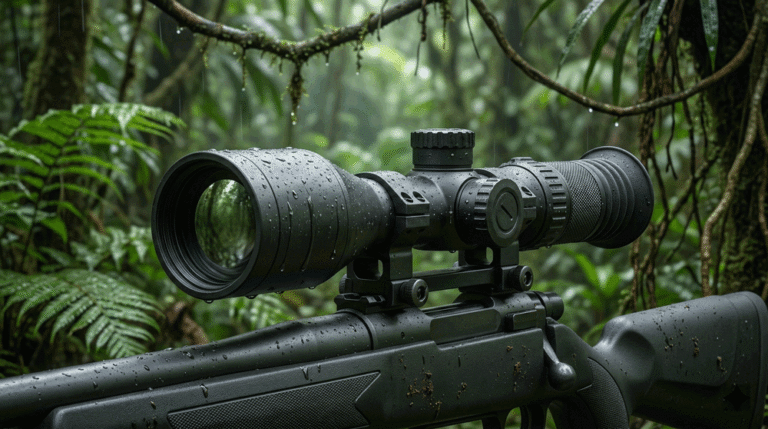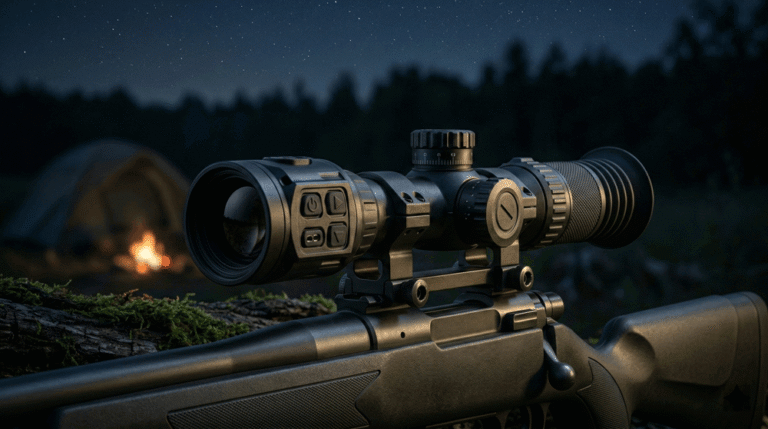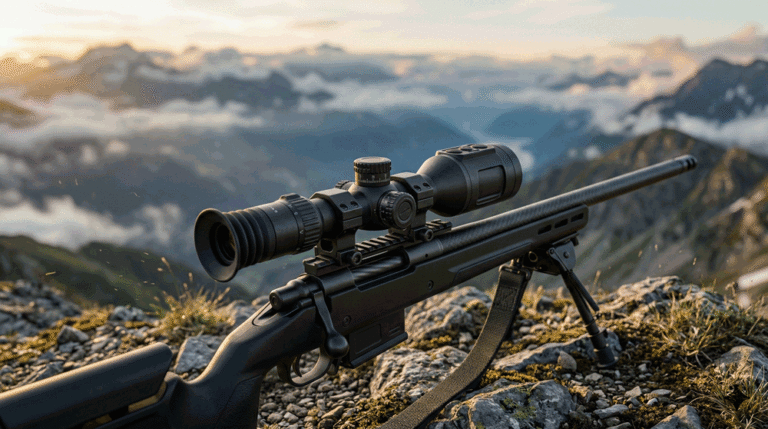
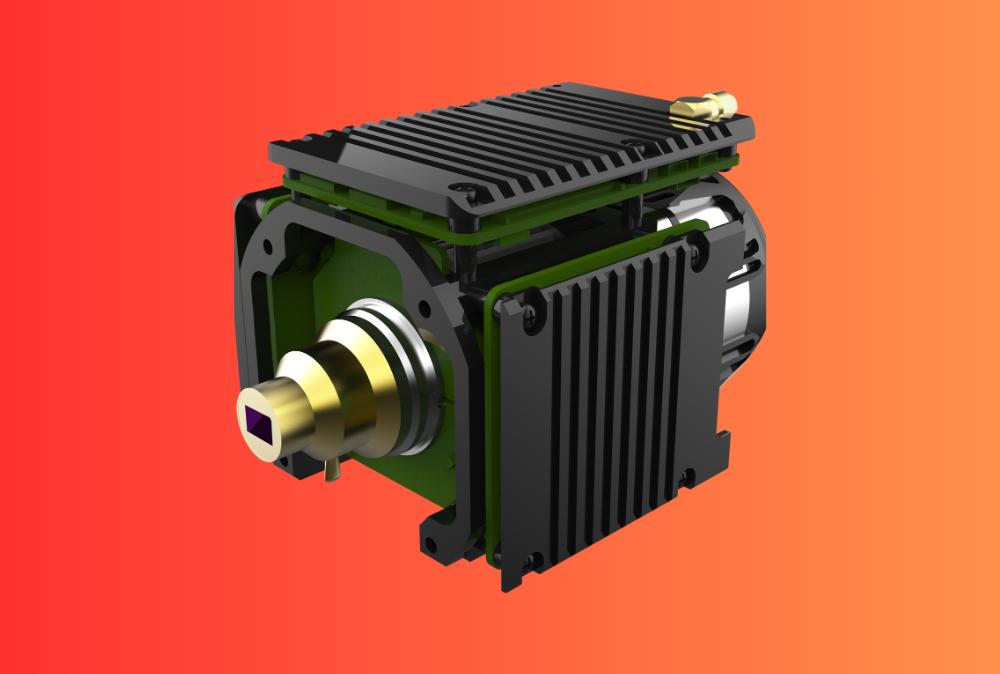
A thermal imaging camera core reaches its limits long before the marketing numbers do: detection, recognition, and identification (D/R/I) are set by how optics, sampling, noise, and the atmosphere preserve contrast at the spatial frequencies your target requires—not by pixel count or NETD alone. In practice, D/R/I is a geometry-plus-physics problem: how many usable pixels land on the target at range, and how much of their contrast survives the lens, the air path, and your display pipeline.
Table of Contents
ToggleThe planning language: Johnson criteria, made useful
Most teams still plan with Johnson’s criteria: a pragmatic mapping from “line pairs across the target” (or pixels across its critical dimension) to the probability of completing a task—detection (~object present), recognition (class), and identification (specific). The canonical thresholds—about 1 line pair for detection, ~4 for recognition, and ~6+ for identification—came from observer studies and remain the common baseline for thermal systems. Use them to size lenses and to align expectations early.
But Johnson numbers assume you’ve delivered contrast to the imager. That’s where the rest of the chain decides whether the math holds outside a conference room.
Geometry first: FOV, IFOV, and pixels on target
Two angles control range more than anything else:
- Field of view (FOV)—the wedge of world your lens projects onto the sensor (≈ 2arctan(s/2f), with sensor width sss and focal length fff).
- Instantaneous field of view (IFOV)—the angle per pixel, essentially the pixel pitch divided by focal length (in radians). The smaller the IFOV, the more pixels span the same target at the same distance.
With FOV and IFOV set, you can predict pixels across a target and check which Johnson task is within reach at each distance before you buy lenses or publish datasheets. That’s why “more pixels” without the right IFOV often disappoints in the field.
The optical truth: MTF, not megapixels, decides detail
The modulation transfer function (MTF) describes how your lens transfers contrast at different spatial frequencies. Defocus, aberrations, small protective windows, and diffraction all shave contrast right where recognition and ID live (mid-to-high spatial frequencies). If MTF is soft at the frequencies implied by your IFOV, the Johnson math collapses even when pixel counts look fine. In short, resolution creates opportunity; MTF cashes the check.
The thermal truth: MRTD links sensitivity to detail
NETD tells you how small a temperature difference rises above noise in general; MRTD tells you how much ΔT you need to resolve a pattern at a given spatial frequency. MRTD is thus a system curve (scene → optics → detector → display), not a single number. If your MRTD is high at the frequencies your target requires, recognition/ID will be elusive in warm, low-contrast scenes no matter what the NETD headline says.
The atmospheric truth: the IR window helps—but weather still taxes you
Thermal imagers work in the infrared atmospheric window (≈8–14 µm), where absorption is relatively low. But humidity, aerosols, and clouds still attenuate or emit along the path; on muggy nights the window narrows and contrast decays with distance (think Beer-Lambert). A camera that recognizes confidently at 400 m on a dry autumn night may only detect at that range in midsummer humidity. Plan for seasonal swings.
The human-machine truth: display and codec can undo good physics
Even a great core can lose recognizability if tone mapping and compression flatten mid-tones or smear edges. Operator task performance has been shown to move with display image quality for thermal cameras—proof that bitrate floors and conservative tone curves belong in the spec, not as an afterthought. (If you starve the stream, those precious line pairs vanish.)
Security vs UAV: same physics, different “good enough”
Fixed security. Distances are predictable; wind and window cleanliness are your biggest enemies. A common pattern is a broader FOV node for awareness and a narrower “corridor” node where you promise recognition at the far gate. MTF stability (focus, mount stiffness) matters more than a small NETD win when you’re already operating at long focal lengths.
UAV payloads. Altitude, motion, and pilot workload push you toward moderate FOVs for productive swath. Narrow HFOV magnifies micro-jitter; if the gimbal isn’t rock-steady, you trade away the recognition you hoped to gain. Many teams search with a 20–35° HFOV and switch to a narrower view only during hover—when stabilization is best and bitrate can be raised briefly.
A worked intuition: why your 640 may not beat a tuned 384
Imagine a 0.5 m human torso at 300 m. If your IFOV is ~1 mrad/pixel, the torso spans ~0.5/300 = 1.67 mrad → ~1.7 pixels—detection only. To reach recognition (~8 pixels across), you need ~4× more sampling at that distance (longer focal length or smaller pitch) and sufficient MTF at the corresponding spatial frequency. A shaky gimbal or a soft focus can erase the extra pixels you paid for. The winner is the configuration that delivers usable pixels on target under motion and weather—not the theoretical maximum.
Turning physics into spec language your stakeholders will understand
When you draft PRDs and datasheets, write the outcomes, not just the parts:
- State the Johnson task, target width, and distance at a probability (e.g., “recognition of a 0.5 m human torso at 350 m, ≥50%”).
- Publish FOV and IFOV and show how they were derived so reviewers see the geometry.
- Provide MRTD curves for the camera, not just detector NETD; ensure curves reflect your lens and display pipeline.
- Acknowledge atmospheric conditions (e.g., “validated at 24 °C, 70% RH, light haze”).
- Fix display/encoder presets (bitrate floor, tone-curve, no oversharpening halos) for long-range tasks.
Engineering levers that actually move D/R/I
- Lens f/# and focus discipline. Faster optics raise detector irradiance; good AR stacks and clean windows keep contrast high. Lock a focus method (hyperfocal vs motorized) and verify on a bar target at your critical range.
- IFOV matched to target geometry. Choose pixel pitch and focal length to place enough pixels across the critical dimension at your real distances—then protect that advantage with mechanics and tuning.
- NUC/Calibration policy. Keep fixed-pattern noise low across temperature swings so faint contrasts aren’t riding on striping; continuity matters on UAV, radiometry on inspection.
- Display/codec discipline. Bitrate and tone-curves belong in acceptance criteria; otherwise, the operator never sees the detail your optics delivered.
Two compact tables you can paste into a PRD
What each concept tells you (and doesn’t)
| Concept | Strength | Blind spot |
|---|---|---|
| FOV/IFOV | Predicts pixels across target at distance | Says nothing about contrast transfer or noise |
| MTF | Shows contrast vs spatial frequency (lens/system sharpness) | Doesn’t include noise or display effects |
| NETD | Scalar sensitivity (small ΔT visibility) | Not frequency-specific; ignores optics and display |
| MRTD | ΔT needed to resolve detail at each frequency | Still assumes display/codec neutral |
| Johnson criteria | Task probabilities at given pixels-on-target | Assumes usable contrast; ignores weather/codec |
Security vs UAV—default FOV/resolution posture
| Platform | Search posture | Clarify posture | D/R/I caveats |
|---|---|---|---|
| Fixed security | Wider HFOV node for awareness | Narrow corridor node at known distances | Wind/mounting erode MTF when long |
| UAV gimbal | 20–35° HFOV for swath | Narrower view only in hover | Jitter kills mid-frequency detail |
Buyer’s workflow (simple, defensible, repeatable)
- List target sizes and distances that actually matter to your site or mission.
- Pick FOV families for awareness vs corridor/overwatch.
- Compute IFOV and pixels-on-target for candidate lenses/pitches.
- Check Johnson thresholds for each distance; label what’s “detect,” “recognize,” or “ID.”
- Derate for MTF and atmosphere using an MRTD curve and your worst-month weather.
- Lock display/codec presets and test with operators before you cut POs.
Integration & OEM/ODM—keep outcomes stable across SKUs
If you ship multiple payloads or housings, standardize behavior around the thermal imaging camera core so operators don’t relearn outcomes:
- Publish a single SDK surface for gain/NUC, palette, focus, and encoder presets; honor it across air and ground enclosures.
- Keep optical keep-outs common (clear aperture, flange distance) so you can swap focal lengths without re-spinning the housing (which would invalidate your focus/MTF tuning).
- Version-control tone-curve LUTs and acceptance scripts; treat them as spec artifacts, not app preferences.
When you’re ready to productize, anchor readers with internal links (each used once):
- Explore modules in <a href=”/thermal-camera-module/”>Thermal camera module</a>
- See practical build notes in <a href=”/thermal-camera-module-integration/”>Thermal camera module integration</a>
- For mixed sensing, review <a href=”/laser-rangefinder-module/”>Laser Rangefinder Modules</a>
- Align programs via <a href=”/oem-odm-partner-program/”>OEM/ODM Partner Program</a>
FAQs
Does digital zoom improve recognition?
No. It crops; IFOV doesn’t change. Use it for framing only. (Recognition is about usable pixels and contrast at the right spatial frequencies.)
Is lower NETD always better for D/R/I?
It helps, but only if MTF and display preserve detail. A soft lens or harsh compression can erase the advantage of a better NETD.
How much does humidity matter?
A lot. The 8–14 µm window narrows with water vapor and cloud; plan range derates for muggy nights.
Can two cameras with the same resolution perform differently?
Yes—IFOV, MTF, NETD, NUC policy, and display settings can make a 384 system beat a poorly tuned 640 system at practical recognition.
Call to Action
Want D/R/I numbers you can defend in a design review—and confirm on a mast or airframe? We’ll map FOV/IFOV to your targets, fold in MTF/MRTD, and return a shortlist of lenses, windows, and encoder settings you can actually source this quarter. Start with our configurable Thermal camera module, review build details in Thermal camera module integration, align via OEM/ODM Partner Program, and contact us to schedule a D/R/I planning session.