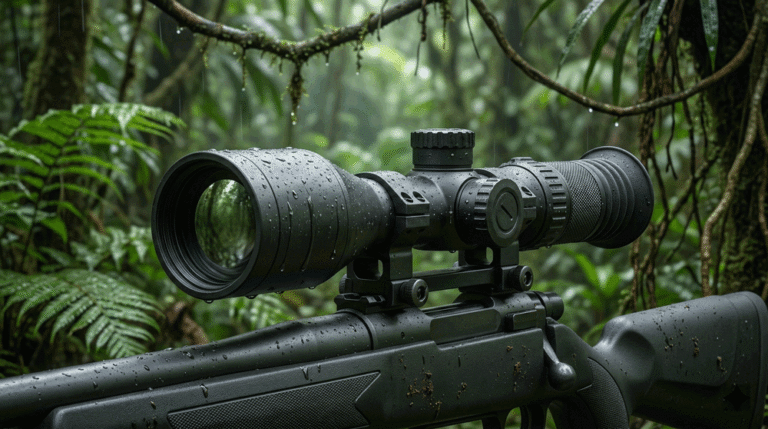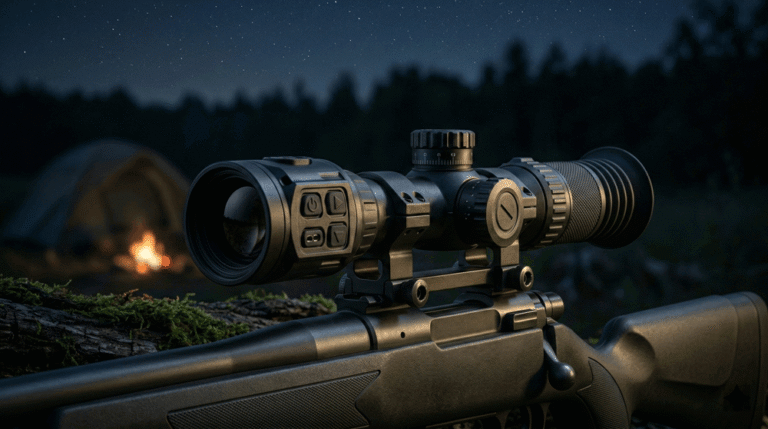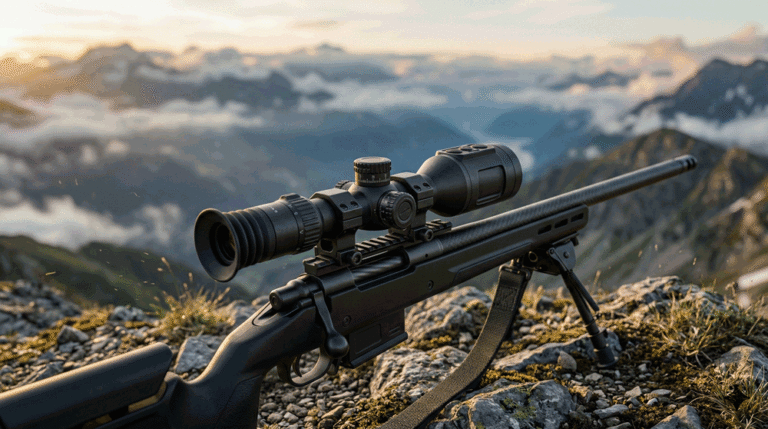
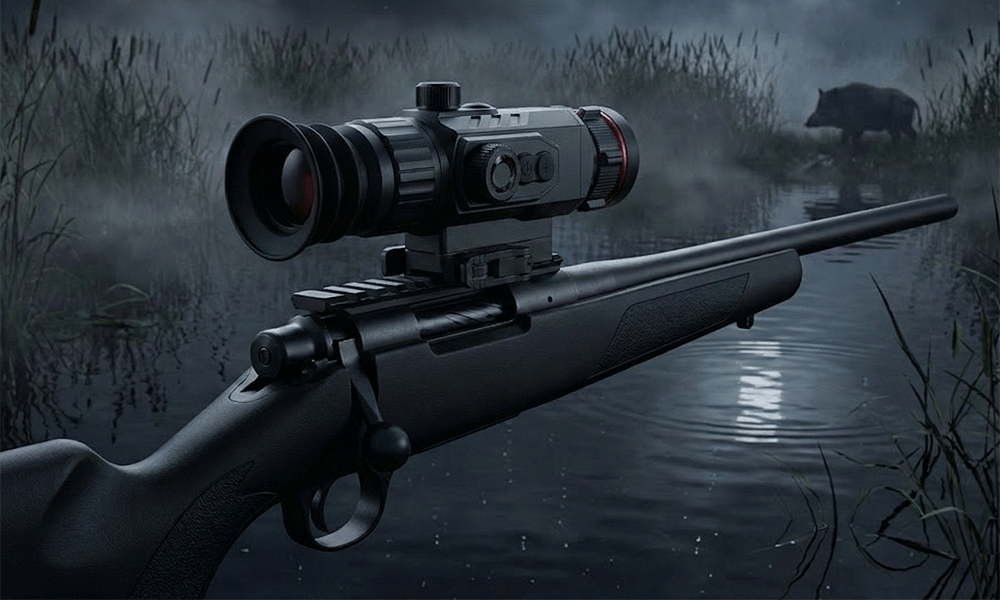
If you’re building a thermal product line (thermal riflescopes, monoculars, clip-ons, or compact modules), you will see one spec come up in every serious conversation: NETD.
Table of Contents
ToggleSome brands treat NETD like a trophy number. Others ignore it and talk only about resolution. Both approaches are risky.
NETD is the clearest “first-pass” signal of real-world thermal usability, especially in the conditions that actually matter for hunting and outdoor work: humidity, cluttered backgrounds, dawn/dusk crossover, and long observation sessions where image noise becomes fatigue.
This article explains NETD with a product-line mindset: not just what it means, but how to use it for segmentation, sourcing, validation, and marketing without getting trapped by spec-sheet games.
What NETD Really Measures
NETD stands for Noise Equivalent Temperature Difference. It describes the smallest temperature difference your thermal system can distinguish from its own noise.
-
- Unit: mK (millikelvin)
-
- Lower is better: <20 mK is more sensitive than <35 mK
-
- Intuition: NETD tells you how much “micro-contrast” the device can extract when the scene itself has weak contrast.
Thermal imaging isn’t a thermometer. The user doesn’t care if the animal is exactly 31.2°C. They care whether the device shows enough contrast to separate:
-
- animal vs. warm ground
-
- animal head vs. torso
-
- legs vs. brush
-
- one animal vs. another in a group
-
- animal vs. stump at 150–300 meters
That’s the zone where NETD matters most.
Why NETD Should Lead Your Product-Line Strategy
When brands plan thermal product lines, they typically define tiers like:
-
- entry / value
-
- mid-range / best-value
-
- premium / high-end
NETD is one of the few metrics that aligns cleanly with those tiers because it correlates strongly with perceived image confidence in hard environments.
NETD is a “Customer Experience” Spec in Disguise
Resolution affects detail when contrast exists. NETD affects whether contrast exists at all when the environment is working against you.
For outdoor hunting, the worst moments are usually not “pitch-black with a glowing-hot target.” They’re the opposite:
-
- humid air flattening thermal contrast
-
- dawn/dusk thermal crossover
-
- background clutter (grass, shrubs, rocks)
-
- warm ground after sunny days
-
- wind equalizing surface temps
In these cases, lower NETD often produces a clearer, more usable image with less aggressive noise filtering.
NETD Tiers: A Practical Map for Positioning
This is not a universal law, but it’s a highly usable commercial framework:
| NETD Tier (Typical) | What Users Usually Feel | Best Fit |
|---|---|---|
| <20 mK | Strong micro-contrast, better separation in humidity/crossover, less “mush” | Premium / high-end hunting |
| 20–30 mK | Very capable, strong value, good in most environments | Upper-mid / premium-value |
| 30–40 mK | Works in “easier” scenes; more noise in tough conditions | Mid-range / entry-premium |
| >40 mK | Heavily dependent on processing; weak in low-contrast scenes | Budget / basic observation |
If your target market includes Europe forests, coastal humidity, or dawn/dusk hunting, your “hero SKU” should not be in the 35–40 mK class if you want to claim premium.
Why NETD <20 mK Usually Beats <35 mK in Hunting
A common reaction is: “20 mK vs 35 mK is only 15 mK. That seems small.”
In the field, that difference can be the gap between:
-
- recognition (“it’s an animal”)
-
- and identification confidence (“it’s a hog, head left, moving, clear shot”)
NETD Drives Micro-Contrast in Low Delta-T Scenes
When the temperature difference between target and background is low, your device relies on sensitivity to pull out small gradients. Better NETD typically means:
-
- less visible noise (or less need for aggressive smoothing)
-
- clearer edges and shape definition
-
- better separation of objects with similar temperatures
Practical Examples
| Scenario | Typical User Complaint | What Better NETD Helps |
|---|---|---|
| High humidity / haze | “Everything looks flat.” | Preserves subtle contrast and edges |
| Dawn/dusk crossover | “It’s all gray blobs.” | Reveals shape and motion with minimal contrast |
| Animals in brush | “Hard to separate body from foliage.” | Improves partial signature visibility |
| Long scanning sessions | “My eyes get tired from noise.” | Reduces fatigue, improves confidence |
This isn’t about marketing. It’s about the user making a correct decision quickly.
The Trap: NETD Can Be “Real” and Still Misleading
NETD is important, but it can be misused.
1) NETD is measured under specific conditions
NETD depends on measurement setup (and sometimes on how the device is configured during testing). Two brands can both say “<20 mK” while delivering different real-world impressions.
2) NETD is not the same as “system performance”
NETD is often discussed as if it belongs only to the sensor. In reality, thermal performance is a system:
-
- optics (aperture and transmission)
-
- detector + electronics noise
-
- calibration and uniformity correction (NUC)
-
- processing (denoise, edge enhancement)
-
- display quality
A strong sensor with weak optics can underperform a slightly less sensitive sensor paired with better optics and processing.
The NETD + Lens Aperture Reality: What OEM Buyers Must Understand
NETD is not isolated from lens design. The lens determines how much infrared energy reaches the sensor. That’s why F-number (F/#) matters.
-
- Lower F/# = “faster” lens = more energy to the detector
-
- More energy generally improves signal-to-noise behavior at the system level
-
- Faster lenses can make low-contrast scenes more usable
“Sensitivity Stack” Summary
| Component | Why It Matters | How It Impacts NETD Experience |
|---|---|---|
| Lens aperture (F/#) | Controls IR throughput | Can make image look cleaner/brighter |
| Lens transmission | Material + coatings | Preserves contrast, reduces washout |
| Detector noise | Sensor + ROIC quality | Defines baseline sensitivity |
| Calibration/NUC | Uniformity stability | Prevents drifting “dirty” image |
| Processing | Noise vs detail trade | Too much denoise destroys details |
Procurement implication: When comparing products, don’t accept NETD alone. Evaluate NETD together with lens F/# and transmission quality.
NETD and “Perceived Image Quality”: Why Some Devices Look “Smooth but Dumb”
Many thermal devices use strong denoising to make the image look clean. The problem: heavy denoise can remove the tiny gradients that help identification.
This is why some users say:
-
- “It looks smooth but I can’t identify what I’m seeing.”
A better NETD device can often use less aggressive denoise, keeping micro-details visible while maintaining a stable image.
How to Specify NETD Correctly (So Your Product Line Doesn’t Collapse Later)
If you’re launching under your own brand, you need a NETD spec that can be delivered consistently, not just in a golden sample.
Recommended NETD Specification Template (B2B / OEM Use)
| Item | What to Require | Why |
|---|---|---|
| NETD target | e.g., <20 mK, <25 mK, or <35 mK | Defines tier and positioning |
| Measurement conditions | Ask supplier to state conditions used | Protects comparability |
| Sample size evidence | Multiple units, not one | Ensures consistency |
| Acceptance criteria | Define what happens if units exceed | Controls risk and returns |
| QC link | NETD tier tied to QC sampling and test plan | Avoids “spec drift” |
Even if you don’t publish testing conditions publicly, your internal sourcing agreement should include them.
Building a NETD-Based Product Line (Practical Segmentation)
A clean lineup does not require 10 models. It requires clarity.
Example Product Line Architecture
| Tier | Typical Buyer | Suggested NETD Direction | Message |
|---|---|---|---|
| Value-premium | First-time thermal buyers | 30–40 mK | “Reliable entry to thermal” |
| Premium-value | Dealers’ best seller | 20–30 mK | “Best balance of clarity and price” |
| High-end | Serious hunters / professional use | <20 mK | “Confidence in harsh conditions” |
NETD gives you a rational segmentation that dealers understand and customers feel immediately in the field.
NETD in Marketing: How to Sell It Without Sounding Like a Spec Brochure
NETD is technical. Your content must translate it into user outcomes.
Better framing than “lower is better”
-
- “Better separation in humidity and clutter.”
-
- “More usable at dawn/dusk crossover.”
-
- “Less noise fatigue during long scanning.”
-
- “Higher identification confidence at distance.”
Avoid overclaiming
If you claim “best clarity in all conditions,” users will test that claim in the worst conditions possible and leave reviews accordingly.
How to Validate NETD Claims Before Mass Launch
To meet E-E-A-T expectations (and avoid costly returns), validate performance with a repeatable protocol.
A Simple Field Validation Plan (30–60 Days)
| Test | What You’re Checking | Why It Matters |
|---|---|---|
| Dawn/dusk crossover | Low-contrast performance | NETD difference shows clearly |
| Humid night scan | Contrast retention | Real hunting environments |
| Clutter test (brush) | Partial signature separation | Identification reliability |
| Long session usability | Noise fatigue + stability | Dealer and user satisfaction |
| Multi-unit consistency | Unit-to-unit similarity | Prevents “good sample” problem |
If a supplier can’t support multi-unit validation, that’s a business risk, not a technical detail.
NETD Procurement Checklist (For Brands, Distributors, Importers)
Use this checklist in RFQs and supplier evaluation.
Questions that protect you:
-
- Is the NETD value sensor-level or system-level?
-
- What are the measurement conditions (lens F/#, environment assumptions)?
-
- What is the expected unit-to-unit distribution (not just a max claim)?
-
- What QC process supports the NETD tier (sampling, burn-in, acceptance rules)?
-
- How stable is the image across temperature ranges (drift, NUC behavior)?
-
- Can the supplier provide real-world sample images/videos in difficult scenes?
Decision table for sourcing risk
| Supplier Response Quality | Risk Level | Recommendation |
|---|---|---|
| Clear test method + multi-unit data + QC linkage | Low | Suitable for premium launch |
| Only a marketing claim, vague conditions | High | Not safe for high-end branding |
| Refuses validation or consistency discussion | Very High | Avoid for brand products |
Common NETD Mistakes That Kill New Brands
-
- Choosing NETD too high for the target positioning
Claiming premium while shipping 35–40 mK in humid hunting markets is asking for disappointment.
- Choosing NETD too high for the target positioning
-
- Selecting based on one demo unit
One good sample can hide distribution problems.
- Selecting based on one demo unit
-
- Ignoring optics
NETD without fast, high-transmission optics is an incomplete solution.
- Ignoring optics
-
- Over-smoothing the image
Denoise can hide noise but destroy identification cues.
- Over-smoothing the image
-
- No field validation in tough scenes
Customers will do the hard testing for you, publicly, with reviews.
- No field validation in tough scenes
NETD FAQ (Quick Answers for B2B Conversations)
Is NETD the most important spec?
It’s the best single metric for sensitivity and low-contrast usability, but it must be evaluated with optics and processing.
Is higher resolution always better than lower NETD?
No. Resolution helps detail when contrast exists. NETD helps reveal contrast when the environment flattens it.
Do users really feel the difference between 20 mK and 35 mK?
In easy scenes, less. In humidity, clutter, and crossover, yes, often dramatically.
Can software compensate for poor NETD?
Software can reduce noise, but it often sacrifices micro-details. You can hide problems, not solve physics.
Build a NETD-Right Thermal Product Line (Without Guessing)
If you’re planning a thermal product line for the US/EU/AU hunting markets, we can help you choose a NETD tier and system configuration that matches your positioning, budget, and real environments.
Send these 5 details via your website inquiry form:
-
- Target region (US / EU / AU / other)
-
- Product type (riflescope / monocular / clip-on / module)
-
- Typical environment (humid forest / open fields / mountains / mixed)
-
- Priority (detection / recognition / identification + typical distance)
-
- Target tier (value-premium / premium-value / high-end)
You’ll receive:
-
- Recommended NETD tier and lens aperture direction
-
- SKU structure (1–3 beachhead models)
-
- QC + validation checklist aligned to your tier
-
- Upgrade roadmap (LRF, UI/firmware, accessories)
-
- Suggested NETD tier + lens aperture strategy
-
- Recommended sensor/resolution direction for your positioning
-
- QC and validation checklist to protect your brand reputation
-
- Optional upgrade roadmap (LRF, UI/firmware, accessories ecosystem)