
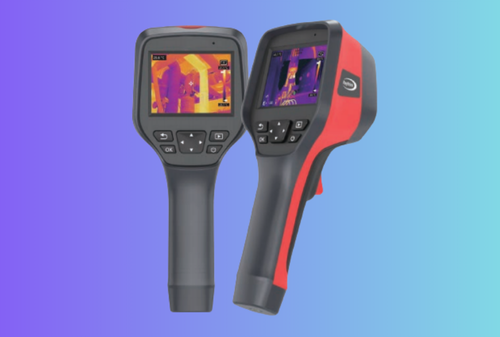
For many maintenance teams, the biggest bottleneck is no longer finding problems—it’s getting the data into the system. Technicians still walk routes with a thermal imager, then spend hours at a desk renaming files, pasting screenshots into reports, and updating the CMMS by hand.
Table of Contents
ToggleA WiFi thermal camera changes that. When a thermal imager connects directly to mobile devices and cloud systems, your inspection route becomes a live data stream instead of a pile of images on an SD card. A well-designed WiFi infrared camera can:
- Push images into your maintenance platform in real time
- Tag assets and locations automatically
- Share findings with remote experts while you’re still standing at the machine
Research on smart factories and predictive maintenance shows that wireless sensors and connected devices are central to modern condition-based maintenance strategies. Studies also show that thermal imaging–based maintenance can reduce maintenance costs by 30–40% by catching issues before failure.
In this article, we’ll look at how to design a wireless reporting workflow around a WiFi thermal imaging camera WiFi platform—whether you’re:
- A maintenance manager upgrading from USB-based cameras
- A service company building digital inspection services
- Or a brand / distributor sourcing a WiFi thermal camera China manufacturer as an OEM/ODM partner
1. Why WiFi Thermal Cameras Matter for Modern Maintenance
1.1 From clipboard and USB stick to live data
Traditional thermal inspections look like this:
- Technician walks the route with a handheld industrial thermal camera.
- Exports images via USB or SD card.
- Manually renames files, adds notes, and builds a PDF report.
- Someone else updates the CMMS or ERP with condensed findings.
This manual process is slow, error-prone, and hard to scale. At the same time, industrial predictive maintenance programs are moving toward continuous data capture, wireless IIoT sensors, and machine learning analytics.
A WiFi thermal imaging camera is a natural bridge: it keeps the ergonomics of a handheld inspection but connects directly to the same wireless data infrastructure you already use for other smart sensors.
1.2 Wireless condition monitoring is now mainstream
In many plants, wireless vibration, temperature, and multi-sensor nodes already send data to the cloud through WiFi, Bluetooth gateways, or LTE backhaul. Predictive maintenance roadmaps from NIST and academic studies highlight wireless sensor networks as a key enabler for data-driven maintenance.
Adding a WiFi infrared camera into that ecosystem means:
- You enrich your sensor data with visual thermal evidence, not just numbers.
- You can correlate anomalies from fixed sensors with on-demand thermal inspections.
- You get a more complete picture of asset health without extra cabling.
1.3 Thermal imaging has proven ROI in predictive maintenance
Thermal imaging is widely used to detect early-stage problems in motors, bearings, electrical panels, and process equipment. Independent analyses report that thermal imaging can cut maintenance costs by 30–40% and reduce unexpected downtime by detecting issues weeks or months before failure.
Combine that with wireless reporting and you get:
- Fewer missed findings (no more “images stuck on the camera”)
- Faster decisions (anomalies show up in dashboards the same day)
- Better documentation (every image is linked to an asset and work order)
A WiFi thermal camera China OEM supplier can help you turn those benefits into a branded product line for your own industrial customers.
2. What Is a WiFi Thermal Camera or WiFi Infrared Camera?
2.1 Basic definition
A WiFi thermal camera or WiFi infrared camera is simply a thermal imager with built-in wireless networking. Instead of being a “stand-alone” device that only stores images internally, a thermal imaging camera WiFi can:
- Connect to a mobile app or tablet over WiFi (direct or via access point)
- Stream live thermal video to the app
- Transfer radiometric images wirelessly for analysis and reporting
- In some cases, upload images directly to cloud services or CMMS systems
This connectivity layer sits on top of the same thermal core you’d find in a conventional industrial thermal camera.
2.2 Smartphone-centric WiFi thermal imaging camera
Several instrument manufacturers now offer WiFi thermal imaging camera designs that pair a compact imager with a smartphone app:
- Some models stream live images to a mobile device and let users tune palette, level/span, and measurement parameters via the app, then build reports and share them wirelessly.
- Others, like smartphone-based thermal imagers, use the phone as the display and processing platform, while the thermal sensor communicates wirelessly or over a short link.
For an OEM/ODM buyer working with a Chinese WiFi thermal imaging camera factory, this smartphone-first architecture can drastically shorten time-to-market: the camera does the sensing; your app and cloud services create the user experience and workflow.
2.3 WiFi vs Bluetooth vs wired
Why focus on WiFi, when Bluetooth and USB already exist?
- USB / SD cards – Highest throughput, but require physical access and manual handling. Good for bulk export; bad for real-time workflows.
- Bluetooth – Great for low-power sensors sending compact data (vibration, simple temperatures), but less ideal for high-resolution thermal images or live video.
- WiFi – Offers enough bandwidth for images and live streams, works with standard industrial and enterprise networks, and can talk to the same infrastructure as your tablets and PCs.
A wifi infrared camera OEM supplier can still include Bluetooth or USB, but WiFi becomes the backbone for high-value workflows like live collaboration and cloud archiving.
3. Key Specs and Design Choices for Thermal Imaging Camera WiFi
A WiFi thermal camera still has to be a good camera. Wireless features are an extra layer on top of core thermal performance.
3.1 Thermal core: resolution, NETD and optics
From a thermal standpoint, your industrial thermal camera needs to match your use cases:
- Resolution
- 160×120 – entry-level, close-range checks.
- 256×192 / 320×240 – solid for general industrial use.
- 384×288 – better detail on crowded panels and small targets.
- 640×480 / 640×512 – premium; excellent for long distances and fine diagnostics.
- NETD (thermal sensitivity)
- ≤60 mK is a practical minimum for industrial work.
- ≤40–50 mK is better for subtle temperature differences in predictive maintenance.
- Optics
- Standard FOV (≈24–32°) for general inspections.
- Optional wide-angle or telephoto depending on whether you scan tight equipment rooms or large outdoor assets.
All of this applies equally whether you’re buying a conventional unit or a WiFi thermal imaging camera from a China manufacturer.
3.2 Wireless connectivity: modes and options
Not all WiFi implementations are equal. When evaluating a WiFi thermal camera China manufacturer, consider how the WiFi layer is designed:
- Client mode – The camera joins your plant WiFi or dedicated maintenance SSID and talks to your servers or cloud via existing infrastructure.
- Access Point (AP) mode – The camera creates its own WiFi hotspot; a technician’s phone or tablet connects directly. Useful in the field or in plants with complex IT.
- Hybrid – Camera can act as AP for the app, while the app forwards data to cloud via 4G/5G or plant WiFi.
Real-world WiFi thermal cameras and app ecosystems often support image streaming, wireless file transfer, parameter tuning, and simple report generation directly from the mobile app.
3.3 App and data workflow requirements
The real value of thermal imaging camera WiFi is in what happens after the image is captured. Your app and backend should:
- Tag every image with asset ID, location, inspector, and timestamp.
- Attach findings to work orders in your CMMS or EAM system.
- Allow basic analysis and annotation (temperature deltas, notes, arrows, voice memos).
- Sync offline work – technicians may work in WiFi dead zones; the app should cache data and upload when connectivity returns.
Mobile CMMS studies show that mobile-first maintenance tools significantly improve response times, work-order handling, and organization of maintenance processes. A wifi infrared camera that integrates directly into such a mobile CMMS adds visual diagnostics to that workflow with almost no extra effort.
3.4 Security and industrial networking (IEC 62443 context)
Connecting a WiFi thermal imaging camera to industrial networks raises legitimate cybersecurity questions.
The IEC 62443 series defines best practices for securing industrial automation and control systems, covering policies, technical requirements, and device-level security. A wifi thermal camera China manufacturer should be able to:
- Support modern WiFi security (WPA2-Enterprise / WPA3) and encrypted connections.
- Provide options to restrict or disable external internet access if required.
- Offer firmware update mechanisms that fit your OT security policies.
For OEM/ODM buyers, aligning the device design with IEC 62443 principles makes it easier to get acceptance from plant IT/OT security teams.
3.5 Practical UX touches
Last but not least, the industrial handheld thermal camera WiFi has to work for technicians in real environments:
- Rugged housing (IP54+), drop resistance, glove-friendly buttons.
- Bright display readable in outdoor and plant lighting.
- Simple WiFi pairing flows that don’t require IT skills on the shop floor.
- Clear indicators for connection status and upload progress.
These details are where a good wifi thermal imaging camera OEM can differentiate its platform from generic “consumer-style” devices.
4. Typical Use Cases for WiFi Thermal Imaging Cameras
4.1 Live collaboration: technician on site, expert in the office
A common pattern in WiFi-enabled thermal apps is live streaming of thermal video from the camera to a mobile device, and then onwards to a remote expert.
With a WiFi infrared camera:
- A junior technician can walk up to a motor or electrical panel.
- A senior reliability engineer sees the live thermal view remotely.
- The expert guides what to scan, what to capture, and how to interpret the patterns.
This reduces travel, speeds up problem resolution, and gives confidence to both sides. For OEM/ODM buyers, offering thermal imaging camera WiFi streaming as a built-in feature can be a strong value proposition to service companies and multi-site industrial clients.
4.2 Mobile CMMS integration: from image to work order in one tap
With a wifi thermal imaging camera paired to a mobile CMMS app, the workflow can look like this:
- Technician scans an asset and sees an abnormal hot spot.
- Captures a radiometric image and tags it with the asset ID from a QR code.
- The app auto-creates or updates a work order, attaching the thermal image and notes.
- Supervisors see new issues in their dashboards instantly, instead of waiting for a PDF report.
Cloud-based CMMS solutions emphasize the value of mobile access, real-time data sharing, and centralized asset management for modern maintenance teams. A WiFi thermal camera China manufacturer that provides open APIs and SDKs makes this kind of integration much easier for your development team.
4.3 Predictive maintenance with mixed sensor fleets
Research on smart factories and predictive maintenance shows that combining different sensor modalities—vibration, temperature, process data—improves fault detection and prediction accuracy.
In such programs:
- Wireless vibration or process sensors continuously stream numeric data.
- When an anomaly is detected, a technician is dispatched with a wifi thermal camera to collect thermal images around the suspected fault.
- The images are pushed to the same cloud platform and correlated with time-series sensor data.
Studies highlight that such integrated PHM (prognostics and health management) systems support more efficient maintenance strategies and better asset reliability.
For an OEM/ODM brand, a WiFi infrared camera designed from the start to connect into IIoT and PHM platforms is more future-proof than a stand-alone gadget.
4.4 Service contractors and remote clients
If you deliver thermal inspection as a service—building audits, energy surveys, electrical inspections—a wifi thermal imaging camera simplifies reporting:
- Inspectors upload images and findings during or immediately after the route, even from the field via mobile data.
- Project managers start drafting reports while the team is still on-site.
- Clients receive secure links to dashboards or interactive reports rather than static PDFs.
Smartphone-based WiFi thermal imaging camera solutions show how compact imagers plus mobile apps can support full inspection-and-report workflows from a phone. A wifi thermal camera China OEM supplier can help you build your own branded version of this model.
4.5 Training and standardization across sites
Because WiFi connectivity ties the camera to cloud systems, you can:
- Push standardized checklists and inspection templates to your wifi infrared camera app.
- Monitor which assets were actually scanned, when, and by whom.
- Use captured thermal images in training libraries and competency assessments.
This supports global maintenance programs with consistent standards across multiple plants and regions.
5. Choosing a WiFi Thermal Camera China Manufacturer / OEM Supplier
If you want to launch your own WiFi thermal camera line, picking the right China factory or OEM/ODM partner is crucial.
5.1 Module + wireless architecture
Decide early how you want to split responsibilities between the thermal core and the wireless + app layer:
- Module-first approach
- Use proven thermal imaging modules as the sensing core.
- Add WiFi and processing via your own embedded board or smartphone app.
- Integrated handheld platform
- Take an existing industrial handheld design from a Chinese WiFi thermal imaging camera factory.
- Customize WiFi configuration, branding, and app integration around it.
The first path maximizes control and differentiation; the second accelerates time-to-market.
5.2 Wireless design and regulatory compliance
A serious wifi thermal imaging camera OEM should be comfortable discussing:
- WiFi standards support (2.4 GHz / 5 GHz), roaming behavior, and interference handling.
- Compliance with regional RF regulations (e.g., FCC, CE, relevant regional standards).
- Antenna design suited to industrial environments (metal structures, enclosures, distance).
You should expect factory test procedures for both thermal performance and wireless stability.
5.3 Cybersecurity and IEC 62443 alignment
As mentioned earlier, the IEC 62443 standard series provides a framework for securing industrial communication networks and devices.
When you talk to a wifi thermal camera China manufacturer, ask:
- How do they harden the device OS and network stack?
- Can they support your requirements for user authentication, certificate handling, and firmware signing?
- Do they have experience working with plant operators that follow IEC 62443 or similar guidance?
This is not just an IT issue—many large industrial customers now treat OT cybersecurity as a procurement requirement.
5.4 SDKs, APIs and integration support
To turn a WiFi infrared camera into a real product, you need:
- Documented APIs or SDKs to access radiometric data and device controls.
- Sample code for common stacks (Android, iOS, Windows, Linux).
- Support when your developers hit edge cases.
This is where a specialized wifi thermal camera OEM supplier in China can be more valuable than a generic “box seller”.
6. Gemin Optics as Your WiFi Thermal Imaging Camera OEM/ODM Partner
Gemin Optics is a China-based manufacturer focused on thermal imaging modules, handheld thermal imagers, and laser rangefinder modules for B2B markets. While WiFi chipsets and network stacks evolve quickly, the thermal core and integration know-how are long-term assets.
6.1 Build WiFi thermal cameras from modules
Using configurable thermal camera modules as the heart of your device, you can:
- Choose resolutions and NETD levels that match your target applications.
- Pair the module with your own WiFi-enabled processing board or mobile device.
- Design housings and ergonomics around your customers’ inspection workflows.
Gemin Optics can work with your team on optics selection, calibration and environmental testing, while you own the thermal imaging camera WiFi app and cloud experience.
6.2 Customize handheld industrial thermal cameras
If you prefer an end-to-end handheld platform, Gemin Optics’ industrial handheld thermal imagers can be adapted for WiFi-enabled workflows by:
- Adding or integrating WiFi connectivity via internal modules or companion devices.
- Customizing UI, menus and presets around your wireless reporting process.
- Branding devices under your own label for distribution and service programs.
This is a practical route if you want to become a WiFi infrared camera OEM supplier for maintenance contractors, utilities and industrial end users.
6.3 Long-term collaboration and roadmap
Because Gemin Optics also supports module-level integration for fixed systems, you can evolve from:
- WiFi handheld imagers for mobile inspections, to
- Fixed thermal nodes that stream data continuously, under the same brand and SDK.
That gives you a path from wifi thermal imaging camera handhelds to full IIoT thermal monitoring solutions.
7. Work with a China WiFi Thermal Camera Manufacturer You Can Trust
A well-designed WiFi thermal camera turns thermal inspections into part of your live data pipeline, not a side project. When you connect a wifi infrared camera to mobile apps, cloud CMMS and predictive maintenance platforms, you:
- Cut reporting time and manual data entry
- Make it easier for experts to support technicians remotely
- Enrich your sensor data with visual thermal evidence
- Lay the groundwork for more advanced PHM and IIoT strategies
As a China-based industrial thermal camera manufacturer and OEM/ODM supplier, Gemin Optics can help you:
- Map your inspection and reporting workflows into concrete device and app requirements
- Choose or design WiFi thermal imaging camera platforms that fit your markets and channels
- Build a multi-year roadmap covering handheld WiFi thermal imagers and future fixed thermal monitoring nodes
If you’re planning a new wireless thermography solution or upgrading from USB-only devices:
- Contact the Gemin Optics team to discuss your WiFi thermal camera project and OEM/ODM requirements.
- Share your target applications, volumes and integration needs so we can recommend module or handheld platforms that make sense for your program.