
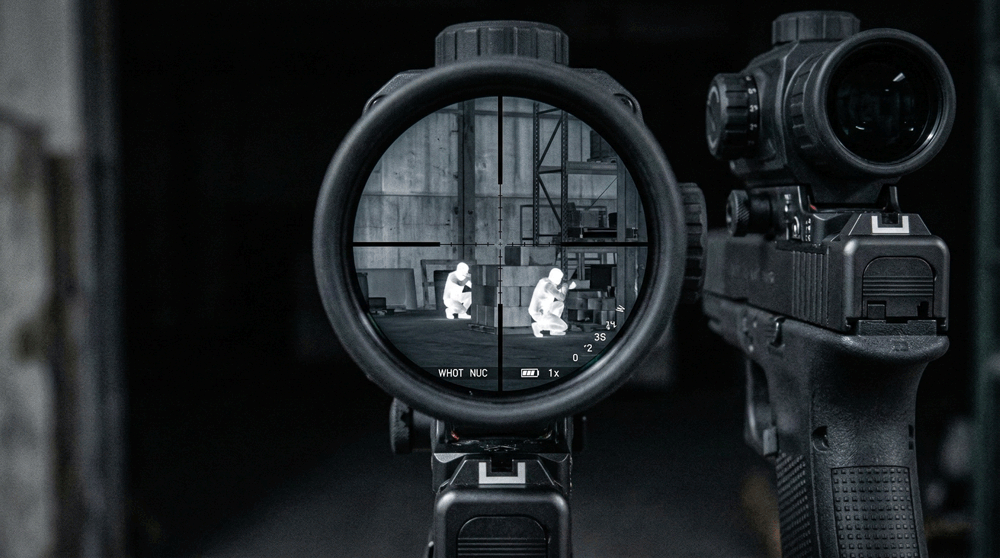
Thermal pistol sights don’t fail in the market because they “aren’t clear enough.” They fail because they don’t survive the slide.
Table of Contents
ToggleDealers can forgive a learning curve. They can’t forgive a unit that reboots intermittently, loses zero, cracks a mounting boss, or develops a “mystery drift” after a few range sessions. Once that story exists—even if it’s only a small percentage of units—your product becomes risky inventory. Risky inventory doesn’t get reordered. It gets discounted, returned, or avoided.
Slide shock is the reason this category is uniquely unforgiving. A pistol slide is not a gentle recoil environment; it’s a rapid acceleration event repeated thousands of times, with significant axis changes, and with a tight mechanical interface that magnifies any weakness in fasteners, base design, internal mass support, and connector integrity. Add thermal-specific factors—battery mass, shutter/NUC mechanisms, display modules, and higher overall weight than typical red dots—and you have a platform that requires validation discipline, not optimism.
This article explains how B2B brands should validate thermal pistol sights for slide shock: what “pass” must mean commercially, how to design a test plan that is repeatable and supplier-friendly, how to define acceptance criteria that correlate with dealer returns, and what evidence to demand before you scale. It builds directly on Thermal Pistol Sight OEM Platform Selection and the mounting ecosystem framing from Thermal Pistol Sight Mounts: RMR vs Picatinny.
Why slide shock is not “recoil rating”
Many suppliers will answer slide shock questions with a recoil number or a generic statement like “tested for .45 ACP” or “tested for 6000J.” Those answers are not useless, but they’re not sufficient because they do not define how the unit was mounted, how many cycles were applied, what axis loads were involved, or what was measured after the test.
In B2B channel terms, “survived recoil” means very little if the unit still powers on but the zero shifts, the mount loosens, the housing deforms slightly, or the image intermittently freezes. Dealers experience these as quality failures even when the factory would call them “still functional.”
So a serious slide shock validation plan must be tied to outcomes that matter to the channel:
- Does the unit keep zero stability after realistic slide cycles?
- Does it maintain mount integrity without loosening or cracking?
- Does it maintain electrical stability (no reboot, no intermittent display dropouts)?
- Does it maintain UI stability (no weird button behavior, no random mode changes)?
- Does it maintain sealing integrity and battery access behavior after repeated shock?
If your test plan doesn’t measure outcomes like these, it won’t predict dealer returns.
The three slide shock realities most RFQs ignore
The first reality is that slide shock isn’t one event. It’s a repetition of harsh impulses where small weaknesses accumulate into failures. A product that looks “fine” after 50 rounds can show drift after 500. A product that looks “fine” after 500 can loosen after 1500.
The second reality is that slide shock is not purely rearward recoil. Slides experience complex motion: rearward acceleration, abrupt deceleration, return-to-battery impact, and vibration harmonics that excite different parts of the housing and PCB assemblies. If your design has a heavy battery, a shutter mechanism, or an internal module supported poorly, repeated shocks become fatigue.
The third reality is that “pistol use” spans multiple hosts and behaviors. Some customers shoot occasionally; others shoot heavily. Some use heavier calibers or hotter loads. Some mount on compensated pistols. Some clean aggressively and remove the optic repeatedly. Your validation plan doesn’t need to cover the entire universe, but it must cover the range that your channel will consider normal.
These realities are why slide shock should be treated as a platform gate, not as a marketing checkbox.
Define what “slide shock validation” must prove
A clean way to frame this for procurement and suppliers is to define slide shock validation as proving two things:
First, survivability: the unit remains fully functional after defined cycles and conditions.
Second, identity stability: the unit remains equivalent to baseline behavior in the ways the channel cares about (zero, mounting integrity, and operational stability). A thermal pistol sight that boots slower, reboots occasionally, or loses zero is not the same product in the dealer’s mind.
If you only validate survivability, you’ll ship units that “work” but generate returns. If you validate identity stability, you protect channel trust.
Choose the right mount configuration before testing anything
Slide shock validation is meaningless if the mount configuration isn’t realistic and repeatable.
If you validate on a proprietary plate that customers won’t use, you may get optimistic results that don’t translate. If you validate with perfect screws and perfect torque under engineering supervision, you may miss looseness and drift that happens in normal use. If you validate with random plates and uncontrolled torque, you’ll get noisy results that can’t be interpreted.
A practical B2B approach is to define a “reference mounting stack” for validation:
- A specific footprint and plate family that is representative of your target market.
- A defined screw specification (material, thread engagement, head type).
- A defined torque window and anti-loosening approach (threadlocker policy or equivalent).
- A defined witness mark or verification method for post-test loosening detection.
This reference mounting stack becomes part of your OEM spec baseline. It also becomes part of dealer training later, because mounting discipline is the fastest way to prevent false “zero drift” complaints.
The failure modes you must expect—and design tests to expose
Slide shock failures in thermal pistol sights usually show up in one of five ways. Understanding them is how you design tests that predict channel pain.
One failure mode is mount loosening. The sight doesn’t crack, but micro-movement appears. The user sees zero wander or inconsistent groups. Dealers interpret this as “won’t hold zero.”
Another failure mode is mount boss fatigue or base deformation. This can be invisible at first. Over cycles, stress concentrates, cracks begin, and then one day a screw pulls or the base shifts.
A third failure mode is electrical intermittence. The sight reboots under shock, the display cuts out, the buttons glitch, or recording fails intermittently. These failures are brutal in the channel because they’re hard to reproduce and feel like “cheap electronics.”
A fourth failure mode is internal module movement. A display module, lens mount, or shutter assembly shifts microscopically. The unit still “works,” but image alignment changes or NUC behavior becomes weird. Dealers experience it as inconsistency.
A fifth failure mode is sealing and battery access degradation. Battery doors loosen, seals creep, or contacts become unreliable. These failures often appear after users begin to handle the unit repeatedly, not in a clean factory environment.
Your validation plan should be designed to reveal these modes early, not to confirm optimistic assumptions.
Don’t confuse “shot count” with “validation”
Some brands try to validate slide shock by firing a round count and checking if the unit still powers on. That approach is too blunt. It’s not wrong to shoot, but you must tie shooting to measurable acceptance outcomes.
The most important acceptance outcomes are:
- Zero stability (measured in a repeatable way, not “feels okay”)
- Mount integrity (no loosening, no boss deformation, no plate distortion beyond envelope)
- Operational stability (no reboot, no unexpected shutdown, no intermittent UI faults)
- Post-test structural integrity (no cracking, no fastener pull, no housing deformation)
- Post-test sealing confidence (especially around base and battery access points)
If your supplier can’t provide these outcomes, you don’t have validation—you have a range day.
Make “zero stability after shock” a measurable acceptance
Zero acceptance doesn’t need to become a ballistics dissertation. It needs to be consistent.
In B2B programs, the best practice is to define a baseline zero method and then measure shift envelope after cycles. You do not need to chase single-shot noise; you need to compare group centers and define what constitutes meaningful drift.
The key is to write this so it can be repeated by the supplier and by your QA team. That means defining ammunition type and consistency assumptions, distance, group size, and the exact mount stack used. You’ll never remove all variance, but you can remove enough that real drift becomes visible.
If you treat “zero stability” as subjective, your post-launch disputes will become subjective too.
Add “operational stability under recoil” as a first-class requirement
Thermal pistol sights aren’t only about impact point; they’re about whether the device behaves reliably in the moment.
A unit that reboots once every 200 shots is a return generator. A unit whose buttons glitch after shock is a support burden. A unit whose display intermittently flickers becomes a “brand risk” because the complaint is hard to reproduce.
So your slide shock validation should include an operational stability requirement. In practice, this means the unit must complete defined firing cycles without reboot, without freeze, without mode changes, and without loss of display. If recording is a promised feature, you should also validate that recording doesn’t corrupt or stop unexpectedly under shock.
This is an area where thermal brands can win against competitors by being disciplined. Many competitors chase specs and under-invest in stability. Stability is what dealers remember.
Use a stage-based validation plan so you don’t “discover late”
Slide shock validation should not be a single event near launch. It should be staged across your development and scaling process so you find issues when you can still fix them cheaply.
This is the only table in this article. It’s a stage-based validation plan that aligns to how B2B OEM programs actually run.
| Stage | What you prove | What you test | What “pass” means commercially |
|---|---|---|---|
| Platform screening | the architecture is viable | short-cycle firing + mount integrity check | no obvious looseness, no reboot patterns |
| Design validation | the product identity survives real use | extended firing + post-test zero envelope + inspection | dealers won’t see “won’t hold zero” stories |
| Pilot qualification | reproducibility across units and batches | multi-unit testing with same mount stack | failure rate and drift stay within envelope |
| Mass monitoring | drift control over time | periodic sampling + field complaint correlation | “same model stays the same” across shipments |
This structure is powerful because it forces discipline: you don’t pretend one prototype proves mass production; you prove reproducibility.
Instrumented tests vs live-fire tests
Not every brand can instrument shock, and not every supplier will share deep test equipment. That’s okay. The point is not fancy equipment; the point is repeatable outcomes.
Instrumented testing is valuable for diagnosing design weaknesses and correlating failures to acceleration spikes, especially when you’re tuning internal supports or mount rigidity. Live-fire testing is valuable because it is the real impulse and includes real mounting behavior.
A practical B2B plan often uses both:
- Use instrumented tests early to identify where the design is sensitive.
- Use live-fire as a validation gate that reflects real user behavior.
- Use post-test measurements (zero envelope, loosening checks, stability checks) to define pass/fail.
If your supplier can only provide live-fire count without evidence and post-test checks, you should treat that as incomplete validation.
Define “mount integrity” as more than “screws are tight”
Mount integrity is the sum of the base, the screws, the plate, and the slide interface.
A disciplined validation includes checks that can detect micro-movement before it becomes catastrophic:
- Witness marks on screws to detect rotation.
- Measurement of base-to-plate seating after cycles.
- Inspection of screw heads and boss areas for early cracking.
- Confirmation that torque retention remains within the expected window.
This is not about making life hard for suppliers. It’s about ensuring you don’t launch a product that slowly loosens in the field.
What OEM evidence you should demand before scaling
For B2B sourcing, the key question is: can the supplier show maturity, not only enthusiasm?
A mature evidence pack for slide shock validation usually includes:
- Definition of the mount stack used (plate type, screw spec, torque method)
- Cycle definition (round count, host platform, calibers, and conditions)
- Post-test acceptance outputs (zero shift envelope, operational stability logs, inspection results)
- Failure analysis notes for any anomalies (what failed, how it was corrected, what changed)
- Version discipline (firmware build ID for the tested units)
If the supplier can’t provide this evidence pack, you’re being asked to trust. In thermal pistol sights, trust without evidence becomes expensive quickly.
Avoid the “wrong host” validation trap
One subtle failure mode is validating on a host platform that reduces stress relative to what customers use. For example, a heavy, compensated pistol might produce different impulse patterns than a common duty-size handgun. Or a particular plate system may be unusually rigid.
This doesn’t mean you must validate on every pistol platform. It means you should validate on a representative host, and you should choose that host based on your target channel’s reality. If your channel is dominated by mainstream duty pistols and common plate systems, validate there. If your channel is specialty competition pistols, validate there.
Your validation should match your commercial story. Otherwise your first dealer wave becomes your real validation, and that is the most expensive place to learn.
Design mitigation: what the best platforms do differently
When thermal pistol sights succeed under slide shock, it’s rarely because of one magic component. It’s because the platform does several things right:
It treats the mounting base as a structural element, not as a cosmetic interface. It distributes stress rather than concentrating it. It supports internal mass (display, battery, thermal core) with anti-fatigue discipline. It uses connector and PCB retention strategies that assume vibration, not “gentle use.” It designs battery access so it doesn’t become a loosening and sealing failure point.
From a B2B brand perspective, you don’t need to tell suppliers how to do their internal design. You do need to require that their design choices deliver the outcomes you care about and that they can prove it through validation evidence.
Production implications: slide shock issues often become batch issues
Many brands assume slide shock problems are “design problems.” In mass production, they can also be process problems.
If torque control on fasteners is inconsistent, some units loosen sooner. If threadlocker application varies, some units drift. If plate flatness varies, seating changes. If assembly stress isn’t controlled, fatigue occurs earlier.
So once you select a platform that passes design validation, your pilot qualification should confirm that multiple units built across normal production variation still meet your acceptance envelope. This is how you prevent the “demo units were fine, shipped units are inconsistent” problem that destroys channel trust.
Dealer implications: slide shock validation becomes a sales tool
Dealers don’t need your lab report. They need confidence. If you can say, credibly and simply, that your pistol thermal sight is validated to maintain zero and stability under realistic slide cycles—with defined mounting and usage assumptions—dealers become willing to demo and recommend.
The key is to keep claims bounded and honest. Over-promising absolute “never shifts” creates returns. Under-communicating validation creates doubt. The best brands communicate the essence: it’s tested, it’s stable, here are the mounting rules, and here’s what we’ll do if something goes wrong.
That last part is important because robustness and after-sales trust reinforce each other. If you validate shock but can’t handle RMAs fast, the channel still feels exposed.
FAQ
Why do thermal pistol sights face more shock risk than red dots?
They are usually heavier, have more internal modules, and can include mechanisms like shutters. The slide impulse is harsh and repeated, so mass and internal retention matter more.
What should “pass” mean in slide shock validation?
Not only “powers on,” but also stable zero envelope, no loosening, no cracking, and no reboot or intermittent behavior under defined cycles.
Is round count alone a good validation metric?
No. Round count must be tied to acceptance outcomes: zero stability, mount integrity, operational stability, and inspection criteria. Otherwise it’s just a story.
Should I validate on multiple pistol hosts?
You should validate on at least one representative host that matches your channel’s reality. Multiple hosts can be added later, but the initial host should not be a “soft” case.
What is the biggest cause of “won’t hold zero” complaints?
Often mounting interface discipline: screw spec, torque control, plate quality, and loosening prevention. True internal drift happens too, but mounting issues are the fastest return driver.
Call to action
If you tell me your target channel (pistol-first hunting vs duty/LE vs PDW), your preferred mounting ecosystem (RMR footprint family and typical plates), and the calibers/platforms you expect most customers to run, I can convert this into an RFQ-ready slide shock appendix: test stages, acceptance envelopes, evidence pack requirements, and the minimum post-test checks that correlate with dealer returns.
Related posts
- Thermal Pistol Sight OEM Platform Selection
- Thermal Pistol Sight Mounts: RMR vs Picatinny
- Slide Shock Validation for Thermal Pistol Sights
- Thermal Pistol Sight Sight Height and Ergonomics
- Thermal Pistol Sight Zeroing and Multi-Gun Profiles
- Thermal Pistol Sight GTM and Warranty Pack