Most commercial laser rangefinder modules today are built around 905 nm laser diodes. They power golf rangefinders, hunting units, construction meters and many embedded sensors. At the higher end, however, more OEM buyers are asking about 1535 nm / 1550 nm–class rangefinders: better eye safety, higher pulse energy, and alignment with defence or industrial specifications.
Table of Contents
ToggleIf you run a B2B brand or design instruments that must stay competitive for 3–5+ years, wavelength is not just a component choice. It is a platform roadmap question: which modules do you deploy now, and how do you prepare for future 1535 nm options without throwing away your current investment?
This article looks at 905 nm and 1535 nm from an OEM perspective—performance, eye safety, cost and integration—and how to design a rangefinder platform that can evolve. It draws on Gemin Optics’ experience supplying configurable laser rangefinder modules for consumer, industrial and special-application projects.
1. Why wavelength is a strategic decision for OEMs
To an end user, a rangefinder “just measures distance.” To you as an OEM, the wavelength drives several things:
- component ecosystem (diodes, detectors, optics, coatings);
- eye-safety classification (IEC 60825-1 laser classes);
- certification effort and legal exposure;
- performance in fog, dust and bright sunlight;
- costs and margins, especially in mid-volume B2B segments.
For many brands, 905 nm has been “good enough” for years. But as markets mature, two pressures grow:
- Regulatory and liability concerns – some customers want more safety margin, especially for rangefinders pointed at people or vehicles.
- Differentiation and roadmap – high-end models and industrial sensors need stronger performance and long-term room to evolve.
That is where 1535 nm comes into the picture.
2. 905 nm today: mature, cost-effective and widely understood
2.1 Component ecosystem and detection
At 905 nm, you benefit from a very mature ecosystem:
- high-volume laser diodes, cheap and available from multiple suppliers;
- silicon photodiodes or APDs as receivers, also high-volume and cost-effective;
- coatings and optics that are well understood and easily sourced.
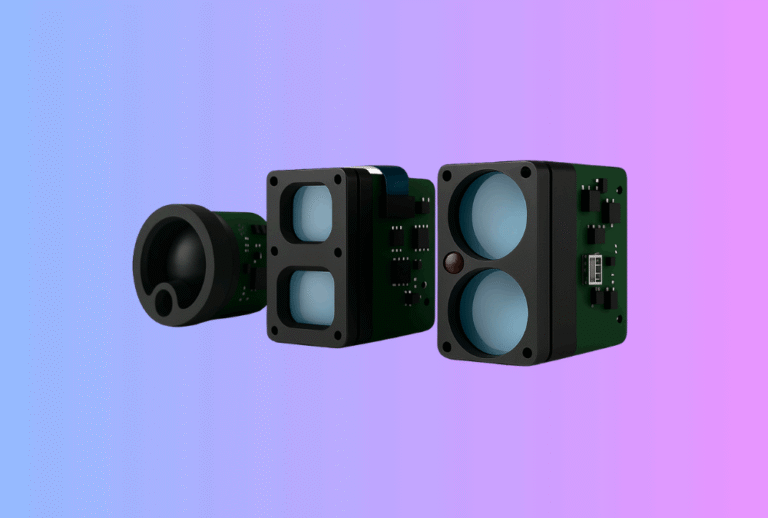
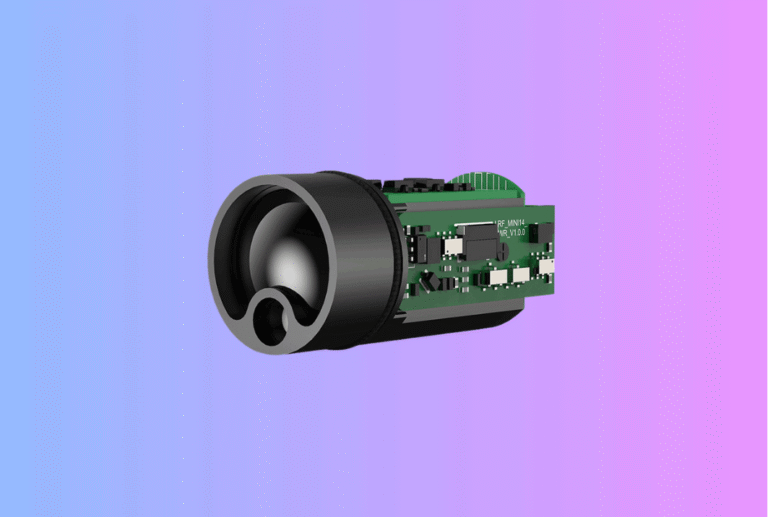
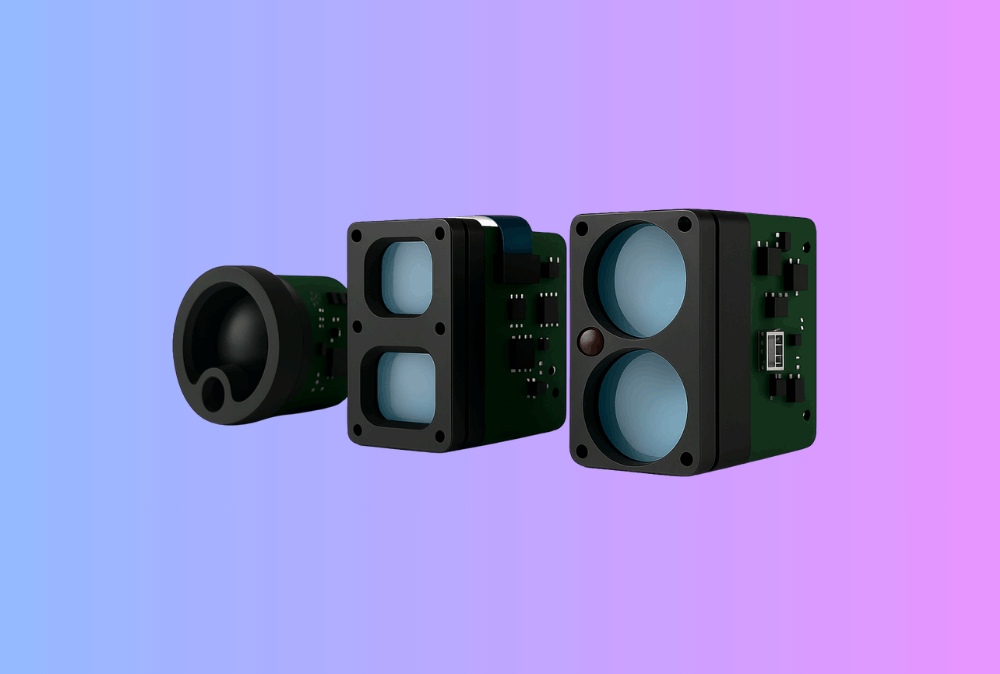
This keeps BOM costs low, simplifies design and enables compact laser rangefinder modules like the ones used in Gemin’s golf rangefinder modules and generic LRF cores.
2.2 Eye safety and regulatory comfort
The challenge is eye safety. 905 nm is near the peak sensitivity of the human retina. Light at this wavelength can pass through the cornea and lens to the retina, where concentrated energy is most dangerous.
To stay within IEC Class 1 or Class 2 limits, 905 nm systems must control:
- peak power and pulse width;
- pulse repetition frequency (PRF);
- beam divergence and minimum focus distance.
With careful design and derating, this is perfectly manageable for golf, hunting and construction products, but it limits how much energy you can put on target—and therefore the maximum range, especially for dark, non-cooperative surfaces.
2.3 Where 905 nm shines
Despite these constraints, 905 nm remains ideal for:
- mass-market golf and hunting rangefinders up to ~1,000–1,500 m claimed range;
- construction meters and surveying tools where ranges are moderate and targets are bright;
- many embedded sensors with modest range and clear, controlled FOV.
For these segments, the combination of cost, size and known behaviour makes 905 nm the default today.
3. 1535 nm tomorrow: eye-safe, powerful and more specialised
3.1 Eye-safety advantages
Moving to 1535 nm / 1550 nm shifts the game. At these wavelengths, most light is absorbed in the cornea and lens, not the retina. The retina is essentially blind to this band, so the risk of permanent retinal damage is much lower for the same energy.
As a result, IEC standards allow significantly higher permissible exposure levels. In practice, that means you can emit more energy per pulse—or more pulses per second—while remaining in Class 1 or Class 1M categories, depending on beam properties.
For applications where the beam might cross people or vehicles at close range, this offers a safety and liability comfort margin that some customers strongly prefer.
3.2 Detectors, optics and cost
The trade-off is complexity and cost:
- 1535 nm requires InGaAs detectors instead of silicon. These are more expensive and may have higher dark noise.
- Some standard glass materials and coatings need adjustment for best performance in this band; off-the-shelf 905 nm optics are not always optimal.
- Laser sources are typically fiber lasers, OPOs or Er:glass-based sources, more complex than small 905 nm diodes, although integrated and miniaturised solutions keep improving.
This makes 1535 nm attractive for higher-priced defence, long-range or industrial instruments, but challenging for low- to mid-price consumer products.
3.3 Performance in weather and clutter
In terms of atmospheric transmission, both 905 nm and 1535 nm face attenuation in heavy fog, rain or dust. In some scenarios 1550 nm can have modest advantages, but it is not a magic bullet; careful system design and signal processing are still needed.
However, the ability to safely emit higher energy and use narrower beam divergence can improve long-range performance and target discrimination, especially in cluttered scenes or for small reflectors at long distances.
4. Positioning: where 905 nm and 1535 nm fit in your portfolio
Given the trade-offs, a realistic roadmap for most brands looks like this:
- keep 905 nm as the workhorse for high-volume golf, hunting and construction lines;
- introduce 1535 nm in premium, long-range or special-regulation SKUs where customers will pay for the extra safety and capability;
- use a platform strategy to share as much mechanical, electronic and firmware infrastructure as possible across both.
This lets you address different customer segments and price bands without running two completely separate engineering and supply chains.
5. Designing a platform that can evolve from 905 nm to 1535 nm
The core idea of a platform roadmap is simple: even if you ship only 905 nm today, you design the hardware envelope so that a future 1535 nm module can fit without major surgery.
5.1 Mechanical and optical envelope
Treat the laser engine as a replaceable module with:
- standardised mounting points and reference surfaces;
- a defined optical axis and window position;
- enough internal space and thermal headroom to accept a 1535 nm module later.
Your first generation may use a compact 905 nm core, but mechanical design should avoid tight constraints that would make a slightly larger 1535 nm source impossible to fit. Think in terms of an “LxWxH budget” for the optics block.
Coatings and windows can be chosen for good performance at 905 nm today while staying compatible with 1535 nm in future, or at least without needing a complete tooling change.
5.2 Electronics and drivers
On the electronics side, you can:
- design power stages with current and voltage margins that can handle a somewhat different laser driver in future;
- choose connector pin-outs and signal definitions for the module that are wavelength-agnostic (trigger, status, temperature, diagnostics);
- implement firmware abstraction layers so the higher-level system talks to a generic “rangefinder engine,” not to 905 nm–specific behaviours.
Your first module might expose only some signals; a future 1535 nm module could use the same connector but connect additional pins (for example, more detailed temperature monitoring or fault reporting).
5.3 Firmware and protocol
Make your application firmware treat the module as a black box with a defined protocol. Commands such as “start measurement,” “read distance,” “set mode” should remain stable across generations.
When a 1535 nm module is installed, the firmware can detect its type via ID registers or serial numbers and adjust:
- maximum range displayed;
- mode options (for example, additional long-range modes);
- safety messages or indication icons.
This way, you can upgrade internals without forcing customers or distributors to learn entirely new UIs or workflows.
6. Migration strategies for OEMs
There are several practical ways to move from a 905 nm-only portfolio to one that also includes 1535 nm.
6.1 Premium SKUs first
Launch 1535 nm variants at the top of your range:
- flagship hunting rangefinders or combo devices;
- specialised surveying or industrial instruments where long range and safety are key;
- B2B-only models for regulated markets.
Keep mainstream golf and mid-range hunting devices on proven 905 nm cores, but make sure they share as much of the platform as possible—housings, UI concepts, app integration.
6.2 Parallel module development
Work with your OEM partner to develop a 905 nm and 1535 nm module family that shares mechanics and interfaces. Even if you deploy only 905 nm for the first 1–2 product generations, having a lab-ready 1535 nm prototype and clear integration docs reduces future NPI risk.
6.3 Customer and regulatory feedback loop
Talk to key distributors and enterprise customers early:
- do they actually need 1535 nm, or are robust 905 nm Class 1 devices sufficient?
- are there specific national regulations or tender requirements mentioning 1550 nm?
- what price premium would the market accept for 1535 nm models?
This feedback helps you decide whether 1535 nm becomes 5–10% of your portfolio as a specialist offering, or a larger strategic shift down the road.
7. Standards, testing and documentation
Both 905 nm and 1535 nm devices must respect relevant standards, but the classification outcomes differ. When designing a roadmap, you should:
- align on the IEC 60825-1 classes you want to maintain (Class 1, Class 1M, etc.);
- ensure that your 905 nm and 1535 nm modules are tested and documented consistently;
- keep laser safety documentation, hazard analyses and lab reports organised so they can support tenders and regulatory inquiries.
Good documentation is not only a compliance tool; it is also a sales asset. High-end customers—especially in defence, security and industrial sectors—appreciate clear, conservative statements about safety and performance backed by real test data.
8. How Gemin Optics supports wavelength roadmaps
As a China-based OEM/ODM manufacturer, Gemin Optics approaches wavelength as part of a broader platform strategy, not just a spec line. For B2B partners, we offer:
- configurable 905 nm laser rangefinder modules for golf, hunting, construction and embedded applications, described in our laser rangefinder module portfolio;
- design and integration services that anticipate future module upgrades via our rangefinder module integration programmes;
- feasibility support for 1535 nm-class designs where eye safety, long range or regulatory requirements justify the extra complexity and cost.
By co-designing mechanics, electronics and firmware around a modular engine concept, we help brands avoid dead ends: your first-generation products meet today’s needs, while your platform keeps options open for tomorrow’s wavelength shifts.
CTA – Plan Your Laser Rangefinder Module Roadmap from 905 nm to 1535 nm
Choosing 905 nm vs 1535 nm is not a one-time bet; it is a roadmap decision. 905 nm will remain the workhorse for many mass-market and industrial applications, while 1535 nm opens doors for safer, more powerful and more specialised products.
If you are planning your next rangefinder line or rethinking your platform for the next 3–5 years, it is worth aligning wavelength choices, mechanical envelopes and module interfaces now. Explore Gemin Optics’ configurable laser rangefinder modules and integration services, and talk with our engineering team about a practical 905 nm–to–1535 nm roadmap that fits your brand, budget and markets.