Thermal clip-ons don’t win in B2B because they have “good image quality.” They win because they behave like a disciplined extension of the day optic—repeatable, predictable, and trustworthy for dealers to demonstrate and for end users to rely on.
Table of Contents
ToggleFor clip-ons, that trust collapses faster than in most thermal products because the user is stacking systems: the clip-on, the mounting interface, the day scope (or LPVO), the rifle, the shooter, and the environment. A small inconsistency anywhere in that stack shows up as POI shift (Point of Impact), and once POI shift becomes a customer story, dealers stop recommending the SKU, distributors hesitate to stock deeper, and your returns become emotional rather than technical.
That is why an OEM specification for a thermal clip-on must be built around one commercial outcome: control POI shift in real use, not only in a clean bench demo.
This pillar article gives a B2B brand framework to write a thermal clip-on OEM spec that suppliers can build, QA teams can verify, and channels can sell with confidence. It focuses on how to define POI shift requirements, how to manage compatibility with day scopes, how to validate mount repeatability, and how to convert all of that into acceptance criteria and production control—without turning your RFQ into an un-executable document.
If you want a reference point for how we frame clip-on products generally, start with Thermal Clip-On Sight. If your team needs the broader OEM/ODM operating view—milestones, documentation, and quality governance—use Thermal Rifle Scopes OEM/ODM and Manufacturing & Quality to align internal expectations.
Why POI control is the clip-on business model
A dedicated thermal riflescope is a closed system. A clip-on is not. That one difference changes everything about your OEM spec.
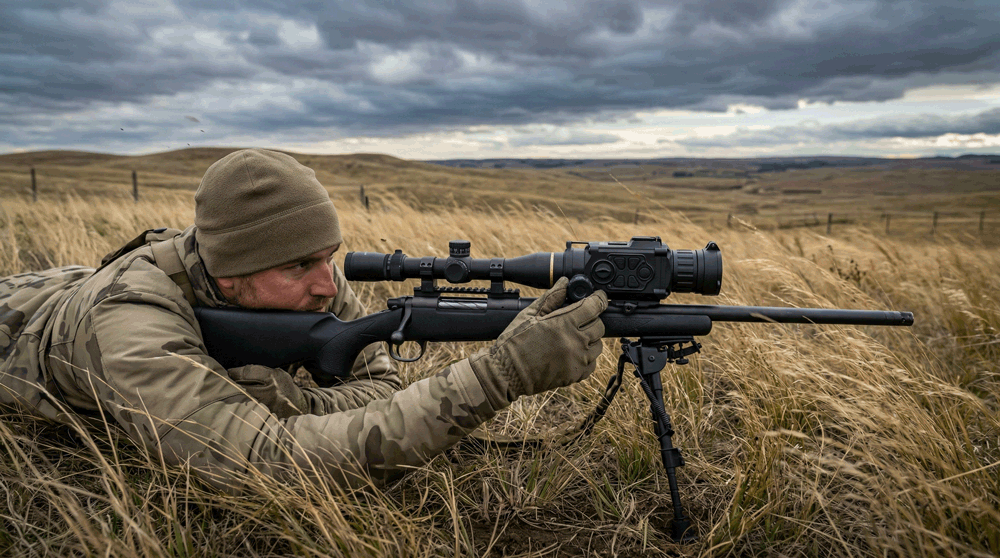
A clip-on lives in front of a day optic and is expected to preserve the day optic’s point of impact while providing a usable thermal image through the day scope at realistic magnifications. That expectation is exactly what makes clip-ons commercially attractive: the customer keeps their familiar day optic, their mount, their eye box, their reticle and dope workflow, and they “add thermal” with minimal disruption.
But that expectation is also why clip-ons are unforgiving. When a customer experiences POI shift after mounting, after temperature changes, or after recoil cycles, they don’t interpret it as an engineering trade-off. They interpret it as a trust violation. That interpretation drives returns, negative reviews, and dealer reluctance.
So the question for a B2B program is not “can the clip-on see far.” The question is “can the clip-on preserve trust under real stacking variables.”
Define the language: POI, POA, and what “shift” actually means
Procurement and product teams often use POI terminology loosely. Your supplier will too—unless you define it.
POI (Point of Impact) is where rounds land on target.
POA (Point of Aim) is where the reticle is aimed.
In clip-on programs, “POI shift” is the change in where rounds land when the clip-on is installed versus when the day optic is used alone, assuming the rifle, shooter, and ammo are controlled as much as practical.
What matters is not only “shift exists.” What matters is whether the shift is repeatable and whether it stays within an envelope your brand can defend.
A workable OEM spec treats POI shift as a set of behaviors:
- Static POI offset: the baseline difference when the clip-on is mounted and the shooter confirms with a controlled group.
- Dismount/remount repeatability: how much the POI changes when the clip-on is removed and installed again.
- Environmental drift: how much POI changes after temperature cycling, humidity exposure, or long-run operation.
- Recoil drift: how POI behaves after defined recoil impulses and cycles.
- Magnification sensitivity: how the perceived alignment behaves across a realistic magnification range of the day optic.
The purpose of writing these behaviors separately is practical: your supplier can only control what you define, and your QA team can only verify what is testable.
The clip-on stack: three interfaces you must specify
A thermal clip-on behaves like a system of interfaces. If you want POI stability, you don’t “optimize POI” at the end. You control the interfaces early.
Interface 1: Mechanical mounting repeatability
This is the physical coupling between clip-on and weapon/day optic system. It includes mounting rings, clamps, rails, torque rules, and the tolerance stack from mating surfaces.
Interface 2: Optical axis alignment with day scope
This is where many clip-on programs fail quietly. If the clip-on’s output is not properly aligned or the system is sensitive to misalignment, the shooter can see a centered image but still experience POI shift under magnification or at different ranges.
Interface 3: Digital processing and “aiming integrity”
Clip-ons often provide their own overlays (on-screen cues, palettes, enhancement modes). Even when there is no ballistic reticle inside the clip-on, digital processing can influence perceived center, perceived edge clarity, and the user’s confidence in holding. If processing behavior changes between builds or batches, the product feels inconsistent even when mechanical alignment is nominal.
A strong OEM spec treats these three interfaces as the core, and everything else—accessories, recording, app—is secondary.
Where POI shift comes from in real use
You can’t control what you can’t map. The most useful step before writing numbers is to map failure modes in plain language so procurement, engineering, and your OEM partner are aligned on what “POI problem” means.
This is the only “risk map” table in this article. Use it to turn dealer complaints into controllable levers.
| POI shift source | What it looks like in the channel | Why it happens | What your OEM spec must control |
|---|---|---|---|
| Mounting repeatability | “It moves every time I remount” | ring fit variation, torque variability, rail flex | mounting method + torque window + repeatability acceptance |
| Day scope parallax / setup | “It shifts at different distances” | day scope parallax setting, eye position, magnification use | approved day scope use conditions + training language |
| Clip-on optical axis sensitivity | “Looks centered but hits off” | optical alignment, afocal/collimation tolerance, mechanical alignment | optical alignment verification + collimation checks + QC jigs |
| Thermal drift effects | “After 20 minutes it’s different” | internal temperature changes affect alignment/correction | long-run stability checks + temperature cycle acceptance |
| Recoil and shock | “After recoil it’s off” | mechanical loosening, alignment shift, mount slip | recoil profile + cycle count + post-test POI envelope |
| Manufacturing variation | “One unit is fine, another isn’t” | tolerance stack, station-to-station variance | production process control + AQL + traceability |
Notice what this table does: it keeps you from blaming the sensor. POI stability is almost always an interface and governance problem.
Compatibility is part of the specification, not an afterthought
A clip-on is only as good as the day optic it is paired with. That sounds obvious, but most RFQs still treat “compatibility” as a vague marketing statement. Then the brand gets hit with returns when customers pair the unit with a day scope outside the supplier’s comfortable range.
A B2B OEM spec should explicitly define compatibility boundaries in a way that dealers can repeat:
- What magnification range is recommended for best performance.
- What objective lens sizes and typical day-scope designs are within the validated set.
- What parallax behaviors are assumed (fixed parallax vs adjustable).
- Whether certain scope features (illumination, certain reticles, extreme FOV designs) create known constraints.
You do not need to publish a giant compatibility list on day one. You do need to define how compatibility will be validated and what the brand will claim.
A practical approach is to require an “approved day scope matrix” as a deliverable. It can start small (a few representative scope families) and expand as you collect field data. What matters is that the matrix exists as an internal truth so your sales team and dealers don’t over-promise.
How to write POI requirements that suppliers can actually build
The fastest way to break an RFQ is to write a POI requirement that is either too vague (“minimal shift”) or too absolute (“no shift ever”).
A production-realistic POI requirement has three characteristics:
- It uses a measurable unit (MOA/MIL or linear shift at distance) and defines test distance(s).
- It distinguishes between baseline offset and repeatability after remounting.
- It distinguishes between controlled bench conditions and realistic field envelope.
Many brands set a target like “sub-MOA repeatability” as a commercial class expectation, but the more important point is not the exact number. The important point is that you define the envelope and make it testable and auditable.
A practical spec language pattern looks like this:
- Baseline POI offset: maximum allowable offset after initial mount under defined setup.
- Remount repeatability: maximum spread of POI after N mount/dismount cycles with defined torque method.
- Environmental drift: maximum additional POI change after defined temperature cycling and long-run operation.
- Recoil drift: maximum additional POI change after defined recoil cycles and handling vibration.
This pattern prevents the common supplier defense: “You didn’t say remount matters,” or “You didn’t say temperature cycling matters,” or “You didn’t define torque.”
Mounting design is where repeatability is won or lost
Clip-on programs often focus heavily on the thermal core and under-specify the mount system. In practice, the mount is the POI system.
If you want channel success, you must treat mounting as a deliverable with constraints: ring sizes, clamping method, torque guidance, and what constitutes “correct installation.” Dealers need to be able to teach it quickly, and customers need to be able to reproduce it.
A high-performing mount strategy is typically one where the interface is mechanically unambiguous. If a customer can mount the clip-on in multiple “almost correct” ways, you will see repeatability complaints.
This is also why you should specify the mounting torque window and the method. “Hand tight” is not an OEM spec. Your supplier should provide torque guidance, and your dealer kit later should turn that into a simple instruction.
In Series A, we will go deeper on rings and fit consistency as a dedicated article, but at the pillar level you should treat mounting as a core POI control lever, not as an accessory.
Optical alignment: specify it as a QC outcome, not as an engineering claim
Many suppliers will say “optical axis aligned” without giving you a way to verify it at scale. That is not sufficient in a clip-on program.
Your OEM spec should require:
- A defined optical alignment verification method used in production (jigs, targets, station checks).
- A recordable output or pass/fail criterion tied to serial/batch traceability.
- A defined response when alignment is out of tolerance (rework path, re-test path).
This is where the “OEM discipline” mindset matters. A great engineer can make a few units look perfect. A great production system makes many units behave equivalently. That production system is what protects your channel.
If your team is building broader governance expectations with your supplier, use Manufacturing & Quality as a reference for how quality claims should map to traceability and repeatable checks.
Validation: make it stage-based, not “one big test”
Clip-on validation is often treated as a single test event: shoot a group, declare success, ship. That approach fails in B2B scaling because it doesn’t prove reproducibility.
A better approach is to validate POI and compatibility across stages: early engineering validation, design validation, and production/pilot validation. You want to answer different questions at each stage:
- Early: is the concept stable, and what are the sensitivity drivers?
- Design validation: does the system hold POI envelope under realistic stress?
- Production validation: can the factory reproduce the same behavior across multiple units and stations?
This second table is the only other table in the article. It is a lightweight gate plan you can adapt.
| Stage | What you’re proving | What to test for clip-ons | What “pass” means in B2B terms |
|---|---|---|---|
| Prototype lock | baseline configuration is stable | baseline POI + basic compatibility set | “we have a reference identity” |
| Design validation | POI envelope holds under stress | remount cycles + recoil + temp cycle + long-run | “dealers won’t see surprise shifts” |
| Pilot validation | reproducibility across units | multi-unit POI repeatability + station checks | “batch behavior matches demo units” |
| Mass monitoring | drift control over time | periodic POI sampling + traceability | “same model stays the same” |
The point here is not to add bureaucracy. It’s to prevent the classic clip-on failure: demo units are stable, shipped units feel different, and dealers lose trust.
Acceptance criteria: keep it auditable and dealer-relevant
A clip-on acceptance plan should include both technical checks and “dealer reality checks.” Dealer reality checks are simple scripted actions that simulate real handling: mount/dismount cycles with realistic user torque, quick on/off sequences, and a short live-fire confirmation where possible.
You do not need to accept every unit by live-fire. You do need a validation method that ties live-fire outcomes to production checks so the factory has a proxy for POI integrity.
That is why optical alignment QC and mounting repeatability QC are so important: they are the production proxies that support the channel promise.
If you want your acceptance logic to be enforceable through your commercial program, incorporate it into your RFQ and purchase terms. If the supplier is selected solely on price, POI discipline will be the first thing sacrificed under schedule pressure.
Documentation deliverables are part of POI control
In clip-ons, documentation is not a brochure. Documentation is part of performance.
Your OEM spec should require a deliverables pack that includes:
- Mounting guidance (torque window, ring fit rules, alignment checks).
- Approved day scope matrix (validated compatibility boundaries).
- A POI test protocol summary (what was validated and under what assumptions).
- A dealer quick guide for expectation setting (range language, magnification guidance, parallax notes).
- Firmware/version identification guidance if the clip-on has software-driven behavior that can change.
A B2B program that ships hardware without this documentation will pay the cost later in support load and returns. Dealers cannot teach what you do not define.
Production controls that keep POI stable batch to batch
Most clip-on drift at scale comes from one of three things: mechanical tolerance variation, optical alignment station drift, or uncontrolled “small changes” (components, processing defaults, assembly steps).
Your spec should require that critical interfaces are controlled:
- Mounting interface tolerance stack must be documented and monitored.
- Optical alignment station checks must be logged and traceable.
- Any change that could affect POI behavior (mount components, optical alignment process, firmware affecting image centering/behavior) must trigger controlled change notification.
Even if your brand does not use formal ECO/PCN language with smaller suppliers, you still need the discipline. Without it, “same model” becomes a marketing phrase rather than a controlled product identity.
GTM implications: POI control is a dealer confidence story
A clip-on line sells when dealers feel safe. They feel safe when you give them:
- A clear installation method that is hard to get wrong.
- An honest compatibility story that doesn’t over-promise.
- A predictable POI repeatability claim that you can defend.
- A support system that resolves issues fast if something is genuinely wrong.
That is why POI control is not only an engineering requirement. It is part of your commercial positioning and dealer enablement. If your clip-on behaves consistently, dealers will demo confidently and recommend. If it behaves inconsistently, dealers will avoid the SKU regardless of your sensor.
FAQ
What is the most important OEM requirement for a thermal clip-on?
POI control under real handling. That means you must specify baseline POI, remount repeatability, recoil drift, and environmental drift as testable acceptance criteria, not as marketing language.
Why do clip-ons cause “it moved” complaints more than dedicated thermal scopes?
Because clip-ons stack systems: mount fit, day scope parallax, optical axis alignment, user setup, and environmental conditions. Small variation anywhere in that stack can show up as POI shift.
Should I promise “no POI shift” in marketing?
Usually no. It is safer to promise a bounded, validated repeatability envelope and specify assumptions. Over-promising absolute zero shift increases returns when customers encounter real-world stacking variation.
Do I need an approved day scope matrix?
If you want channel trust, yes. It can start small and expand, but dealers need compatibility boundaries to avoid pairing the clip-on with optics that create unavoidable dissatisfaction.
Can POI shift be controlled without heavy live-fire testing on every unit?
Yes, but only if your production proxies are real: mounting repeatability control, optical alignment QC, and traceable process discipline. Live-fire validation should be used to validate the system and calibrate the proxies.
What’s the biggest “silent risk” in clip-on OEM programs?
Uncontrolled small changes: a mount component revision, an assembly process tweak, or a firmware/processing change that subtly shifts perceived centering. Without change control, the channel experiences drift.
Call to action
If you share your target market (hunting vs professional), your day-scope pairing assumptions (magnification range, common scope families), and your channel promise (what POI repeatability envelope you want to claim), we can convert this into a supplier-ready OEM spec pack: POI requirements language, mounting deliverables, compatibility matrix format, and a stage-based validation plan that is executable in production.
Use Contact to share your clip-on program scope. For a product overview reference, start with Thermal Clip-On Sight.
Related posts
- Thermal Clip-On OEM Spec and POI Control
- Thermal Clip-On Mounting Rings and Fit Consistency
- Thermal Clip-On Day Scope Compatibility and Parallax
- Thermal Clip-On POI Shift Test and Acceptance
- Thermal Clip-On UI for Fast Mode Switching
- Thermal Clip-On Dealer Stock and Demo Program