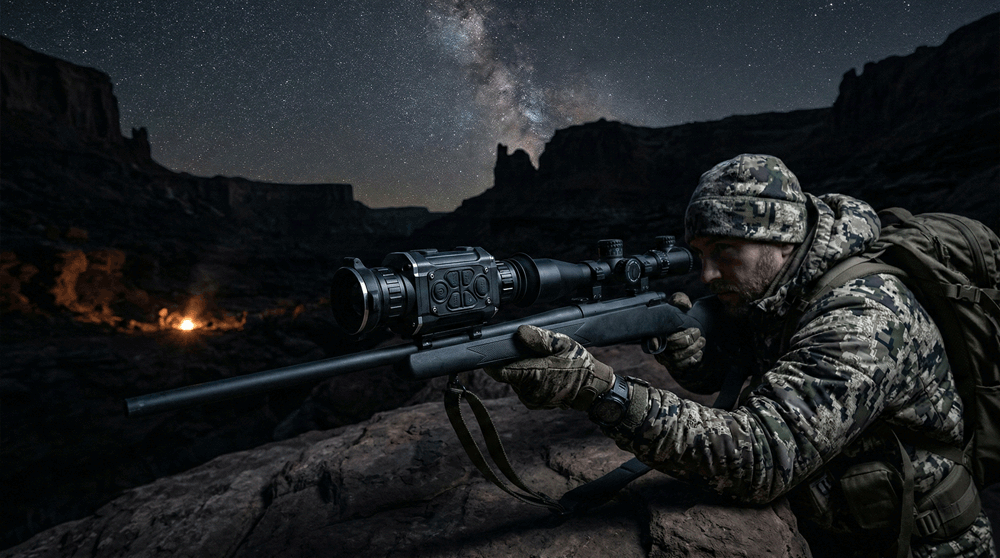
A thermal clip-on is one of the most “dealer-shaped” products in thermal optics. The end user may love the idea, but in practice the dealer decides whether the product is safe to recommend, safe to stock, and safe to demo.
Table of Contents
ToggleThat decision is rarely based on a spec sheet. It is based on operational confidence. Can the dealer mount it quickly? Can they demo it through common day scopes without embarrassment? Can they explain POI expectations without triggering fear? Can they handle the first return conversation without getting stuck in policy ambiguity? And when a customer brings a unit back after a trip and says “it moved,” does the dealer have a structured way to respond?
Your inventory strategy and your demo program are what make that operational confidence possible. If you ask dealers to “just stock it,” you will get shallow buys and slow reorders. If you give them a controlled stock model, a governed demo plan, and a support path that feels predictable, you get deeper commitment and cleaner sell-through—especially in seasonal hunting markets where confidence cycles are short and reputations are sticky.
This article shows how B2B brands should design dealer stocking and demo programs for thermal clip-ons so channel partners can sell confidently without creating discount loopholes or return chaos. It builds on the foundations of Series A: POI control, mounting repeatability, and validated pairing assumptions. If you haven’t aligned those foundations yet, start with Thermal Clip-On OEM Spec and POI Control, then confirm mounting system discipline with Thermal Clip-On Mounting Rings and Fit Consistency, and lock pairing assumptions with Thermal Clip-On Day Scope Compatibility and Parallax. For a product-level reference page, see Thermal Clip-On Sight.
Why clip-ons punish weak dealer programs
Clip-ons fail in channels for a reason that’s easy to miss: the first friction looks like product weakness even when the product is fine. A slow or awkward demo, a mounting confusion moment, a parallax misunderstanding, or an unclear POI explanation creates doubt. Doubt becomes “maybe this clip-on is finicky.” Once that label exists, stocking depth drops and the SKU becomes a special-order item rather than a shelf mover.
That’s why your dealer program must do two jobs at once. It must increase conversion, and it must reduce doubt. Inventory and demos are the two levers that shape both.
Inventory influences confidence. Dealers stock deeper when they believe returns are manageable and demos are easy. Demos influence belief. Clip-ons sell when the customer sees the experience through a real day scope, in real lighting, with a salesperson who knows the boundaries and can explain them in plain language.
If you design inventory and demos as an afterthought, you’ll be forced into the worst recovery strategy: discounts, special exceptions, and ad-hoc swaps. That recovery strategy might move a few units, but it damages long-term channel trust.
Stocking clip-ons is not like stocking thermal scopes
Thermal riflescopes are self-contained. Clip-ons are not. Dealers worry about “does it work with my customer’s day scope?” more than “is the sensor good.”
That means dealers are cautious about stocking clip-ons unless you reduce pairing risk. The way you reduce pairing risk is not by claiming universal compatibility. It is by giving dealers:
A validated compatibility story they can repeat without over-promising.
A structured demo workflow that shows the product working through common day scopes.
A clear POI repeatability envelope they can explain.
A fast way to solve the most common complaints (mounting, parallax, configuration misunderstanding) without turning everything into an RMA.
When those exist, clip-ons can sell quickly. When they don’t, the category becomes “high-touch,” and dealers avoid inventory exposure.
Define the dealer “offer” before you define dealer stock
Before you talk about quantities, you must define what you are asking the dealer to do.
For clip-ons, dealers typically do five things that actually drive sell-through: they mount the unit, they demonstrate it through a day scope, they set expectations on magnification and parallax, they explain POI repeatability boundaries, and they handle the first-line return conversation. If your dealer program doesn’t support those five tasks, your inventory strategy won’t matter because conversion will remain low.
So define the dealer offer in operational terms: what the dealer gets (demo eligibility, training assets, quick reference guides, priority support, spare accessories), what the dealer must do (MAP compliance if relevant, maintain demo readiness, follow mounting/compatibility guidance, follow intake steps for returns), and what your brand promises (response time, swap thresholds, spare parts availability, and how quickly issues are resolved).
Once the offer is defined, inventory becomes an extension of a system rather than a guess.
Clip-on inventory should be built around the “demo-to-sale funnel”
Clip-on sales often follow a predictable funnel: demo first, then sale. If the dealer cannot demo, the sale becomes hard. If the dealer can demo, the sale becomes easier and price resistance drops because the customer experiences the value.
That means your inventory strategy should protect the demo first. You want demo readiness to be stable across time, not “we have a demo sometimes.”
A strong dealer program usually treats the demo unit as mandatory for qualified dealers and treats stocked units as a function of sell-through history and seasonality. In early stages, you don’t need to push dealers to stock a wide assortment. You need to push them to stock what they can sell confidently and to demo reliably.
If you push too many variants early, you create confusion. Dealers don’t know which one to show. Customers don’t know which one to buy. Inventory sits. Discounting begins.
A practical stocking architecture for clip-ons
A clip-on line is typically easiest to stock when you separate it into three “inventory objects”: the clip-on unit, the adapter ecosystem, and the fast-replace accessories.
The clip-on unit is the primary SKU. The adapter ecosystem includes mounting rings (and any interface hardware) that makes the clip-on compatible with common day scope objective sizes. The fast-replace accessories include things like batteries, caps, eyecups if relevant, and small parts that prevent unnecessary returns.
Dealers become confident when they can solve small problems on the spot. If a customer’s ring fit is wrong, a spare ring can save the sale. If a customer’s accessory is missing or damaged, a small accessory kit can prevent a return.
This is why your dealer stock plan should never be “clip-on only.” It should be “clip-on plus the minimum ecosystem that makes it usable.”
Seasonal planning matters more for clip-ons than most products
Clip-ons are often pulled into purchase decisions by seasonality. That means dealers will either stock early and sell through during peak season, or they will avoid stock and take special orders, which reduces sales and increases price sensitivity.
A good B2B program gives dealers a seasonal plan: pre-season demo readiness, in-season replenishment triggers, and post-season inventory handling rules. If you don’t provide this, dealers invent their own plan, and it usually means “stock shallow.”
Seasonal planning also reduces after-sales burden. Many returns happen when customers buy late in the season, don’t have time to learn, and return in frustration. A demo-ready dealer helps prevent that by setting expectations before the customer buys.
Demo units must be governed or they become a pricing loophole
A demo program is one of the highest ROI tools in clip-ons, but it is also one of the easiest ways to accidentally destroy pricing discipline and channel fairness.
If demo units are simply “discounted units,” some partners will treat them as cheap inventory and sell them as new. If demo eligibility is unclear, better dealers will resent weaker dealers. If demo warranty handling is vague, dealers will avoid using demos because they fear demo abuse becomes a service burden.
A governed demo program solves these risks. It treats demo units as infrastructure: tracked, serialized, eligible only under defined partner tiers, and supported by clear rules about resale, labeling, and warranty handling.
A good demo program also doubles as a compliance incentive. Partners who invest in training and maintain pricing discipline should have better access to demos and better support response. Partners who violate rules should lose privileges. That creates a channel culture where good behavior is rewarded without you having to argue constantly.
What a clip-on demo must prove in under one minute
The purpose of a dealer demo is not to show every feature. It’s to eliminate doubt quickly.
A strong clip-on demo proves four things in under one minute: mounting is straightforward, image experience is usable through a day scope, switching is simple, and your claims about magnification and compatibility are honest.
Dealers should be trained to demonstrate within validated boundaries, not to chase extreme magnification just because it looks impressive. Over-demoing beyond the validated envelope is one of the fastest ways to create expectation-gap returns. Customers remember what they saw. If the customer’s home setup looks worse, they return.
So your demo program is inseparable from your compatibility guidance. The “approved day scope matrix” concept from Thermal Clip-On Day Scope Compatibility and Parallax should influence what demo scopes are chosen and what magnification range is shown.
Demo readiness requires accessories, not only the device
Dealers don’t fail demos because the unit is defective. They fail demos because something small is missing: the right ring, a charged battery, an adapter piece, a clean lens, a known-good day scope setup, or a simple “quick script.”
This is why your demo program should include a demo kit standard: clip-on unit, a small ring set covering common objective sizes, a defined day scope (or two) in validated families, a torque method or consistent lever setup, and a one-page demo script with “what to say” and “what not to say.”
This is channel engineering. It doesn’t feel glamorous, but it is what makes demos repeatable across dealers.
Returns: use a “triage-first” model to protect dealer confidence
Clip-on returns can be expensive when every complaint turns into a physical return. Many “POI complaints” are actually mounting inconsistency, parallax misunderstanding, or pairing beyond validated boundaries.
A strong dealer stock program includes a triage-first model: a simple flow that allows dealers to resolve common issues quickly and decide when a return is genuinely warranted.
This triage-first model reduces cost, but more importantly it reduces time. Dealers hate uncertainty more than they hate paperwork. If your triage flow gives them a clear next step quickly, they trust you more.
This is also why your POI acceptance envelope and your mounting rules must be written in language that dealers can use. If you only keep those documents internal, dealers improvise explanations and disputes increase.
One dealer stock and demo blueprint that scales
Below is the only table in this article. It is a practical blueprint that defines what dealers should hold, what qualifies them to hold it, and how it links to sell-through and returns. You can adapt it to your brand’s tiering, but the structure is stable.
| Dealer level | What they stock | What they must do | What the brand provides | Why it works for clip-ons |
|---|---|---|---|---|
| Starter dealer | limited sellable units + basic ring set | follow validated pairing guidance | quick guides + priority intake | reduces mis-selling and returns |
| Demo dealer | demo unit + sellable units + expanded ring set | maintain demo readiness + train staff | demo kit assets + faster support | improves conversion through real demos |
| Stocking dealer | deeper sellable inventory + demo + ring coverage | meet sell-through and compliance rules | replenishment priority + spares access | rewards execution and stabilizes channel |
| Regional partner | deeper inventory + demo pool + spare parts | handle first-line triage | RMA workflow + reimbursement rules | scales support without chaos |
This blueprint makes one principle explicit: not all partners are equal, and that’s healthy. Clip-ons require execution. Partners who execute should be rewarded with better tools and better support.
How to prevent “adapter chaos” in dealer inventory
Clip-on adapter ecosystems can become a mess if you allow unlimited ring variants, unclear sizing, or inconsistent part numbering. Dealers hate that because it turns a sale into a fitting problem.
The fix is to standardize: keep ring sizes and fit ranges disciplined, provide clear part numbers, and keep compatibility guidance aligned to those parts. If a dealer needs to guess which ring fits which day scope family, they will avoid stocking rings and will push the problem to the customer, which increases returns.
A mature program also teaches dealers how to measure and choose correctly. That training should be short and practical, not engineering-heavy.
Sell-through stability depends on how you handle early failures
Every clip-on program will have early issues. What matters is how you handle them.
If early issues are handled fast and fairly, dealers will treat them as normal new-product learning. If early issues turn into delays and arguments, dealers will decide the product is risky and will not reorder.
This is why early dealer programs should be conservative in partner count and aggressive in support speed. Fewer partners means you can support deeply and keep demos consistent. Deep support builds the trust that allows later expansion.
Your program is not judged by whether there are issues. It is judged by whether issues are handled professionally.
Demo unit lifecycle: keep demos “fresh” or they become liabilities
Demo units get abused. They are handled more often, mounted more often, and used in less controlled conditions than customer units. If you do not manage demo lifecycle, demos become unreliable and start creating negative impressions.
A practical demo lifecycle plan defines inspection cadence, battery health management, accessory replacement, cleaning rules, and refresh or swap rules after a defined period or a defined number of demo cycles. The dealer should not be forced to guess whether a demo is still representative.
This is also an integrity issue. Customers should not be shown a “best unit” and then sold a unit that behaves differently. Your demo lifecycle is part of keeping product identity honest in the channel.
Pricing discipline and demo programs must reinforce each other
Demo discounts can be a powerful incentive, but if pricing discipline is weak, demo discounts become an arbitrage tool.
The solution is to link demo eligibility to compliance. Dealers who violate advertised price rules should lose demo privileges. Dealers who maintain discipline and invest in training should be rewarded. This turns compliance into a self-reinforcing system rather than a policing exercise.
Even if you don’t run formal MAP programs in every market, the principle holds: the channel must feel fair. Fairness reduces conflict, conflict reduces discounting, and reduced discounting protects your ability to fund service.
What to include in the dealer-facing clip-on pack
A dealer pack should be small enough to be used and specific enough to prevent mis-selling.
At minimum, clip-on dealers need a one-page pairing guidance summary (magnification envelope and parallax notes), a one-page mounting guidance (ring choice and installation method), and a one-page POI expectations statement (what repeatability means and what variables matter). They also need a triage checklist for common complaints so the first return conversation becomes structured rather than emotional.
If you want dealers to keep the pack current, it must be versioned and updated when firmware or procedures change. Otherwise, old guidance becomes a source of mistakes.
FAQ
Why do dealers hesitate to stock thermal clip-ons?
Because pairing risk and POI uncertainty create return risk. Dealers stock when you reduce that risk through validated compatibility boundaries, repeatable mounting, and a predictable triage and support workflow.
Are demo units necessary for clip-ons?
In most dealer channels, yes. Clip-ons are experiential and customers want to see the view through a real day scope. A governed demo program increases conversion and reduces expectation-gap returns.
How do I stop demo programs from becoming discount loopholes?
By governance: serialized demo tracking, eligibility tiers, resale rules, labeling rules, and linking demo privileges to pricing compliance and training obligations.
What should a dealer stock besides the clip-on unit?
At minimum, the adapter ecosystem that makes the clip-on usable—rings for common objective sizes—and fast-replace accessories that prevent unnecessary returns. “Clip-on only” stocking creates friction and lost sales.
How do dealer programs reduce POI complaints?
By enforcing correct mounting procedure, validating pairing boundaries, setting POI repeatability expectations honestly, and providing a triage-first workflow so setup issues are solved before they become RMAs.
Call to action
If you share your target dealer channel type, the most common day scope objective sizes in your market, and your preferred demo governance level, we can convert this into a dealer-ready clip-on program pack: stocking tiers, demo unit rules, ring kit standard, triage checklists, and dealer-facing one-page guides that prevent mis-selling and reduce returns.
Use Contact to share your clip-on program scope. For product context, start with Thermal Clip-On Sight.
Related posts
- Thermal Clip-On OEM Spec and POI Control
- Thermal Clip-On Mounting Rings and Fit Consistency
- Thermal Clip-On Day Scope Compatibility and Parallax
- Thermal Clip-On POI Shift Test and Acceptance
- Thermal Clip-On UI for Fast Mode Switching
- Thermal Clip-On Dealer Stock and Demo Program