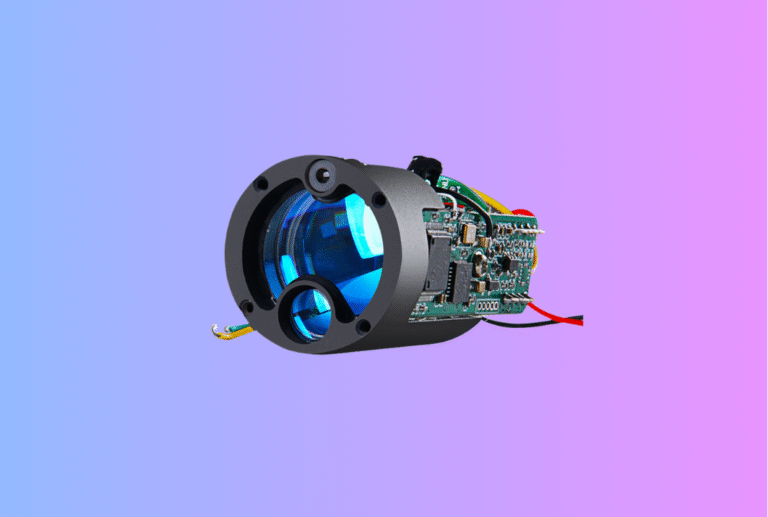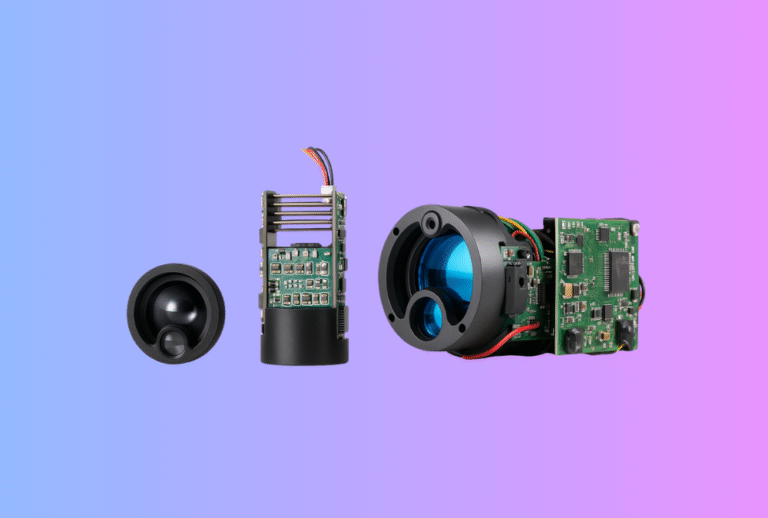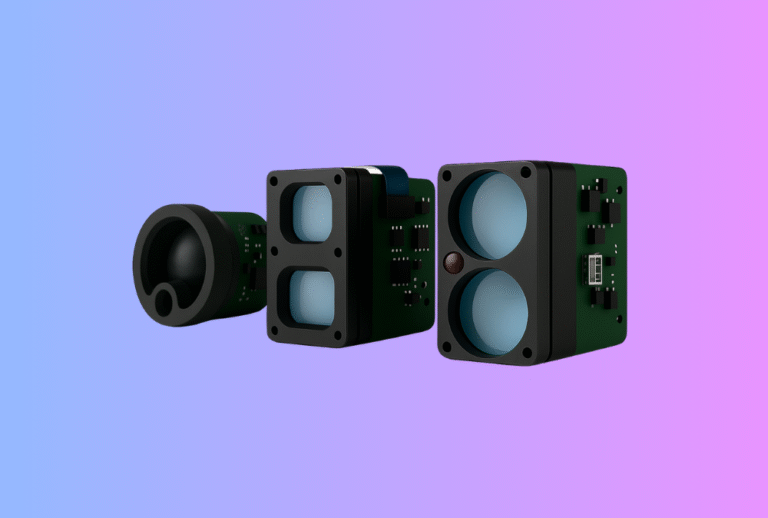
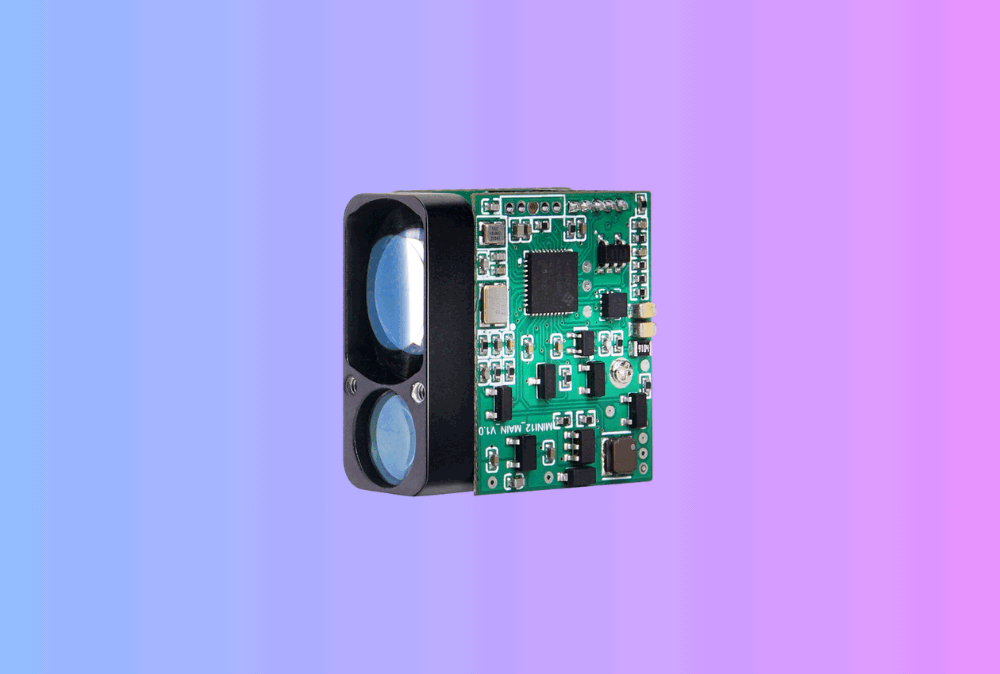
Lead: Pilot units behave; field units misbehave. This hands-on guide turns Laser Rangefinder Module symptoms into fast, reproducible fixes—so OEM/ODM teams cut RMAs, unblock pilots, and keep distributors happy.
Table of Contents
ToggleExecutive Summary
- Diagnose with data, not guesses. Always capture SNR, return count, pulse width, hardware timestamp, temperature, and environment notes before acting.
- Tie symptoms to methods. Specify target reflectivity (Lambertian vs retroreflector) and weather when reproducing issues; otherwise “no return” vs “false alarm” is meaningless.
- Control the basics. Eye-safety and divergence checks belong in the same loop as range accuracy—firmware should “fail dark” on over-power or sensor fault.
- Time is a system. Use ROS 2
/clocksemantics and MAVLink TIMESYNC or PTP for alignment; many “range jumps” are timestamp errors, not physics.
Need hardware to test? Start with our Laser Rangefinder Module family. For fused imaging, see Thermal camera module and handhelds like Thermal Monoculars.
Use Cases & Buyer Scenarios
UAV mapping & robotics fleets
Symptoms: intermittent “no return,” geotag drift, or delayed overlays during fast motion. Likely causes: time sync offset/jitter, PRF too low for platform speed, or reflectivity assumptions.
Outdoor optics brands (hunting/outdoor)
Symptoms: reticle overlay “jumps,” poor dusk performance, higher FAR in light fog. Likely causes: boresight drift, window fogging, or wavelength/energy choices; 1550 nm paths often retain more performance in fog vs 905 nm.
See also Thermal Rifle Scopes, Thermal Binoculars.
Industrial/security integrations
Symptoms: stable bench results but site alarms trigger at dawn/dust; gate sensors mis-range bright retroreflectors. Likely causes: FAR threshold too aggressive, sun angle/glint, or EMI coupling into APD/TIA. For patrol kits, consider Thermal Clip-On Sight stacks.
Spec & Selection Guide (the heart)
20 symptoms → root causes → fast fixes
| Symptom (field) | Likely root cause | Quick fix (triage) |
|---|---|---|
| 1) No return on matte targets | SNR too low; window fog/contamination; mis-set PRF | Clean/defog window; raise PRF; log SNR/width; test retroreflector vs 20% board |
| 2) False alarms (FAR↑) | Glints, electrical noise, aggressive thresholds | Increase confidence threshold; enable multi-return gating; check grounding/filters |
| 3) Range jump 1–3 m | Timestamp mismatch; wraparound in host time | Use hardware timestamp; verify ROS 2 /clock and use_sim_time; run MAVLink TIMESYNC |
| 4) Intermittent long-range loss | Power budget limited by eye-safety; beam divergence drift | Check IEC 60825-1 class margins; re-map divergence and safety-aperture power. |
| 5) Perimeter alarms at sunrise | Sun angle/glare; retroreflectors in scene | Add sun shields; adjust thresholds by time-of-day; prefer 1550 nm for public demos. |
| 6) Good bench, bad truck | Vibration/shock moving optics | Validate per MIL-STD-810H (516/514); torque checks; thread-locker. |
| 7) After recoil, overlay off | Boresight shift between LRF and thermal/EO | Run boresight quick-check; pin datums (V-groove/dowel); shim once, lock always. |
| 8) Cold start misses | APD bias/thermal LUT not settled; battery sag | Add warm-up samples; verify bias vs temperature; check peak current limits. |
| 9) Fog hurts 905 nm more | Mie scattering & eye-safe energy limits | For fog-heavy users, evaluate 1550 nm builds; tune confidence/SNR gates. |
| 10) Only retroreflectors look good | Divergence/profile or timing offset | Profile beam (95% EE) and timing; widen divergence or fix timestamping. |
| 11) “Ghost” near hits | Internal reflections/window ghosting | Use AR/anti-fog coatings; baffle redesign; tighten window torque spec. |
| 12) EMI site-specific | APD/TIA pickup; motor/relay bursts | Add shielding/RC on lines; verify CE/FCC plan; re-route harness away from motors. |
| 13) Drifts with humidity | Window/gasket swelling; contamination | Specify anti-fog + hydrophobic coatings; stable gasket compression. |
| 14) Factory pass, field fail | Missing field check | Ship tripod retroreflector + 20% board + 5-min script; tie to warranty. |
| 15) Firmware update breaks range | Coefficients/compatibility lost | Versioned NVM schema; rollback; export coefficients per S/N. |
| 16) Units vary lot-to-lot | Calibration artifacts out of date | ISO/IEC 17025 traceability; re-certify meters/rails; publish uncertainty. |
| 17) Electrostatic “mystery” faults | Handling/packaging ESD weak | Enforce ANSI/ESD S20.20 EPA, logs, and packaging; audit quarterly. |
| 18) App shows “swim” on video | Overlay at publish time, not shutter time | Interpolate to camera mid-exposure; stamp event time at the module. |
| 19) Outdoor icing/condensation | Poor vent/thermal design | Add anti-fog window; heat path; specify IP66/67 + anti-fog coatings. |
| 20) Spec disputes | No method (reflectivity/weather/FAR) | Re-test on course with method: distances + reflectivity + weather + FAR. |
Decision flow
Start
├─ Is timestamp trustworthy? → No → Fix ROS2 /clock or MAVLink TIMESYNC → Re-test. :contentReference[oaicite:11]{index=11}
├─ Is window clean/dry? → No → Clean/defog; check coatings/torque → Re-test.
├─ Eye-safety & divergence verified at FT? → No → Audit IEC 60825-1 method & beam map. :contentReference[oaicite:12]{index=12}
├─ Environment logged (reflectivity + weather)? → No → Reproduce on 20% vs retro; log FAR.
└─ Still failing → Run vibration/thermal checks per 810H; capture SNR/width histograms. :contentReference[oaicite:13]{index=13}
Integration & Engineering Notes
Electrical & Interfaces
-
Always export diagnostics:
range_m, snr, width, n_returns, t_event_ns, temperature, status. -
Time sync hooks: PPS in/out, MAVLink
TIMESYNC, and ROS 2 examples; set/clock/use_sim_timein launch files. -
DFT access: Test pads and a test-mode command set (laser on/off, PRF, power readback, APD bias, histogram dump) to reproduce issues without opening enclosures.
Optics & Mechanics (mounting, alignment, recoil, sealing)
-
Datum strategy: V-groove/dowel pins let you repeat boresight after transport/recoil.
-
Window discipline: AR + anti-fog coatings; torque spec + thread-locker; periodic checks in humid zones.
-
Sub-assembly proofs: Validate emitter/receiver cans under 810H shock/vibe before final product tests.
Firmware/ISP/Tuning (AGC, palettes, LRF fusion, algorithm)
-
Fail-dark safety: Exceeding AEL or over-temp forces shutdown and a logged code (protects IEC 60825-1 class).
-
Confidence you can tune: Gate by SNR + width + multi-return count; expose FAR targets in SDK.
-
Boresight UI: Add a guided zeroing step for fused devices like Thermal Pistol Sights.
Testing & Validation (bench → field, acceptance criteria)
-
Course design: 50/100/250/500/1000 m markers with Lambertian 20% and retroreflector; log weather and sun angle.
-
Acceptance gates: Accuracy, repeatability (1σ), FAR thresholds; divergence/power via safety aperture; records stored per S/N.
-
Traceability: Keep calibration artifacts in date (ISO/IEC 17025) and uncertainty inside your spec margin.
Compliance, Export & Certifications
-
Eye safety: Verify Class 1/1M under IEC 60825-1 and keep label proofs + test methods in the CoC. For US shipments, confirm FDA Laser Notice No. 56 alignment.
-
EMC/ESD: CE/FCC/UKCA emissions/immunity plus ANSI/ESD S20.20 program evidence for assembly and packaging.
-
Environmental: Quote relevant MIL-STD-810H methods (shock, vibe, temp/humidity) in proposals and SAT plans.
Business Model, MOQ & Lead Time (OEM/ODM)
-
Field kits: Tripod retroreflector + 20% matte board + 5-minute script reduce truck-rolls; bundle for channel partners.
-
Sampling & MP: 2–4 weeks samples (standard optics), 4–6 weeks with custom windows/divergence; MP 6–10 weeks ARO.
-
Attach-rate booster: For handhelds and patrol kits, pair with Thermal Monoculars or Thermal Clip-On Sight to improve detection + range UX.
Mini ROI—troubleshooting discipline pays
| Driver | Before | After playbook | Units/yr | Impact |
|---|---|---|---|---|
| “No return” RMAs | 1.2% | 0.5% | 2,000 | −14 RMAs |
| Truck-rolls / mo | 6 | 3 | — | ↓ service cost |
| Time-to-fix (avg) | 3.5 days | 1.5 days | — | ↑ customer NPS |
Pitfalls, Benchmarks & QA
Seven traps that waste weeks
-
No method with your complaint. Always include reflectivity & weather; otherwise engineers chase ghosts.
-
Using publish time as event time. Breaks fusion; stamp at capture and honor ROS 2
/clock. -
Skipping divergence maps. Eye-safety and SNR both hinge on beam profile.
-
“Golden unit” bias. Reproduce with two units; inspect per-serial coefficients and logs.
-
ESD theater. Signs without audits; enforce S20.20 evidence (EPA checks, packaging specs).
-
Ignoring shock/vibe. Transport moves optics; run 810H-style checks on sub-assemblies.
-
Window torque drift. Gasket compression alters divergence; add torque labels and checks.
Benchmark recipe (copy/paste)
-
Distances: 50/100/250/500/1000 m on Lambertian 20% + retroreflector.
-
Metrics: Dmax, accuracy, repeatability (1σ), FAR, SNR/width distributions; weather log.
-
Fusion check: align range to camera shutter mid-exposure (no “swim”).
FAQs
1) Why does fog hit 905 nm harder in demos?
Beyond scattering physics, 1550 nm systems often operate at higher eye-safe energy, delivering stronger returns in fog. Evidence from automotive LiDAR studies supports performance advantages at 1550 nm in fog/rain scenarios.
2) We pass bench tests but fail after logistics—why?
Likely shock/vibe moving optics or gasket compression changes. Run MIL-STD-810H checks and torque audits.
3) Can time sync really cause “range jumps”?
Yes. If nodes mix system time and ROS time, or MAVLink TIMESYNC isn’t stable, overlays drift. Use hardware timestamps + /clock + TIMESYNC.
4) How do we keep field units safe if calibration drifts?
Firmware should “fail dark” on AEL over-power or bad sensors, protecting your IEC 60825-1 class until service.
5) Does ESD handling really change FAR?
Yes. Latent ESD damage in APD/TIA raises noise floor → more false alarms. Enforce ANSI/ESD S20.20.
6) What’s the simplest site-acceptance test (SAT)?
Run our course method (above), publish FAR thresholds, and archive logs per serial. Repeat after firmware or window changes.
7) Should we always choose 1550 nm?
Not always. 905 nm + Si-APD can win on cost and availability. Choose based on range, environment, and TCO—not wavelength alone.
Call-to-Action (CTA)
Send us your symptom + method (reflectivity, weather, logs). We’ll map it to a 5-minute triage and, if needed, a bench plan—starting from our Laser Rangefinder Module lineup and fused options across Thermal Pistol Sights and other handhelds.