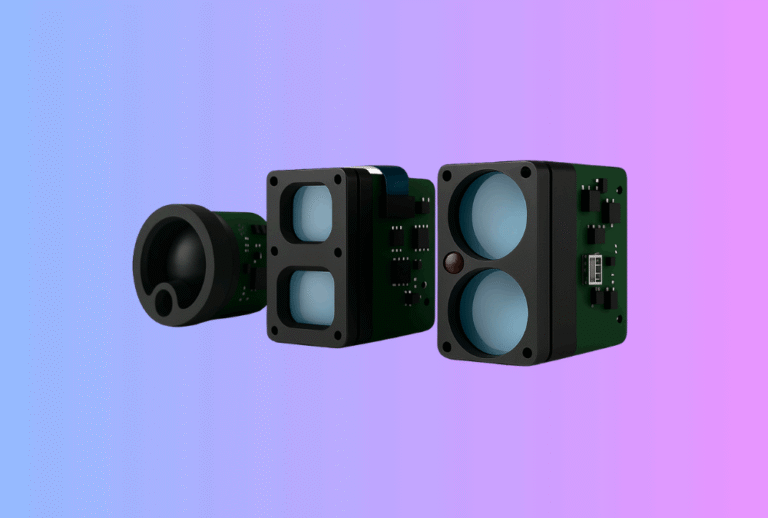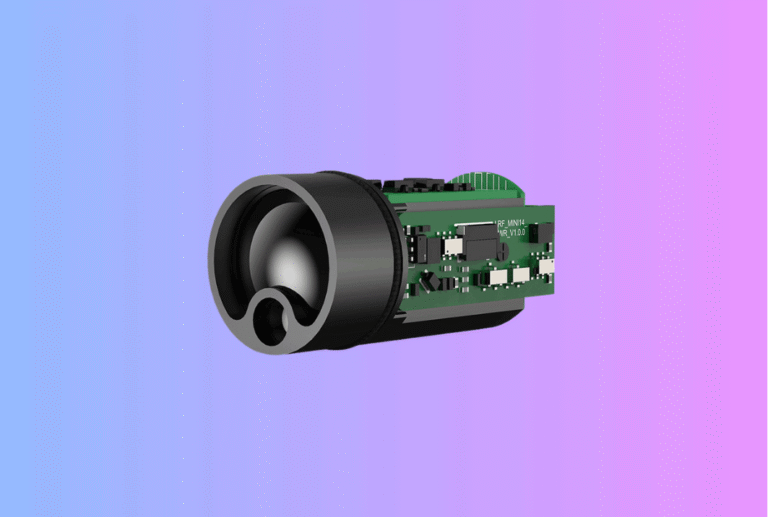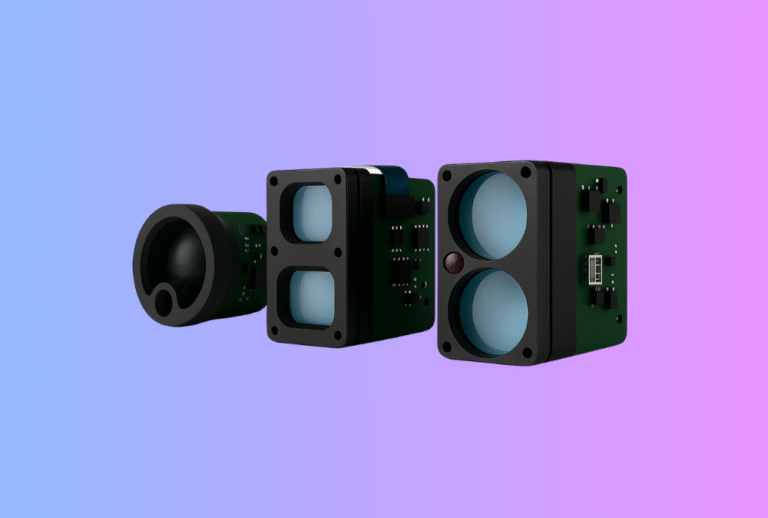
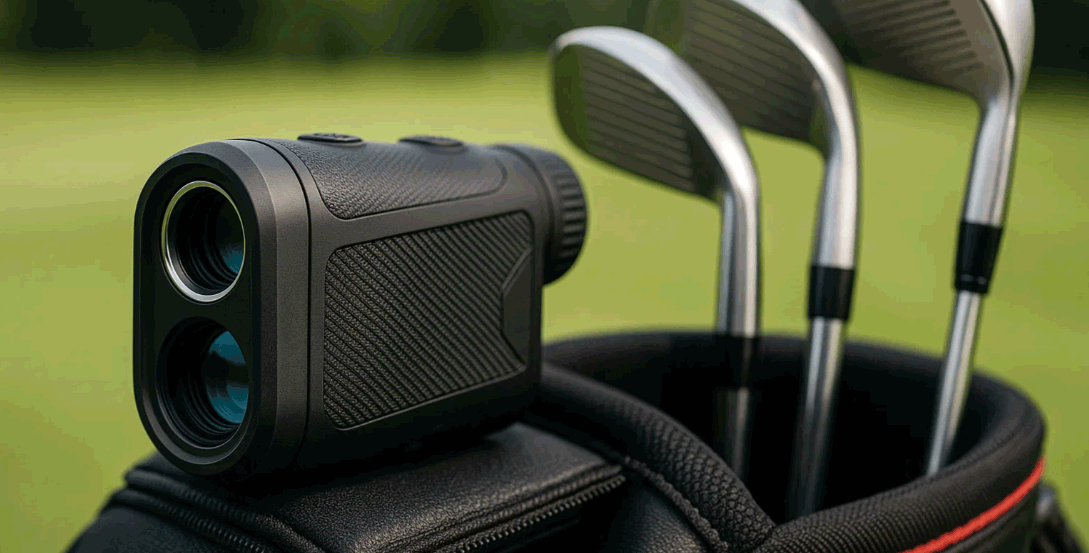
Lead: If you’re building a new handheld golf rangefinder, the core you choose—the Laser Rangefinder Module—decides how “sticky” your pin lock feels and how clean your compliance file is. This guide translates beam divergence and IEC 60825-1 Class 1 into practical selection rules, integration checklists, and ROI math for OEM/ODM programs.
Table of Contents
ToggleExecutive Summary
- Why it matters: Beam divergence (in mrad) sets spot size, which controls pin-seeking accuracy vs. background false locks; use consistent definitions (full vs. half-angle) and document measurement method. RP Photonics’ divergence definition and far-field math are the basis for the rules of thumb here.
- Eye safety baseline: For U.S. market entry, the FDA’s Laser Notice No. 56 recognizes conformance to IEC 60825-1 Ed. 3; build labels, AEL calculations, and manuals accordingly.
- Tournament reality: Distance-measuring devices are broadly allowed, but a Local Rule may restrict use to distance-only (slope and other “conditions” must be disabled). Your module + UI must make slope-off unambiguous.
- Demand backdrop: Independent estimates show the golf rangefinder segment in the US$160–400 M range (2024) with mid-single to low-double-digit CAGR into the 2030s—supporting conservative distributor ROI models.
- System thinking > one spec: Pair divergence with receiver FOV, scan logic, and signal chain. Use Gentec-EO’s methods/calculators for consistent beam math across vendors.
Use Cases & Buyer Scenarios
Scenario 1 — Tournament-legal consumer handhelds (distance-only mode)
Brief your module vendor for Class 1 at 905 nm, divergence ~2.0–2.5 × 1.0–1.5 mrad (full-angle), receiver FOV ≤ 3 mrad, and closer-target bias during scan. UI must show a clear slope-off state for competition under Local Rule.
Internal link: Evaluate our Laser Rangefinder Module options for golf .
Scenario 2 — Pro-shop bundles and coaching kits
A golf rangefinder paired with auxiliary observation tools for dawn/dusk practice or marshaling. If your brand portfolio includes thermal viewing, position it as a low-light companion for course staff, not in-round player aid.
Internal link: See Thermal Monoculars for low-light course checks.
Scenario 3 — Course maintenance & grounds teams
Facilities teams use rangefinders for staking, line-of-sight checks, and equipment placement. Prioritize ruggedization (IP, drop), Class 1 labeling for safety briefings, and displays readable at noon sun.
Internal link: For binocular-style observation across large properties, explore Thermal Binoculars.
Spec & Selection Guide (the heart)
Key parameters and trade-offs
- Beam divergence (H×V, mrad): Far-field angular spread; spot diameter (m) ≈ divergence (mrad) × distance (m) / 1000. Tighter beams raise flag SNR but demand steadier aim; wider beams “paint” trees behind the pin. Use full-angle and state the definition (1/e² vs. FWHM).
- Receiver FOV (mrad): If FOV ≫ beam, you integrate clutter; if too tight, jitter hurts lock rate. Tune FOV to just envelope the spot at target distances.
- Pulse energy & PRF (eye-safety limited): Optimize optics/efficiency so AEL stays within Class 1 while maintaining on-target irradiance. Align with IEC 60825-1 Ed. 3 per FDA guidance.
- Wavelength: 905 nm is common (cost/size); 1550 nm shifts hazard considerations and optics cost—still requires correct classification/labeling.
- Scan & priority logic: Multi-return clustering, closer-target bias (“flag priority”), and temporal filtering reduce tree-lock errors.
- Display & UX: Fast refresh (≥8–12 Hz in scan), crisp reticle, and clear slope-off icon for events.
Illustrative comparison (module-level targets)
| Parameter | Entry Golf Handheld | Mid-Tier Flag-Lock | Premium Stabilized |
|---|---|---|---|
| Emitter / Class | 905 nm / Class 1 | 905 nm / Class 1 | 905 or 1550 nm / Class 1 |
| Beam Divergence (full-angle) | ~3.0 × 1.8 mrad | ~2.2 × 1.2 mrad | ~1.5 × 1.0 mrad |
| Receiver FOV (approx.) | ≤4–5 mrad | ≤3 mrad | ≤2 mrad |
| Scan Rate | 8 Hz | 10–12 Hz | 10–12 Hz + stabilization |
| Typical Flag Lock | 180–250 yd | 220–320 yd | 250–400 yd (with prisms) |
| Tournament Mode | Slope toggle | Slope toggle + clear indicator | Slope toggle + lockable mode |
Decision flow (quick):
- Need tournament-ready? → Yes → enforce distance-only mode & slope-off indicator → target ~2.2×1.2 mrad, FOV ≤3 mrad → validate lock rate at 200–300 yd.
- Selling to new golfers? → Yes → choose ~3×1.8 mrad with robust scan filtering & strong haptic “lock.”
- High-end flagship? → Yes → add stabilization → ≤1.5 mrad beams + tight FOV → extra QA on alignment and AEL.
Integration & Engineering Notes
Electrical & Interfaces
Specify a module with UART command/control (mode, PRF, multi-return payload), USB for firmware and logs, and a compact SDK exposing confidence scores and raw/filtered returns. If you pair the golf rangefinder with mapping/GNSS (coaching kits), a lightweight CAN or MAVLink-style stream is helpful so UI latency stays ≤100 ms during scan.
Internal link: Module control and integration examples: Laser Rangefinder Module.
Optics & Mechanics (mounting, alignment, sealing)
-
Alignment jig: Collimate emitter to sight axis; verify H×V divergence and orientation (note many beams are slightly elliptical).
-
Receiver baffling & filters: NIR band-pass + AR coatings mitigate solar glare and boost SNR at noon.
-
Sealing & drop: IPX4–6, gasketed windows, and lens recessing to reduce impact.
-
Mag mounts: Popular magnetic “stick-to-cart” features must not induce long-term alignment drift.
Internal link: For ruggedization discipline (shock, sealing) learnings from weapon-class optics, see Thermal Clip-On Sight.
Firmware/ISP/Tuning (ranging algorithm)
-
Closer-target bias: When multiple returns exist (flag fabric vs. trees), bias the closest stable cluster within a height-change gate.
-
Temporal filtering: Require N of M confirmations (e.g., 3/5 frames) before flag-lock vibration.
-
Battery-aware thresholds: Tighten thresholds at low voltage to prevent false locks.
-
Stabilization handshake: If using gyro/ois, synchronize dwell time and confidence scoring so haptic cues coincide with true stability.
Cross-category link (for brands with broader lines): Image pipeline practices carry over from thermal: see Thermal camera module notes on AGC/latency discipline.
Testing & Validation (bench → field)
-
Bench (divergence): Two-distance imaging (e.g., 25 m & 75 m) using an NIR-sensitive camera + ND filters; fit Gaussian profiles in X/Y and report 1/e² or FWHM clearly. Gentec-EO provides a step-by-step guide.
-
Field (course): Run 10 scans × 4 distances (150/200/250/300 yd) on three course types (open, tree-lined, prismed flagsticks). Record lock rate, mean lock time, false-lock %, and display readability at noon sun.
-
Stability: Thermal cycle (–10 °C to +50 °C), re-check alignment and divergence drift; shock/drop then verify calibration.
Compliance, Export & Certifications
-
Laser safety: Build a Class 1 technical file to IEC 60825-1 Ed. 3; FDA Laser Notice No. 56 describes U.S. acceptance of IEC conformance and the expectations around labeling/records. Keep label artwork, AEL calcs, and manuals under document control.
-
EMC/Radio: CE (EMC/LVD/RED as applicable), FCC Part 15 for unintentional radiators.
-
RoHS: Align BOM to restricted substances lists for EU and other adopting regions.
-
Tournament note: Under USGA/R&A, devices may be used for distance; Local Rule may require distance-only—disable slope and any “conditions” computations during play. Cite this in the manual and make the slope-off state obvious.
Internal link: Documentation discipline (labels, test reports, warranty) mirrors our processes on Thermal Rifle Scopes.
Business Model, MOQ & Lead Time (OEM/ODM)
-
MOQ: Commonly 500–1,000 units for private-label handhelds; sample kits (3–10 pcs) in 2–4 weeks.
-
Mass production: First PO to SOP ~10–12 weeks after golden sample; replenishment 4–6 weeks (optics lead time may dominate).
-
Private label & kit-packing: Magnetic mounts, carry cases, microfiber cloths, optional rechargeable packs (or CR2/18650) with regional charging compliance.
-
Documentation pack: Class 1 label PDFs, AEL calc worksheet, divergence report, quick-start, compliance letter.
Simple distributor ROI model (example)
| Item | Assumption |
|---|---|
| Ex-works unit cost | US$95 |
| MSRP | US$199 |
| Street after promo | US$179 |
| Distributor gross/unit | ~US$84 |
| Sell-through | 40 units/store/season |
| Store count | 25 |
| Season length | 28 weeks |
| Gross margin/season | US$84,000 |
Market sanity-check: Industry reports place the segment around US$161 M (2024) with ~6% CAGR (IMARC), while others show US$365–403 M with ~5–7% CAGR (GM Insights/Zion). Use conservative turns in your model.
Pitfalls, Benchmarks & QA
Common mistakes (and fixes)
-
Mixing half- vs. full-angle divergence across teams or vendors → standardize on full-angle; state your definition (1/e² or FWHM) in the datasheet.
-
Over-tight beams without stabilization → users miss the pin; slightly increase V-axis divergence and lengthen scan dwell.
-
Receiver FOV too wide → background locks; tighten FOV and strengthen closer-target bias and temporal filters.
-
Legacy labels written to older notices → align language to Laser Notice No. 56 and IEC Ed. 3; Intertek summarizes practical transition considerations.
-
No glare/noon testing → washed-out UI; specify higher display brightness, AR coatings, and ambient auto-dimming.
-
Assuming all flags have prisms → many do, but not all; validate performance on non-prism fabric flags as well.
-
Ambiguous slope-off UI → tournament-illegal in practice; make the state obvious at boot and during scan, and document it with R&A/USGA references.
Benchmark methodology (publishable one-pager)
-
Distances: 150/200/250/300 yd; Courses: open, tree-lined, prismed.
-
Metrics: lock rate (%), mean lock time (s), false-lock %, noon readability score, low-battery behavior.
-
Accept/reject: e.g., ≥90% lock rate at 250 yd, ≤1.0 s mean lock at 200 yd, ≤3% false-lock overall.
FAQs
1) What is a sensible divergence target for a non-stabilized golf rangefinder module?
Aim for ~2.0–3.0 × 1.0–1.8 mrad (full-angle), then tune receiver FOV and scan logic. Always state your definition and measurement method.
2) Does Class 1 limit my achievable range?
Not directly. Class 1 caps accessible emission for eye safety; range is a system outcome (optics efficiency, divergence, receiver SNR, and algorithms). Conform to IEC 60825-1 Ed. 3 per FDA guidance and optimize the rest.
3) Are slope features legal in tournaments?
Only if allowed by the Local Rule, and the device must operate in distance-only. Provide a clear, persistent slope-off indicator.
4) How do we measure divergence without an expensive profiler?
Use two-distance imaging with an NIR-sensitive camera and ND filters; fit Gaussian profiles and report 1/e² or FWHM. Gentec-EO’s guide covers practical setups.
5) Does Gaussian beam theory matter for consumer devices?
Yes—understanding Gaussian propagation and beam quality helps you predict spot growth and align definitions with suppliers.
6) What market data should I put in my retail pitch?
A concise line like “the golf rangefinder market was ~US$161 M in 2024 with ~6% CAGR” or “~US$403 M with ~7% CAGR through 2034” (source-cited) supports inventory planning without over-promising.
Call-to-Action (CTA)
Ready to spec a Laser Rangefinder Module that locks flags fast and ships Class 1 cleanly? Our engineering team can help you pick divergence/FOV, tune scan logic, and compile an IEC-aligned safety file. Start with a proven OEM core, then private-label for your brand.
Contact & modules: Laser Rangefinder Module .
Sources
-
FDA — Laser Products: Conformance with IEC 60825-1 Ed. 3 … (Laser Notice No. 56), 2023. U.S. Food and Drug Administration
-
FDA (PDF) — Laser Notice No. 56 (details on IEC conformance & labeling). U.S. Food and Drug Administration
-
RP Photonics — Beam Divergence (definition/spot growth); Gaussian Beams (background). RP Photonics+1
-
Gentec-EO — Quick guide on laser beam divergence measurement; Beam divergence & diameter calculator. Gentec-EO+1
-
USGA — Major Change: Use of Distance-Measuring Devices; USGA-R&A Joint Statement (distance-only when Local Rule in effect). USGA+1
-
IMARC Group — Golf Rangefinder Market Size & Forecast 2024–2033, 2024. IMARC Group
-
Zion Market Research — Golf Rangefinders Market Size & Forecast 2024–2034, 2024. Zion Market Research
-
Global Market Insights — Golf Rangefinders Market Size 2023–2032, 2023. Global Market Insig