Outdoor users judge a rangefinder by one thing: whether the number they see is the number they trust—especially at dusk and inside brush. That trust is engineered, not accidental. This article explains how a laser rangefinder module can deliver high confidence in low light and in vegetation-heavy scenes, and how outdoor-optics brands can prove it with repeatable tests and clean safety files.
Table of Contents
ToggleWhy low light and brush are the hardest places to win
Low-light scenes ask your rangefinder to perform two opposite tasks at once. On the one hand, darkness reduces ambient near-infrared background that normally floods the receiver on sunny days, which is good for SNR. On the other hand, low light often coincides with haze, dew, mist, and deep shadows—conditions that increase scattering and partial occlusions in brush, which is bad for ranging stability. If your product is meant for hikers, hunters, course crews, and land managers, dusk and timber are precisely where confidence needs to be highest.
The engineering path through this is a system story: beam divergence and receiver FOV set your geometric odds; the detector chain and DSP decide which return to trust; and user-interface timing turns a raw range into an answer the hand believes.
First principles you can lean on
1) Solar background sets the daytime floor; low light lifts your SNR ceiling.
The dominant background for 905–1550 nm receivers is solar irradiance reflected by the scene. Standard AM1.5 spectra (ASTM G-173) show the NIR bands where daytime background is non-zero; remove that source at dusk/night and your receiver’s ambient-limited noise floor drops correspondingly. That’s why many units feel “calmer” at twilight—until fog or drizzle adds backscatter.
2) The beam/spot relationship is geometry, not myth.
Beam divergence is the far-field angular spread; spot diameter grows linearly with distance for a given definition (most vendors use 1/e²). Keep the definition consistent—full vs half-angle, 1/e² vs FWHM—or you cannot compare modules honestly.
3) Your detector and preamp decide the real SNR.
Avalanche and Geiger-mode receivers respond differently to ambient and shot noise. Analytical SNR treatments for APDs/SiPMs show how detection probability and false-alarm rate vary with wavelength, gain, and background. This is why some 905 nm and 1550 nm designs “trade blows” in the field rather than one simply dominating.
4) Brush is a multi-return world.
Vegetation produces partial occlusions and multiple returns from leaves, twigs, and the target itself. Multi-return lidar literature is unambiguous: you should expect successive echoes at different ranges as a pulse threads gaps in foliage. A confidence-worthy rangefinder doesn’t just grab the first strong number—it clusters returns and chooses correctly.
Translating physics into design choices
Beam divergence and receiver FOV: tuning the odds in brush
In brush, the worst failures happen when your beam “paints” a bright white trunk behind the animal or property marker you’re trying to range. A larger divergence increases the chance of such overlap; an overly tight beam, however, becomes unforgiving with hand tremor or a moving subject.
For outdoor optics (binoculars/monoculars), a practical starting point is an elliptical beam with slightly more vertical forgiveness—e.g., a horizontal full-angle near 2.0–2.6 mrad and a vertical near 1.2–1.6 mrad, then match the receiver FOV to just envelope that spot at your typical ranging distances. The exact numbers will shift with aperture, coatings, and detector NEP, but the rule holds: FOV ≈ spot at working range keeps clutter down while preserving aim tolerance.
Keep beam definitions consistent. If your supplier quotes half-angles or FWHM widths, convert to full-angle 1/e² equivalents before you compare; RP Photonics and Gentec-EO provide the reference language and calculators your teams can standardize on.
Implementation note: Build a two-distance imaging rig with an NIR-sensitive camera and neutral-density filters so every incoming module is measured the same way. State your definition on the acceptance report and keep it in your safety/quality file.
Wavelength, safety, and low-light behavior
A persistent meme claims 1550 nm is always “safer and longer-ranging” than 905 nm. The real story is more nuanced. Eye-safety classification depends on accessible emission under the test standard, not simply the central wavelength; background radiance and detector choice drive practical SNR; haze and aerosol scattering complicate the “penetration” narrative. Industry trade press has documented credible questions about blanket claims regarding 1550 nm; meanwhile, neutral overviews from standards bodies and test labs emphasize that safety is proven by IEC 60825-1 math and labeling, not by folklore. For consumer outdoor products, the cleanest path is to design to Class 1 and document it thoroughly for the U.S. market under FDA Laser Notice No. 56.
The receiver chain: how to be calm at dusk
When ambient NIR drops at dusk, you’ll notice two things if your laser rangefinder module is well-engineered: (1) fewer false locks in open terrain because background shot noise is lower; (2) more returns in brush because the system is now sensitive to faint glints off leaves and stems. Your DSP must respond differently in those two regimes.
A robust chain does the following:
- Captures multiple returns when present, time-tags them precisely, and clusters by range gate so that several twigs at 23–25 m don’t masquerade as your true target at 24 m. Forestry and aerial-lidar literature is illustrative here; the same physics applies handheld.
- Surfaces a confidence metric derived from return strength, temporal consistency, and gate isolation. Users don’t need your math—but your haptic or tone should not fire until the metric is truly high.
- Adapts thresholds to ambient so that low-light operation doesn’t devolve into “ghost” readings from dew and mist. Analytical SNR models make those threshold choices defensible across temperature and battery states.
Low-light is not no-light: displays, HUDs, and human eyes
Even if your detector thrives at dusk, your human still needs to read a number without blowing their night adaptation. That is a UI problem as much as an electronics one.
- Display luminance should auto-dim at twilight, ideally with a logarithmic response so relative differences remain visible without blooming.
- Reticle design matters: thin lines and modest contrast avoid masking small targets in brush; thick symbols hide more than they help.
- Latency is perception: a range that settles inside ~100 ms is perceived as “instant” in hand-held glassing; above that threshold, users start to “chase” numbers and over-steer.
If your portfolio includes imaging products, the same pipeline hygiene—latency budgets, gain/AGC discipline, and sunlight readability—already exists. Those habits carry over from our Thermal camera module program to rangefinders with almost no translation.
Proving confidence in brush: a validation plan you can publish
A repeatable plan earns trust with retailers and field users:
Bench:
Set up a two-distance NIR imaging jig (e.g., 25 m and 75 m), measure spot H×V at both planes with ND attenuation, and fit Gaussian profiles. Record definition (1/e² vs FWHM) and convert to full-angle for the acceptance report. Gentec-EO’s “quick guide” is a practical reference for technicians.
Field:
Test three biomes—open range, brush/timber, and rocky backdrops. At each site, run 10 scans per distance at 100/200/300/500 m on both artificial reflectors and natural targets. Log lock rate, mean lock time, false-lock %, and a confidence score distribution. In brush, annotate scenes by occlusion ratio (rough estimate of the target’s covered area in the reticle). Publish a one-page “brush card” with photos and numbers instead of adjectives.
Low-light runs:
Repeat the brush protocol from golden hour through civil twilight. Track ambient NIR proxies (e.g., a simple photodiode channel or camera EV) so you can correlate ambient with lock behavior. Expect fewer wide-scene false alarms yet more faint returns clustered near the target—your algorithm should choose “closest stable cluster” with N-of-M temporal confirmation before the haptic fires.
After-stress:
Thermal cycle –10 °C → +50 °C, plus a drop sequence for handheld products. Re-verify boresight, divergence, and AEL margin; misalignment in brush is worse than in open fields because a few mrad of error can move your spot from a torso to a nearby trunk.
What helps most in dusk + brush
- Matched FOV to spot.
Clutter enters when your FOV greatly exceeds the beam footprint at working ranges. Matching the two keeps bright backstops from dominating returns when the target is partially occluded. - Elliptical beam with modest vertical forgiveness.
Hand-held panning in timber benefits from a slightly taller vertical spot, reducing “fall-off” during micro-movements while keeping horizontal isolation against trunks. - Confidence-gated haptics.
A vibration cue should occur only when a close-target cluster is both strong and temporally consistent. Otherwise, users memorize that the buzz is unreliable and range twice. - Ambient-aware thresholds.
At dusk your detector sees deeper into the scene; that’s good, until dew or mist produces a forest of weak glints. Thresholds and range-gate widths should shift with ambient so your false positive rate stays controlled. - Safety early, not late.
Eye-safety classification is not a finishing-line problem. Design to Class 1 from day one and keep your IEC 60825-1 calcs, labels, and user-manual pages under version control. U.S. market entry follows the FDA Laser Notice No. 56 pathway; aligning early prevents rework.
The outdoor-optics angle: integrating a module without changing your brand’s voice
Outdoor users don’t want science projects; they want gear that does the thing quietly. That’s why private-label binoculars and monoculars built around a proven core outperform “from-scratch” experiments in most channels.
- If you’re building a glassing-first kit, start from a binocular or monocular that already fits your brand language, then embed the ranging core and HUD you can stand behind.
- If you’re stepping toward night, make the LRF the dependable day baseline, and let step-up customers graduate to Thermal Monoculars or Thermal Binoculars without relearning controls.
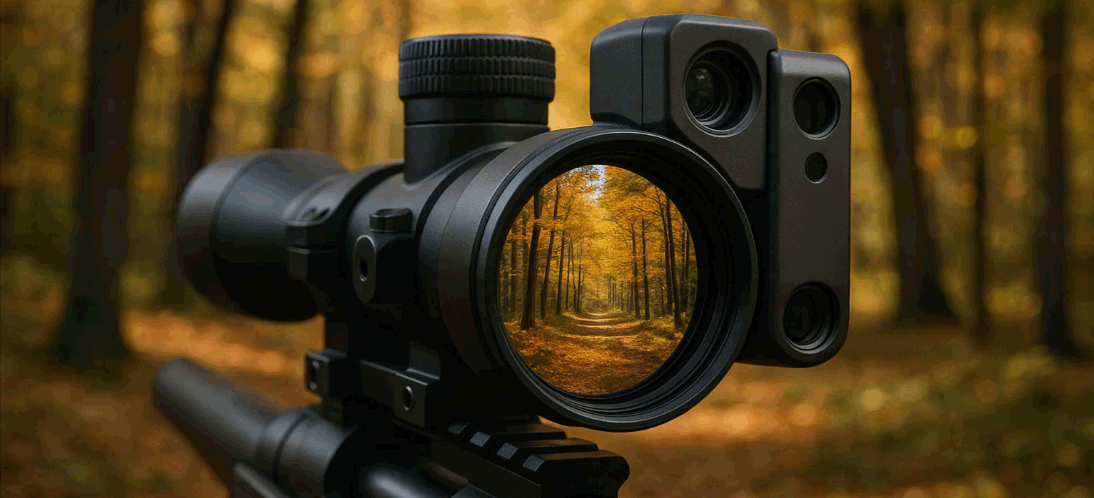
- If your roadmap includes weapon-mounted products, the same ranging discipline feeds your Thermal Rifle Scopes and Thermal Pistol Sights—but recoil hygiene, alignment, and compliance need to scale accordingly.
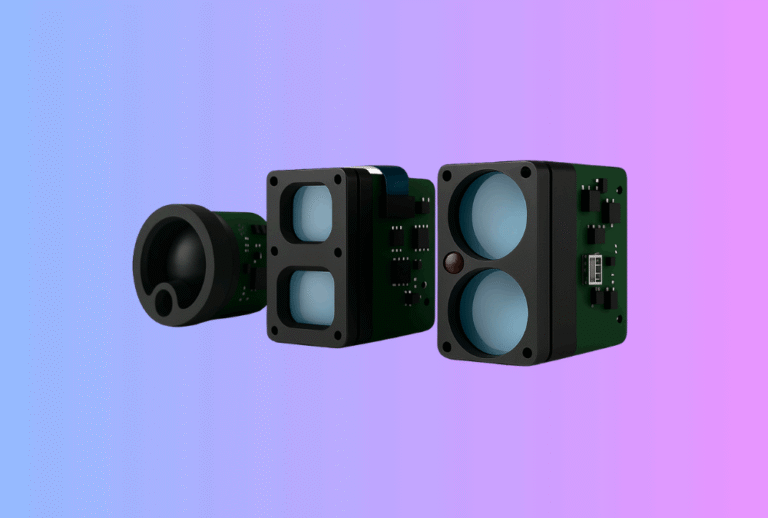
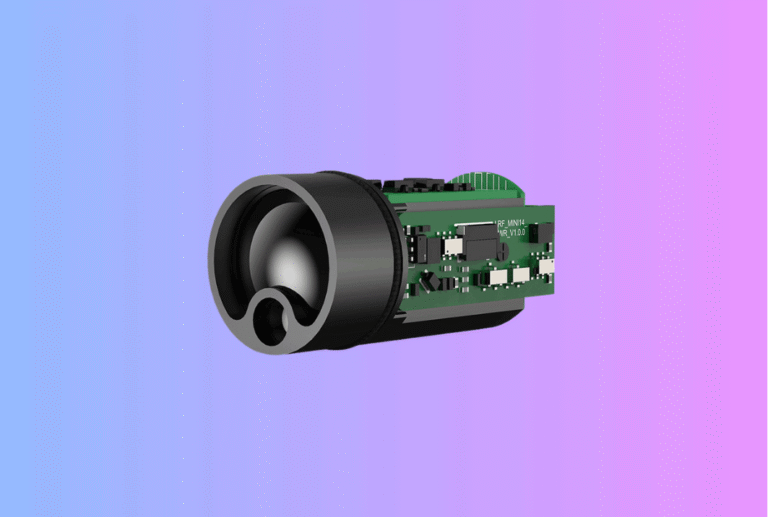
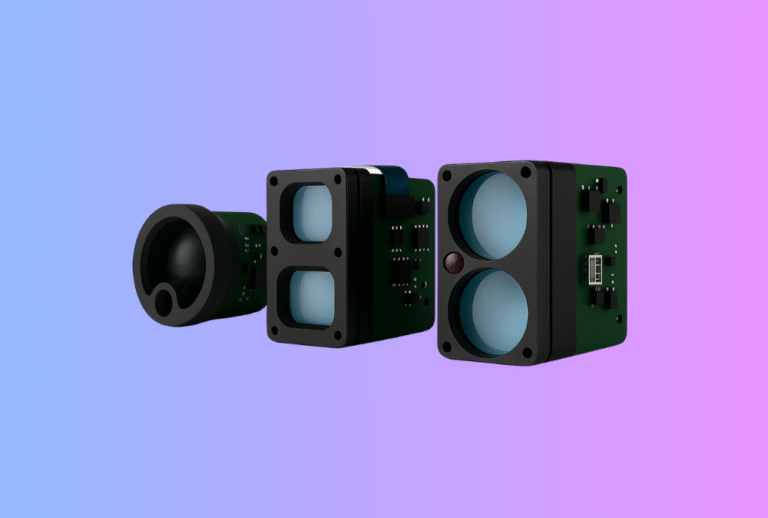
Wherever you start, anchor the program on a technical core you can support for years. Our Laser Rangefinder Module exposes clean UART control, returns confidence with distance, and is designed to be documented to Class 1 under IEC 60825-1.
A buyer’s table you can share with retailers
Below is a concise table that product managers can put in a line review deck. It converts engineering ideas into shelf-level claims with honest caveats.
| Field condition | What the module sees | What the user feels | How to earn confidence |
|---|---|---|---|
| Open terrain at dusk | Low ambient; strong returns | “Calm” numbers, fast locks | Keep scan latency < ~100 ms; haptic only on high confidence |
| Timber/brush, late afternoon | Many faint returns from leaves/branches | Occasional jumpy readings | Multi-return capture; closest-cluster + N-of-M confirmation |
| Mist/dew at twilight | Increased backscatter | Sporadic false locks if thresholds fixed | Ambient-aware thresholding; narrow range-gate widths |
| Bright sun, mid-day | High background NIR | Washed HUD if not designed | AR-coated windows; higher display brightness with auto-dim |
| After drop/temperature cycle | Slight boresight drift | “Off by a tree” in brush | Alignment SOP; re-verify divergence and AEL margin |
The power of the table is not the numbers—it’s the discipline of promising only what you can prove and then showing how you measured it.
Compliance notes you should copy–paste into your plan
-
Classification: Document Class 1 per IEC 60825-1 (Ed. 3) with AEL calculations for your exact pulse parameters and wavelengths; keep the calculation sheet with your incoming QC reports.
-
Labeling & manual: Use the correct Class statement, wavelength, and manufacturer identity; include a user-manual safety page tied to the product photos you actually ship—auditors notice mismatches.
-
Change control: If you change the emitter, optics stack, or coatings, re-verify both divergence and AEL; those two drift more than teams expect and drive both performance in brush and safety classification.
Putting it all together: a reference architecture
An outdoor-ready laser rangefinder module sits behind an AR-coated window, collimated to produce an elliptical spot about 2.2×1.4 mrad (full-angle), with a receiver FOV that just envelopes the footprint at 200–300 m. The detector is an APD front-end tuned for low noise and temperature stability, and the DSP captures multiple returns per shot, then clusters and confidence-gates a closer-target bias. A haptic fires only when confidence crosses a defined threshold; the HUD auto-dims at dusk and stays legible in sun. The quality file contains the two-distance divergence report, the IEC Class 1 calculation, and label artwork. That same core can ship inside a compact monocular today and migrate to a binocular tomorrow without changing the story you tell retailers.
For brands with a night portfolio, the day rangefinder becomes the trustworthy baseline that feeds or coexists with imaging. You can then cross-sell users into Thermal Clip-On Sight packages or larger Thermal Binoculars as their use cases grow.
FAQs (focused on low light and brush)
Does low light always improve ranging?
Often—but not universally. Dropping ambient NIR reduces background noise, improving SNR. But low light frequently arrives with fog or dew, which adds backscatter and partial occlusions in brush. Your thresholds and clustering need to adapt. AM1.5 spectra explain why daytime backgrounds are high; nighttime removes that floor.
Is 1550 nm categorically safer and better in vegetation?
No simple rule covers all cases. Eye safety is proven by IEC 60825-1 calculations (Class 1 is fully achievable at 905 nm), and vegetation performance depends on beam/FOV geometry and DSP more than wavelength alone. Industry coverage has raised valid caveats about blanket claims.
How do I measure beam divergence accurately?
Use two-distance imaging with an NIR-sensitive camera and ND filters. Report whether your diameters are 1/e² or FWHM, and convert to full-angle before comparing suppliers. Gentec-EO provides practical guides and calculators.
What’s the single best algorithmic change for brush?
Implement multi-return capture with closest-cluster selection and N-of-M confirmation before haptics. The approach mirrors best practice in forestry and aerial lidar for penetrating vegetation while avoiding false positives.
What human-factors choices matter most at dusk?
A calm HUD beats a bright one. Auto-dimming, thin reticles, and well-timed cues reduce cognitive load. Keep end-to-end updates under ~100 ms so users don’t chase changing numbers.
Call-to-Action
If your next outdoor optics program needs a daytime-to-dusk rangefinder that stays honest in brush, start from a core designed for confidence: clean geometry, robust SNR, and repeatable tests. We can help you pick divergence/FOV, implement multi-return clustering, and compile an IEC-aligned Class 1 file.
Start here: Laser Rangefinder Module
Step-up options for your line: Thermal Monoculars · Thermal Binoculars · Thermal Rifle Scopes · Thermal Pistol Sights
Sources
-
FDA — Laser Products: Conformance with IEC 60825-1 (Laser Notice No. 56), 2023 (guidance + PDF). U.S. Food and Drug Administration+1
-
RP Photonics — Beam Divergence; Beam Quality (definitions; 1/e²; far-field). rp-photonics.com+1
-
Gentec-EO — Quick guide on beam divergence measurement; Beam divergence & diameter calculator. Gentec EO+1
-
NREL / ASTM G-173 — Reference Air Mass 1.5 Spectra (solar spectral irradiance). nrel.gov
-
ON Semiconductor — Analytical SNR for APD/SiPM LiDAR (application note). onsemi
-
RP Photonics — Gaussian Beams. rp-photonics.com
-
LIDAR Magazine / ScienceDirect — Vegetation & multi-return explanations/examples. LIDAR Magazine+1
-
Laser Focus World — Safety questions raised about 1550 nm lidar (nuanced view). Laser Focus World