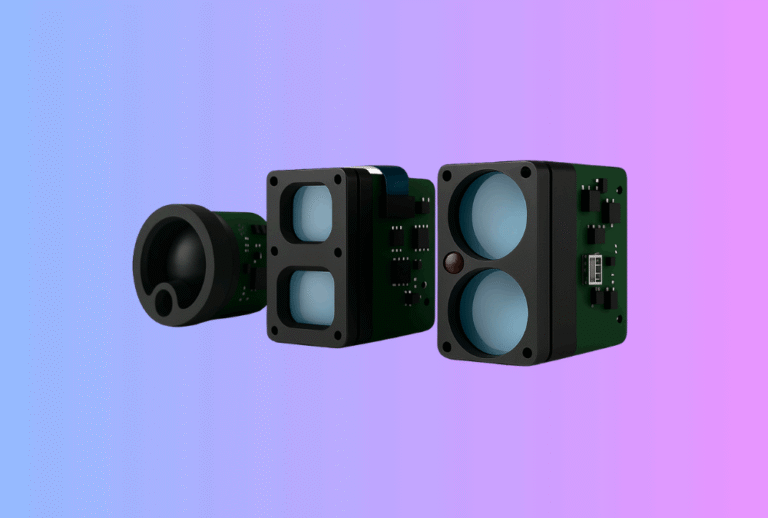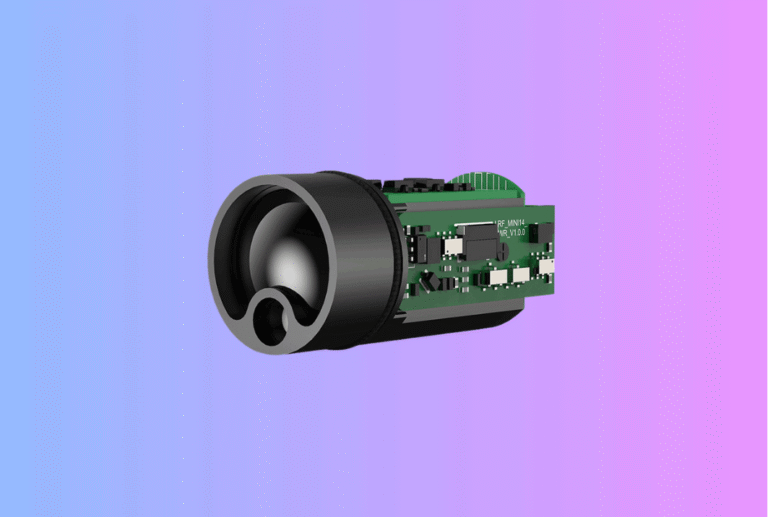
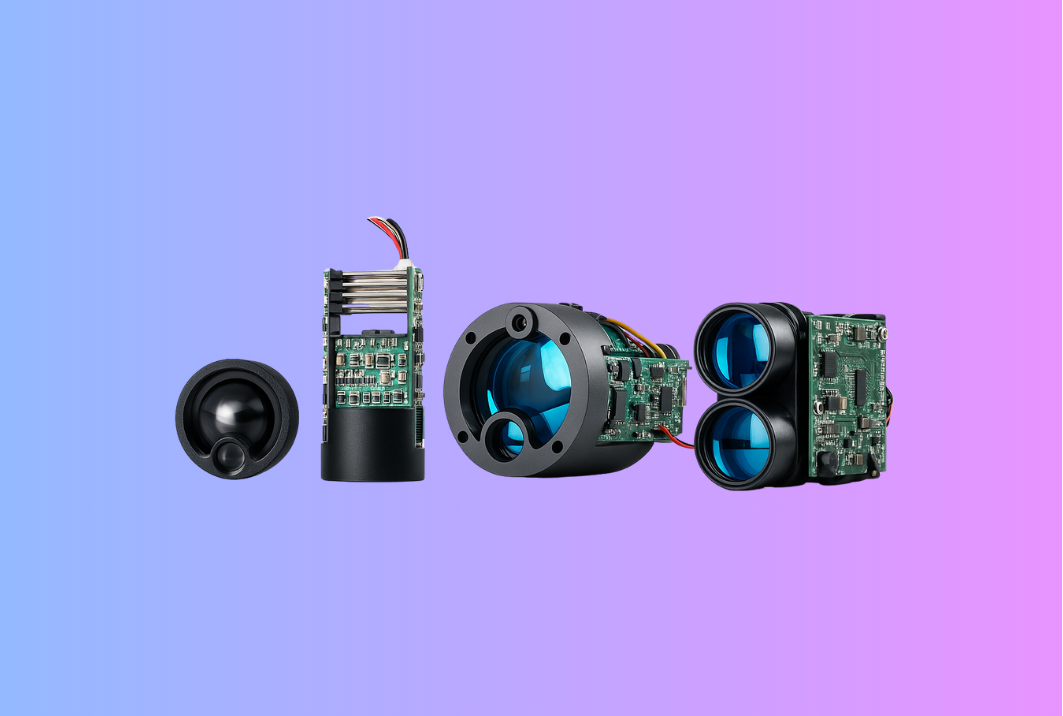
Laser distance module designers share one non-negotiable goal: keep the product safely Class 1 from EVT to field use. This guide maps the AEL power budget, pulse timing, and divergence checks required by IEC 60825-1—and shows how to document labels and tests so retailers and regulators say “yes.”
Table of Contents
ToggleExecutive Summary
- Class 1 is achieved at the system level—optics, timing, firmware, mechanics, and labeling—not by picking a “safe laser.”
- Control AEL (Accessible Emission Limit) with a power budget tied to worst-case pulse width, repetition rate, duty cycle, and divergence.
- Lock the emission path with hardware limits (current/voltage clamps) and signed firmware so field updates cannot exceed the certified envelope.
- Validate with repeatable eye-safety measurements, then guard production with incoming optical QA, emission spot checks, temperature/voltage sweeps, and label control.
- Publish a one-page Eye Safety File: classification statement, optical layout, worst-case timing, measurement plots, and label locations. It reduces audits and speeds channel onboarding.
Use Cases & Buyer Scenarios
Scenario 1 — Golf handheld heading to big-box retail
Retailers demand Class 1 proof plus clear user labeling. You provide a signed Eye Safety File, an on-device “Class 1” mark near the aperture, and a web page QR for the certificate. Your product listing links back to the same page. Range performance matches the glare-tested Laser Rangefinder Module family, with identical timing tables.
Scenario 2 — Dual-SKU, consumer + pro variants
The consumer version remains Class 1 with conservative timing; the pro SKU adds longer bursts only for a tripod profile but still within Class 1. Both share optics and labeling; firmware keys prevent cross-flashing. Night kits later pair with Thermal Monoculars using the same safety envelope.
Scenario 3 — Integrator bundles with day/night overlays
An integrator mounts your module into binoculars and wants on-screen warnings if service covers are open. Your API exposes GET_AEL_BUDGET() and a “cover-status” GPIO. HUD guidance mirrors conventions used in the company’s Thermal Rifle Scopes.
Spec & Selection Guide (the heart)
What “Class 1” means—precisely
- Class 1: the highest safety class for continuous and pulsed emitters as defined in IEC 60825-1. For a given wavelength (e.g., 905 nm/940 nm), exposure must not exceed the AEL for the specified emission duration and aperture.
- AEL depends on pulse regimen: energy per pulse, pulse width τ\tauτ, repetition rate fff, burst or “grouping,” and total exposure time. For pulse trains, both single-pulse and multiple-pulse rules apply; aggregate energy matters.
- Divergence and aperture affect how much energy enters the limiting aperture at the measurement distance; you must cite full-angle 1/e21/e^21/e2 divergence and verify spot size.
- Accessible means under reasonably foreseeable conditions—covers open/closed, focus drift, temperature extremes, and supply variation.
Build a power budget you can ship
A simple, auditable model: AEL margin=AELClass 1(λ,t)NEpulse⏟pulse energy over exposure×AbeamAlimiting aperture\textbf{AEL margin} = \frac{\text{AEL}_{\text{Class 1}}(\lambda, t)}{\underbrace{N E_{\text{pulse}}}_{\text{pulse energy over exposure}}} \times \frac{A_{\text{beam}}}{A_{\text{limiting aperture}}}AEL margin=pulse energy over exposureNEpulseAELClass 1(λ,t)×Alimiting apertureAbeam
Where NNN is pulses within the exposure time ttt. Your design target should keep AEL margin ≥ 2.0 in worst case (temp/voltage corners, narrowest divergence spec, longest τ\tauτ, highest fff).
Design rules of thumb
- Budget from the receiver back. Start with SNR needed at the detector; choose optics, then find the minimum transmitter energy that meets performance.
- Keep τ\tauτ modest and use matched filtering to recover precision rather than pushing peak power.
- Choose a divergence that serves the scene and helps eye safety (e.g., 0.9–1.2 mrad for handhelds).
- Set current/voltage clamps that physically cap the pulse energy even if firmware misbehaves.
Small comparison table (safety-relevant parameters)
| Parameter | Why it matters | Typical handheld value | Safety risk if wrong |
|---|---|---|---|
| Wavelength | AEL is wavelength-dependent | 905–940 nm | Wrong class calc |
| Pulse width τ\tauτ | Affects AEL & ranging resolution | 8–20 ns | Over-AEL at long τ\tauτ |
| Repetition rate fff | Multiplies energy in exposure time | 5–20 kHz (engine), 9–15 per burst | Over-AEL in bursts |
| Divergence (full-angle) | Sets irradiance & limiting-aperture coupling | 0.9–1.3 mrad | Over-irradiance at eye |
| Optical train losses | Realistic energy at aperture | 1.5–2.5 dB | Under-estimating AEL margin |
| Limiting aperture distance | Test geometry per IEC | e.g., 100 mm | Mis-measured class |
Decision rules (if/then)
-
If pulse timing changes (new firmware), then re-compute AEL and re-run the multiple-pulse rule.
-
If optics change (window/lens/AR coat), then re-measure divergence and transmission—update the budget.
-
If you enable Scan or new Last-Target verify bursts, then include the longest burst in the worst-case envelope.
Integration & Engineering Notes
Electrical & Interfaces (limits that hold in the field)
-
Hardware clamps. Set TX driver current and cap charge voltage with tolerances that hold across −20…+60°C-20…+60 °C−20…+60°C and supply ±10%.
-
Signed timing.
SET_TX_TIMING()accepts only signed profiles; OTA cannot exceed certified tables. -
Telemetry.
GET_AEL_BUDGET()returns live estimates: current τ\tauτ, fff, temperature, and AEL margin. Host firmware logs margin < 1.5. -
Power domains. Isolate TX energy store from HUD logic; brownouts skew pulse shapes.
Optics & Mechanics (keeping the beam honest)
-
Aperture control. Use a fixed field stop; avoid user-adjustable focus that could narrow divergence.
-
Windows & AR coatings. Track transmission; batch drift changes delivered energy.
-
Boresight stability. A shocked window can act like a weak lens—re-check divergence after drop/thermal cycles.
-
Stray light. Blacken baffles; prevent internal reflections that can return to the receiver and encourage over-driving the TX in tuning.
Firmware & Timing (Class 1 aware engine)
-
Profiles.
COMPETITION(distance-only) andPRACTICE(same emission) share identical TX timing—slope/UX features must not change accessible emission. -
Burst accounting. Engine tracks pulses per 100 ms window and lifetime exposure for diagnostics.
-
Temperature derate. As LEDs/diodes heat, pulse energy rises; derate current vs. TTT to keep the AEL margin stable.
-
Scan cadence vs. AEL. UI debouncing does not change TX timing; never “fill in” numbers by adding extra bursts.
Testing & Validation (bench → field)
Bench (classification)
-
Measure pulse energy and τ\tauτ with a fast photodiode + oscilloscope (≥1 GHz BW).
-
Verify divergence at 5–10 m using a calibrated target; report full-angle 1/e21/e^21/e2.
-
Apply single-pulse and multiple-pulse rules per IEC 60825-1 and compute AEL margin.
Production (guard rails)
-
Incoming inspection of lenses/windows (transmission, wedge).
-
Emission spot check on golden units per lot; check timing vs. signed table.
-
Temperature/voltage sweep on a few units each run; log AEL margin.
-
Label verification (location, wording, icons, permanence).
Field (sanity checks)
-
Confirm HUD/UI changes do not alter TX statistics.
-
After drop/IP cycles, re-check divergence and pulse timing.
-
Confirm cover interlocks (if any) block emission when optics are exposed.
Compliance, Export & Certifications
-
IEC 60825-1 Class 1. Your device must meet Class 1 AEL limits at the intended wavelength with worst-case timing and optics. Include the optical drawing, divergence measurement, and timing table in your safety file.
-
FDA Laser Notice No. 56 (U.S.). For many products, FDA recognizes conformance to IEC 60825-1; align your report and product report filings with the notice and keep them current when firmware changes timing.
-
CE/FCC/RoHS. Laser classification is separate from EMC/Radio and material compliance; keep a Technical File that ties eye-safety claims to markings and manuals.
-
Labeling. Place the Class 1 label near the aperture; mirror the language in quick-start and web product pages. If you later bundle optics in Thermal Binoculars kits, repeat the label locations in the combined manual.
Business Model, MOQ & Lead Time (OEM/ODM)
-
MOQs. 200–300 pcs for catalog optics; 500–1,000 pcs if you need custom divergence windows or special label tooling.
-
Lead time. Eye-safety-ready EVT in 4–6 weeks with catalog glass; add 6–10 weeks for custom optics/labels and test fixtures.
-
Deliverables to integrators. Eye Safety File (PDF), timing table (CSV), divergence certificate, golden-unit oscilloscope traces, and a short compliance statement that distributors can reuse.
Tiny distributor ROI (illustrative)
| Assumption | Value |
|---|---|
| Ex-works (Class 1 documented) | $99 |
| Landed (duty + freight) | $9 |
| Distributor sell | $159 |
| Gross per unit | $51 |
| Monthly run | 1,000 |
| Monthly gross | $51,000 |
Clear safety paperwork shortens retailer onboarding and reduces line reviews—often worth $5–$10 ASP uplift vs. “undocumented” competitors.
Pitfalls, Benchmarks & QA
-
“Safe diode ≠ safe system.” Class depends on emission at the aperture, not the part number. Always compute with real optics/timing.
-
UI/feature creep changing timing. New modes that alter burst length can break Class 1. Guard with signed profiles and AEL telemetry.
-
Divergence drift after stress. Post-drop or thermal cycling can tighten divergence; re-measure in HALT/HASS.
-
Over-optimistic optics losses. Production AR coatings vary—measure transmission per lot.
-
Uncontrolled labels. Missing or misplaced labels trigger retailer rejects even when physics is compliant—treat artwork as a controlled document.
-
Ignoring multiple-pulse rules. A single-pulse pass is not enough; bursts aggregate energy.
Benchmark recipe (one working day)
Classify five golden units; sweep temp/voltage on two per SKU; drop-test and re-measure divergence; run 30-minute Scan with logging; create a one-page chart “AEL margin vs. conditions.” Sales and service teams will reuse it.
FAQs
Does widening divergence always help eye safety?
It reduces irradiance at the eye for a given pulse energy, which helps AEL margin. But it also affects ranging SNR and UX. Choose divergence to meet scene needs first, then optimize timing.
Can firmware alone guarantee Class 1?
No. You also need hardware clamps, controlled optics, and label/process discipline. Firmware enforces timing; hardware prevents over-current at cold or with aging parts.
Do Scan/First/Last modes change classification?
They can—if they change burst length or rate. Keep TX timing identical across modes; treat UX features as display logic only.
What proof do retailers want?
An IEC 60825-1 classification report, a short compliance statement, label photos, and divergence/timing plots. Many will accept a QR link in the manual that lands on your Eye Safety page.
How often should we re-test?
At major firmware releases, optical BOM changes, and at least annually for golden units. Include temperature and voltage sweeps.
Call-to-Action (CTA)
Need a safety envelope you can defend? We’ll help you map optics, timing, and tests so your laser distance module stays Class 1—from EVT to mass production. If you’re planning day/night kits, we can align UI, timing, and paperwork with your imaging products—whether that’s a laser range module feeding a Thermal camera module HUD or accessories that later sit beside Thermal Clip-On Sight and Thermal Pistol Sights lines.
Sources
-
IEC 60825-1 — Safety of Laser Products (Ed. 3). Classification framework, limiting apertures, single/multiple-pulse rules. (International Electrotechnical Commission — IEC Webstore)
-
FDA — Laser Notice No. 56. U.S. recognition of IEC 60825-1 conformance and filing guidance. (U.S. FDA Guidance)
-
RP Photonics — Beam Divergence. Definitions (full-angle 1/e21/e^21/e2 vs. FWHM), spot size implications. (RP Photonics Encyclopedia)
-
Gentec-EO — Measuring Pulse Energy and Width. Practical setups for eye-safety measurements with fast photodiodes. (Gentec-EO Knowledge Center)