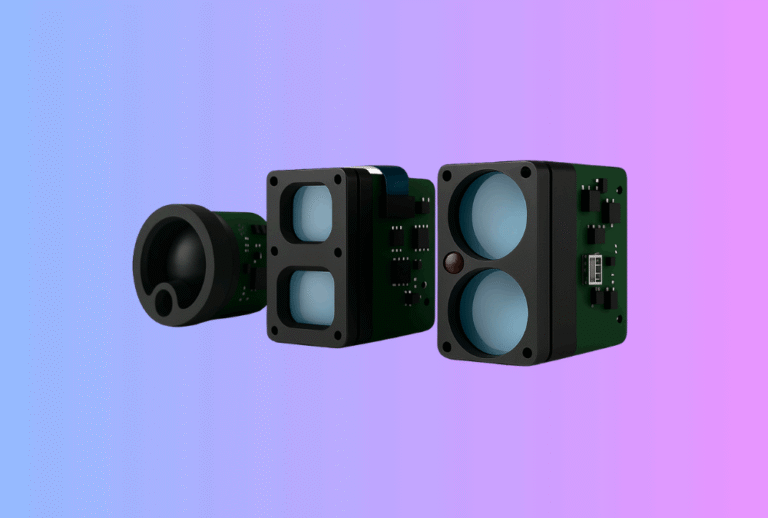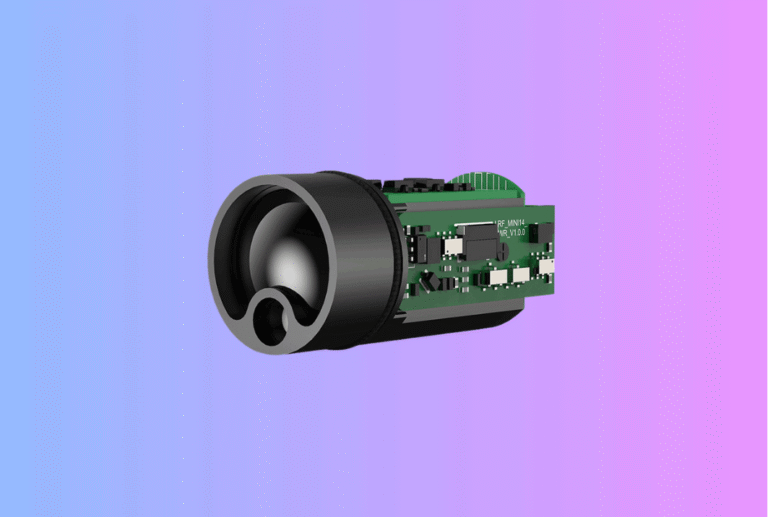
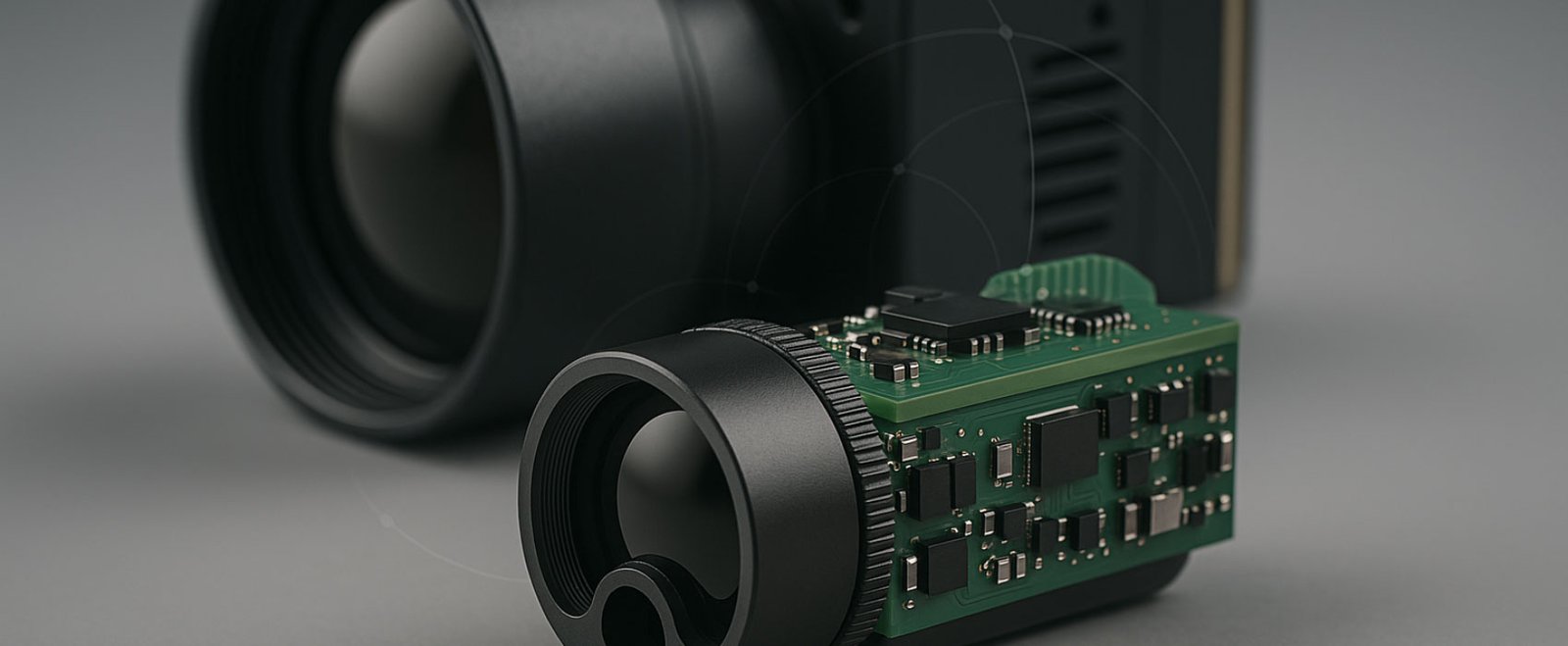
A laser distance sensor module lives or dies by beam divergence—the angular spread of the transmitted pulse. Divergence sets spot size on target, energy density, and how easily the receiver confuses a flag with a tree behind it. This guide explains divergence in first principles, shows how it interacts with FOV, reflectivity, and handheld wobble, and gives practical rules and acceptance tests for compact LRFs built on Laser Rangefinder Module platforms.
Table of Contents
ToggleExecutive Summary
Divergence (full-angle, 1/e²) multiplies with distance to set spot diameter: s ≈ θ·d for small angles. Smaller θ raises energy density and precision but reduces coverage, punishes hand wobble, and increases backstop misses; larger θ forgives aim error but lowers SNR and risks multi-target returns. For handhelds, 0.9–1.2 mrad is the sweet spot; tripods can run ≤0.8 mrad. Always measure θ after stress, align receiver FOV, and publish Pd (probability-of-detection) curves instead of billboard “max range.”
Use Cases & Buyer Scenarios
Scenario 1 — Golf (50–400 m; bright sun)
Flags are small and cooperative; users need “snap” locks. Choose 1.0–1.2 mrad divergence, first-target bias, and glare-resistant HUD. Acceptance must show Pd ≥90% on poles at 150 m with latency 95th ≤180 ms. If slope is on your roadmap, keep it a display function—timing must remain Class-1 safe; see Rangefinder Module Integration.
Scenario 2 — Hunting/Outdoors (100–800 m; brush; dusk)
Foreground clutter punishes narrow beams. Keep 1.0–1.2 mrad, bias last-target with verify bursts, and use a narrowband filter if glare is the limiter. Reuse HUD language from the observation line so users don’t relearn behavior—see Thermal Rifle Scopes.
Scenario 3 — Tripod/Vehicle Mapping (800–2,000 m)
With rigid mounts, you can safely shrink to ≤0.8 mrad, but align TX/RX axes within ≤0.2 mrad and verify boresight after thermal/drop. For fused overlays, coordinate timestamps with imaging under Thermal + LRF Fusion & Ballistics.
Spec & Selection Guide
Key definitions
Divergence (θ), full-angle 1/e²: the angle containing the main energy of the beam. Spot size (s): beam diameter on target; for small θ, s ≈ θ·d. FOV: receiver field-of-view; must cover the returned energy cone while rejecting clutter. Energy density: launch energy divided by illuminated area; controls SNR on low-reflectivity targets. Pd: probability that the device reports a correct range within tolerance and below a latency cap.
Divergence vs handheld reality
Hand wobble is typically 1–2 mrad peak-to-peak; parallax error grows when the visible reticle and IR beam are not coaxial. Below ~0.8 mrad, many users simply miss the target at 150–300 m; Pd falls despite nicer energy density. Above ~1.3 mrad, energy density drops and backstop contamination rises—flags in front of trees become ambiguous until your algorithm clusters and biases correctly.
Comparison table — what changes as you tune θ
| Divergence (full-angle) | Handheld coverage | Energy density | Backstop risk | Use |
|---|---|---|---|---|
| 0.6–0.8 mrad | Narrow; punishes wobble | High | Low | Tripod/vehicle; precision mounts |
| 0.9–1.2 mrad | Balanced for handhelds | Moderate-high | Moderate | General handheld sweet spot |
| 1.3–1.8 mrad | Forgiving; large spot | Lower | Higher | Very shaky users; short ranges |
If/Then decision rules
- If most scenes are flags at 50–350 m in sun, then 1.0–1.2 mrad + first-target + thin reticle; publish “snap-to-flag” acceptance.
- If brush and animals dominate, then keep 1.0–1.2 mrad but bias last-target and fire verify bursts when cluster width (σ) is wide.
- If the unit sits on a tripod, then go ≤0.8 mrad, tighten FOV, and validate boresight drift after stress.
Integration & Engineering Notes
Electrical & Interfaces
Make divergence a first-class parameter in your SDK so hosts can log and audit results: SET_DIVERGENCE(mrad) (calibration token), GET_RANGE() → {range, confidence, n_valid, sigma, mode}, GET_STATS() → latency (mean/95th), mWh/100 ranges. Maintain signed timing tables so UI or mode changes cannot push emissions outside IEC 60825-1 Class 1.
Optics & Mechanics (FOV, windows, alignment)
Receiver FOV must embrace the returned energy while rejecting clutter; for handhelds near 1.0–1.2 mrad TX, FOV around 2–3 mrad is typical. Use IR-friendly glass with hard AR (R ≲0.5%/surface) and blackened baffles to suppress sparkle. Keep TX/RX bores within ≤0.2 mrad after drop/vibe/thermal. Verify parallax (“eye box”) on a 10 m grid by shifting eye relief ±10 mm. Reuse sealing and fogproof discipline from rugged optics such as Thermal Binoculars; fog ruins divergence math faster than any DSP trick.
Firmware/ISP/Tuning (cluster-then-bias; don’t chase noise)
Micro-bursts (9–13 pulses) → histogram of TOF → cluster by proximity → compute amplitude and σ → bias the cluster (first/last) → optional verify burst when σ is wide. Only then render a debounced value at 5–8 Hz perceived with a 0–100 confidence bar. “Smooth numbers” without disciplined decisions hide divergence problems; logs with σ and confidence expose them.
Testing & Validation (bench → field)
Panels: 10/20/80% reflectivity at 50/100/200/400 m.
Natural targets: bark poles, brown fabric (fur proxy), brush wall with/without backstop.
Bright sun: ≥100 klx; handheld sweep 5–10°/s; anti-bloom on HUD.
Stress: −10→+40 °C cycles; IP67 spray/immersion; drop; re-measure θ and boresight.
Acceptance gates (illustrative)
- Pd ≥90% on poles @150 m (first-target), Pd ≥80% on bark behind grass @300 m (last-target + verify).
- Latency 95th ≤180 ms; numeric stability ±0.5 m on steady target in Scan.
- Divergence drift ≤0.1 mrad after stress; FOV alignment error ≤0.2 mrad.
Compliance, Export & Certifications
Divergence enters eye-safety math via limiting apertures and hazard distances. Keep IEC 60825-1 Class 1 under worst-case τ, repetition rate, burst count, and θ; align U.S. filings with FDA Laser Notice No. 56. EMC (FCC/CISPR), sealing (IEC 60529), and RoHS are separate but should live in one Technical File. For retailer audits, host public docs under Certificates, service notes under Support, and downloadable spec sheets under Downloads.
Business Model, MOQ & Lead Time (OEM/ODM)
MOQs. 200–300 pcs baseline; 500–1,000 pcs with custom windows/filters. Lead time. EVT with catalog optics 4–6 weeks; custom glass adds 6–10 weeks. Sales teams should present Pd curves and θ/FOV certificates with each quotation; they justify ASP uplifts more than any “max range” claim. For end-to-end integration help, see Module Integration for OEMs.
| Deliverable | Why it matters | Channel effect |
|---|---|---|
| θ certificate (post-stress) | Proves stability and alignment | Fewer returns; faster retail onboarding |
| Pd vs distance curves | Replaces “max range” hype | ASPs +$5–$20; higher close rate |
| Timing CSV + Eye-safety file | Regulatory confidence | Shorter audits |
Pitfalls, Benchmarks & QA
- Chasing ultra-narrow beams on handhelds. Below ~0.8 mrad, misses from wobble/parallax erase energy gains.
- Mismatched FOV. Too narrow: clip returns; too wide: invite clutter. Keep ≈2–3× TX θ for handhelds.
- No sun/brush tests. A nice bench spot fails in noon glare or foliage; test ≥100 klx and natural scenes.
- Assuming θ never changes. Windows and mounts creep; re-measure after every stress sequence.
- Pretty HUD, noisy decisions. Decide after clustering; then render smoothly with confidence.
FAQs
Q: How do I measure divergence quickly?
Project onto a far wall (e.g., 25 m), image the spot, and fit a 1/e² contour. Compute full-angle θ ≈ s/d. Repeat after thermal/drop.
Q: Is narrower always better for range?
No. Energy density rises, but handheld miss rate rises too. The best Pd for pocket LRFs sits around 0.9–1.2 mrad.
Q: How does divergence interact with slope mode?
It doesn’t—slope is math and display. Emission timing must stay fixed for Class-1 safety regardless of UI.
Q: Can I share one chassis for day and night?
Yes—align θ/FOV, sealing, and HUD cadence; reuse overlays and typography from Thermal Monoculars for a single learning curve.
Decision Flow — from beam spec to field confidence
Start
  ├─ Primary scene? (golf / hunting / tripod)
  │     ├─ golf    → θ = 1.0–1.2 mrad; First-target; glare-proof HUD
  │     ├─ hunting → θ = 1.0–1.2 mrad; Last-target + verify; narrowband filter if glare
  │     └─ tripod  → θ ≤ 0.8 mrad; align FOV; rigid mount
  ├─ Set receiver FOV ≈ 2–3× θ; verify parallax on 10 m grid (≤0.2 mrad error)
  ├─ Tune bursts (N=9–13) and matched filtering; log σ & confidence 0–100
  ├─ Acceptance: Pd curves (panels & natural), latency 95th ≤180 ms, θ drift ≤0.1 mrad
  └─ Freeze optics + timing + UI kit → Pilot → MP → Publish at Products
Call-to-Action (CTA)
Need a divergence spec you can defend with field curves and Class-1 paperwork? We’ll help you size θ and FOV, harden alignment and sealing, and publish Pd charts buyers believe—then package an SDK and acceptance card for your channel. Start a review via Contact or explore system options on Products and Modules.
Sources
- RP Photonics — Beam Divergence. Definitions, 1/e² vs FWHM, and measurement notes. (RP Photonics)
- Edmund Optics — Gaussian Beam Propagation. Spot size, waist, and divergence relations. (Edmund Optics)
- Ocean Optics Book — The LiDAR Equation. Returned power and atmospheric loss intuition. (Ocean Optics Book)
- IEC 60825-1 (Ed. 3) — Safety of Laser Products. Class-1 limits and multiple-pulse rules. (IEC Webstore)