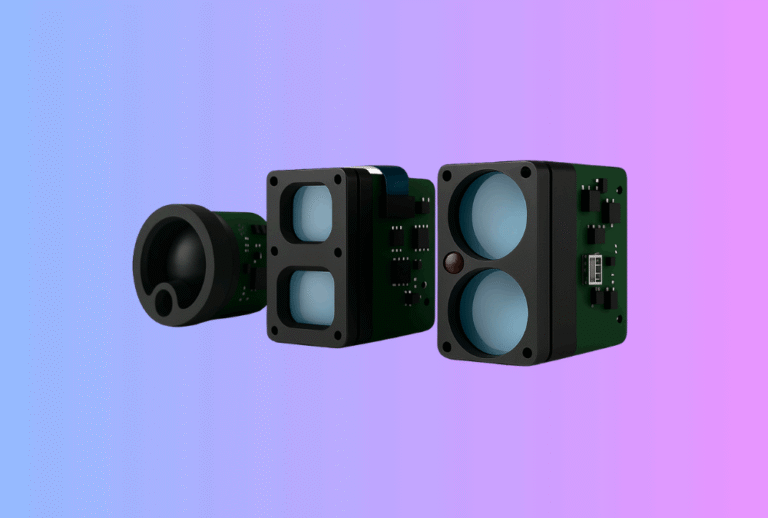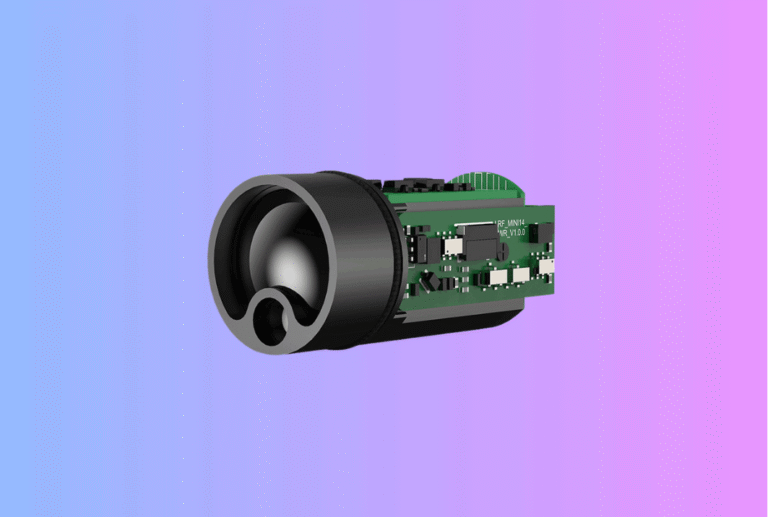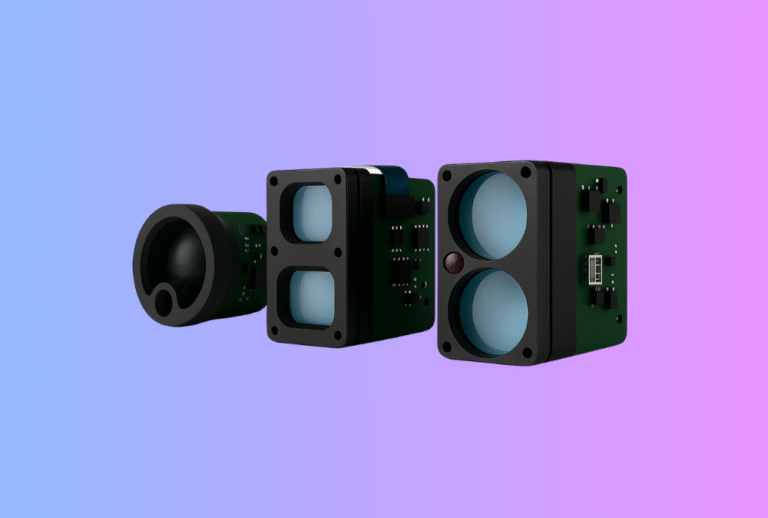
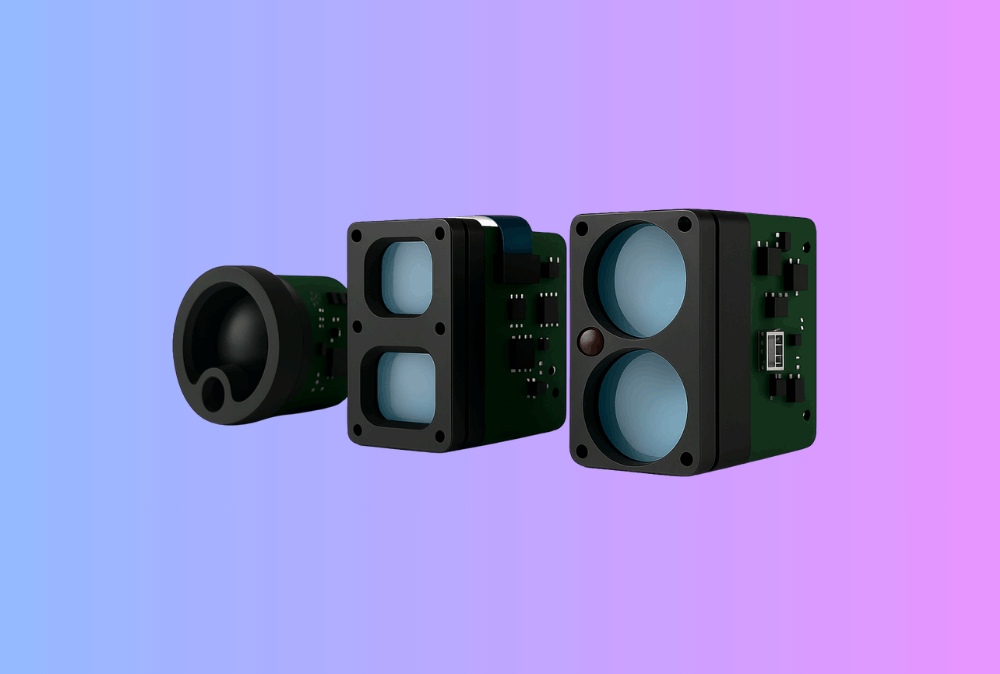
A laser distance sensor module only becomes a product when every lot passes the same quick, repeatable gates. This field guide condenses what we run at receiving to catch 80–90% of issues before a module touches your PCB: accuracy vs distance, short-term repeatability, EMI/ESD tolerance on the harness, thermal drift and optics fog checks, and log integrity. It works for pocket devices around a laser rangefinder module and scales to rigs listed under Modules and Products.
Table of Contents
ToggleExecutive Summary
Incoming tests should be short, objective, and loggable. Measure the minimum that predicts field success: distance accuracy on calibrated panels, repeatability on a steady target, immunity to common EMI/ESD events on your harness, temperature/fog stability of the optics and timing, and whether the module’s own logs are trustworthy. Publish your acceptance card with each PO and store golden logs under Downloads so vendors can dry-run before shipping.
Use Cases & Buyer Scenarios
Scenario 1 — Golf handheld assembly line
Throughput and false-fail cost dominate. You need a 3–5 minute jig: three distances (50/150/300 m optical path), a bright-sun lamp for HUD testing, and an automated CSV. The outcome is pass/fail against ±0.5 m typical accuracy and latency 95th ≤180 ms, then modules move to optics sealing with discipline shown on Manufacturing & Quality.
Scenario 2 — Hunting/field SKU with last-target bias
Foreground clutter and low light punish decisions. You add a “brush wall” and a bark pole behind grass to validate probability-of-detection (Pd) and false backstop rates. Logs must expose σ (cluster width) and confidence to prove tuning, and your acceptance mimics usage seen near Thermal Optics.
Scenario 3 — Multi-sensor rigs (tripod/vehicle)
Harness noise and long cables create latent faults. You’ll bias tests toward EMI/ESD, CAN/UART robustness, and thermal drift across −10→+40 °C. Golden lots ship with DBC/CSV message maps via Rangefinder Module Integration to lock protocol parity.
Spec & Selection Guide (the heart)
What you must define up front
Write a one-page “Incoming Acceptance Card” per module family. It lists distances, targets, ambient light, harness type, connector pinout, firmware build hash, CSV column names, and pass/fail gates. Keep units consistent (meters, milliseconds, mWh/100 ranges). Store the PDF with revision history under Certificates and firmware notes under Support.
| Parameter | Definition | Why it matters |
|---|---|---|
| Accuracy | Mean(|reported−true|) over N samples at each distance | Mis-scaled optics or timing shows here first |
| Repeatability | Std dev (σ) of range on a static panel at fixed distance | Reveals noisy analog, APD bias drift, jitter |
| Pd (probability-of-detection) | Share of shots within tolerance and latency cap | Predicts user trust on flags and brush scenes |
| Latency | 95th percentile time from trigger to displayed range | Humans perceive 5–8 Hz; spikes hurt UX |
| Energy | mWh/100 ranges at nominal settings | Protects runtime claims and thermal headroom |
If/Then mini matrix
- If your retail claim hinges on “snap-to-flag,” then bias first-target and demand Pd ≥90% on 10–20% panels @150 m in ≥100 klx.
- If you sell into brush/dusk, then require Pd ≥80% on bark behind grass @300 m with last-target + verify, false backstop ≤10%.
- If your harness runs near motors/heaters, then add CAN/UART immunity gates and hot-plug recovery checks.
Integration & Engineering Notes
Test 1 — Distance Accuracy on Panels
Set up three distances representative of your SKU (e.g., 50/150/300 m optical path using a corner cube or folded range). Targets: 10%, 20%, 80% reflectance panels. For each, capture 30–50 readings in Scan with a steady mount; log range, confidence, σ, latency, ambient estimate.
Acceptance (illustrative). Mean error ≤±0.5 m @150 m; ≤±1.0 m @300 m on 20% panel. Latency 95th ≤180 ms. No more than one outlier >±2 m per 50 shots. Save CSV into your lot folder under Downloads for traceability.
Test 2 — Short-Term Repeatability (σ) & Stability
At 150 m, hold a single 20% panel and record 200 consecutive readings. Compute σ and Allan deviation to catch 1/f noise or thermal creep across minutes. Repeat with the module warmed 10 min to expose bias drift.
Acceptance. σ ≤0.35 m (steady mount) and Allan deviation minimum within 10–20 s. Drift of the mean ≤±0.3 m over 10 min. These thresholds predict a stable HUD for golf and outdoors.
Test 3 — Harness EMI/ESD Immunity
Wire the module with the exact production harness (length, shield, grounding). Inject radiated RF near the cable, sweep 80–1000 MHz @ 3–10 V/m, and fire ±4 kV contact/±8 kV air ESD at the connector shell and near signal pairs. For UART/CAN behavior and choices, see our bus guide and protocol maps provided with Rangefinder Module Integration.
Acceptance. No stuck bus; BER <1e-6 under RF; automatic recovery after every ESD event; ≤1 dropped frame per 106 bits. Range error must remain within the accuracy limits above while RF is on.
Test 4 — Thermal Drift & Fogproof Optics
Cycle −10→+40 °C (or your spec) with 30-minute dwells. At each plateau, run the 150 m panel test. Observe the window for fogging/condensation and record divergence (θ) via far-wall imaging. Nitrogen purge plus O-ring stack should mirror what you do on rugged optics; if in doubt, compare to the sealing discipline used across Thermal camera module builds.
Acceptance. Accuracy drift ≤±0.5 m across the cycle; divergence drift ≤0.1 mrad; no fog for 30 min after each step; HUD contrast ratio ≥4.5:1 under ≥100 klx sun lamp. Failures here predict field returns.
Test 5 — Log & Self-Report Integrity
Trustworthy logs reduce debug time. Require the module firmware to emit: {timestamp, range, confidence, n_valid, σ, mode, τ, N, supply, temperature}. Validate counters (monotonic) and checksums. Verify that “slope on/off” and UI changes cannot change emission timing (critical for IEC 60825-1). Keep golden examples on Support.
Acceptance. 100% of records parse; CRC matches; no gaps >2 frames; timing columns prove fixed τ/f/N per your eye-safety file.
Compliance, Export & Certifications
Incoming tests don’t replace compliance—but they should reference it. Keep IEC 60825-1 Class 1 invariant under worst-case pulse width (τ), repetition rate (f), burst count (N), and divergence (θ). Align U.S. filings to FDA Laser Notice No. 56. For environmental stress, refer to IEC 60068 (thermal cycles, shock/vibe). For ingress, IEC 60529 (IP67) is typical. EMC immunity on the harness maps to IEC 61000-4 series. Archive declarations on Certificates and warranty terms on Warranty.
Business Model, MOQ & Lead Time (OEM/ODM)
Quality gates shorten MP ramps. We ship modules with a ready test script, a mini acceptance card, and CSV/DBC templates; see Module Integration for OEMs. Typical MOQs are 200–300 pcs for catalog optics; 500–1,000 pcs with custom windows/filters. EVT lead time is 4–6 weeks; custom glass adds 6–10 weeks. Once your incoming station is froze, we can pre-run the same tests on our line and attach the report to each lot on Downloads.
| Deliverable | Why it matters | Channel effect |
|---|---|---|
| Acceptance card (1-pager) | Removes ambiguity and debate | Fewer DOA disputes |
| Golden CSV & timing table | Proves Class-1 envelope & performance | Faster retailer onboarding |
| Brush wall Pd curves | Stops “max range” marketing fights | Higher ASP and trust |
Pitfalls, Benchmarks & QA
Common ways teams waste time:
Testing too many distances with too few shots. Three well-chosen ranges with 30–50 readings beat seven ranges with five shots each. Ignoring ambient light. Noon-sun glare destroys HUD trust; always add a 100 klx step. Running TTL UART over long harnesses. Convert to RS-485 or CAN for immunity. Skipping thermal dwell. Most fog appears during plateaus, not ramps. Not saving raw logs. CSV or it didn’t happen—archived with the PO.
FAQs
Q: What’s the quickest way to stage a 300 m test indoors?
Use a Class-1-rated corner cube and a folded path or a calibrated reflector target on a rooftop across a known baseline; verify with a survey tape or total station once per quarter.
Q: How many samples define repeatability?
For incoming screening, 200 shots on a steady panel give a robust σ; for line checks, 50 shots is a good compromise.
Q: Do I need separate tests for 905 vs 1535 nm?
The geometry is the same; sensitivity to ambient and filter losses differs. Keep the same distances but record ambient estimate and note filter stack in the CSV.
Q: Can I reuse the station for imaging SKUs?
Yes. The same acceptance discipline (Pd curves, latency, bright-sun readability) carries into overlays for observation devices; see product families under Thermal Binoculars and Thermal Monoculars.
Q: Where do I store and version control results?
Per-lot folders with the acceptance PDF, firmware hash, and raw CSVs; reference them from the PO and your internal PLM.
Decision Flow — from PO to pass/fail
Start (PO opened)
  ├─ Confirm module FW hash + acceptance card rev
  ├─ Set distances: 50 / 150 / 300 m; targets: 10 / 20 / 80%
  ├─ Run Accuracy test → compute mean error & latency (95th)
  ├─ Run Repeatability (200 shots) → sigma & Allan deviation
  ├─ EMI/ESD on harness → BER, recovery, hot-plug
  ├─ Thermal cycle −10→+40 °C → drift, fog, divergence
  ├─ Log integrity → CRC, monotonic counters, fixed τ/f/N
  ├─ Decision:
  │     • All green → Receive lot; attach CSV & report
  │     • Any red   → Quarantine; re-test on golden jig; escalate supplier 8D
  └─ Archive results under Downloads; update retailer acceptance sheet
Call-to-Action (CTA)
Want this acceptance flow templated for your factory? We’ll ship a jig BOM, Python/CSV scripts, and golden logs mapped to your module—then train your team to run it in under five minutes per unit. Start a spec review via Contact, or explore integration kits on Module Integration for OEMs and product families at Products.
Sources
- IEC 60825-1 — Safety of Laser Products (Ed. 3). Class-1 limits; single/multiple-pulse rules. (IEC Webstore)
- IEC 61000-4 Series — EMC Immunity. ESD, radiated immunity, EFT/surge levels and methods. (IEC Webstore)
- IEC 60068-2-14 — Environmental testing: temperature cycling. Dwell and ramp basics for component screening. (IEC Webstore)
- IEC 60529 — IP Code (ingress protection). IPX5/IP67 references for sealing checks. (IEC Webstore)
- RP Photonics — Beam Divergence. Practical definitions and measurement notes. (RP Photonics)