Thermal optics have gone from exotic military gear to everyday tools for serious night hunters. In 2025 you can buy everything from a cheap thermal scope that costs less than a mid-range glass optic to professional systems that rival high-end NV setups.
Table of Contents
ToggleBut having more models doesn’t make choosing easier. Search for the best thermal scope for hunting and you get hundreds of SKUs, all promising “HD image quality” and “extreme range.” What really matters in the field is much simpler:
- Can you detect and identify animals reliably at the ranges you actually shoot?
- Does the scope hold zero, survive recoil and bad weather, and stay charged all night?
- Does it fit your rifle, your hunting style and your budget?
This 2025 guide breaks those questions down step by step. It’s written from the perspective of a manufacturer that designs thermal rifle scopes and OEM modules, but it’s deliberately brand-neutral so you can apply it to any optic on your shortlist.
What Is the Best Thermal Scope for Hunting?
Before comparing specifications, it helps to be honest about what “best” really means. For most hunters the best thermal scope for hunting is not the most expensive one, but the optic that gives you the highest confidence per dollar spent.
Start with your hunting reality
Ask yourself three practical questions:
- What do you mostly hunt at night?
- Coyotes and foxes across open fields
- Hogs at feeders and crop edges
- Mixed predators in rolling or wooded terrain
- What are your realistic shot distances?
- Inside 150 yards
- 150–300 yards
- Beyond 300 yards
- How often will you use the scope?
- A couple of nights per year
- Several weekends per season
- Weekly or as part of pest-control work
For a casual hunter taking 50–100 shots per year, the best budget thermal scope might be a mid-range 384×288 unit. For a guide or landowner shooting pests all year, the “best” scope may be a durable 640×512 platform that will pay for itself in recovered crops and saved time.
Avoid the two common mistakes
Mistake 1 – Chasing maximum magnification.
High digital zoom looks great on paper but destroys image quality. It’s better to buy a scope with a suitable base magnification and good resolution than to rely on 10× or 12× digital zoom that turns animals into blurry blobs.
Mistake 2 – Treating “cheap” and “good value” as the same.
A truly cheap thermal scope from an unknown brand may work fine for a season and then die, leaving you with no support or resale value. A well-designed best budget thermal scope from a proven manufacturer might cost a little more up front but saves money over five or ten seasons.
Key Specs of the Best Thermal Rifle Scopes
Once you know your hunting reality, specifications stop being confusing and start being tools. Let’s look at the specs that actually matter when you’re picking a thermal scope in 2025.
Sensor resolution and pixel pitch
Most hunting scopes today use uncooled microbolometer sensors with one of three common resolutions:
- 256×192 (or 240×180) – Entry level. Perfectly usable inside 150 yards but limited for long-range ID.
- 384×288 (or similar) – The sweet spot for many hunters. Strong performance to 250–300+ yards with good optics.
- 640×512 (or higher) – Premium resolution. Offers better detail at all ranges, especially when you need to zoom in for clear ID.
Pixel pitch (usually 12 μm or 17 μm) influences how much detail each pixel can capture relative to the lens. A 12 μm sensor with a 35 mm lens, for example, can give similar or better detail than an older 17 μm sensor with a larger lens, while keeping the scope more compact.
Lens size, field of view and base magnification
Lens diameter and focal length control both how much heat the scope gathers and how narrow the field of view (FOV) becomes.
- 25 mm lenses – Wide FOV, great for close-range hogs in tight brush and for scanning. Ideal if you mostly shoot inside 150 yards.
- 35 mm lenses – Balanced choice for mixed terrain and shots out to 250–300 yards.
- 50 mm (and above) – Narrower FOV but serious reach for western coyote hunting and open country.
Think of base magnification (e.g. 1.5×, 2×, 3×) as the “native zoom.” Most of the time you’ll be hunting on this base. Digital zoom is useful but should be treated as a bonus, not the main selling point.
NETD sensitivity and image processing
NETD (“Noise Equivalent Temperature Difference”) is a measure of how small a temperature difference the sensor can detect. Lower values (e.g. <25 mK) mean better contrast in fog, rain and warm, humid nights.
In practice, two scopes with the same NETD can look very different because of their image processing pipelines:
- Automatic gain control and dynamic range settings
- Noise filtering and sharpening
- Algorithms that maintain detail when you zoom
When you’re choosing the best thermal scope for hunting, try to look at real footage from the field rather than just reading spec sheets. High-quality firmware and careful calibration can make a supposedly “inferior” sensor perform like a more expensive one.
Refresh rate, latency and eye comfort
A modern hunting scope should offer at least 50 Hz refresh rate. Lower refresh (25 Hz or less) tends to feel laggy when you swing quickly or track running game.
Latency—the delay between what the sensor sees and what shows up on screen—also affects hit probability. Scopes designed using mature OEM cores and processing pipelines, such as those used in many thermal rifle scopes OEM/ODM solutions, typically keep latency low enough that you don’t “chase” the image.
Eye comfort is easy to overlook. Long sessions behind a thermal screen are less tiring when:
- The display has adequate resolution and refresh
- Brightness and contrast are adjustable
- The eyecup seals well without forcing you into an unnatural head position
Power system and runtime
Thermal imaging burns more power than daytime glass, so power design is critical. Consider:
- Removable vs internal batteries – Removable packs (or 18650 cells) let you carry spares. Internal packs are fine for casual users if runtime is solid.
- Runtime claims vs real world – A “10-hour” rating may assume minimal Wi-Fi use and moderate temperatures. Cold weather and constant recording shorten runtime.
- Charging options – USB-C with fast charging is becoming standard in 2025; useful if you top up during lunch or between stands.
For serious night work, you want enough runtime to cover at least one long hunt without anxiety, plus the option to swap packs if you guide multiple groups.
Recoil rating, mounting and zero stability
Most modern scopes are rated at least for .308-level recoil; some support heavier calibers. Pay attention to:
- The mounting system (integrated rail vs separate rings)
- How easily you can adjust eye relief on AR-15 vs bolt-gun stocks
- Whether the scope stores multiple zero profiles for different rifles or loads
A good thermal scope should feel like a solid, repeatable piece of your rifle—not a fragile gadget you worry about every time you touch the trigger.
Cheap Thermal Scopes vs Best Budget Thermal Scopes (2024–2025)
It’s tempting to type “cheap thermal scope” into a shopping site and sort by lowest price. But in 2025 there’s a clear difference between “cheap” and “best value.”
What you usually give up with truly cheap thermal scopes
Ultra-low-priced scopes often cut corners in areas that don’t show up in a basic spec sheet:
- Sub-par calibration – leading to drifting zero or inconsistent temperature readings
- Poor environmental sealing – fogging, internal moisture or failure after a few rainy hunts
- Slow, clunky user interface – tiny buttons or confusing menus that are hard to operate in gloves
- Weak after-sales support – limited warranty, no spare parts, no firmware updates
If you only plan to shoot a few times a year, you might accept some of these compromises. But there’s a hidden risk: a failed optic in the field can ruin a trip or, worse, mislead you into taking an unsafe shot.
What defines the best budget thermal scope
The best budget thermal scope sits in the sweet spot between price and reliability. It will usually offer:
- A 256×192 or 384×288 sensor with good lenses and processing
- Reliable zero holding and at least basic recoil rating for .308 or 6.5 CM
- Honest runtime, stable firmware and useful features (picture-in-picture, multiple profiles)
- A warranty and service network you can actually use
These scopes may cost more than ultra-cheap units, but they last longer, resell better and give you fewer headaches. Over five seasons, they often end up cheaper than repeatedly replacing failed bargain optics.
A simple rule: if a scope costs a bit more but you trust it enough to put in front of your favorite rifle on your only free weekend of the month, it’s a best budget thermal scope.
Choosing a Thermal Scope for Coyote Hunting
Coyotes push equipment harder than most big-game animals. They move fast, appear from odd angles and often hang up at 200–300+ yards in open fields.
Priorities for coyote hunters
- Detection range and detail
You’ll often spot eyes or shapes far away and need to decide quickly whether they’re coyotes, foxes, dogs or livestock. A 384×288 or 640×512 sensor with a 35–50 mm lens is ideal. - Base magnification vs FOV
Many coyote hunters prefer a base magnification between 2× and 3×. This gives enough detail while still letting you see multiple animals in the field of view. - Fast, intuitive controls
Coyotes seldom give you time to scroll through menus. Look for scopes with tactile buttons and a straightforward interface—no three-second long-presses for basic tasks. - Picture-in-picture (PIP)
PIP lets you keep a wide FOV in the main window while a zoomed-in box on top shows your aim point. For moving coyotes at varied ranges, this is effectively “free magnification” without losing situational awareness.
For dedicated night-time coyote work, you’re likely better off stepping above truly cheap products and into the mid-range where these features are standard. That’s where the best thermal scope for hunting coyotes usually sits.
Choosing a Thermal Scope for Hog Hunting
Hog hunters often face different conditions: closer ranges, multiple animals and more emphasis on scanning than on single long-range shots.
Priorities for hog hunters
- Wide field of view
Inside 100–150 yards, a 25–35 mm lens with 1–2× base magnification is ideal. You want to see the whole sounder, not just the hog in your crosshairs. - Good image in mixed backgrounds
Hogs often blend into plowed fields, tall grass and brush. Scopes with stronger contrast algorithms and lower NETD make it easier to spot pigs slipping along tree lines or ditches. - Ruggedness and waterproofing
Many hog hunts involve mud, rain, dust, bouncing UTVs and rough handling. Good sealing and solid construction matter more here than having every possible app feature. - Battery life and hot-swap options
Hog hunts can last all night. A scope that’s marketed as a cheap thermal scope but dies after four hours will prove expensive in wasted time. Look for hot-swappable packs or at least honest runtime claims.
A lot of hog hunters also pair their scope with a dedicated thermal scanner or monocular. If you need both, consider matching a rifle scope with a handheld from the same family or from compatible thermal monoculars, so controls and image style feel familiar.
How to Choose a Thermal Scope for AR-15 Platforms
AR-pattern rifles are popular hosts for thermal optics because they are modular, accurate and easy to shoot fast. But not every scope suits an AR equally well.
Weight, balance and eye relief
AR-15s tend to be front-heavy once you add suppressors, lights and bipods. A bulky thermal scope can make the rifle feel unwieldy. When shopping for the best thermal scope for hunting on an AR-15, pay attention to:
- Overall weight (including mount)
- How far forward the scope needs to sit for proper eye relief
- Whether you can still operate charging handles, backup irons or magnifiers
Mounting height and cheek weld
Most AR shooters prefer mounts around 1.5–1.93 inches above the rail, depending on personal preference and stock design. Some thermal scopes ship with very high or low mounts intended for traditional stocks, so check compatibility.
If your cheek weld becomes inconsistent because you’re “craning” to the screen, your practical accuracy will suffer no matter how good the sensor is.
Controls and ambidexterity
AR-15s are commonly run in dynamic positions: kneeling behind barricades, leaning around trees, or shooting from vehicles. Controls should be reachable with gloved hands without breaking grip or sight picture. Left-handed shooters should verify that focus rings, turrets or joystick controls don’t interfere with the charging handle or safety.
If you plan to swap the scope between multiple ARs, look for models that store several zero profiles. That way your best budget thermal scope can serve multiple rifles without constant re-zeroing.
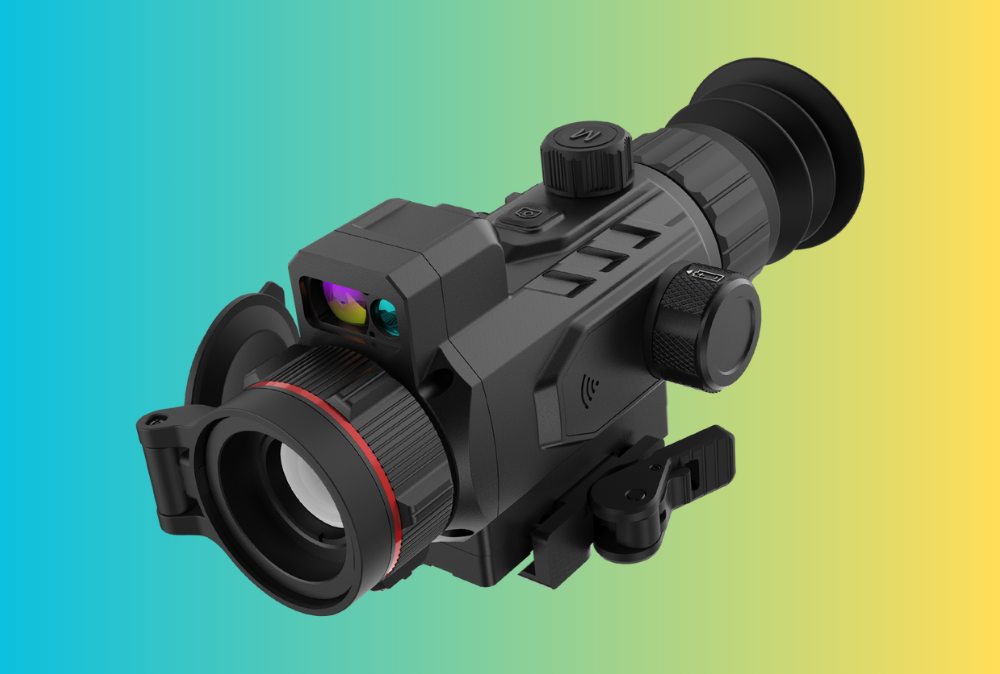
Do You Really Need a Thermal Scope with Rangefinder?
Many 2025 models advertise integrated LRFs and ballistic calculators. They’re impressive—but do you truly need a thermal scope with rangefinder?
When an integrated LRF makes sense
You’ll benefit most from built-in ranging if:
- You shoot in open country where distances are deceptive (e.g. western coyote or jackal hunting).
- Your shots often extend beyond 250–300 yards where trajectory drop matters.
- You hunt solo and don’t want to carry a separate rangefinder.
In these cases, a thermal + LRF combo or a scope built on a thermal + LRF fusion platform like those described on thermal LRF fusion pages can be a fantastic upgrade.
When a separate rangefinder is enough
If most of your shots are inside 200 yards, or you usually hunt from fixed stands at known distances, a compact handheld rangefinder will do just fine. Many hunters already own one for daytime use.
In B2B or OEM projects, scope designers sometimes use dedicated laser rangefinder modules to add ranging to existing thermal platforms. For individual hunters, the key is balance: don’t pay for an integrated LRF if you rarely shoot far enough to justify it.
Top-Rated Thermal Scopes: Matching Budget to Hunting Style
Instead of naming specific brands, it’s often more helpful to think in tiers. Here’s how the market typically breaks down in 2025.
Entry level – getting into the game
- Typical spec: 256×192 sensor, 19–25 mm lens, 1–4× base magnification
- Best for: short-range hog and predator hunting inside 120–150 yards, farm use, casual shooters
- Pros: lowest price, simple controls, light weight
- Cons: limited range, image degrades quickly at high digital zoom
If you hunt a few weekends per year and want a very cheap thermal scope that is still usable, this tier is fine—as long as you pick a reputable brand and accept its limits.
Mid-range – the real sweet spot
- Typical spec: 384×288 sensor, 35 mm lens, 2–3× base magnification, 50 Hz refresh
- Best for: mixed hog/coyote hunting, most AR-15 builds, landowners and outfitters
- Pros: enough performance for 200–300+ yard ID, better image in tough conditions, more features
- Cons: price roughly 2–3× entry level, still not as crisp at extreme zoom as 640 cores
For the majority of hunters in 2025, a well-built mid-range scope from the best budget thermal scope tier is the logical choice. It’s also where many modern thermal rifle scopes optimized for export markets sit.
Premium – professional-grade performance
- Typical spec: 640×512 sensor, 50 mm lens, advanced processing, often with LRF
- Best for: professional pest control, guides, serious night shooters, SAR and law enforcement
- Pros: exceptional detail at all ranges, strong ID performance at extended distances, better PIP
- Cons: high initial cost, more features than casual hunters really need
For some buyers, these scopes do represent the best thermal scope for hunting because they are tools of the trade. For others, they are aspirational gear that may only be justified if you hunt very frequently or share costs within a group.
Don’t forget alternative form factors
Depending on your situation, a thermal clip-on in front of your daytime scope or a dedicated handheld may actually be a smarter investment than a single high-end riflescope. Many OEM providers, such as those offering thermal clip-on sights and thermal monoculars, build families of products that share the same core technology but serve different roles.
For example:
- A mid-range riflescope on your main rifle
- A compact scanner in your pocket
- A clip-on that lets a second rifle join night duty when needed
Thinking in terms of a system rather than one “magic” optic often leads to better real-world results.
CTA – Work with a Trusted OEM Partner for Thermal Hunting Optics
Choosing the best thermal scope for hunting in 2025 is about more than scrolling spec sheets. It’s about matching resolution, lens, power system, and features to the way you actually hunt—and then buying from a partner you trust to support you for years.
Gemin Optics is a China-based manufacturer specializing in export-grade thermal technology. We develop OEM/ODM platforms for thermal rifle scopes and complementary products such as thermal monoculars, clip-ons and LRF fusion systems.
For hunting brands, distributors and outfitters, that means you can:
- Build your own line of thermal scopes on proven, calibrated cores
- Tailor optics, reticles and firmware to your regional markets
- Rely on stable supply, QC and long-term support instead of one-off batches
If you’re a B2B buyer looking to launch or upgrade a thermal product line—or a serious hunter who wants to work with a manufacturer that understands field realities—you’re welcome to reach out through our Contact page.
Tell us about your rifles, your terrain and your budget, and our engineering and product teams can help you translate that into the best thermal scope for hunting projects for 2025 and beyond.