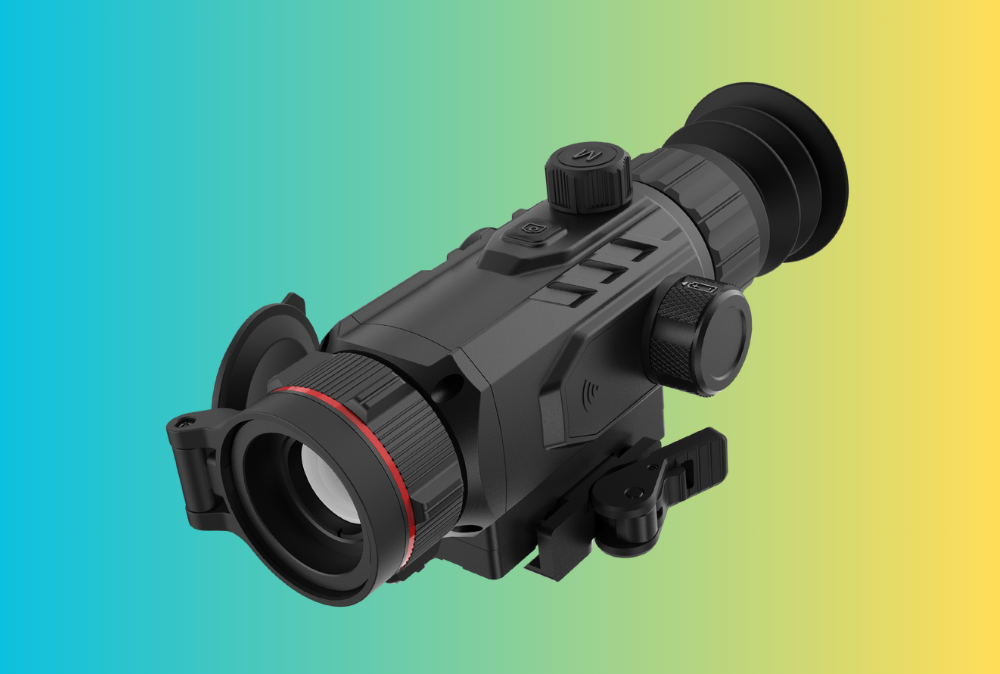
When hunters and shooters talk about “thermal scopes”, they usually mean one of two things: a dedicated rifle scope that lets you aim in total darkness, or a clip-on device that turns a normal optic into a night-time tool. In both cases, the goal is simple: see heat, not light, so you can detect and identify animals or threats regardless of moon, fog or background clutter.
Table of Contents
ToggleBehind that simple idea sits a lot of technology and quite a few confusing product options. Is an infrared scope for rifle the same as a thermal scope? How does a clip on thermal scope differ from a dedicated scope? What makes some models the best thermal scopes on the market, while others are merely good enough? And how do brands actually build and source these devices in the first place?
This in-depth guide answers those questions in a practical, engineer-friendly way. We will look at how thermal scopes work, how different form factors compare, what separates a best budget thermal scope from cheap gadgets, and how to match specifications to specific hunting scenarios such as AR-15 setups and coyote control.
1. Thermal scope rifle basics – how an infrared scope for rifle actually works
At its core, a thermal scope is simply a specialised imaging system bolted to a rifle. Instead of using visible light like a classic day optic, it relies on LWIR infrared imaging. Everything above absolute zero emits infrared radiation; a thermal scope collects that radiation and converts it into an electronic image.
Inside the housing you will find:
- a thermal camera module containing the microbolometer sensor, lens and image-processing electronics
- a display (often OLED or LCOS) that shows the processed thermal image to the shooter
- reticle generation and zeroing controls so you can aim precisely
- power management, buttons and sometimes recording and Wi-Fi functions
From the user’s point of view, you shoulder the rifle, look through the eyepiece and see a black-and-white or coloured image where warm objects—hogs, coyotes, humans, engine blocks—stand out against cooler backgrounds. The scope may highlight the hottest spots, provide digital zoom and show a ballistic reticle or subtensions.
Because the system senses heat instead of reflecting light, a thermal scope works equally well on a moonless night, in the early morning fog or against complex backgrounds where animals visually blend into crops or brush. That’s why serious night hunters increasingly consider a thermal hunting scope essential kit rather than a luxury.
2. Types of thermal scopes for rifles
When people say “thermal scopes”, they actually refer to a family of products with different roles and integration levels. Understanding that family helps you choose the right tool and helps OEM buyers plan a product portfolio instead of chasing single models.
2.1 Dedicated thermal hunting scopes
A dedicated thermal scope rifle replaces your traditional day optic. It has its own optical path, reticle and zeroing system, often with multiple profiles for different guns and loads.
Modern dedicated thermal hunting scopes usually share these traits:
- base magnification between 1× and 4×, depending on application
- 256×192, 384×288 or 640×512 uncooled microbolometer sensors
- 19–50 mm infrared lenses, tuned for specific field-of-view and range combinations
- internal video recording and sometimes Wi-Fi streaming
- multiple colour palettes plus picture-in-picture modes
From an OEM point of view, many of these scopes are built around common thermal rifle scopes platforms: the same imaging core and electronics are placed into different housings for hunting, law-enforcement or industrial roles.
2.2 Clip on thermal scope systems
A clip on thermal scope sits in front of an existing day optic. The shooter keeps their favourite daytime scope and uses the clip-on as a thermal “converter” attached via Picatinny rails or objective-bell adapters.
This approach has several advantages:
- you preserve the familiar eye relief, turrets and daytime zero of the underlying scope
- you can share one thermal unit between multiple rifles
- during the day, you remove the clip-on and run pure glass; at night, you attach the thermal front-end
Products in this category are sometimes marketed as the best thermal clip on solutions because they respect the investment many shooters already have in high-end day scopes. On the OEM side, brands often develop dedicated thermal clip-on sights using the same core technology as their rifle scopes but with different mechanics and alignment requirements.
2.3 Helmet- and rail-mounted scopes for flexible use
Some thermal scopes blur the line between rifle optic and handheld device. They may be designed to mount on a helmet, a chest rig or a short rail section and then be moved onto a rifle when needed.
These systems behave more like multi-role thermal hunting scopes: they can act as scanners, spotters or aiming devices. For brands, they are usually based on modular thermal imaging camera cores that emphasise compact form factor and flexible interfaces.
3. Key specifications that define the best thermal scopes
Once you understand the main categories, the next step is decoding specifications. Knowing what each metric means lets you decide whether you’re looking at the best thermal rifle scope for your needs or an over- or under-engineered option.
3.1 Sensor resolution and pixel pitch
Most modern scopes use uncooled microbolometer arrays. Common resolution classes are:
- 256×192 or 320×240 – entry level, suited to short-range work
- 384×288 – the current sweet spot for many hunting scopes
- 640×512 (and occasionally higher) – premium performance with better detail at distance
Pixel pitch—usually 12 μm or 17 μm—defines the angle each pixel covers for a given lens. A 12 μm sensor with a 35 mm lens offers similar angular resolution to a 17 μm sensor with a longer lens, but in a more compact package. This is why many 2024–2025 products highlight “12 μm” in marketing.
For shooters, the practical takeaway is: more pixels plus an appropriate lens equals more confidence when identifying game at distance. A “best thermal scope for coyote hunting” in open fields will almost always have a 384 or 640 sensor paired with a 35–50 mm lens; a budget hog gun inside 150 yards can manage with a good 256 sensor and a shorter lens.
3.2 Lens focal length, FOV and base magnification
The lens determines both how wide you can see and how far you can reach.
- Short lenses (e.g. 19–25 mm) offer wide field of view, ideal for thick woods, bait sites and fast shooting at closer ranges.
- Medium lenses (35 mm) balance FOV and range for mixed terrain and typical predator work.
- Long lenses (50 mm and up) narrow the FOV but extend detection and identification distances, fitting long-range coyote or fox hunting.
Base magnification is the “native” zoom level of the scope, before digital zoom. A base of 1–2× gives you flexibility in close cover, while 3–4× is better if most of your shots stretch beyond 200 yards. Digital zoom can help, but extreme zoom levels inevitably trade detail for magnification.
3.3 NETD, contrast and image processing
Noise Equivalent Temperature Difference (NETD) measures sensitivity: the smaller the NETD, the finer temperature differences the sensor can distinguish from noise. Values below 40 mK and especially below 30 mK generally indicate stronger performance in warm, humid or low-contrast conditions.
However, the raw sensor is only part of the story. The best thermal scopes rely on mature image pipelines:
- robust non-uniformity correction so the image stays flat over time
- carefully tuned automatic gain control so hot and cold objects share the scene gracefully
- smart filtering that reduces noise without smearing edges
If you are choosing between options, real hunting footage is more revealing than a single NETD figure on a datasheet.
3.4 Refresh rate, latency and eye comfort
A fast refresh rate (typically 50 Hz) keeps the image smooth when you sweep across a field or track a running hog. Lower rates (25 Hz or less) can look jumpy and may contribute to motion sickness for some shooters.
Latency is the delay between what’s happening in front of the lens and what you see on the display. For most hunting scenarios, a well-designed scope keeps this delay short enough that you don’t consciously notice it, but for rapid close-range shots or moving targets, lower latency does help.
Eye comfort matters on long nights. Look for:
- adjustable diopter for a crisp display
- brightness and contrast settings that work in different environments
- an eyecup that seals light but doesn’t force your head into an awkward angle
3.5 Power, controls and ergonomics
A thermal scope is only useful when it’s powered. Consider:
- battery type (proprietary packs vs 18650/21700 cells vs built-in battery)
- typical runtime at realistic settings, including Wi-Fi and recording if you use them
- whether packs are hot-swappable without losing zero or settings
Controls should be intuitive with gloves, ideally clustered so you can operate them by touch without leaving the firing position. A well-designed thermal hunting scope lets you change palettes, zoom and PIP modes without digging through nested menus.
4. Cheap thermal scope vs best budget thermal scope
Search engines are full of ads for “cheap thermal scope” deals, but not every low-priced optic is truly economical. It’s helpful to distinguish cheap from value.
4.1 What you give up with ultra-cheap thermal scopes
Very low-cost units often cut corners in areas that don’t show up in a simple spec list:
- inferior sealing and build quality, leading to fogging or failure after a few wet hunts
- inconsistent zero due to mechanical flex or poor recoil management
- laggy, confusing user interfaces
- weak or non-existent after-sales support and firmware updates
For a casual shooter who uses a thermal once or twice a season, this may seem acceptable—until a failure ruins the only weekend trip of the year. For guides, landowners and serious pest-control crews, such compromises quickly become unacceptable.
4.2 What defines the best budget thermal scope
A best budget thermal scope balances price with reliability and long-term usability. It may not have the highest resolution or longest range, but it should offer:
- honest, well-tuned imaging performance at typical hunting distances
- robust mechanics that hold zero on realistic calibres
- decent runtime with accessible batteries
- basic recording and PIP features that actually work in the field
- warranty and service from a brand that intends to be around for years
From a B2B perspective, brands that want to offer “good, better, best” product tiers often build their entry-level and mid-range models on the same family of thermal imaging modules, simplifying spare parts and service while giving consumers genuine choice instead of confusing model sprawl.
5. Thermal scope for AR15 platforms – what to pay attention to
AR-pattern rifles are arguably the most popular hosts for thermal optics today. Lightweight semi-auto rifles in .223, 6 mm ARC or 6.5 Grendel paired with a good thermal are ideal predator and hog tools. But not every scope fits an AR equally well.
5.1 Mount height, eye relief and cheek weld
Most AR shooters run optics at 1.5–1.93 inch mount heights. A thermal scope that sits much higher can force an unstable chin-weld; one that sits lower may foul charging handles or flip-up sights. When evaluating a thermal scope for AR15, check:
- whether the supplied mount gives a comfortable head position with your stock
- if you have room for backup irons, a magnifier or a clip-on IR illuminator if you also run night vision
- how easy it is to access charging handles and safety selectors with the scope mounted
Eye relief must also accommodate the more forward head position common on ARs, especially with collapsible stocks and different shooting stances.
5.2 Weight and balance
ARs often carry suppressors, lights and bipods. Hanging a very heavy thermal on top can turn a handy carbine into a clumsy club. When you compare thermal hunting scopes, consider not just the bare weight but the effect on overall balance.
Lightweight 256 or 384 scopes, or even compact clip-ons, sometimes make more sense on an AR that you carry all night on foot, while heavier 640 scopes may belong on static stands or tripods.
5.3 Control layout for dynamic shooting
Semi-auto platforms invite faster, more dynamic shooting than heavy bolt guns. Controls need to be reachable from a firing grip so you can tweak zoom or palettes between bursts without taking your eyes off the field.
Designers who build OEM thermal rifle scopes — OEM/ODM specifically for AR-use pay close attention to button placement, turret shapes and how easily you can manipulate them with either hand.
6. Best thermal scope for coyote hunting – what actually matters
Coyotes drive many purchases in the thermal market. They are smart, fast, and often hold up at 200–300+ yards to study a call or decoy. Picking the best thermal scope for coyote hunting therefore means focusing on specific capabilities.
6.1 Identification at realistic ranges
Coyotes can look a lot like farm dogs or foxes in poor conditions. For ethical and legal reasons, you must be able to tell them apart. That argues for:
- at least a 384×288 sensor, and preferably 640×512 for open country
- a 35–50 mm lens that provides enough magnification for positive ID at 250–300 yards
- good NETD and image processing so contrasts stay crisp when the ground and background are still warm
In other words, many coyote hunters find themselves shopping among mid- to high-tier thermal hunting scopes rather than the cheapest options.
6.2 Field of view and scanning strategy
Coyote stands involve a mix of scanning and shooting. An excessively narrow FOV can make it easy to lose incoming dogs, especially if they approach at angles you did not expect. A common compromise is to run the scope at base magnification with PIP zoom enabled, so you maintain awareness while still seeing a zoomed aim point.
Pairing the scope with a dedicated handheld scanner is another tactic: the scanner handles wide-area detection while the rifle scope stays on a smaller FOV optimised for taking the shot. Brands that offer both scopes and thermal monoculars built on the same core technology simplify training and user familiarity.
6.3 Durability and weather resistance
Coyote seasons can include rain, snow, dust, and sub-zero nights. The best thermal rifle scope for this work must shrug off impact, moisture and temperature swings. Look for stated IP ratings, recoil limits, and real-world track records rather than assuming every unit is equally robust.
7. Thermal scope with rangefinder – when integrated ranging pays off
The idea of a thermal scope with rangefinder is attractive: one device that handles detection, identification, ranging and even ballistic calculation. In practice, whether you need it depends on how you hunt.
7.1 Situations where integrated LRF shines
Built-in rangefinding is particularly valuable when:
- you shoot in open terrain where distance estimates are unreliable
- your shots routinely stretch past 250–300 yards
- you hunt solo and prefer not to juggle a separate rangefinder in the dark
An integrated LRF allows you to range while still behind the rifle, and some systems use ballistic profiles to auto-adjust the reticle based on range and calibre.
From an engineering standpoint, such scopes are often built by combining a thermal core with compact laser rangefinder modules, then running fusion firmware to align the thermal image with the laser spot. Pages like Gemin Optics’ thermal + LRF fusion & ballistics guide explain how this works on the system level.
7.2 When a separate rangefinder is enough
If most of your shots are inside 150–200 yards, or you hunt known-distance fields and bait sites, a small handheld rangefinder is usually sufficient. It is cheaper, lighter and easier to replace on its own.
For many hunters, the ideal compromise is:
- mid-range dedicated thermal hunting scope without LRF
- inexpensive, compact rangefinder for the occasional long shot
OEM designers can reflect this reality by offering parallel product lines—one with LRF for advanced users and one without, using the same underlying thermal module platform.
8. Thermal hunting scopes vs clip on thermal scope vs handheld scanners
It is tempting to think of the market as a contest between form factors—people asking which is better, a dedicated scope or a clip on thermal scope. In reality, many successful hunters treat them as complementary tools.
8.1 Dedicated scopes as primary aiming devices
For rifles dedicated to night work, a direct-mount scope is often the cleanest solution. You get a purpose-built system with optimised eye relief, simple controls and fewer moving parts. Zeroing is straightforward, and you avoid stacking too many components on the rail.
8.2 Clip-on systems for flexibility
If you already own premium day glass, or you frequently swap between night and day roles on the same rifle, a clip-on makes sense. You keep your familiar zero and reticle, yet gain thermal capability when needed. Hunters who travel by air or share thermal gear within a group often regard well-designed clip-ons as the best thermal clip on option because they fit multiple rifles without re-zeroing each time.
8.3 Handheld scanners as force multipliers
Even the best scope can only look where the rifle is pointed. Many serious teams run dedicated scanners—compact monoculars or binoculars—alongside their thermal hunting scopes. One person scans widely, calls out approaching targets and then hands off specific animals to shooters whose scopes are already at suitable zoom levels.
From a product-strategy viewpoint, this is why many brands build families of devices rather than isolated products. Gemin Optics, for instance, supports OEM clients with modules and finished concepts for rifle scopes, monoculars and clip-ons so distributors can offer coherent packages instead of unrelated gadgets.
9. OEM/ODM perspective – designing and sourcing thermal scopes
Behind every commercial optic sits a supply chain of sensors, thermal camera modules, mechanics and firmware. For B2B buyers—brands, distributors and large dealers—it is critical to choose not only the right product specification but the right technology partner.
9.1 Building on proven thermal imaging modules
Most serious manufacturers base their scopes on dedicated thermal imaging modules. These modules integrate the microbolometer, lens and signal processing into a factory-calibrated block, simplifying integration into rifle-ready housings.
Working with a module supplier such as Gemin Optics lets OEMs:
- standardise on a small number of sensor resolutions and FOV options
- share firmware and control protocols across rifle scopes, monoculars and clip-ons
- scale production without constantly redesigning the imaging core
This approach reduces engineering risk and creates a clear upgrade path when next-generation sensors arrive.
9.2 Mechanical and environmental engineering
For a thermal scope, enclosure design is more than aesthetics. The body must:
- withstand recoil and impact without losing boresight
- protect the germanium objective lens from rain, dust and scratches
- manage internal heat so electronics remain within their operating range
OEM partners look for module vendors who can advise on proper mounting, shock isolation and environmental sealing, not just ship a core and leave integrators to guess.
9.3 Quality control, testing and lifecycle support
Choosing a production partner is as much about QC processes as it is about raw specs. Serious brands want to know:
- how each module and finished scope is calibrated and tested
- what environmental and recoil tests are performed at the factory
- how long a given sensor family will remain available, and what migration path exists to its successor
Companies like Gemin Optics highlight this on their Why Choose Us and quality pages, because long-term relationships with distributors and white-label brands depend on predictable quality and lifecycle management.
10. FAQ: common questions about thermal scopes
Are thermal scopes and night-vision scopes the same thing?
No. Night-vision amplifies existing light (starlight, moon, IR illuminators) in the visible or near-infrared band. Thermal scopes sense emitted heat in the long-wave infrared region. Thermal works in complete darkness and through many obscurants; night-vision preserves more visual detail and is sometimes more comfortable for extended observation.
Can a thermal scope damage my daytime optic if used as a clip-on?
A properly designed clip-on should not. It sits in front of the day scope and passes collimated thermal imagery through, so the underlying optic sees what looks like a normal collimated scene. Problems arise only if the clip-on is misaligned, poorly mounted or of low optical quality, which can introduce parallax or blur.
What calibres can thermal scopes handle?
Most quality hunting scopes are rated at least to .308 Winchester / 7.62×51 levels of recoil; many handle larger calibres used on hogs or predators. Always check the manufacturer’s recoil rating and be cautious with ultra-light rifles or magnum loads.
Do thermal scopes require regular calibration by the user?
Scopes perform quick internal calibrations (NUC) using shutters or electronic methods; some do this automatically, others let the user trigger it manually when image quality drifts. You do not normally need to send the scope back for recalibration unless it suffers major shock or shows clear defects.
Can I record video with any thermal scope?
Not all, but many modern thermal hunting scopes support on-board recording and still images. Others stream via Wi-Fi or HDMI to an external recorder. If you plan to create content or review shots for training, confirm recording options before purchase.
Are thermal scopes legal for hunting everywhere?
Regulations vary widely by country and even by state or province. Some jurisdictions restrict night hunting, others restrict artificial light but allow thermal, and some treat thermal as regular optics. Always check local rules before investing heavily.
How long do thermal scopes typically last?
With careful handling, many scopes remain usable for a decade or more. The microbolometer itself has no moving parts in an uncooled system; the main aging mechanisms involve electronics, display burn-in, lens coatings and physical wear. Buying from a reputable brand with spare-parts support increases the chances that your optic will remain serviceable.
11. Work with a China partner for OEM thermal scopes you can trust
To the end user, thermal scopes are tools that either help them see and shoot better in the dark or get in the way at the worst moment. To brands and integrators, they are systems built from sensors, modules, mechanics, firmware and support networks. In both cases, success depends on solid engineering and reliable partners, not just impressive marketing phrases like “best thermal scopes” or “infrared scope for rifle”.
Gemin Optics focuses on that engineering foundation. By providing robust thermal imaging modules, dedicated thermal rifle scopes, thermal clip-on sights and integrated rangefinding solutions, the company helps OEM and ODM customers launch competitive thermal hunting scopes across price tiers—from entry-level best budget thermal scope concepts to flagship scopes with LRF and advanced ballistics.
If you are planning your own thermal product line or looking for a private-label supplier that understands both hunting realities and international compliance, you can reach the engineering and sales team through the Contact page. Together you can map out the right mix of thermal scope rifle platforms, clip-ons and supporting devices so that your customers get exactly what they need: reliable, field-proven thermal scopes that make the dark feel as easy to read as daylight.