For many night hunters, the Thermal Hunting Scope has gone from luxury gadget to essential gear. It lets you see animals as bright heat signatures against cooler backgrounds, whether you are calling coyotes on a moonless night or stalking hogs in thick brush.
Table of Contents
ToggleBut what exactly is a thermal hunting scope? How does it differ from traditional night-vision, a handheld thermal, or a clip on thermal scope? And what makes some models the best thermal rifle scope choices while others belong only in the “toy” category?
This guide takes a practical, engineering-minded look at how thermal scopes work, how they are built, and how hunters and OEM buyers can choose the right configuration for their needs.
1. Thermal hunting scope vs ordinary rifle scope
A conventional scope simply magnifies visible light. It works great in daytime but quickly becomes useless once light levels drop. You can add an IR illuminator and rely on image intensifier tubes or digital night-vision, but those still depend on reflected light.
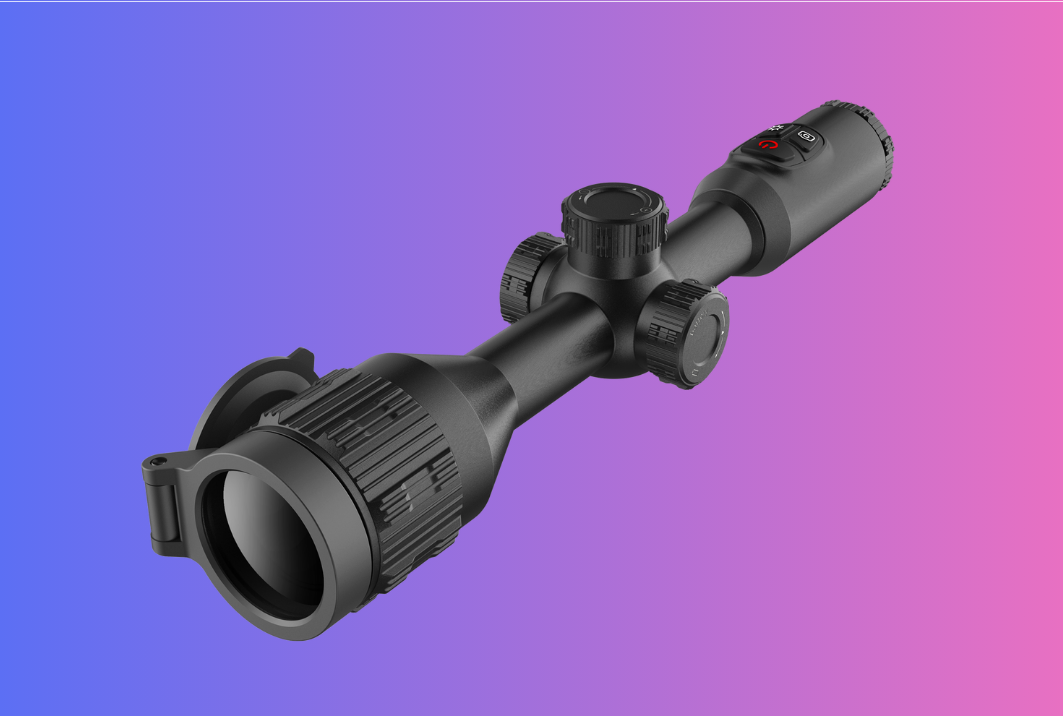
A Thermal Hunting Scope is different. It is effectively a tiny thermal camera bolted to your rifle, designed to work as an aiming device. Instead of collecting reflected light, it captures the long-wave infrared radiation emitted by warm objects—animals, people, engine blocks, even recently driven vehicles.
From the shooter’s perspective, that means:
- You see animals as clear heat signatures even in complete darkness.
- Backlighting, glare and camouflage patterns matter less, because the scope is reading temperature, not colour.
- You can spot and track animals hidden in tall grass, brush or crop stubble where traditional optics struggle.
That combination of detection and identification is why serious hunters now put thermal at the top of their wish lists when shopping for best thermal scopes.
2. How a Thermal Hunting Scope actually works
Inside the housing, a thermal scope is a specialised imaging system built around an uncooled microbolometer. Understanding the signal chain makes the whole device much less mysterious.
2.1 From heat to electrical signal
Every object above absolute zero emits infrared radiation. The detector array at the heart of the scope—sometimes called a thermal camera module or thermal imaging core—uses thousands of microscopic sensing elements to absorb that radiation.
Each detector element changes its electrical resistance in response to temperature. Readout electronics measure these tiny changes many times per second and convert them into digital values. At this point, you have a raw thermal image: effectively a 2D temperature map.
2.2 Image processing and display
The digital data then passes through a signal-processing pipeline:
- Non-uniformity correction removes fixed pattern noise between pixels.
- Automatic gain control adjusts contrast so both hot and cold objects are visible.
- Filters reduce random noise while preserving edges and fine detail.
- A colour palette maps temperature values to shades (white-hot, black-hot, red-hot, etc.).
Finally, the processed image is sent to a miniature OLED or LCOS display in the eyepiece. The scope overlays a digital reticle and any other information (battery level, zoom, range, profiles) on top of the thermal scene.
To the shooter, it looks simple: you see hogs glowing against a cooler field, align the reticle, squeeze, and the rifle does the rest. Behind the scenes, thousands of pixels and several processors are working together to make that happen.
3. Anatomy of a modern Thermal Hunting Scope
Every manufacturer has its own design language, but most thermal hunting scopes share the same core components.
3.1 Thermal imaging core
The core is the self-contained thermal imaging camera module that handles detection and image processing. It combines:
- the uncooled microbolometer sensor (commonly 256×192, 384×288 or 640×512)
- an infrared lens made from germanium or chalcogenide glass
- electronics and firmware that produce a digital video stream
Many brands source their cores from OEM specialists and then design custom housings and firmware on top. Platforms like Gemin Optics’ thermal camera module families are typical examples used in scopes, monoculars and clip-ons.
3.2 Optical train and eyepiece
Behind the core sits the display and eyepiece assembly. The shooter looks through this optical path much like a regular scope, but instead of seeing the real world directly they see the screen that shows the processed thermal image and reticle.
The eyepiece includes:
- diopter adjustment so different users can get a crisp view
- protective glass and seals
- sometimes a manually adjustable focus ring for the display itself
3.3 Controls, power and mount
Buttons, dials or joystick controls let you adjust magnification, palette, brightness, PIP (picture-in-picture) and recording. Power comes from internal batteries or removable packs (often 18650/21700 cells or proprietary modules).
Mounting is usually via Picatinny/Weaver rails. Some scopes use integrated one-piece mounts; others rely on separate rings. For an infrared scope for rifle use, recoil-proof mounting and repeatable zero are crucial.
4. Dedicated thermal hunting scopes vs clip on thermal scope systems
Thermal optics for rifles fall into two broad categories. Each has a clear role, and many hunters use both.
4.1 Dedicated Thermal Hunting Scope
A dedicated thermal scope replaces your day optic. It has its own reticle, zeroing turrets, magnification range and on-board controls.
Advantages:
- Optimised eye relief, FOV and controls purely for thermal use
- Clean, simple mounting with fewer adapters
- Multiple zero profiles for different rifles or loads
- Often the best choice for hardcore night-only rifles
Hunters looking for the best thermal rifle scope typically focus on these dedicated models. They form the backbone of most professional pest-control and serious predator setups.
4.2 Clip-on thermal scopes
A clip on thermal scope is designed to live in front of an existing day scope. The shooter looks through their normal glass; the clip-on turns the incoming scene into thermal imagery but maintains the day scope’s zero and reticle.
Advantages:
- You keep your familiar daytime scope and its optical quality.
- One clip-on can serve multiple rifles; you move it between hosts as needed.
- During the day you simply remove it and run pure glass; no rezeroing required.
Well-designed clip-ons—often marketed as the best thermal clip on options—are especially popular with hunters who travel or who own several already-optimised rifles. From a product-development angle, brands often base them on the same cores used in their thermal clip-on sights and monoculars.
5. Step-by-step: how a Thermal Hunting Scope works in the field
Understanding the workflow makes it easier to appreciate why certain specifications matter.
- Detection – As you scan a field, the scope’s lens gathers long-wave infrared radiation from everything in view. Warm targets emit more radiation than the background, so they register as brighter (or darker, depending on palette) spots.
- Recognition – With enough resolution and contrast, you can tell whether that heat blob is a hog, a cow, a coyote or a human. This is where sensor quality, lens choice and image processing define whether a scope truly belongs among the best thermal scopes.
- Identification and decision – You watch behaviour, movement and relative size to make an ethical decision about taking the shot. Fine detail—ears, tails, posture—is easier to see on high-resolution sensors at suitable base magnification.
- Aiming – Once you commit, you stabilise the rifle, align the digital reticle and control your trigger just as with any scope. If your Thermal Hunting Scope is properly zeroed and recoil-rated, point of impact should be consistent.
- Follow-up and review – Many scopes record video or stills. After the shot you can review the footage, learn from hits and misses, and document your hunts.
Even though it feels almost like cheating compared with old-school red lights and moonlit nights, the technology still relies on careful setup and zeroing.
6. Key specs to evaluate when choosing a Thermal Hunting Scope
Shopping by brand name or marketing phrase alone is a recipe for disappointment. It is better to consider how each specification maps to your real hunting needs.
6.1 Resolution and lens: the range equation
A 256×192 scope with a 19 mm lens will detect warm objects far away, but you might not feel comfortable identifying game beyond 100–150 yards. A 640×512 scope with a 50 mm lens, on the other hand, can give you the confidence to shoot much farther—critical if you’re after the best thermal scope for coyote hunting in open country.
Ask yourself:
- What are my typical shot distances?
- Am I often trying to ID animals at the edge of fields or just confirming at closer ranges?
Match resolution and optics to that reality instead of chasing headline numbers.
6.2 Base magnification vs field of view
The base (optical) magnification is where the scope performs best. Digital zoom is useful but always trades resolution for magnification.
- For tight brush and bait sites, a base magnification of 1–2× keeps FOV wide and shots fast.
- For mixed terrain, 2–3× is a solid all-round choice.
- For long-range coyotes, 3–4× helps you see more detail at the cost of some FOV.
Many of the best thermal scopes also offer picture-in-picture modes so you can keep the main view wide while a small window shows a zoomed aiming area.
6.3 NETD and image contrast
NETD values below 40 mK (and especially below 30 mK) indicate better sensitivity to subtle temperature differences. That translates into clearer images in warm, humid or foggy weather.
However, don’t fixate on NETD alone. The overall look of the image—edge sharpness, dynamic range, how well the scope handles very hot and very cold objects in the same scene—depends heavily on firmware tuning.
6.4 Refresh rate and latency
A smooth refresh rate (typically 50 Hz) makes tracking running hogs or circling coyotes much easier. Lower frame rates can feel choppy and introduce motion lag.
Latency is critical but rarely specified. In a well-designed Thermal Hunting Scope, total lag from scene to display is low enough that you can swing naturally and still break the shot at the right moment. Very slow systems can cause you to “chase” the image, particularly at high magnification.
6.5 Battery life and practicality
Realistic runtime is more important than theoretical maximums. When comparing options, consider:
- Can you complete your typical hunt on a single charge?
- Are batteries removable or internal only?
- Can you carry a spare pack in a pocket and swap it quickly in the field?
A truly best budget thermal scope combines reasonable runtime with readily available batteries, not just impressive numbers on a cold test bench.
7. Thermal Hunting Scope on an AR-15
The AR-15 platform is almost tailor-made for thermal optics. Lightweight semi-auto rifles chambered in .223 or 6 mm calibres make efficient predator and hog tools. Still, there are AR-specific issues to keep in mind when selecting a thermal scope for ar15 rifles.
7.1 Mounting height and ergonomics
Because of the AR’s straight-line stock and rail height, most shooters prefer mounts around 1.5–1.93 inches above the rail. A thermal that sits much higher can make cheek weld inconsistent; one that sits too low may interfere with charging handles or backup sights.
When evaluating a scope, check photos of it mounted on ARs, not just bolt guns. Controls should be reachable with the support hand while maintaining firing grip, and the eye box should still be comfortable in seated, kneeling and standing positions.
7.2 Weight and balance
ARs are often accessorised with suppressors, bipods and lights. Adding a very heavy thermal can shift the balance far forward. If you hike long distances, a lighter mid-range scope or compact clip on thermal scope in front of a slim day optic can be more practical than a massive all-in-one unit.
7.3 Recoil and reliability
Although AR-15 calibres are not punishing, thermal scopes still need to withstand repeated recoil and rough handling. Look for declared recoil ratings and proven track records in the field. A good infrared scope for rifle use should be rated at least for .308-class recoil to handle a wider variety of hosts.
8. Thermal Hunting Scope with rangefinder – convenience vs complexity
Many new models advertise built-in rangefinding and even ballistic calculators. A thermal scope with rangefinder promises to detect, identify, range and help you hold over—all from a single unit.
8.1 When integrated ranging is worth it
Integrated LRF is particularly helpful when:
- You routinely shoot beyond 250–300 yards.
- Terrain makes distance estimation difficult (rolling hills, featureless crop fields).
- You prefer to keep both hands on the rifle instead of carrying a separate rangefinder.
For OEMs, this kind of scope often combines a thermal core with a compact laser rangefinder module. Fusion firmware aligns the thermal and laser axes so that the displayed range matches the point of aim, as described in integration guides like Gemin Optics’ thermal + LRF fusion & ballistics content.
8.2 When a separate rangefinder is simpler
If most of your shots are within 150–200 yards and you hunt in more confined spaces, the extra cost and menu complexity of an integrated LRF may not pay off. A separate pocket rangefinder remains a light, inexpensive solution that you can use with multiple rifles and optics.
9. Matching Thermal Hunting Scopes to different hunting styles
There is no single “perfect” scope that fits every hunter. Instead, think about a few archetypes and where they sit on the price–performance curve.
9.1 Close-range hog hunter
You hunt over feeders, in dense brush or around crops, often inside 120 yards. Your priorities: fast acquisition, wide FOV, good battery life and ruggedness.
- Sensor: 256×192 or 384×288
- Lens: 19–25 mm
- Base magnification: 1–2×
In this zone, a solid best budget thermal scope from a proven manufacturer often beats an ultra-expensive flagship whose long-range capabilities you will never exploit.
9.2 Mixed-terrain predator and hog hunter
You alternate between tight cover and open pastures, with many shots between 100 and 250 yards.
- Sensor: 384×288 or 640×512
- Lens: 25–35 mm
- Base magnification: 2–3×
You may consider both dedicated thermal hunting scope models and flexible best thermal clip on systems, depending on how many rifles you run.
9.3 Long-range coyote specialist
Your stands are set up overlooking big fields, prairie or desert. You regularly take shots at 250–350+ yards.
- Sensor: 640×512 strongly preferred
- Lens: 35–50 mm
- Base magnification: 3–4×
- Extra: integrated rangefinder or reliable external rangefinder
In this world, higher-end optics earn their keep. This is where the market’s true best thermal rifle scope contenders live, and where you see the biggest gap between good and mediocre scopes.
10. OEM/ODM perspective – building Thermal Hunting Scopes as a product line
For brands and distributors, understanding the underlying technology helps position themselves beyond simple reselling. Instead of ordering a random catalogue model, they can design a coherent line of thermal hunting scopes that share cores, accessories and service procedures.
10.1 Building on common modules
By basing all models on a small family of thermal imaging modules—for example, 256/384/640 cores with a few lens options—OEM partners:
- simplify spare-parts logistics and after-sales service
- reduce development risk by reusing proven electronics and firmware
- offer a clear upgrade path from entry-level to professional scopes
Companies like Gemin Optics supply those modules and also complete thermal rifle scopes and monocular platforms that OEM customers can brand, customise and bundle.
10.2 Balancing “best thermal scopes” marketing with honest engineering
End users increasingly see through exaggerated marketing claims. Brands that communicate realistic detection and identification ranges, explain sensor classes clearly, and position models honestly as best budget thermal scope vs flagship options tend to build stronger loyalty.
A transparent technical foundation—combined with solid manufacturing, QC and support—turns “thermal scope” from a buzzword into a dependable category in a company’s portfolio.
11. Final thoughts – making Thermal Hunting Scope technology work for you
At first glance, a Thermal Hunting Scope can look like magic: crisp silhouettes glowing in the dark, animals revealed in tall crops, and heat trails visible long after a target has moved. In reality, it is a sophisticated but understandable combination of LWIR physics, microbolometer sensors, signal processing and rifle-scope design.
Whether you are an individual hunter comparing thermal hunting scopes, a dealer advising customers, or an OEM building your own line of optics, the right questions are always the same:
- What distances do we truly need to shoot, and in what terrain?
- How much resolution, lens and battery life are enough for that job?
- Do we need flexibility from a clip on thermal scope, or the simplicity of a dedicated optic?
- Where does it make sense to pay for extras like integrated rangefinding, and where is a simpler infrared scope for rifle use enough?
Answer those honestly, and you can choose or design thermal optics that genuinely fit your hunting reality instead of chasing specs for their own sake.
For brands and integrators seeking a China-based technology partner in this space, Gemin Optics offers modules, rifle scopes, clip-ons and fusion solutions tailored to hunting markets worldwide. Through engineering-driven cooperation rather than just catalogue sales, it becomes possible to deliver Thermal Hunting Scope products that make the dark understandable and the shot ethical, season after season.