When you move from paved highways to mines, construction sites or forest tracks, “normal” vehicle vision fails fast. Headlights bounce off dust clouds, work lights blind the driver, and cameras that looked great in the showroom turn into noisy grey smears at night.
Table of Contents
ToggleThat is why more OEMs are integrating thermal camera modules into off-road and special vehicles: wheel loaders, mining trucks, fire engines, airport tugs, snow plows, off-road SUVs and UGVs. A well-designed thermal system gives drivers a clear, stable view of people, animals, obstacles and hot-running equipment in all lighting conditions.
This article walks through the design basics for these systems from an OEM/ODM perspective: lens selection, camera placement, latency, shock and protection levels. The focus is practical B2B engineering, based on experience with integrating thermal camera modules into harsh-duty vehicles and industrial environments.
1. Where thermal imaging really helps drivers
Before choosing modules and lenses, it helps to define exactly what problems you want to solve for each vehicle type. Off-road and special vehicles share some common challenges but also have unique scenarios.
1.1 Construction and earth-moving equipment
Wheel loaders, excavators and bulldozers work in dusty, uneven sites, often at night. Large buckets and booms create huge blind spots close to the machine.
Thermal imaging helps by:
- highlighting people and other machines hidden in dust or shadows;
- seeing pedestrians behind piles of material or around tight corners;
- checking for overheated hydraulic components or brake systems near the wheels.
1.2 Mining haul trucks and underground equipment
In open-pit mines, visibility changes quickly with weather and lighting. In underground mines, it is dark almost all the time and there may be smoke or diesel exhaust.
Thermal modules can:
- give drivers a reliable picture of ramps and intersections even in dust and fog;
- help detect parked vehicles, fallen rocks or animals on haul roads;
- monitor tyre and brake temperatures on long downhill runs.
1.3 Fire trucks and rescue vehicles
Fire and rescue teams must drive into smoke-filled, chaotic areas and then navigate on foot.
A good thermal camera system lets them:
- see through smoke and darkness while approaching a scene;
- check for people near the vehicle during manoeuvres;
- scan building facades, roofs or chemical tanks for hot spots before crews exit the truck.
1.4 Off-road and special-purpose vehicles
Agricultural machinery, military and border-patrol vehicles, airport snow removal trucks and expedition 4×4s all benefit from:
- improved night driving on unlit tracks;
- early detection of animals or obstacles beyond headlight range;
- safe manoeuvring around ground crews in adverse weather.
Across all these cases, the goal is the same: give the driver more information with less effort, not just more screens. That must guide your technical choices.
2. How thermal camera modules improve driver vision
Thermal imaging brings three specific advantages over visible cameras and simple IR night-vision systems.
2.1 Independence from ambient light
Because thermal cameras detect long-wave infrared energy emitted by objects, they work:
- in total darkness;
- against oncoming headlights;
- in back-lit scenes such as tunnels or tunnel exits;
- in mixed lighting where visible cameras constantly re-expose.
This gives a stable visual baseline for drivers and for any AI analytics you add later.
2.2 Strong contrast for people, animals and hot machinery
Humans and animals stand out clearly from the background, even if they wear dark clothing or stand in shadows. Likewise, hot tyres, brakes, engines, bearings and electrical cabinets show up as bright regions.
This contrast:
- supports quick manual recognition by drivers;
- simplifies machine-vision tasks such as person detection or hot-spot alarms;
- works across many environments with minimal tuning.
2.3 Complementing visible, radar and LiDAR sensors
Thermal imaging does not replace other sensors; it fills gaps:
- where dust or fog reduce visible camera contrast;
- where glass, water or shiny metal disturb LiDAR;
- where radar misses small or warm targets close to the vehicle.
For OEMs designing complete perception stacks, a robust, low-latency thermal module becomes one of the core building blocks alongside LiDAR, radar and visible cameras.
3. Choosing the right thermal camera module for off-road vehicles
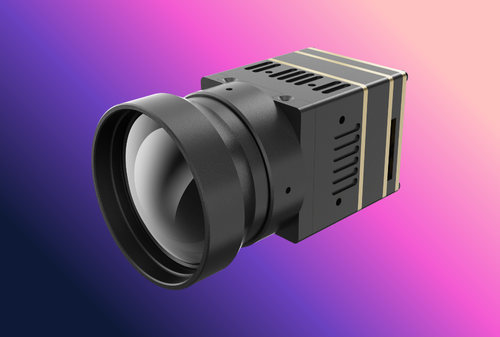
For driver vision, most OEMs integrate a compact OEM core rather than a finished camera. That allows them to design their own housings, connectors and mounting brackets while relying on a proven thermal engine.
When you select a module, four aspects matter most: resolution, frame rate, sensitivity and interfaces.
3.1 Resolution and pixel pitch
Common resolutions for automotive-style driver aids are:
- 256 × 192 – minimal pixel count, suited to slow vehicles or very wide FOV;
- 384 × 288 – good compromise for many off-road applications;
- 640 × 512 – higher detail and better long-range performance.
Smaller pixel pitches (e.g., 12 µm vs 17 µm) allow more resolution in the same lens size but also influence lens choice and depth of field. For front-facing driver vision at typical speeds, 384 × 288 or 640 × 512 modules give a comfortable balance between detail and cost.
3.2 Frame rate and latency
For real-time driving, 25–30 Hz frame rates with low pipeline latency are desirable. Below ~15 Hz, motion becomes jerky and drivers may subconsciously ignore the image.
Check not only the sensor frame rate but also:
- internal image-processing delays (AGC, NUC, enhancement);
- encoding delays if using compressed streams;
- transport latency over Ethernet or GMSL;
- display refresh and any overlays.
A well-designed module should support raw or Y16 output with minimal delay for safety-critical views, and optionally compressed streams for recording.
3.3 Sensitivity (NETD) and dynamic range
For driver vision, you want enough sensitivity to see pedestrians against backgrounds that may be warm themselves (roads, buildings, machines). NETD values of ≤40–50 mK are generally sufficient, provided the AGC is tuned for outdoor scenes.
Dynamic range also matters: a single scene may contain hot exhaust pipes and cool sky. Good modules offer configurable AGC modes and regions of interest so integrators can optimise for driver visibility instead of purely scientific measurement.
3.4 Interfaces and integration
Off-road vehicles increasingly use embedded automotive computers and IP-based networks. For thermal modules, typical interfaces include:
- Ethernet (with PoE or separate power) for flexible routing;
- GMSL / FPD-Link for long, noise-resistant connections directly to ECUs;
- MIPI for short-distance links on compact systems.
For projects that combine fixed thermal cameras and moving vehicles, some OEMs also reuse cores from their industrial online thermal imaging systems to get consistent behaviour and software across platforms.
A module intended for OEM use should provide a clear SDK or API, allowing you to:
- configure palettes, AGC, gamma and temperature ranges;
- read sensor temperature, status and diagnostics;
- update firmware over the vehicle network.
4. Lens selection and field-of-view planning
Lens choice is where driver-vision projects often succeed or fail. A lens that looks impressive in a static demo can be frustrating in real driving because it either sees too little or shows everything too small.
4.1 Balancing FOV, focal length and detection distance
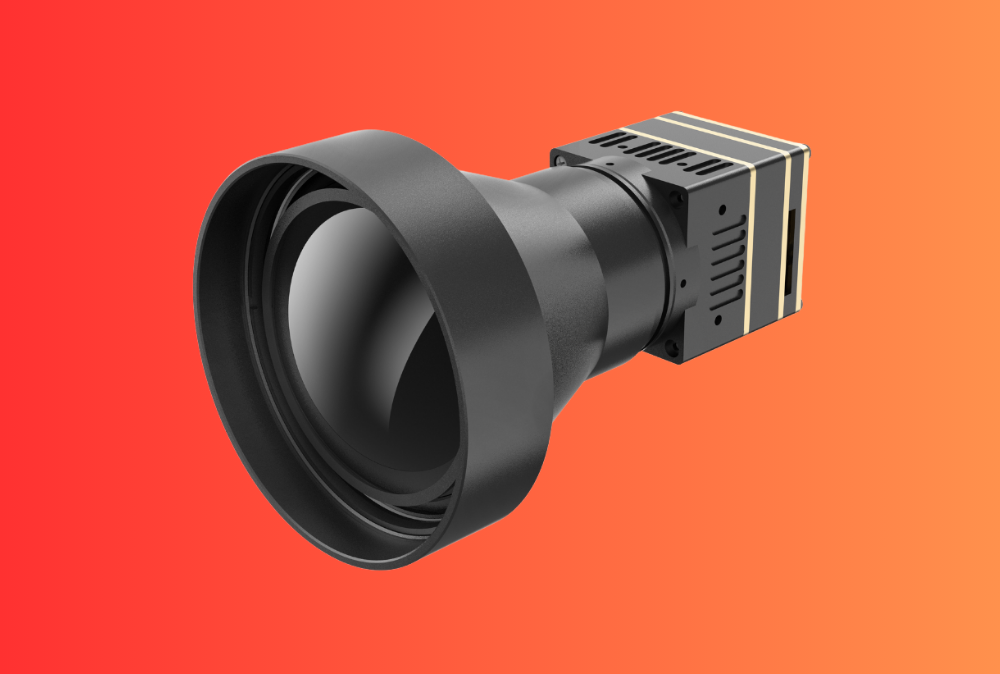
For a given sensor size, focal length determines FOV. Longer focal lengths mean narrower FOV and more detail at long distance; shorter focal lengths mean a wide but less detailed view.
The simplified table below illustrates typical horizontal FOVs for a 12 µm 384 × 288 sensor and their practical use on off-road vehicles:
| Focal length | Approx. H-FOV | Typical use on off-road vehicles |
|---|---|---|
| 7.5 mm | ~50–55° | General forward view at low speeds, side-view for blind spots |
| 13 mm | ~30° | Forward driver vision at moderate speeds, long-nose vehicles |
| 19 mm | ~20° | Long-range detection on haul trucks or high-speed off-road driving |
In practice, many OEMs combine one medium FOV front camera (for example, 30–40°) with complementary cameras for side or rear coverage.
4.2 Vertical FOV and mounting height
Vertical FOV is often neglected. If it is too small and the camera is mounted low, you may see mostly road and vehicle bodywork; if it is too large, distant objects occupy few pixels.
Mounting the thermal module higher on the cab or mast and tilting it slightly downward usually offers the best balance, allowing the upper third of the image to show the horizon and the rest to cover the driving corridor.
4.3 Single-camera vs multi-camera layouts
For small vehicles, a single front-facing thermal view may be enough. Larger platforms—cranes, mining trucks, fire engines—often need multiple modules:
- a front-facing camera for driving;
- a rear camera for reversing;
- side-mounted cameras for ladder access or blind-spot monitoring.
Using the same thermal camera module family with different lenses and housings simplifies qualification and maintenance across these views.
5. Camera placement and mounting strategies
Even the best module cannot compensate for a poor mounting position. When you plan camera placement on off-road and special vehicles, consider:
5.1 Protecting the field of view
Avoid positions where:
- buckets, booms or attachments regularly cross the view;
- wipers, mirrors or handrails create persistent occlusions;
- work lights shine directly into the lens and cause reflections.
On construction machines, a common pattern is to mount the camera on the cab roof, just ahead of the operator, with a small hood to protect against glare and rain. On mine trucks, cameras are often placed on the front corners and rear bumper to cover critical blind zones.
5.2 Vibration and mechanical robustness
Off-road vehicles produce continuous vibration and occasional shocks. To keep the image stable:
- use robust mounting brackets with stiff, short arms;
- avoid thin sheet-metal plates that can resonate;
- consider isolation bushings if vibration levels are extreme.
The camera housing and module should be rated for relevant vibration standards (for example, profiles aligned with construction or mining equipment testing). This is where modules derived from rugged industrial thermal cameras have an advantage over consumer night-vision devices.
5.3 Cleaning and maintenance
Mud, dust, salt and insects inevitably foul camera windows. Design for:
- easy manual cleaning from ground level;
- protective hoods that reduce direct splashes;
- optional air-knife or washer systems on very dirty applications.
The choice of window material and coatings—hard-coated germanium or chalcogenide glass—should balance optical performance with scratch resistance and cleanability.
6. Environmental protection, IP rating and corrosion resistance
Off-road and special vehicles face harsher environmental conditions than passenger cars. Thermal camera modules must be housed accordingly.
Key parameters include:
- Ingress protection (IP). IP66/IP67 is common for external mounting, resisting dust and high-pressure water jets. For fire trucks and marine platforms, IP68/69K may be considered.
- Operating temperature range. –30 to +60 °C or better is advisable in many markets, especially for snow, desert or tropical use.
- Salt fog and chemical resistance. Coastal vehicles and airport equipment may be exposed to de-icing chemicals, salt spray and cleaning agents. Housing materials and coatings must be chosen accordingly.
Working with an OEM that has proven industrial and maritime cameras allows you to reuse housing designs that already meet these requirements, while integrating your chosen thermal module inside.
7. System architecture: from module to driver display
Once optics and mounting are defined, you must decide how to present information to the driver and to back-end systems.
7.1 Direct video to a dedicated display
The simplest architecture sends the thermal video stream directly to a dedicated in-cab monitor. This is common on retrofit systems and for applications where:
- thermal is mainly a manual aid;
- automatic braking is implemented via other sensors.
In this case, emphasis is on low latency and intuitive user interface: clear palettes, well-chosen contrast and simple overlays (for example, guidelines or vehicle outline).
7.2 Integration with central ECU and ADAS functions
For new vehicle platforms, thermal video often goes into a central ECU or ADAS computer before being rendered or used by driver-assist functions. This enables:
- detection of pedestrians, vehicles and animals using AI algorithms;
- fusion with radar or LiDAR;
- event recording for incident analysis;
- remote monitoring and tele-operation in some cases.
From a module-design standpoint, this means:
- consistent timestamps for sensor fusion;
- support for uncompressed or lightly compressed streams;
- APIs to adjust settings dynamically based on driving mode.
7.3 Recording and fleet analytics
Mining fleets, fire departments and rental companies increasingly want evidence and analytics:
- near-miss analysis;
- driver-training scenarios;
- maintenance optimisation based on hot-spot detection logs.
Modules that can output both video and radiometric data provide more options here. Instead of recording only a pretty picture, you can reconstruct actual temperature values for tyres, brakes or equipment surfaces.
8. Safety, standards and driver acceptance
Adding a thermal view can improve safety—but only if drivers actually use it and understand its limits.
8.1 Human factors
Best practices include:
- placing the thermal view in the primary field of view, not far to the side;
- using palettes that match intuition (for example, white-hot or red-hot for people and obstacles);
- avoiding constant mode-switching; the image should be predictable;
- providing basic training on what thermal can and cannot see (for example, glass and shiny surfaces).
8.2 Functional safety and standards
If thermal-based detection triggers automatic braking or speed limitation, it becomes part of the vehicle’s functional safety concept. This may involve standards such as ISO 26262 (automotive) or IEC 61508 (general functional safety), depending on the category of machine.
Thermal modules intended for such roles should provide:
- clear diagnostic information and error reporting;
- predictable failure modes (for example, defined behaviour on over-temperature or sensor fault);
- configuration options that support safe state transitions.
Even if the module itself is not safety-certified, a well-documented behaviour model helps OEMs design safety-rated systems around it.
9. Working with a China OEM/ODM partner on driver-vision thermal systems
Designing driver-vision systems for off-road and special vehicles is not just about buying a camera. It requires co-engineering across optics, mechanics, electronics, software and testing.
As a China-based manufacturer, Gemin Optics supports B2B partners by offering:
- configurable thermal camera modules with multiple resolutions, lenses and interface options;
- experience from industrial and online thermal monitoring projects that face similar environmental challenges;
- OEM/ODM development of vehicle-grade housings and mounting brackets tuned for vibration, ingress protection and cleaning;
- long-term module lifecycle planning, including new sensor generations and lens updates.
By treating the thermal core as a building block rather than a sealed gadget, we help OEMs and system integrators create complete driver-vision solutions that match their brand, safety goals and cost structure.
10. FAQ: Thermal Camera Modules for Off-Road and Special Vehicles
Q1. What resolution is recommended for driver-vision thermal cameras on heavy equipment?
For low-speed construction machines in confined areas, 384 × 288 is usually enough. For higher-speed driving, long-range detection or recording for evidence, 640 × 512 modules provide more detail and flexibility.
Q2. Can one thermal camera cover both driving and reversing on large vehicles?
Technically, a wide-angle front-mounted camera could see a lot, but in practice blind spots and occlusions make this risky. Most heavy vehicles use at least one front and one rear module, sometimes side cameras as well.
Q3. How do thermal cameras handle dust, rain and fog?
LWIR imaging is less sensitive to visible-light scattering, so thermal cameras often see better than RGB cameras in dust, light rain and some fog. However, heavy rain or very dense smoke still reduce contrast, so thermal should be part of a multi-sensor strategy, not the sole safety layer.
Q4. Do we need radiometric (temperature-measuring) modules for driver vision?
For pure collision avoidance, non-radiometric modules are often sufficient. If you also want hot-spot monitoring—for tyres, brakes or equipment—radiometric modules that provide temperature data or calibrated ROIs become valuable.
Q5. How much latency is acceptable for thermal driver-vision systems?
As a rule of thumb, aim for an end-to-end delay below 150 ms for slow machines and even lower for faster vehicles. Above ~200 ms, drivers may feel that the video lags behind reality, especially when maneuvering in tight spaces.
Q6. Can thermal imaging be integrated with AI analytics on the vehicle?
Yes. Many OEMs now feed 16-bit thermal streams into convolutional networks for person, vehicle and animal detection. The key is having a module that outputs consistent, properly timestamped data and gives you control over AGC and palettes so the AI sees stable input.
Q7. How long do thermal camera modules typically last on heavy vehicles?
With appropriate derating, sealing and vibration design, uncooled cores are often specified for service lifetimes of 5–7 years or more. Real-world life depends on temperature, duty cycle and mechanical stress. Using industrial-grade modules and housings is essential in mining and construction.
Q8. What is the typical development path for OEMs new to thermal driver vision?
Most start with a pilot project on a single vehicle type, using standard modules and off-the-shelf housings. After field feedback, they move to a second generation with customised optics, better integration into vehicle HMIs and, eventually, analytics. Working with an OEM that offers both standard modules and custom development shortens this learning curve.
CTA – Build Safer Off-Road and Special Vehicles with Thermal Camera Modules
Off-road and special vehicles operate in the toughest environments, where a single blind-spot accident or missed hot spot can have serious consequences. Well-designed thermal camera modules give drivers a reliable extra sense—day and night, in dust, smoke and bad weather—while also enabling future AI and analytics.
If you are planning driver-vision enhancements for construction, mining, fire-rescue or off-road fleets, now is the time to define your thermal strategy. Explore Gemin Optics’ configurable thermal camera modules and industrial online thermal monitoring solutions, and contact our engineering team to discuss how a robust, OEM-grade thermal platform can make your vehicles safer and more competitive in the years ahead.