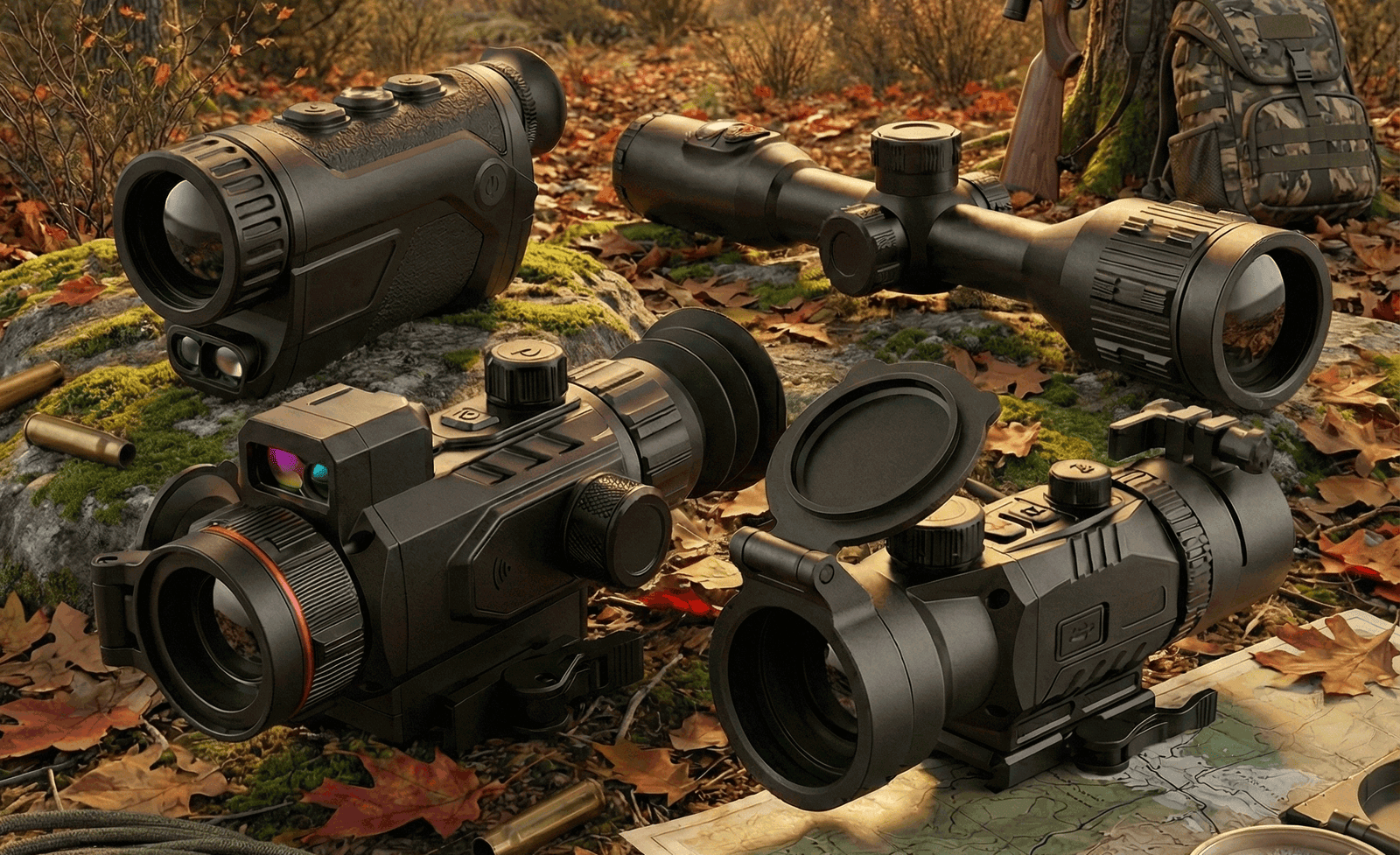
Planning thermal hunting optics accessories as a coherent ecosystem is no longer a “nice to have” for OEM brands and distributors. For many thermal rifle scopes, monoculars and clip-ons, the accessory bill of materials (mounts, power, recording, carry systems) can add 20–40% to the selling price and an even higher share of the margin. A well-designed accessory ecosystem for thermal hunting optics also raises customer satisfaction, reduces returns and makes upgrades easier to sell.
Table of Contents
ToggleThis article looks at accessory planning from an engineering and product-management perspective. The goal is not to list every possible gadget, but to give you a systematic way to design rails, external power, recorders, harnesses, magnetic mounts and tripods so that dealers can reliably increase average order value and repeat purchases—without confusing end users.
1. Why Accessory Ecosystems Matter for Thermal Hunting Optics
For a hunting brand, a thermal optic is rarely sold alone. Dealers almost always add mounts, batteries, chargers and sometimes tripods or support systems. When these accessories are designed as part of a consistent ecosystem, three things happen:
- Attach rate increases. Sales staff can confidently recommend a predefined “kit” rather than improvising item by item.
- Returns decrease. Mechanical and electrical compatibility issues (wrong ring height, unstable power banks, weak harness points) are reduced.
- Future sales become easier. When hunters upgrade to higher-end thermal rifle scopes, they can often reuse the same rails, batteries and mounts.
The opposite also happens: if accessories are treated as an afterthought, each dealer builds their own unofficial ecosystem. This leads to unpredictable performance, higher support load and a weaker brand story.
From a B2B viewpoint, accessories should therefore be treated as platform components, not miscellaneous add-ons. The rest of this guide explains how to design that platform.
2. Defining an Accessory Strategy for Thermal Hunting Optics
Before choosing specific parts, define the boundary conditions for your thermal hunting optics accessory ecosystem.
2.1 Start from Field Workflows
Work backwards from how the devices are actually used:
- Night coyote hunting from vehicles or high seats
- Walking pest-control around farms and vineyards
- Mixed day/night trips where optics are mounted and dismounted frequently
- Guided hunts where multiple hunters share optics and batteries
For each workflow, sketch a simple sequence: scan – identify – range – decide – shoot – relocate. Then mark where accessories touch the sequence: mounting, power, recording, carry, stabilization.
2.2 Map Your Product Families
List the products that should share accessories:
- Thermal rifle scopes
- Thermal clip-on sights
- Handheld thermal monoculars
- Thermal binoculars
Decide where commonality is mandatory (for example, power packs, tripods) and where product-specific solutions make sense (for example, heavy-duty mounts for magnum rifles versus lightweight mounts for air rifles).
2.3 Establish Design Principles
Typical design principles for a thermal hunting optics ecosystem include:
- Cross-compatibility first. Re-use the same rail footprint, tripod thread and power connector wherever possible.
- Minimal SKUs. One robust external battery form factor is better than three similar ones.
- Fail-safe design. Accessories should not create new failure modes (for example, cable snagging near the bolt handle, battery packs blocking ejection ports).
- Retail clarity. A dealer should be able to explain the difference between two kits in under 30 seconds.
These principles help guide trade-offs in the detailed design.
3. Mechanical Interfaces: Rails, Mounts and Attachment Points
Mechanical interfaces are the backbone of any accessory ecosystem. If they are inconsistent or under-specified, everything else becomes fragile.
3.1 Scope Mounting and Rails
For rifle-mounted optics, most brands standardise on Picatinny (MIL-STD-1913) or NATO accessory rails. To support a wide variety of rifles, your thermal hunting optics ecosystem should:
- Use a consistent rail footprint on the underside or side of each scope and clip-on.
- Offer factory-approved one-piece and two-piece mounts in common heights (for AR-style rifles, bolt-actions, and low-profile mounting on euro rails).
- Define clear torque specifications and recoil-lug engagement to avoid zero shift.
If you produce both dedicated thermal scopes and clip-ons, consider a shared clamping geometry so that dealers can re-use mounts between them.
3.2 Secondary Attachment Points
Many accessories are not directly on the top rail but on secondary interfaces:
- Side mini-rails for IR illuminators or alignment aids
- M-LOK or KeyMod interfaces on handguards (for bipods, tripods and secondary optics)
- 1/4″-20 and 3/8″-16 tripod threads on the underside or side of housings
- Harness lugs and strap loops for handheld devices
Document each interface in a simple mechanical specification, ideally with dimensioned drawings that OEM partners and accessory vendors can follow.
3.3 Example Compatibility Matrix
A small compatibility matrix helps engineers and buyers see how the ecosystem hangs together:
| Product Type | Primary Interface | Secondary Interfaces | Typical Accessories |
|---|---|---|---|
| Thermal rifle scope | 30/34 mm rings on Pic rail | 1/4″-20 thread, side mini-rail | QD mount, external battery, recorder |
| Thermal clip-on sight | Pic rail clamp | 1/4″-20 thread | Rail riser, quick-detach adapter |
| Handheld monocular | 1/4″-20 thread | Dual strap lugs | Chest harness, window mount, tripod |
| Thermal binoculars | Central hinge interface | Harness plate, 1/4″-20 thread | Bino harness, tripod adapter |
Such a table becomes the reference when defining new accessory SKUs or approving third-party mounts.
4. Power Ecosystem: Batteries, External Packs and Charging
Power planning is critical for thermal hunting optics accessories. Poor choices here cause failed hunts and negative reviews.
4.1 Standardising Cell Formats
Wherever possible, align products on one or two cell formats—typically 18650 or 21700 Li-ion cells. This simplifies:
- Inventory and replacement in the field
- Charger design and safety approvals
- Cold-weather performance forecasts
For premium products or long-range setups, you may still use proprietary battery packs, but they should ideally share the same chargers or at least the same power connector.
4.2 External Power Packs
External power packs increase runtime and help dealers upsell higher-value kits. Design guidelines include:
- Use a locking low-profile connector that cannot accidentally unplug under recoil.
- Route cables away from moving parts (bolt handles, loading ports, sling mounts).
- Specify clear safe mounting options—belt clip, stock pouch, or rail-mounted pack—for each optic family.
Here, integrating with your existing thermal optics accessories strategy is important, so the same external pack can serve scopes, clip-ons and sometimes handheld devices.
4.3 Cold-Weather and Safety Considerations
Thermal hunting often takes place in sub-zero environments. For your power ecosystem:
- Rate packs down to realistic temperatures (for example –20 °C) and publish the derating curve.
- Provide firmware hooks so devices can limit current draw or reduce display brightness when pack voltage sags.
- Ensure all packs pass relevant IEC safety tests and include proper protection circuitry.
These details give procurement teams confidence when evaluating long-term risk.
5. Data and Recording Accessories
Modern hunters increasingly expect to record and share footage. Recording accessories are therefore part of the core ecosystem, not a niche add-on.
5.1 On-Board vs External Recording
If your optic already supports internal recording, accessories may focus on storage and connectivity:
- Pre-qualified, branded microSD cards
- USB-C cables rated for data transfer
- Compact HDMI or USB capture modules for live demos
If on-board recording is not available, an external recorder can be positioned as an upsell. In that case, document resolution, frame rate and latency so dealers know what quality to promise.
5.2 Mobile Apps and Wireless Bridges
Wi-Fi and Bluetooth bridges extend the accessory ecosystem into software:
- Live preview on tablets for guiding or training
- Simple clipping tools for social media content
- Firmware update channels for deployed optics
For OEM customers, publishing a stable API or SDK—similar to how you might document your thermal + LRF fusion stack—turns the recording pipeline into a platform others can build on.
5.3 Demo and Training Kits
Dealers often run in-store demos or range days. A dedicated “demo kit” (tripod, target, recorder, cables and power) can be a separate SKU, even if many components overlap with retail kits. The important part is the documentation: a one-page checklist makes field staff more willing to use it.
6. Carry, Mounting and Field-Use Accessories
Accessories that touch the hunter’s body are as important as those that touch the rifle.
6.1 Straps, Harnesses and Cases
For handheld thermal monoculars, a simple neck strap is rarely enough. Consider:
- Bino-style chest harnesses that stabilise the unit and prevent swinging
- Convertible straps that can attach to both monoculars and compact binoculars
- Semi-rigid cases sized to hold the optic plus key accessories (batteries, cloth, small tripod)
These accessories are relatively low cost but strongly influence perceived quality.
6.2 Magnetic Mounts and Tripods
Magnetic mounts allow vehicle-based scanning from roofs or hoods. When planning them:
- Ensure rated pull force and safety margins are clearly documented.
- Provide non-marring pads suitable for vehicle paint and agricultural machinery.
- Standardise on 1/4″-20 threads so the same optic can move between magnetic bases and tripods.
Tripods and window mounts deserve similar attention; they should be rated for the weight of your largest optic with external battery and recorder attached.
7. Bundling Strategies: Turning Accessories into Predictable Kits
Accessories only translate into channel value if they are sold in a structured way. Rather than offering a long menu of add-ons, build a small set of named bundles aligned with use cases.
7.1 Example Bundle Architecture
| Bundle Name | Target User | Contents (Typical) | Role in Lineup |
|---|---|---|---|
| Core Hunting Kit | First-time night hunter | Thermal rifle scope, standard mount, two batteries, charger, strap | Entry point, high volume |
| Predator Pro Kit | Frequent coyote / hog hunter | Higher-spec scope, QD mount, external pack, tripod adapter, case | Mid-tier upsell |
| Guide & Outfitter Kit | Professional guide or pest-control crew | Premium scope, external pack, recorder, harness, demo cables | Low volume, high prestige |
Your existing content—for example, best budget thermal scope bundles or thermal monocular hunting kits—can be internally linked from this article to show concrete examples of how such bundles are structured.
7.2 Documentation and Dealer Tools
For each bundle, provide:
- A one-page technical summary (weights, runtimes, mounting notes)
- Clear SKU lists and replacement part numbers
- Suggested retail talking points, focused on outcomes rather than specs
This “white paper” level of documentation is what many procurement managers expect when evaluating new product families.
8. Lifecycle and Service Ecosystem
Accessories have their own lifecycle, separate from the core optics. Planning for spares and replacements is therefore part of the ecosystem strategy.
Key points include:
- Standardising consumables such as lens caps, eyecups and protective windows across product lines
- Maintaining stock of critical small parts (mounting screws, clamp levers, cable strain-relief boots)
- Offering service kits to dealers with the tools and parts needed for basic repairs
From a risk-management viewpoint, it is useful to document which accessories are essential for safe operation (for example, certain mounts or power packs). Those parts should receive higher priority in obsolescence planning, similar to what you may already do for your thermal camera cores.
9. How Gemin Optics Supports Thermal Hunting Optics Accessory Ecosystems
As a China-based OEM/ODM manufacturer supplying thermal rifle scopes, thermal monoculars, thermal clip-on sights and private-label hunting optics, Gemin Optics designs products with the accessory ecosystem in mind from the start.
For brand owners and distributors, this means:
- Shared mechanical standards across scope, monocular and clip-on families, enabling unified mounts and tripods.
- Power and data interfaces documented for integration with external packs, recorders and apps.
- OEM design support to align your accessory roadmap with your existing product tiers and retail channels.
- Access to broader solutions such as thermal hunting scope private-label programs and thermal monocular OEM platforms when you need a complete product line rather than a single optic.
10. CTA – Plan Your Thermal Hunting Optics Accessory Ecosystem with a Trusted OEM Partner
If you want your thermal hunting optics accessories to drive higher margins, smoother deployments and repeat sales, they must be planned as a coherent ecosystem—not a box of unrelated parts. A structured accessory ecosystem for thermal hunting optics starts with clear interfaces, power standards and bundle architectures that distributors can rely on for years.
Gemin Optics can help you align scopes, monoculars, clip-ons and accessories into a unified platform, from mechanical design to documentation and private-label packaging.
Contact our engineering team to discuss your accessory roadmap for thermal hunting optics, or share your current product line and channels so we can help you design kits, mounts and power solutions that create real long-term value for your B2B customers.