When agencies and large landowners evaluate thermal optics today, they are usually not shopping like hobby hunters. They are responsible for predator-management or invasive-species control programmes with legal oversight, public scrutiny, and multi-year budgets. Their question is not, “Which scope looks coolest on a rifle?” but “Which equipment will still be doing its job, safely and reliably, three to five years from now?”
Table of Contents
ToggleFor these buyers, thermal optics are tools inside a wider management system: surveys, night operations, reporting, evidence collection and contractor oversight. This article looks at what those buyers really expect, and how OEM / ODM brands and distributors can design product lines and tenders that speak their language.
1. Predator and Invasive-Species Control Is Not Recreational Hunting
Recreational hunters might buy a single thermal scope for personal use. Predator-control officers and land-management teams operate in very different conditions.
They often work under formal programmes targeting coyotes, feral hogs, foxes, wild dogs, invasive deer or other species that damage crops, infrastructure or native wildlife. These programmes are typically:
- Goal-driven. Targets are defined by livestock loss, crop damage, biodiversity indicators or public-safety incidents.
- Documented. Each outing may require logs, location data and sometimes video evidence.
- Multi-user. Equipment is shared among rangers, contract shooters, helicopter crews or volunteers.
Because of this, procurement decisions favour robust, easy-to-standardise thermal optics over feature-heavy but fragile gadgets.
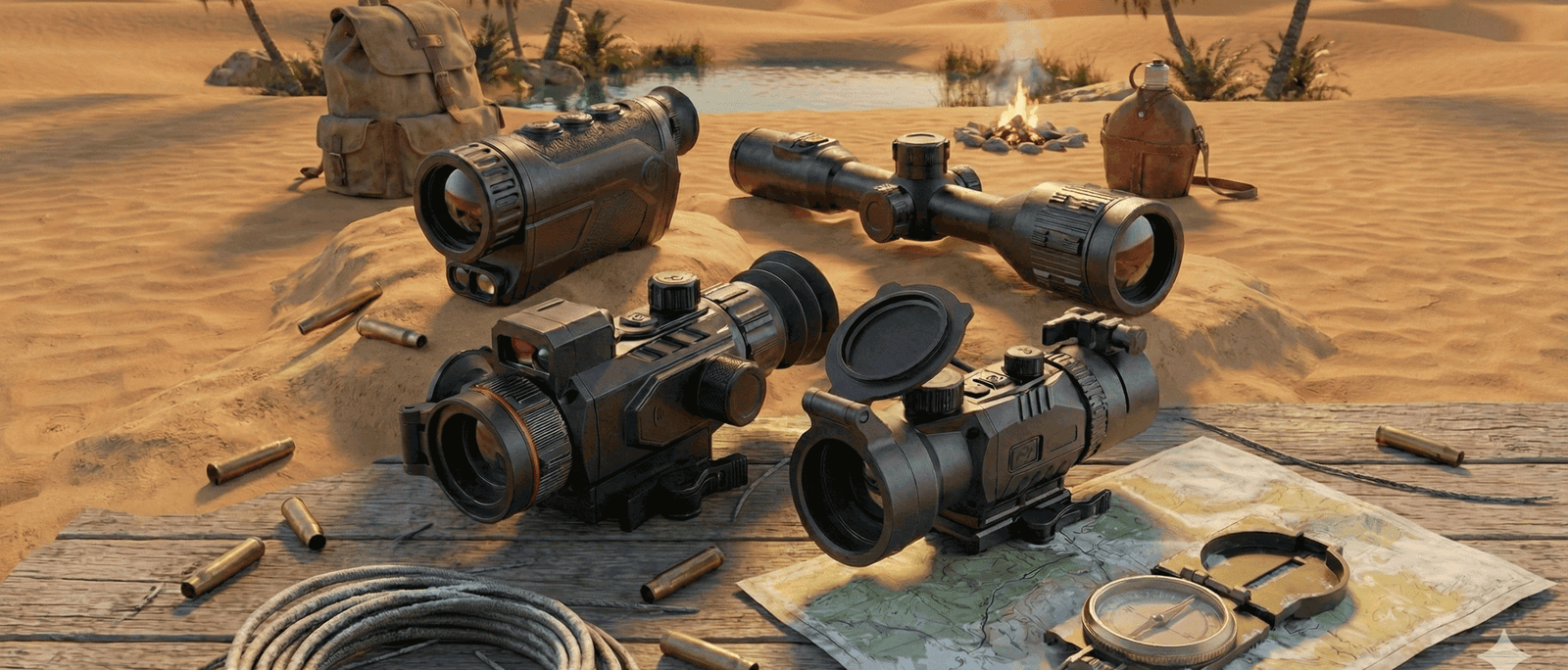
A typical kit list may include:
- Rifle-mounted thermal rifle scopes for primary shooting platforms.
- Handheld or helmet-mounted thermal monoculars for search and observation.
- Clip-on devices for agencies that must retain existing day optics.
- Vehicle-mounted spotters or pan-tilt units for large properties.
The way each device is evaluated is shaped by durability, repeatability and programme-level economics, not only image quality.
2. Who Buys Thermal Optics in Control Programmes?
Understanding the internal stakeholders helps OEMs and distributors frame specifications and proposals correctly.
2.1 Government Agencies
Wildlife departments, agriculture ministries, local councils and pest-control authorities typically purchase through tenders. Their priorities include:
- Demonstrable compliance with procurement rules and technical standards.
- Traceable documentation for each unit (serial numbers, test reports).
- Long-term serviceability and predictable budgets.
These buyers are highly sensitive to warranty terms, training support and integration with existing protocols.
2.2 Large Landowners and Ranch Groups
In regions where private landowners run invasive-species programmes, purchasing is more decentralised but equally professional. A large ranch may buy multiple thermal optics sets for staff and contract shooters and will ask:
- How many seasons can we realistically get from each scope or monocular?
- How easy is it to swap equipment between rifles and vehicles?
- What is the total cost including batteries, mounts, service and downtime?
They often rely on trusted distributors who can supply a coherent ecosystem of thermal hunting optics rather than a basket of unrelated devices.
2.3 NGO and Conservation Projects
Conservation organisations focused on invasive predators (e.g., foxes impacting ground-nesting birds) may run grant-funded programmes. Here, the emphasis is on data and reporting: logging sightings, effort and outcomes as evidence for donors and regulators. Connectivity and recording functions become as important as pure shooting performance.
3. Key Technical Requirements beyond the Consumer Market
3.1 Detection Range and Field of View
Control teams need to scan large paddocks, crop fields or riparian zones efficiently. That usually leads to a mixed fleet of optics:
- Short-to-medium range thermal monoculars with wide FOV for scanning.
- Longer-range scopes or clip-ons with narrower FOV for precise shot placement.
Unlike consumer buyers who might chase extreme detection distances, these programmes value consistent, repeatable performance in their typical engagement ranges (often 100–300 m for rifles, longer from vehicles or helicopters).
3.2 Ruggedness and Environmental Resistance
Predator-control operations often happen in harsh conditions:
- Dust and fine soil on open rangeland.
- Salt spray in coastal depredation work.
- Heavy dew, fog and rain in riverine and wetland habitats.
Government buyers routinely specify IP-rating, drop-test standards and operating temperature range. They expect scopes and monoculars built on proven thermal camera modules such as uncooled LWIR cores that have already been validated in industrial or security applications, not only on the shooting range.
3.3 Zero Retention and Platform Flexibility
Programmes often use AR-15-type carbines, bolt-action rifles, shotguns and sometimes pistol-calibre carbines. Thermal optics must:
- Survive thousands of rounds on calibres commonly used for predator work (.223 / 5.56, .243, .308, 6.5 etc.).
- Maintain zero when moved between rifles or when used as thermal clip-ons in front of day scopes.
- Offer mount options that match agency armoury standards (Picatinny, NATO rails, quick-detach).
A thermal scope with rangefinder or an integrated laser rangefinder module is often justified because it reduces ranging errors for multiple shooters sharing rifles and ammunition types.
3.4 Power Strategy and Night-Long Runtime
Control programmes often run long night shifts, vehicle-based patrols or multi-night operations on remote properties. Buyers look for:
- Standardised batteries across optics (e.g., 18650 or 21700) rather than exotic packs.
- External power options from vehicles or belt-mounted packs.
- Honest, low-temperature runtime specifications at realistic refresh rates.
An OEM that can discuss battery strategy in the context of real field conditions immediately stands out from consumer-only brands.
3.5 Connectivity, Recording and Evidence
For many programmes, being able to document efforts and incidents is nearly as important as removing animals. They need:
- Reliable onboard recording for stills and video.
- Simple ways to export clips for reports without specialist software.
- Optional WiFi/Bluetooth connectivity to apps for logging location and time.
However, connectivity should never compromise operational security or reliability. Government buyers usually prefer simple, well-tested functions over complex streaming features.
4. Compliance, Policy and Public Perception
Predator and invasive-species projects often sit in an uncomfortable public space: necessary for animal welfare, conservation or agriculture, yet open to misunderstanding or opposition. Consequently, thermal optics are purchased under stricter rules than typical hunting gear.
4.1 Legal and Regulatory Considerations
Depending on jurisdiction, buyers may need to demonstrate:
- Compliance with export-control and dual-use regulations.
- Proper classification regarding weapon sights vs observation devices.
- Use of eye-safe rangefinding technology in integrated optics.
Working with a supplier that understands documentation (datasheets, conformity declarations, test reports) and can align with CE/FCC and relevant national standards reduces the risk of delays or tender disputes.
4.2 Ethical Use and Animal-Welfare Guidelines
Some agencies must ensure methods minimise suffering and non-target impacts. Thermal optics can support this by:
- Improving target identification in complex backgrounds.
- Reducing wounding rates through better shot placement.
- Supporting post-shot verification and recovery in difficult terrain.
In tenders, it is increasingly common to see requirements that tie technical specs (resolution, frame rates, detection capability) to humane-killing and non-target-species policies.
4.3 Public Transparency and Reporting
Many control programmes publish annual reports detailing effort, costs and outcomes. Equipment that simplifies data gathering—e.g., through built-in logging or easy integration with mobile apps—adds value beyond the pure shooting performance of the optic.
5. Procurement Logic: How Institutional Buyers Evaluate Thermal Optics
Government and large landowners normally compare proposals using more structured criteria than individual hunters. A typical matrix includes:
- Technical fit. Does the mix of scopes and monoculars actually match terrain, species and shooting distances?
- Reliability data. Are there references from similar programmes, or test results from industrial or security deployments using the same cores?
- Lifecycle cost. Not only purchase price, but batteries, accessories, maintenance, and expected lifespan.
- Standardisation potential. Can multiple teams use the same models, mounts and charging equipment across regions?
- Vendor capability. Is there a credible quality control system behind the production line? Can firmware and spare parts be supported for 5–7 years?
Distributors and OEM brands that present their thermal products as a package solution—including accessories, training and service—are more likely to win such contracts than those who only showcase individual devices.
6. Typical Thermal Optics Configurations for Control Programmes
6.1 Patrol-Based Land Management
On large ranches or forestry concessions, crews may patrol nightly using vehicles and UTVs. A practical configuration is:
- One long-range vehicle-mounted scope or pan-tilt unit for initial detection.
- Handheld thermal monoculars for close-in scanning once the vehicle stops.
- Rifle-mounted thermal rifle scopes for the actual engagement.
All devices ideally share menu logic, iconography and control philosophy, reducing training time and errors in the dark.
6.2 Government Predator-Control Teams
Government units often operate state-owned rifles and must report asset usage. They value:
- Serialised, traceable optics with clear firmware and hardware versions.
- Robust mounts and recoil ratings, especially on heavier calibres.
- Standardised accessories such as helmet mounts, remote controls and tripod interfaces.
Here, rugged, mid-to-high-end thermal optics are preferred over ultra-budget consumer devices, because failure during operations leads directly to reputational and political risk.
6.3 Specialist Invasive-Species Projects
Projects targeting specific invasive species (e.g., feral cats on islands, wild boar near critical infrastructure) may require integration with other sensors or control systems. In those cases, using modular thermal camera modules as building blocks for custom handhelds, vehicle systems or fixed installations can be more effective than simply buying off-the-shelf scopes.
7. What Government and Landowner Buyers Expect from Their Suppliers
7.1 Clear, Conservative Specifications
Institutional buyers prefer realistic numbers over marketing-driven ones. When discussing detection range, NETD or battery life, conservative, independently verifiable data builds trust.
Datasheets should relate specifications to concrete use cases:
- “Detection of a standing coyote at 300 m under typical rural background conditions”
- “Identification of a human-sized intruder at 150 m in moderate fog”
This language is more meaningful to programme managers than generic “2,000 m detection range” claims.
7.2 Training and Documentation
Because equipment is shared among teams, buyers expect:
- Structured user manuals and quick-start guides.
- Training materials that distributors can adapt for local languages.
- Guidance on safe transport, storage and cleaning procedures.
Brands that treat documentation as part of the product—not an afterthought—help agencies reduce accidents and misuse.
7.3 Service, Warranty and Upgrade Path
For multi-year programmes, buyers care about:
- Turnaround time for repairs, either directly or via regional partners.
- Availability of spare parts and standard accessories.
- Firmware maintenance to fix bugs and add incremental improvements.
They also appreciate suppliers who can discuss future roadmap alignment—how next-generation sensors or algorithms may be adopted without throwing away existing investments. That is where platform thinking and modularity become important.
8. How Gemin Optics Supports Predator and Invasive-Species Programmes
As a China-based OEM/ODM manufacturer, Gemin Optics designs and builds both finished devices and core components that underpin many thermal optics applications. For government and landowner programmes, several capabilities are particularly relevant:
- A modular portfolio of thermal camera modules suitable for rifle scopes, handhelds and vehicle or tower systems.
- Field-proven laser rangefinder modules that can be integrated into scopes for more reliable distance estimation.
- Hunting-oriented devices such as thermal hunting optics that can be adapted for professional predator-control tasks with customised firmware, reticles and connectivity.
- Structured OEM/ODM solutions that include joint requirement analysis, sample development, validation support and lifecycle planning.
By combining industrial-grade hardware with hunting-segment ergonomics, Gemin Optics can help brands and distributors deliver equipment that satisfies both field officers and procurement committees.
9. CTA: Plan Your Next Predator-Control Programme with the Right Thermal Optics Partner
Predator and invasive-species control programmes demand more from thermal optics than weekend hunting trips. Government agencies and large landowners expect durable, standardised equipment, backed by transparent specifications, solid training support and long-term service.
If you are planning a product line or tender proposal for this market, working with an OEM/ODM partner who understands both hunting and professional control applications can significantly reduce risk. Gemin Optics offers modular cores, complete devices and engineering support to help you build coherent solutions for predator and invasive-species projects.
To discuss your requirements—from rifle scopes and handheld scanners to vehicle-mounted systems—reach out to our team via the OEM/ODM solutions page or the Gemin Optics contact form. Together, we can design thermal optics packages that meet demanding operational standards while delivering measurable results in the field.