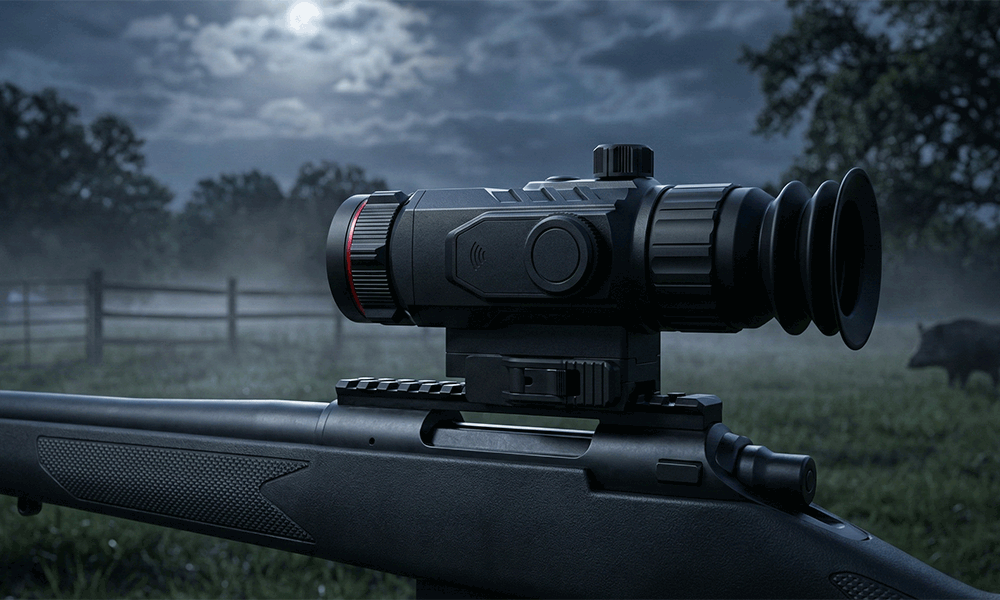
The market for thermal imaging riflescopes is experiencing an unprecedented boom in both the United States and Europe. Once a niche reserved for military and specialist use, thermal scopes have now entered the mainstream of the hunting industry. This surge in demand is driven by a confluence of factors – from expanding wildlife populations and shifting hunting regulations to rapidly advancing technology and changing consumer behaviors. In this article, we delve into the market demand trends for thermal scopes in the US and European hunting markets, examining what’s fueling the growth and what it means for distributors, importers, and OEM brands looking to capitalize on this trend.
Market Growth Trends: A High-Tech Hunting Boom
Not long ago, many hunters considered thermal optics a luxury due to their high cost and specialized use. Today, that picture has changed dramatically. Industry insiders report double-digit annual growth in night-vision and thermal optic sales, propelled by wider adoption among hunters. For example, over the past five years, sales of thermal/night-vision devices have grown consistently by 15–20% annually, with especially high interest in hunting invasive species like feral hogs and predators like coyotes. This growth is reflected in market research as well: the global thermal imaging scopes market was valued around $0.9 billion in 2024 and is expected to exceed $2.2 billion by 2033 (a ~10.9% CAGR). North America currently leads with about 40% of the market share, closely followed by Europe at roughly 30%, underscoring the significant demand in these two regions.
Several underlying trends help explain this boom. First, technology advancements have made thermal scopes more effective and more affordable. Sensor innovations have improved image resolution and detection range, while competition among manufacturers has driven prices down each year. In fact, there are far more brands and models on the market now than ever before, increasing competition and giving consumers more choices at varying price points. High-end thermal rifle scopes that once cost $6,000+ can now be found in mid-range tiers, and even entry-level thermals (though still a significant investment) have dropped to the ~$2,000–$3,000 range. This increased affordability has been a key enabler in pushing thermal scopes into mainstream hunting.
Moreover, smart features are becoming common, further boosting appeal. Roughly one-quarter of new thermal scopes now offer “smart” capabilities like video recording, Wi-Fi streaming, or mobile app integration. Manufacturers like ATN, Pulsar, and others are introducing scopes with built-in ballistic calculators, one-shot zeroing, and even Bluetooth connectivity to smartphones. These innovations cater to a new generation of tech-savvy hunters who appreciate high-tech tools. In the mid-2020s, millennial hunters comprised about 35% of the consumer base for hunting optics, and their interest in features like integrated rangefinders and smartphone apps has pushed companies to add more digital functionality to thermal scopes.
The result of these trends is a vibrant, rapidly growing market. Thermal optics are no longer exotic gear; they are increasingly viewed as must-have equipment for certain types of hunting. As one industry expert put it, “The number of brands vying for consumer dollars is more competitive than it has ever been. This increased competition has driven innovation and continues to drive prices down every year.” In short, the thermal scope market’s boom is characterized by greater adoption, innovation, and accessibility than ever before.
Regulatory Landscape: How Hunting Laws Impact Thermal Scope Adoption
One major factor influencing thermal scope demand, especially in Europe, is the regulatory environment. Hunting with thermal imaging devices is governed by a patchwork of laws that vary regionally – and changes in these laws can either spur or restrict growth in the market.
In the United States, regulations on using thermal or night-vision scopes for hunting are generally determined at the state level and often depend on the species being hunted. Many states permit unlimited night hunting of non-game nuisance species (like feral hogs or coyotes) using thermal optics, while tighter restrictions apply for game animals. The relatively permissive stance toward pest control has encouraged American hunters to invest in thermal scopes as a highly effective tool for night hunts. In Texas, for example, where feral hogs are a well-known menace, landowners and hunters are free to pursue hogs at night year-round – and thermal optics are virtually essential for this purpose. It’s telling that Texas alone is estimated to have ~2.6 million wild hogs, part of a nationwide feral swine population of over 6 million (spread across at least 35 states). With numbers like these, it’s no surprise that many U.S. jurisdictions actively encourage aggressive hog hunting, fueling demand for the best night-fighting gear available. As one Texas hunter quipped, “there are two kinds of landowners: those who have wild hogs, and those who will get them”. Thermal scope sales have boomed in states like Texas, Florida, Georgia, and others where hog hunting has become a year-round activity and even a form of wildlife control necessity.
That said, not all U.S. hunting regulations are lax. For instance, some states require special permits for night hunting of certain predators, and many forbid the use of any artificial illumination or thermal devices for hunting deer or other big game. These restrictions can limit the market in those niches – e.g. deer hunters in most states still rely on daylight optics – but they have done little to dampen the explosion of thermal scope usage for varmint, hog, and predator hunting, which represents a huge segment of overall hunting activity. By and large, the U.S. regulatory climate has been favorable for the expansion of thermal hunting, treating it as a practical solution to real problems (like crop damage and livestock predation by feral hogs, which cause an estimated $1.6 billion in agricultural losses annually in the U.S.).
In Europe, the situation is more complex and historically more restrictive – but significant shifts are underway here as well. European countries have traditionally been cautious about night hunting technologies due to concerns about fair chase and anti-poaching enforcement. In some countries, thermal rifle scopes were outright banned for civilian use in hunting until recently. However, pressures such as surging wild boar populations and the spread of diseases like African swine fever have prompted regulatory changes. A case in point is France, which in August 2020 modified its hunting regulations to permit the use of thermal imaging devices specifically for wild boar population control. French authorities acknowledged that thermal technology greatly aids in managing boar numbers, which had increased by roughly 40% in the past decade in France. Under the new rules, licensed hunters can get authorization to hunt wild boar at night with thermal optics as part of pest control and crop protection programs. Similar allowances exist for certain pest species management and in special wildlife management situations, granted by local prefects.
Europe’s regulatory patchwork is illustrated by a comparison of key countries:
- Spain: Broadly permits thermal scopes for hunting invasive or pest species under a standard hunting license (relatively permissive).
- France: Allows thermal devices for specific purposes (like boar control) under regulated authorization – a middle-ground approach.
- Germany: Generally prohibits hunting with thermal or night vision scopes, except for limited professional wildlife management exceptions (most restrictive).
- Italy: Permits thermal in some regions with varying local rules.
- UK: Permits thermal optics for certain pest control (like foxes) and under specific conditions (e.g. with night shooting licenses for deer control).
This diverse landscape means market opportunities in Europe depend on local legislation. Countries that have loosened restrictions (France, Spain, parts of Eastern Europe) are seeing a more rapid uptick in thermal scope sales, particularly for hog and predator control. By contrast, in places like Germany where such devices remain largely off-limits to recreational hunters, demand is softer and tends to be confined to law enforcement or professionals. Overall, however, the trend in Europe is toward gradual liberalization. As one 2024 European hunting report noted, more countries are recognizing that thermal optics, when properly regulated, are valuable tools for wildlife management and safety. For distributors and OEMs, staying attuned to these regulatory shifts is crucial – it affects everything from product design (e.g. offering clip-on thermal attachments in markets where dedicated thermal rifle scopes are restricted) to marketing and education efforts needed to assure compliance.
Wildlife Population Pressures: Hogs and Boars on the Rise
One of the most compelling drivers behind the surge in thermal scope demand is the explosion of certain wildlife populations, creating both opportunities and necessities for hunters. In particular, feral hogs in North America and wild boars in Europe have reached crisis levels, where traditional daytime hunting barely makes a dent in their numbers. Thermal scopes, by enabling effective night hunting, have become a game-changer in controlling these species.
In the United States, feral hogs are an invasive scourge. Experts estimate there are over 6 million feral swine in the U.S. as of the mid-2020s, with presence in at least 35 states. These hogs breed rapidly and are extraordinarily destructive to crops, native habitats, and even other wildlife. States like Texas, Florida, Georgia, and Louisiana are particularly overrun. In Texas alone, the wild hog population is pegged around 2.6 million and growing. Feral hogs are largely nocturnal, especially once they’ve been exposed to hunting pressure (they quickly learn to avoid humans and shift to nighttime activity). As a result, night hunting with thermal optics is arguably the most effective method to remove them, short of large-scale trapping programs. Hunters and landowners have embraced thermal scopes enthusiastically for this task. The ability to scan fields in complete darkness and pick out heat signatures of hogs has made night culling far more efficient than it was in the past with spotlighting or moonlight alone. Many guide services and landowners now routinely organize thermal hog hunts, and a cottage industry of outfitted night hunts (especially in Texas) has flourished. This not only adds to the demand for scopes among guides and outfitters but also serves as a “gateway” experience – once an enthusiast tries a thermal scope on a hog hunt, they often want one for themselves.
The situation in Europe with wild boars mirrors the U.S. hog problem in many ways. Wild boar populations have skyrocketed across Europe, fueled by factors like milder winters (climate change aids their survival and breeding), abundant food (they thrive on crops and waste), and lack of predators. Before the latest African swine fever outbreaks, Europe’s wild boar numbers were estimated between 13.5 and 19.6 million animals – an astonishing figure. Hunters are harvesting close to 4 million boars annually in recent years, up from about 2.2 million a decade earlier, yet even that heavy hunting pressure only slows the growth. Countries such as Germany, Poland, France, Italy, and Spain all report boar densities at or near historic highs. Boars cause extensive agricultural damage (for example, in Italy they cause an estimated $20+ million in crop losses per year and even encroach into city suburbs). European farmers and wildlife managers are desperate for solutions, and many have turned to night-time boar control. In several countries, special night shooting permits for boar have been introduced, and thermal optics are a natural fit for these operations.
France’s decision in 2020 to legalize thermal optics for boar control, mentioned earlier, directly reflects this need. The French Hunting Federation explicitly cited the effectiveness of thermal imaging in managing wild boar populations that had ballooned by ~40% over ten years. In Spain, too, using thermal scopes for invasive species (boar included) is generally accepted, and hunters have eagerly adopted the technology. Conversely, countries that have been slower to allow thermal optics, like Germany, face criticism from landowners who see them as a necessary tool given the boar problem. It’s a telling sign that demand sometimes outpaces legality – reports suggest that even in places with strict laws, some hunters quietly acquire thermal monoculars for spotting and then use traditional shooting methods, illustrating a latent demand that could officially unlock if regulations ease.
Beyond hogs and boars, predator populations are another factor. In the U.S., animals like coyotes are widespread and often hunted at night to protect livestock. Thermal scopes make predator hunting far more effective, as coyotes are cunning and often nocturnal. The growing coyote hunting community has been quick to adopt thermal riflescopes for improved success. Similarly, in parts of Europe, hunters use thermal optics for controlling foxes (especially around farms and preserves) and jackals in Eastern Europe. These use cases, while smaller in scale than hog/boar hunting, contribute to the overall uptick in thermal scope usage.
In summary, wildlife population pressures have created a need for 24/7 hunting capabilities, and thermal scopes fulfill that need by opening the night hours to effective hunting. Whether it’s Texas hog hunters protecting their crops or French wildlife managers culling boars to curb ASF disease risk, the real-world necessity drives market demand. OEM brands and distributors should recognize that behind the sales numbers are very practical motivations – products that can demonstrably help manage an invasive species or boost a hunter’s success are likely to see sustained demand.
Shifting Hunter Demographics and Consumer Behavior
The modern hunter is not the same as a generation ago, and their buying behavior has evolved. Demographic shifts and changing consumer preferences are contributing to the growth of the thermal optics market in notable ways:
- New and More Diverse Participants in Hunting: Hunting as a pastime saw a resurgence in the late 2010s into the 2020s, including a notable increase in female hunters and younger hunters. In North America, women now represent about 22% of all hunters, a dramatic rise (65% increase) from a decade prior. This growing segment often values different features – for instance, women hunters have shown a preference for lighter-weight gear and user-friendly designs. Thermal scope manufacturers have responded by emphasizing more compact, lighter thermal scopes (reducing weight by using magnesium alloy bodies, smaller optics, etc.) and simplifying controls. A lightweight thermal scope not only appeals to this segment but also to any hunter trekking long distances. The diversification of the hunting community means the “one-size-fits-all” approach is fading; consumers now seek out equipment that matches their personal comfort and style, and there’s greater willingness to invest in quality gear that enhances the hunting experience.
- Tech-Savvy, Experience-Oriented Buyers: Many hunters under 40 have grown up with advanced technology and expect their gear to integrate with their digital life. These consumers are drawn to thermal scopes that offer high-tech features and a certain cool factor. For example, a scope that can stream footage to a smartphone or record video of a hunt is highly attractive (for personal review or sharing on social media). We see rising demand for scopes that can connect via Wi-Fi/Bluetooth, pair with ballistic apps, or even live-stream a hunt. This generation also researches products heavily online, values peer reviews and YouTube demonstrations, and is receptive to online marketing by brands. The e-commerce boom in sporting goods has made thermal scopes more accessible than ever – hunters can now order advanced optics online after comparing specs and watching field tests. In fact, the expanding e-commerce sector has been identified as a facilitator of hunting scope sales globally. For distributors and resellers, this means an omnichannel approach (strong online presence combined with knowledgeable in-store service) is key to capturing these customers.
- “Aware Citizens” and Non-Traditional Users: Interestingly, not everyone buying a thermal scope fits the traditional hunter mold. Manufacturers report a subset of customers who are rural homeowners and hobbyists using thermal devices for home security or wildlife watching on their property. These individuals might not have a hunting license at all – they may use a thermal monocular or scope to monitor their ranch for predators or intruders, check on livestock at night, or simply observe wildlife (like seeing which critter is raiding the chicken coop at midnight). This “prosumer” segment adds to demand especially for handheld thermal units and clip-on scopes that can double for security use. Their presence in the market underscores that consumer interest in thermal imaging extends beyond just harvesting game; it’s also about having enhanced vision in the dark for whatever task is at hand.
- Higher Expectations and Willingness to Invest: As thermal scopes become more common, consumers are becoming more educated and discerning. They expect clear imagery, reliable performance, and good after-sales support given the price points. The concept of EEAT (Experience, Expertise, Authoritativeness, Trustworthiness), borrowed from content quality terminology, could just as easily apply to the products and brands hunters trust. Hunters talk in forums and at camp about what gear works. A brand that establishes a reputation for rugged, accurate, and user-friendly thermal scopes will earn loyalty (and conversely, a brand that ships subpar units will be quickly called out). Many hunters now see a thermal scope as a long-term investment – much like buying a quality traditional scope – and are willing to pay more upfront for a device from a reputable maker with warranties and proven performance. The fact that even entry-level thermals often start around $2,500 hasn’t deterred purchases; indeed, these units are selling steadily, suggesting that hunters have justified the expense relative to the benefits (especially if the device helps them succeed in hunts or manage pests). For retailers, one upside noted is that profit margins on thermal optics tend to be higher than on firearms – selling one $3,000 scope can yield the profit of selling a dozen budget rifles. This incentivizes retailers to stock and actively sell thermal scopes, further feeding into consumer uptake because the products are front-and-center in stores and recommended by sales staff.
In summary, the profile of the thermal scope buyer is broadening, and their motivations range from pure hunting utility to tech enthusiasm to personal security. This broad base of consumers – united by the desire to “own the night” with thermal vision – ensures that demand is not a short-lived fad but rather a lasting shift in how people approach hunting and outdoor observation.
Product Preferences and Technology Trends in Thermal Scopes
The booming demand is not just for any thermal scope, but for those that meet the evolving preferences of today’s users. Let’s break down some of the key features and product trends that hunters and B2B buyers (distributors/OEMs) are favoring:
- Higher Resolution and Image Clarity: Resolution in thermal scopes is a top selling point. While entry models might offer 240×180 or 384×288 sensors, many hunters are now gravitating toward “640-class” thermal scopes for the superior detail. A 640×480 (or 640×512) thermal sensor provides much clearer target identification at range than lower-res sensors. In competitive markets, brands highlight their NETD (thermal sensitivity) figures (with <40 mK or even <25 mK being touted) to show how their scopes can distinguish subtle temperature differences and produce crisp images. For example, FLIR’s and ATN’s latest scopes boast improved detection ranges and higher-resolution displays. The trend is clear: as component costs fall, hunters want the best image quality they can afford, and many will choose a slightly more expensive model if it means the difference between seeing just a blob vs. clearly identifying a hog or deer at 300 yards.
- Integrated Laser Rangefinders (LRF): An increasingly popular feature – so much so that we dedicate Article 2 to it – is the integration of laser rangefinders into thermal scopes. Knowing the exact distance to a target at night is a huge advantage for making an ethical shot or deciding if a target is in range. Many newer thermal rifle scopes (and monoculars) now come in two versions: LRF-equipped vs. non-LRF. For instance, Pulsar’s high-end Thermion scope and Axion monocular lines offer models with built-in rangefinders. Hunters with varying shooting distances or who hunt in open terrain are finding the LRF models extremely useful, as they “reduce guesswork and speed decision-making” in the field. The trade-offs are typically a slightly higher cost and weight for the LRF version, but many consider it worth it. (As a quick example, Pulsar’s Axion 2 thermal monocular without LRF weighs about 300 g, whereas the LRF version weighs ~350 g, roughly a 50 g increase for the rangefinder hardware.) We’ll explore this in depth later, but from a market standpoint, LRF integration is a major trend – OEMs are working to add LRF modules in a compact way, and distributors find that LRF models often become best-sellers despite the premium price.
- Enhanced Durability and Ergonomics: Hunters expect their thermal scopes to handle tough conditions – recoil, weather, and rough handling. Top manufacturers have responded by improving build quality: ruggedized housings (often aluminum or magnesium alloy), better waterproof ratings (IP67 or IP68 common now), and tested recoil resistance for high-caliber rifles. For example, scopes undergo shock tests up to 6,000 Joules to simulate heavy rifle recoil. On the ergonomics front, features like quick-detach mounts, tactile control buttons or turrets (usable with gloves), and thoughtful weight distribution are increasingly emphasized. Hunters prefer scopes that are easy to mount and zero and that maintain zero reliably even if detached and reattached. Compact design is also a selling point – shorter, lighter scopes that don’t imbalance the rifle. In Europe, some hunters favor thermal clip-on systems that attach in front of a day scope, as this can be a legal workaround and allows dual use of one optic. OEMs have been refining clip-on designs to minimize any shift in point of impact (some advertise “no zero shift” when adding the clip-on). All these product improvements reflect that as the market matures, buyers are looking for well-rounded scopes that are not only high-performing in vision but also practical in real hunting scenarios.
- Smart and Connected Features: As mentioned earlier, many scopes now come with built-in video recording (often with on-board memory like 16–64 GB) and wireless connectivity. Some even offer live streaming of the thermal view to a tablet/phone or to secondary viewers (handy for guided hunts or training). A notable development is the integration of ballistic calculators into thermal scopes – a few models can input the range (from the LRF) plus ammunition ballistics and display a adjusted reticle or holdover point. For instance, ATN introduced scopes with onboard ballistics that can adjust aim points when paired with their auxiliary ballistic laser or with app input. Such “smart scope” capabilities blur the line between traditional optics and wearable computers. While some traditionalists find this overkill, a significant segment of hunters – especially those who love long-range shooting or precision – appreciate having these tools at their fingertips at night. OEM brands entering this space often partner with tech firms or use licensed software to provide these features, knowing that the future of hunting optics is trending digital.
- Price Segmentation and Value: There’s a clear stratification in the thermal scope market: entry-level, mid-range, and premium. Entry-level (around $1k-$2k) gives just the basics – often a lower resolution and fewer features – targeting budget-conscious buyers or first-time users. Mid-range ($3k-$5k) tends to offer the best value: good resolution (like 384 or 640 sensors), some recording features, maybe optional LRF, and solid build quality. Premium ($6k and up) pushes the envelope with the highest resolution sensors (even 1280×1024 in cutting-edge cases), longest detection ranges, integrated LRF, top-tier lenses, and sometimes fusion (thermal + digital overlay) technology. Interestingly, the mid-range segment (roughly $2000–$5000 scopes) has dominated market share by revenue – in general hunting scopes (including day optics) this mid-tier accounts for over 60% of revenue, and a similar pattern is likely in thermal optics where most buyers aim for a balance of performance and price. OEMs entering the market often target the mid-range sweet spot with a feature-rich scope at a relatively affordable price, to undercut legacy premium brands. At the same time, premium brands maintain a loyal following among professionals and enthusiasts who demand the absolute best and are willing to pay for it. From a distributor perspective, having a range of products covering multiple price points is ideal to cater to different customer segments – but ensuring that each tier delivers appropriate value is crucial for reputation. Hunters will quickly call out products that are overpriced for what they offer.
In conclusion, product preferences are skewing toward scopes that offer superior performance (optics and detection), integrated solutions (like built-in rangefinding and recording), and reliable durability. Brands that keep innovating on these fronts – while also minding the user experience and price-value equation – are the ones leading the booming market. For OEMs and new entrants, there is an opportunity to differentiate by either offering more for the money (value innovation) or by pushing technology forward (such as AI target recognition, or unique form factors) to capture attention in this dynamic space.
Key Drivers of Growth in US and Europe
Bringing the above threads together, what are the key drivers behind the growth of thermal scope demand in the US and European hunting markets? Here’s a summary of the primary factors:
- Proliferation of Nuisance Wildlife: As discussed, exploding populations of feral hogs (U.S.) and wild boar (Europe) have created an urgent need for effective night hunting. This is a direct driver – many purchases are justified entirely by the prospect of controlling these animals. In the US, feral hog and coyote hunting enthusiasm has made thermal scopes almost standard equipment for pest hunters. In Europe, boar control operations have similarly driven adoption where legal.
- Advancements in Technology & Affordability: Rapid improvements in thermal imaging tech (better sensors, longer battery life, smaller form factors) combined with increasing competition have driven down costs. Hunters who previously sat on the sidelines due to price are now entering the market. The fact that a thermal scope today offers far superior performance at a given price than one five years ago makes the value proposition stronger year by year. Innovation has lowered the barrier to entry, fueling broader adoption.
- Regulatory Easing and Support: Especially in Europe, regulatory changes to allow or expand the use of thermal optics for hunting have opened up new markets. Each time a country relaxes a rule (as France and Spain have done), it unleashes a wave of demand from hunters who were waiting for the green light. In the US, supportive regulations (like year-round hog hunting and night hunting allowances) have institutionalized the use of thermal gear as part of standard hunting practice for certain species.
- Increasing Hunter Participation Post-2020: In both the US and Europe, there was an uptick in outdoor recreation and hunting participation in recent years (partly as a response to global events pushing people toward outdoor activities). For example, the number of hunting license holders in the US surpassed 39 million in 2023, growing ~3% annually, reversing declines seen in earlier decades. More hunters overall means a larger addressable market for optics of all kinds, including thermal. Many new hunters are also drawn to hog or predator hunting (as it’s often more accessible than, say, an elk hunt), which again leads them to thermal scopes sooner or later.
- Consumer Enthusiasm for High-Tech Gear: Modern consumers love gadgets, and thermal scopes have a certain allure as high-tech gadgets for the outdoors. The “cool factor” of seeing heat signatures in the dark cannot be understated – as one retailer said, “It’s nearly impossible to find someone who doesn’t want one after they look through one”. This organic excitement drives word-of-mouth marketing. Hunters share nighttime video clips with friends, YouTubers publish thermal hunt videos, and social media posts show off successful night hunts – all of which generate buzz and aspirational demand. In essence, thermal scopes have captured the imagination of the hunting community, becoming a bit of a status symbol as well as a practical tool.
- Distribution and Market Push: On the industry side, manufacturers and dealers have put a lot of effort into marketing and educating the market. There are now countless reviews, comparison videos, trade show demonstrations (e.g. at SHOT Show), and even manufacturer-led “universities” to teach consumers about night vision and thermal. This education has helped demystify thermal technology and build trust. Additionally, as noted earlier, dealers find thermal optics financially attractive due to higher margins, so they actively promote them. This creates a reinforcing cycle: the more thermal scopes prove profitable, the more shelf space and visibility they get in stores, leading to more sales.
Each of these drivers reinforces the others. For instance, a hunter dealing with a hog problem might be swayed by a friend’s recommendation (enthusiasm factor), find a reasonably priced model due to tech advances, and have no legal hurdles to using it – leading to a purchase. Or a European hunting club might lobby for legalizing thermal after seeing the success in neighboring countries, then once legal, members quickly invest in scopes. The synergy of these factors explains why the demand boom has momentum and is likely to continue in the near future.
Opportunities and Entry Points for OEMs, Distributors, and Resellers
For businesses operating in this space – whether you’re an OEM manufacturer of thermal optics, a distributor looking to carry products, or a reseller aiming to cater to hunting clientele – the booming demand translates into significant opportunities. However, capitalizing on them requires strategic understanding of the market dynamics:
1. Expanding Product Lines and Private Label Opportunities: OEM brands have a chance to introduce new thermal scope models tailored to specific market segments. For example, recognizing the popularity of integrated LRF scopes, an OEM could develop a mid-priced thermal riflescope with a built-in rangefinder to hit the market sweet spot (many existing premium LRF scopes are high-end; there’s room for more affordable versions). There is also an opportunity for private-label arrangements – some distributors or large retailers may want to offer thermal scopes under their own brand. Given the technical complexity, partnering with established OEMs that can provide a ready-to-brand solution is a viable entry strategy. Companies like InfiRay (through iRay USA) and others have engaged in OEM partnerships, essentially allowing new brands to emerge by leveraging off-the-shelf tech. With the thermal market growing, we have seen an estimated 32% growth in the number of active brands from 2018 to 2023 in the broader hunting optics arena. Many of these are likely partnerships or new entrants carving a niche. The window is open for new brand entries, especially if you can differentiate on either price or unique features.
2. Education and After-Sales Service as Differentiators: For distributors and resellers, one way to stand out is by offering superior customer education and support. Selling thermal scopes is not like selling a pair of binoculars – customers often have many questions about how the technology works, how to zero the scope, how to interpret what they see on the screen, etc. Those B2B players that invest in training their sales teams (or providing robust online resources) will build trust with consumers. As SHOT Business reported, “know the technology” is the number one advice for retailers. Manufacturers are helping by providing training materials, but it’s up to the channel to utilize them. Post-sale support is equally critical; if a hunter has trouble with their device, responsive customer service, easy warranty processes, and even user communities or FAQs can make a huge difference. A satisfied customer is likely to become a repeat customer or upgrade down the line (e.g. buying a second thermal for a friend or an accessory). Thus, investing in customer experience builds brand loyalty in a market where trust and word-of-mouth are key.
3. Navigating Regulations and Compliance: OEMs and distributors need to be cognizant of export controls (thermal imagers often fall under dual-use technology restrictions like ITAR/EAR in the U.S.) and local compliance (CE marking in Europe, laser safety certifications for LRF, etc.). Being on top of these regulations and even assisting partners in understanding them can be a selling point in B2B relationships. For example, a European distributor might choose an OEM partner that provides all necessary certifications and documentation for smooth import into the EU. Additionally, keeping abreast of changing hunting laws and possibly even lobbying or providing input on regulations can position a company as a leader. If, say, Germany were to soften its stance on thermal hunting scopes in the future, those companies that have laid groundwork (perhaps through professional use cases or demonstrating ethical use) will be poised to benefit first.
4. Emphasizing Unique Value Propositions: With many players in the field, having a clear value proposition is vital. Are you the “affordable but reliable” option? The “cutting-edge tech” option? Or perhaps you focus on a niche like thermal clip-ons for law enforcement, or ultra-compact scopes for bowhunters? Identifying underserved niches can be lucrative. For instance, there is growing interest in thermal attachments for crossbows and air rifles in some regions – a niche an agile company could fill. Another example is catering to the search-and-rescue and safety market: while this article focuses on hunting, the overlap of products means some distributors successfully sell the same thermal units to both hunters and SAR teams or even yacht owners (for night-time navigation spotting). Versatility can be a selling point – showcasing the multiple applications of a thermal device (hunting, ranch security, wildlife observation, SAR) can broaden the customer base.
5. Partnership and Ecosystem Building: Distributors might consider partnerships with hunting outfitters, clubs, or ranges to provide hands-on experiences with thermal gear. There’s evidence that when customers try thermal optics, they often decide to buy because the benefits become immediately clear. Hosting nighttime demo events or sponsored hunts can spur local interest. For OEMs, partnering with complementary technology providers (for example, a ballistic app company, or a rifle manufacturer for combo deals) can also enhance market penetration. We see some scope makers bundling products with other gear (like tripods, external battery packs, etc.) to add value and encourage higher sales.
6. Riding the Marketing Wave: SEO-optimized content (like these very articles), active social media presence, and influencer marketing (many hunting YouTubers/TikTokers show thermal hunts) can significantly boost brand visibility. Because thermal imaging is inherently visual and captivating, it lends itself well to video content. Brands that supply demo units to creators or sponsor content can reap rewards as the hunting community is quite active online. For instance, one viral video of a successful boar hunt with your scope can lead to a spike in inquiries. B2B sellers should leverage the excitement factor – sometimes the product really “sells itself” once seen – which means the goal is to get it into potential customers’ hands or at least in their line of sight through marketing.
In summary, the booming thermal scope market is a tide lifting many boats. There is room for established companies to grow and for new entrants to find their footing. The key for any B2B stakeholder is to align with the needs of the market: offer the right product mix, ensure knowledge and support, stay compliant and adaptive, and communicate your value effectively. Those who do so will find that the current surge in demand is not a short-term spike but part of a larger shift toward advanced optics in hunting – a shift that can underpin sustainable business growth for years to come.
Conclusion
The demand for thermal scopes in the US and European hunting markets is indeed booming, fueled by technological progress, pressing needs in wildlife management, and enthusiastic adoption by a new generation of hunters. We’ve explored how factors like wildlife population explosions (hogs and boars), regulatory changes, consumer tech preferences, and market competition have converged to create a fertile environment for thermal optics sales. For distributors, importers, and OEM brands, this represents a golden opportunity – but also a challenge to deliver quality and value in a fast-evolving landscape.
Hunting, at its core, is an exercise in skill and adaptation. Just as hunters adapt to new conditions, the industry must adapt to the night-enabled, tech-empowered form of hunting that is rising in popularity. Thermal scopes offer hunters a remarkable capability: the power to see what was once unseen. It’s no exaggeration to say this is revolutionizing aspects of hunting and wildlife control, making previously impossible tasks feasible. The excitement in the market is palpable, but long-term success for businesses will depend on maintaining Expertise, Experience, Authoritativeness, and Trustworthiness (EEAT) in the products and content they deliver. Brands that build trust by producing reliable equipment and educating users will become the authoritative go-tos in this field.
As the US and Europe continue to embrace thermal hunting optics – whether for keeping farmlands safe from feral hog destruction or for enabling a thrilling night hunt in the backcountry – one thing is clear: the night is no longer off-limits. Those in the industry who recognize this paradigm shift and position themselves as leaders in it will reap the benefits. The booming demand shows no signs of cooling off, and we are likely just at the beginning of a broader adoption curve. For businesses and hunters alike, it’s an exciting time to be involved in the outdoor thermal imaging market.
Key takeaway: The thermal scope market’s boom is a multi-faceted phenomenon. Success in this arena, whether you’re aiming to buy, sell, or build thermal scopes, will come from understanding the unique blend of technology, regulation, and human factors driving demand. The hunt for market share is on – and in this hunt, having the right insights (and the right scope) makes all the difference.